Solar PV Label Requirements: NEC 690, 705 & 706 Guide
NEC 690.13(B) requires the disconnecting means for a PV system to be marked so it is clearly identified as a PV system disconnect, and 690.12 requires rapid shutdown capability for PV circuits installed on or in buildings. Those two rules are only the starting point — a complete solar installation commonly carries a dozen or more distinct label types covering disconnects, conduit warnings, voltage markings, and interconnection points.
Important Disclaimer
This article is provided for general informational purposes only and does not constitute legal, safety, or professional compliance advice. Regulations, standards, and codes are subject to change and may be interpreted differently by authorities having jurisdiction (AHJ). Always consult with qualified safety professionals, licensed engineers, or legal counsel to determine the specific requirements applicable to your facility. TagBuilder is not responsible for any actions taken based on this information.
What Labels Does the NEC Require?
Solar installations commonly need a range of label types depending on system size and configuration — smaller residential jobs typically need fewer, while larger commercial and utility-scale systems can require many more once every conduit run and disconnect is accounted for. The table below is a quick-reference summary; see the sections after it for the detail behind each row.
| NEC Section | Label | What It Commonly Covers |
|---|---|---|
| 690.12(D)(2) | Rapid shutdown switch label | Identifies the switch, contrasting color, letters at least 3/8" tall |
| 690.12(D)(1) | Building rapid shutdown placard | Near service equipment, commonly a graphic of the array boundary |
| 690.13 | Disconnect label | Identifies the PV disconnect, shock hazard wording where applicable, max voltage |
| 690.31(G)(4) | Conduit warning label | Marks raceways carrying PV DC circuits, high-contrast, spaced along the run |
| 690.7(D) | Maximum DC voltage label | Highest max DC voltage at the disconnect, inverter, or PV distribution equipment |
| 705.10 | Power source directory | Lists power sources, disconnect locations, emergency contact info |
| 690.54 | Interconnection label | Rated AC output current and nominal operating AC voltage |
| 706 | Energy storage labels | Storage disconnect, nominal voltage, fault current, arc flash info |
Rapid Shutdown Labels (NEC 690.12)
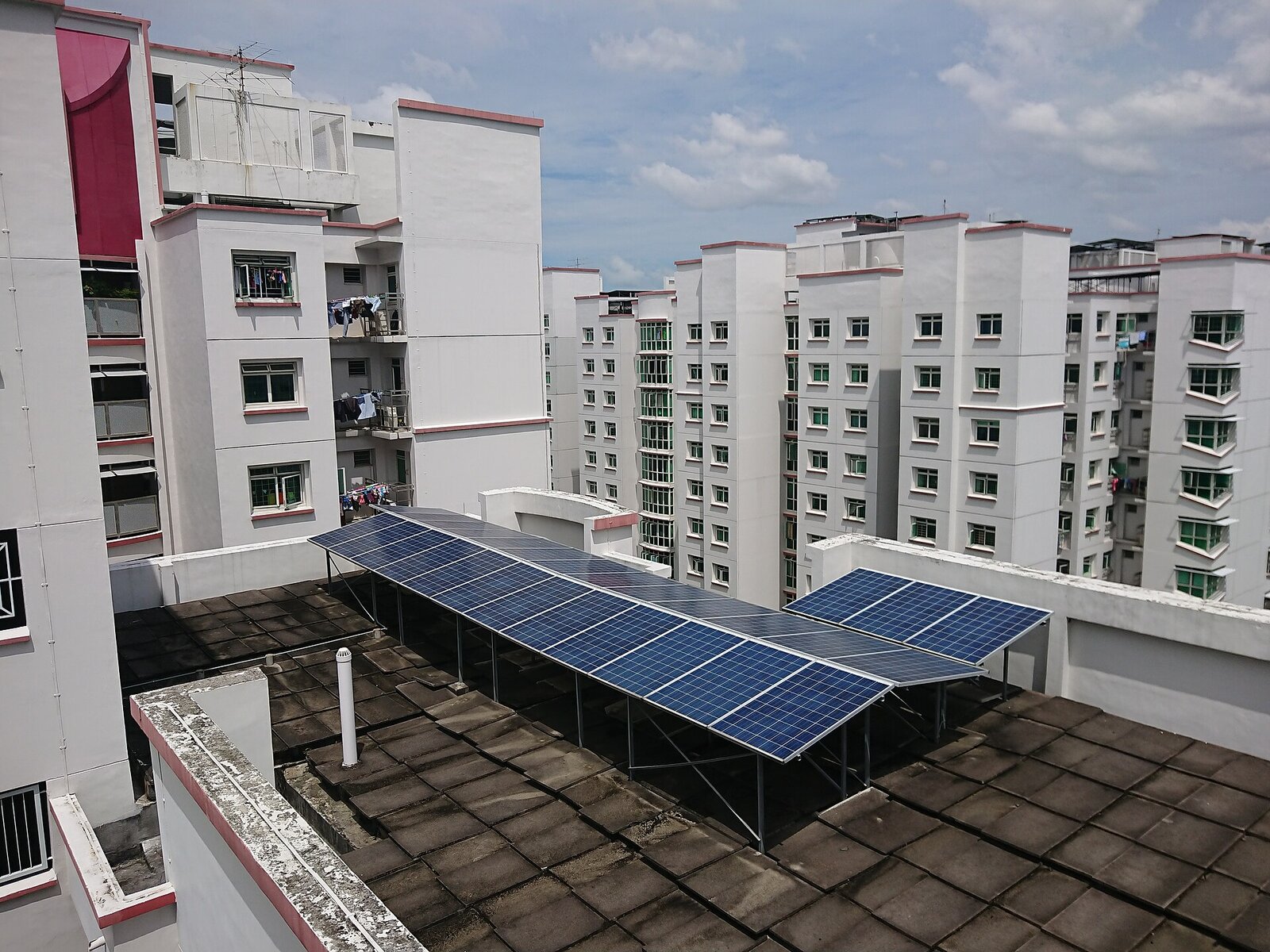
Since the 2017 NEC, building-mounted PV systems have needed rapid shutdown capability, and two labels typically go with it.
Rapid Shutdown Switch Label (690.12(D)(2)): commonly required to be legible, in a color that contrasts with its surroundings, with letters at least 3/8" (9.5mm) tall, located on or near the rapid shutdown switch, and worded to identify it as the rapid shutdown switch for the solar PV system. See our rapid shutdown switch label for one common format, and our rapid shutdown labeling article for edition-by-edition detail.
Building Rapid Shutdown Placard (690.12(D)(1)): under the 2020 NEC this placard is commonly expected to be reflective and to include a graphic showing the array boundary on the building. Many AHJs enforcing the 2023 NEC allow more flexibility in color and finish, though many installers still default to a high-contrast red-and-white treatment because it's what inspectors are used to seeing.
Disconnect Labels (NEC 690.13)
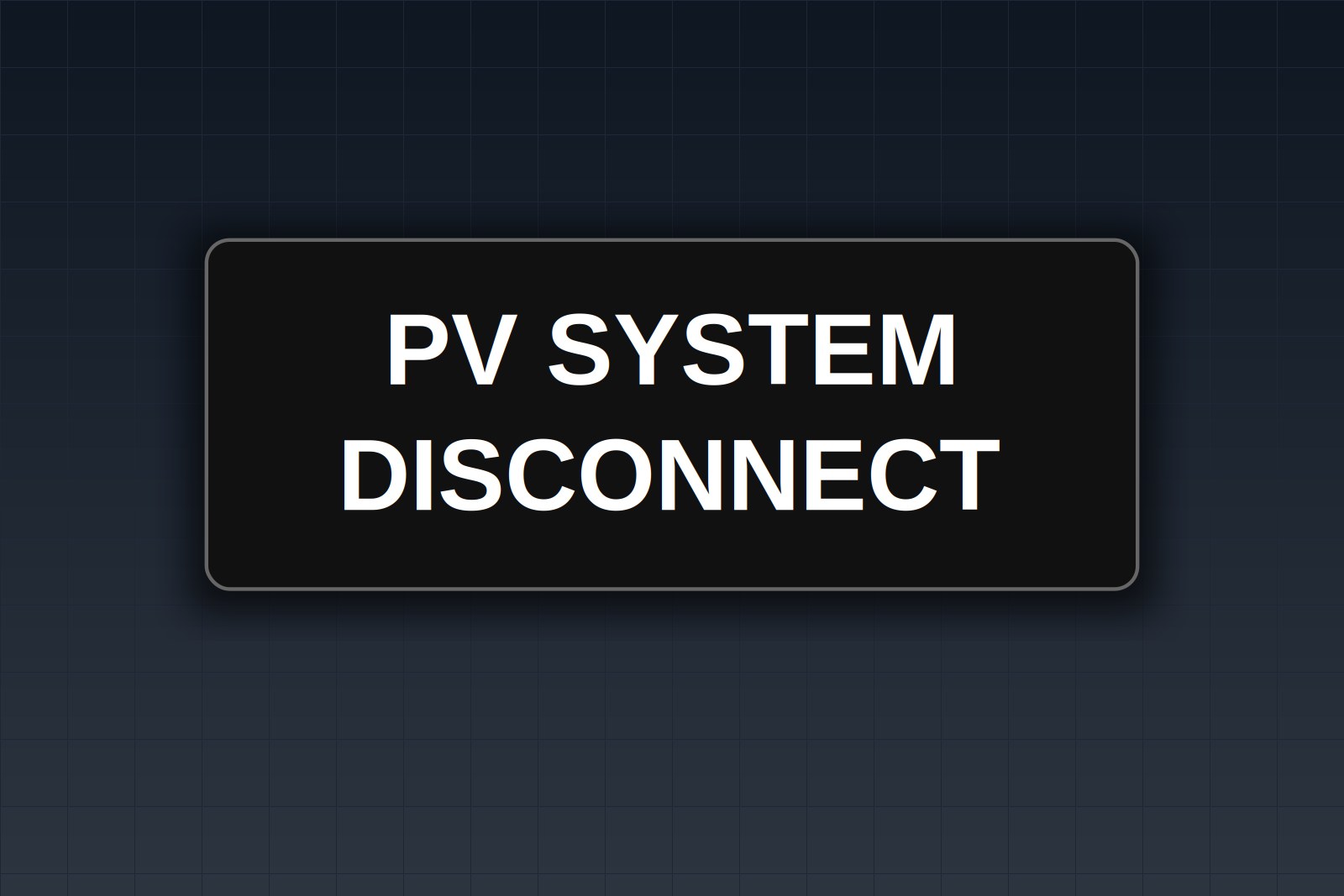
Every DC and AC disconnect on a solar system commonly needs a label identifying it as a PV system disconnect. Where the line or load terminals stay energized when the disconnect is open, many jurisdictions also expect a shock hazard warning, and the label commonly needs to state the maximum system voltage. Our PV system DC disconnect label is one option sized for this use.
Conduit Warning Labels (NEC 690.31(G)(4))
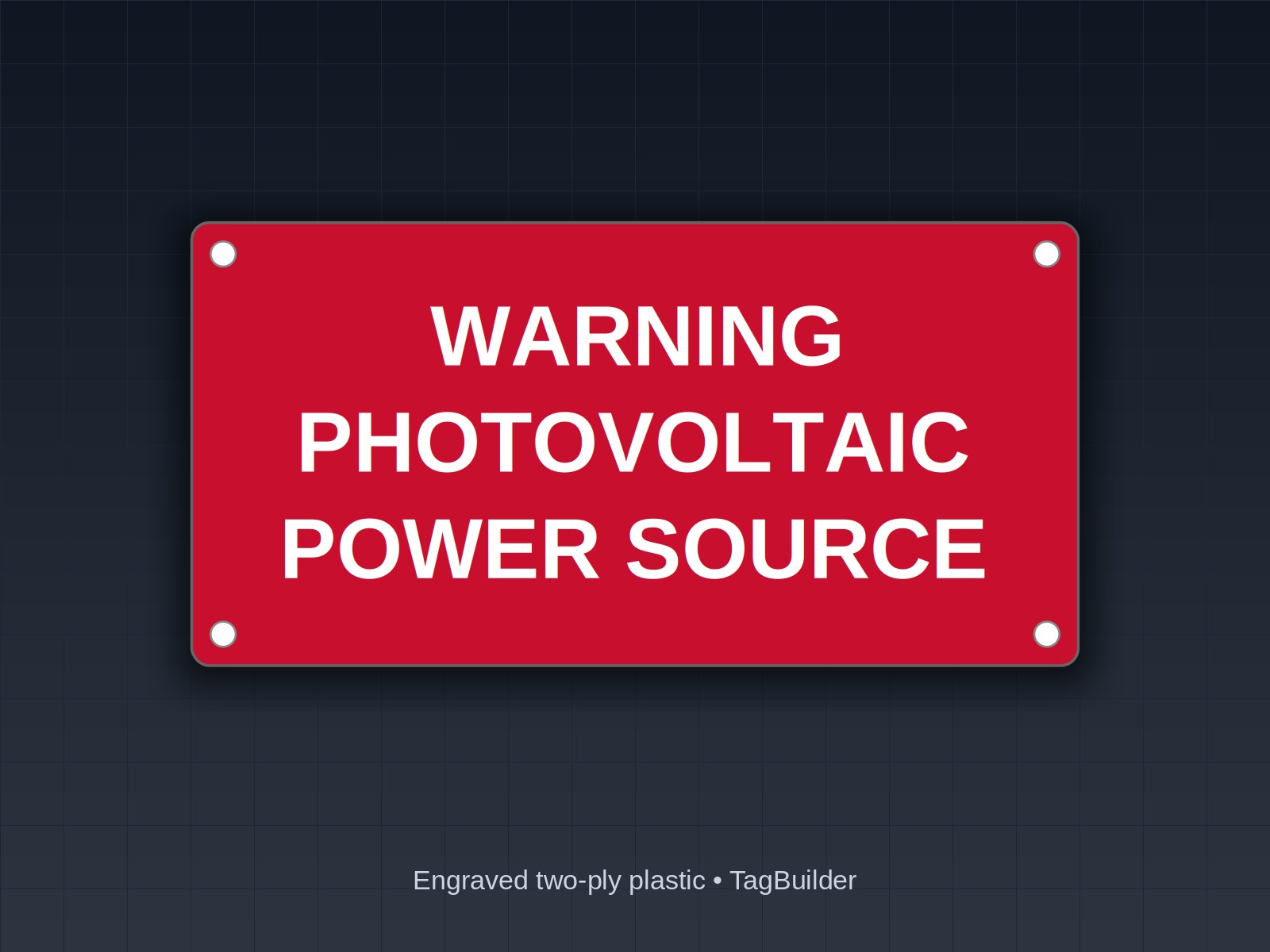
This is commonly the highest-count label on a solar installation. Exposed raceways, junction boxes, and conduit bodies carrying PV DC circuits are commonly marked to warn of a photovoltaic power source, in a high-contrast color scheme with letters at least 3/8" tall, spaced along the run plus at turns, penetrations, and entry or exit points.
A small residential run might need only a handful of these; a commercial building with longer conduit runs can need considerably more.
Maximum DC Voltage (NEC 690.7(D))
The highest maximum DC voltage on the system is commonly labeled at the DC disconnect, inverter, or PV distribution equipment.
Power Source Directory (NEC 705.10)
Service equipment locations commonly need a directory listing every power source connected to the building, where its disconnect is located, and how to reach someone in an emergency, along with a caution notice that multiple sources of power are present. The 2023 NEC folded several older labeling requirements into this section and added "label" as an accepted format alongside "plaque" and "directory."
Because the contents are site-specific, this is one of the label types we build as a custom engraved directory rather than off a fixed template — see the panel labeling requirements article for how this overlaps with general panelboard labeling under 408.
PV Interconnection Label (NEC 690.54)
At the point where the PV system connects to premises wiring, a label commonly needs to show the rated AC output current and nominal operating AC voltage.
Energy Storage System Labels (NEC 706)
Systems that pair solar with battery storage commonly need additional labels at the energy storage disconnect, along with nominal voltage, available fault current, and arc flash information tied to the date it was last assessed.
Arc Flash Warning (NEC 110.16 / NFPA 70E)
Commercial solar equipment that may be serviced while energized commonly needs an arc flash warning label. What has to be on that label — system voltage, arc flash boundary, incident energy or PPE category, and assessment date — varies by edition and by facility; our arc flash label requirements article walks through what NFPA 70E expects in more detail.
Why Engraved Labels Are a Practical Choice for Solar
NEC 110.21(B) calls for labels to be durable enough for the environment they're mounted in, in general terms. Solar equipment sits in one of the more demanding outdoor environments a label sees:
- Maximum UV exposure — arrays are south-facing and in direct sun most of the day
- Wide temperature swings — from winter cold to hot roof surfaces in summer
- Rain, snow, ice, and wind over the life of the installation
- Physical contact from maintenance work, wildlife, and debris
Printed vinyl labels are more prone to fading, curling, and lifting at the edges under this kind of exposure over time. Engraved text is cut into the material itself rather than printed on top of it, so it does not rub or flake off the way ink can.
NEC Adoption Varies by Jurisdiction
States and local AHJs adopt NEC editions on their own schedules — the 2017, 2020, and 2023 editions are all still in force somewhere in the country at any given time, and a jurisdiction can take a year or more between adopting a new edition and actually enforcing it. Before ordering labels for a job, confirm with the local AHJ which edition it is currently enforcing, since label wording and format requirements can shift between editions.
Residential vs. Commercial Solar Labels
Residential solar systems commonly need fewer labels per install, concentrated around the disconnects, rapid shutdown switch, and a shorter conduit run.
Commercial solar systems commonly need many more, spread across longer conduit runs, multiple disconnects, and sometimes energy storage or arc flash labeling on top of the base set.
What We Offer
TagBuilder makes engraved solar PV labels from engraved two-ply plastic and engraved stainless, sized and worded to match common NEC label formats. We offer:
- Individual labels — rapid shutdown, disconnect, conduit warning, voltage, and more
- Residential and commercial label kits
- Custom engraved power source directory placards built from your site-specific information
- Bulk options for installers doing repeat work
Labels are available with adhesive backing or pre-drilled mounting holes for mechanical fastening.
Browse our solar PV compliance label collection or see how ordering works if you'd like to send us a site plan or label list to quote from. We're based in Erie, Pennsylvania, and work with installers across the Northeast, Midwest, and nationwide.
Common questions
What labels does NEC require on a solar system?
The NEC lays out label requirements across several sections rather than one master list: rapid shutdown labels under 690.12, disconnect labels under 690.13, conduit warning labels under 690.31(G)(4), voltage labels under 690.7(D), a power source directory under 705.10, and interconnection labels under 690.54. Systems with battery storage or commercial equipment can add labels under 706 and 110.16.
What does the rapid shutdown label have to say?
The rapid shutdown switch label commonly identifies the switch as the rapid shutdown switch for the solar PV system, in a color that contrasts with its background and letters at least 3/8 inch tall. The separate building placard, near the service equipment, commonly includes a graphic of the array boundary. Exact wording and finish requirements shift somewhat between the 2017, 2020, and 2023 NEC editions.
Does the conduit warning label have to be red?
Under most editions the conduit warning label is commonly shown in a high-contrast color scheme, historically white text on a red background, though the core requirement is contrast and legibility rather than one fixed color pairing. Check the edition your AHJ enforces and any local amendments before assuming a specific color is mandatory.
Do solar labels have to be engraved, or can vinyl work?
The NEC generally does not name a specific material — it asks for labels durable enough for the environment they're mounted in. Vinyl is commonly used and can meet that bar when well made and properly applied. Engraved labels are a durability-focused alternative because the text is cut into the material rather than printed on the surface, so it does not rub or flake off the way ink can.
How many labels does a residential system need?
It depends on the system's layout — the number of disconnects, the length of exposed conduit, and whether battery storage is included all factor in. A small system with a short conduit run and a single disconnect needs fewer labels than one with a longer run, multiple disconnects, or added storage equipment.
Which NEC edition applies to my install?
Whichever edition your local AHJ has adopted and is currently enforcing, not necessarily the most recently published edition. States and municipalities move to a new edition on their own timelines, so the 2017, 2020, and 2023 editions are all in active use in different places. Confirm the enforced edition with the AHJ before finalizing label wording.
UL, NFPA, NEC, ASME, CEMA, TIA, ANSI and OSHA are names or marks of their respective organizations; TagBuilder is not affiliated with or endorsed by any of them. Requirements above are paraphrased summaries, not the text of any standard. Always work from the current published edition and your AHJ.