Available Fault Current Labels: NEC 110.24 Marking for Service Equipment
Get this made: TagBuilder (Solid Ideas Engraving, Waterford, PA) engraves Design your own (from $3.82). No minimum order, no setup fees, most orders ship in 2–3 business days, rush available. Custom text and size: open this design in the configurator. Or email the spec to support@tagbuilder.net for a written quote and PDF proof the same business day.
The service gear is energized, the inspector asks where the available fault current is marked, and the only number on the equipment is the manufacturer's interrupting rating. That is a different number, and it does not answer the question.
Disclaimer: general information, not legal or compliance advice. Codes change and inspectors interpret them differently, so confirm requirements with a qualified professional. Full disclaimer
What NEC 110.24 asks for
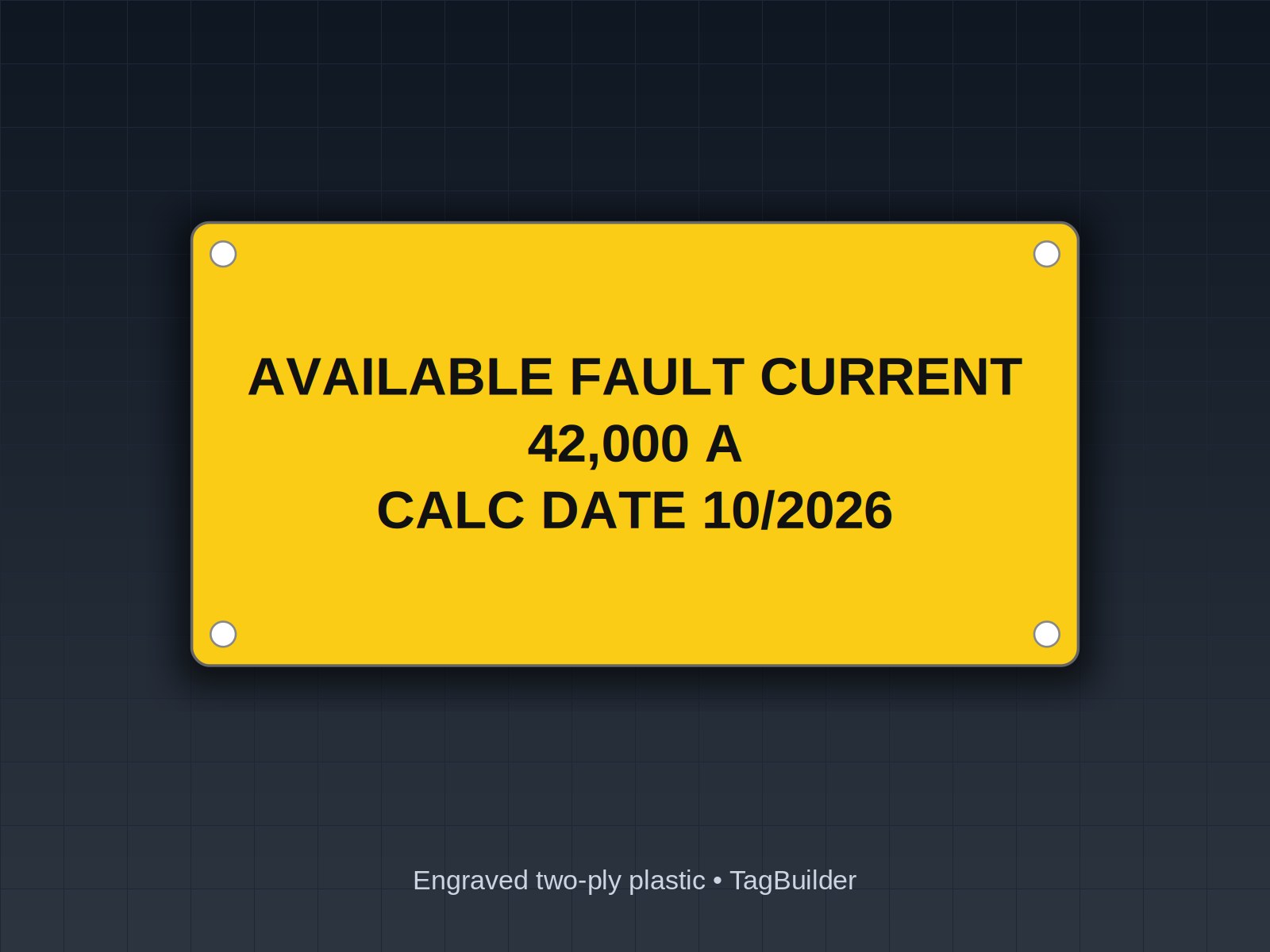
NEC 110.24(A) covers service equipment in other than dwelling units. In the editions that carry it, the equipment is to be marked in the field with the maximum available fault current, and the marking is to include the date the fault-current calculation was made. The marking also has to be durable enough for the environment it sits in.
Three things follow from that wording:
- Field marking. The number belongs to the installation, not the product. It cannot come from the factory because the factory does not know your utility transformer.
- A date, not just a value. The date tells the next person how old the number is.
- Service equipment. The rule is aimed at the service, not every panel downstream.
Earlier editions of this section carried an exception for certain industrial installations. Whether that exception exists, and whether your AHJ honors it, depends on the edition adopted locally. Check the current edition and ask your AHJ before you assume it applies.
110.24(B): when the label has to change
Section 110.24(B) deals with modifications. When a change to the installation affects the available fault current at the service, the value is to be verified or recalculated, and the field marking updated to match. A label showing an old number is worse than no label, because people trust it.
Changes that commonly move the number:
- A utility transformer replacement with a different kVA size or impedance.
- Changes to the service conductors, such as a shorter run or a larger conductor.
- Added on-site generation or large motor load that contributes current.
- A service upgrade that changes the point where the calculation is made.
Re-engraving after a utility transformer change
If the utility swaps or upsizes the transformer feeding the building, treat the existing plate as out of date until proven otherwise. Ask the utility for the new available fault current at the transformer secondary, have the study updated, confirm the service equipment rating still covers the result, then replace the plate with a new date. Do not overwrite or scratch out the old plate. Remove it and mount a new one so the history is not ambiguous.
How this differs from the other numbers on the gear
Four different values show up on or near electrical equipment, and they get mixed up constantly.
| Marking | Where it comes from | What it tells you |
|---|---|---|
| Available fault current (110.24) | Field calculation for this installation | The most current the system can deliver at the service, and when that was calculated |
| Interrupting rating (110.9) | Equipment manufacturer | The most current a device can safely interrupt |
| Short-circuit current rating, SCCR (110.10) | Equipment manufacturer or panel builder | The most current the assembly is rated to withstand |
| Arc flash label (110.16) | Hazard warning, often supported by an incident energy study | A warning that the equipment presents an arc flash hazard |
The practical rule: the field-marked available fault current must not exceed the ratings of the equipment it feeds. That comparison is done by the engineer or the contractor reviewing the study, not by the plate. The plate only records the number.
The control panel nameplate is a separate matter
A control panel nameplate showing a short-circuit rating describes what that panel is built to withstand. It is not a statement about the building service. A panel rated for 65 kA installed on a service with 42 kA available is a rating comparison, and the two plates should never be merged into one. For how the arc flash side is handled, see the arc flash label guide.
What to engrave on the plate
| Field | What goes on the plate | Example |
|---|---|---|
| Heading | Plain description of the value | MAXIMUM AVAILABLE FAULT CURRENT |
| Fault current | Value in amperes, with kA in parentheses | 42,000 A (42 kA) |
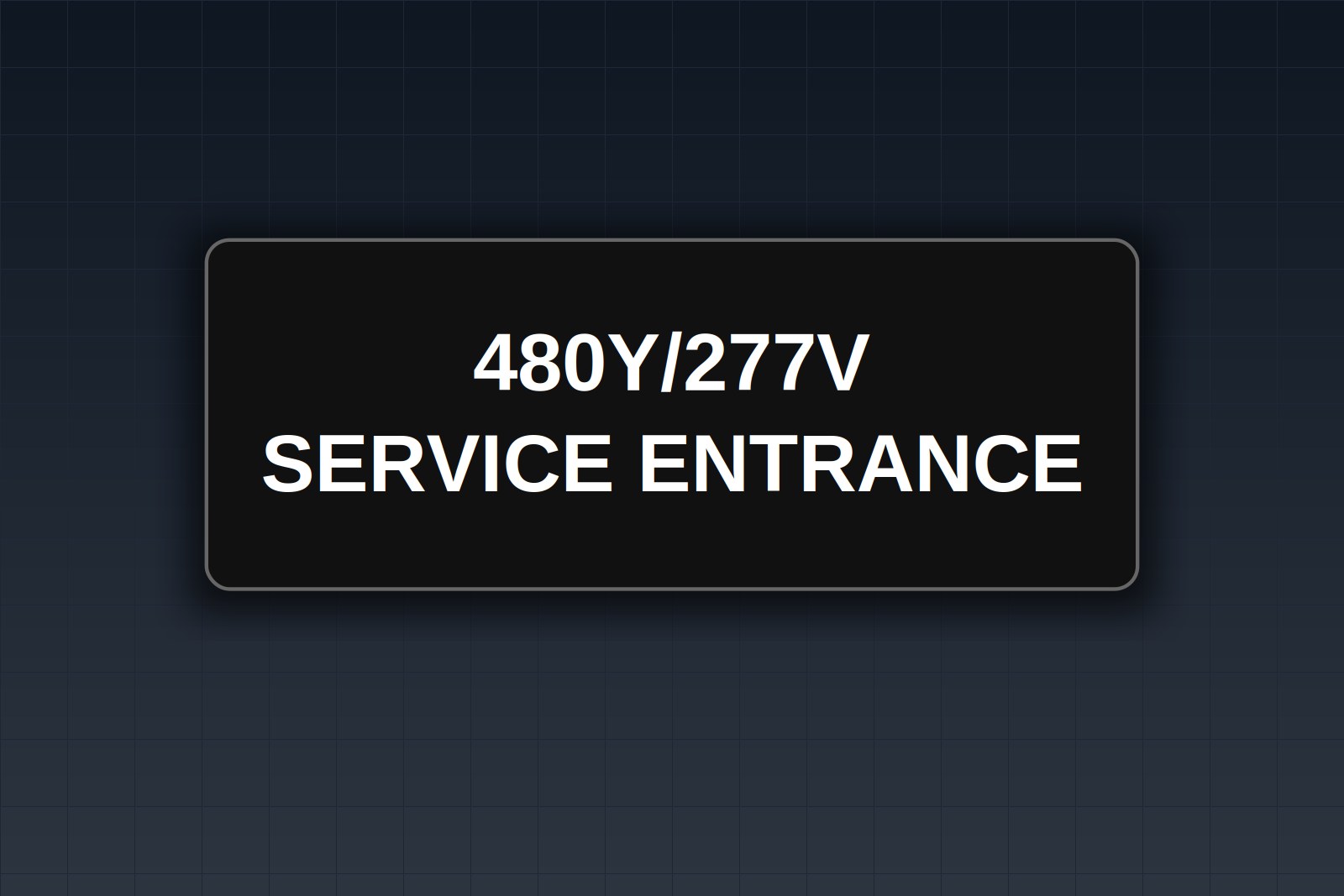
| System voltage | Nominal voltage, phases and wires | 480Y/277 V, 3 PH, 4 W |
| Calculation date | Unambiguous date format | 20 OCT 2026 |
| Calculated by | Firm or engineer who performed it | Name of the firm, not a nickname |
| Document reference | Study or report number and revision | SC-2026-014 REV A |
Section 110.24(A) itself calls for the value and the date. Voltage, who calculated it and the document reference are practical additions that make the plate traceable. Your AHJ or owner specification may ask for more or less.
Worked example: 480Y/277V, 2000 A service, 42,000 A available
Here is a layout for a 2000 A service at 480Y/277 V with a calculated 42,000 A available at the service equipment line terminals.
Plate text, centered, five lines:
- MAXIMUM AVAILABLE FAULT CURRENT
- 42,000 A (42 kA)
- SERVICE: 480Y/277 V, 3 PH, 4 W, 2000 A
- CALCULATED: 20 OCT 2026
- BY: [FIRM NAME] | REF: SC-2026-014 REV A
Recommended size: 4 in x 2.5 in, with the first two lines at roughly 3/16 in to 1/4 in character height and the lower three lines at about 1/8 in. That keeps the value readable from arm's length at the front of the gear and leaves room for two mounting holes or adhesive backing.
Date format: spell out the month. A date written 10/11/26 reads as October or November depending on who is looking. Use 20 OCT 2026 or 2026-10-20 and stay consistent across every plate on the job.
Color: a high-contrast scheme such as white characters on a black face, or black on white, works well. Keep it away from the header treatments used on arc flash warning labels so the two are not mistaken for each other.
Cautions before you order
- Do not copy 110.16 wording onto this plate. The arc flash warning is a different marking with a different purpose. Mixing the two causes confusion and may not satisfy either requirement.
- Mark it where it can be seen. Put it on the exterior of the service equipment, near the main disconnect, where someone opening the door or standing in front of the gear will see it. Do not hide it inside an enclosure.
- Match the plate to the environment. Outdoor gear, washdown rooms and hot mechanical spaces are rough on adhesives and printed ink. Engraved plastic text does not rub off like printed ink, and engraved stainless suits harsher locations. Fasten with screws or rivets where adhesive will not hold.
- Confirm the edition. States and cities adopt NEC editions on different schedules, and the wording and exceptions of 110.24 have changed over time. Ask your AHJ which edition is enforced.
- Use a real calculated number. The value should come from the utility's data and a documented calculation, never an estimate written on the plate.
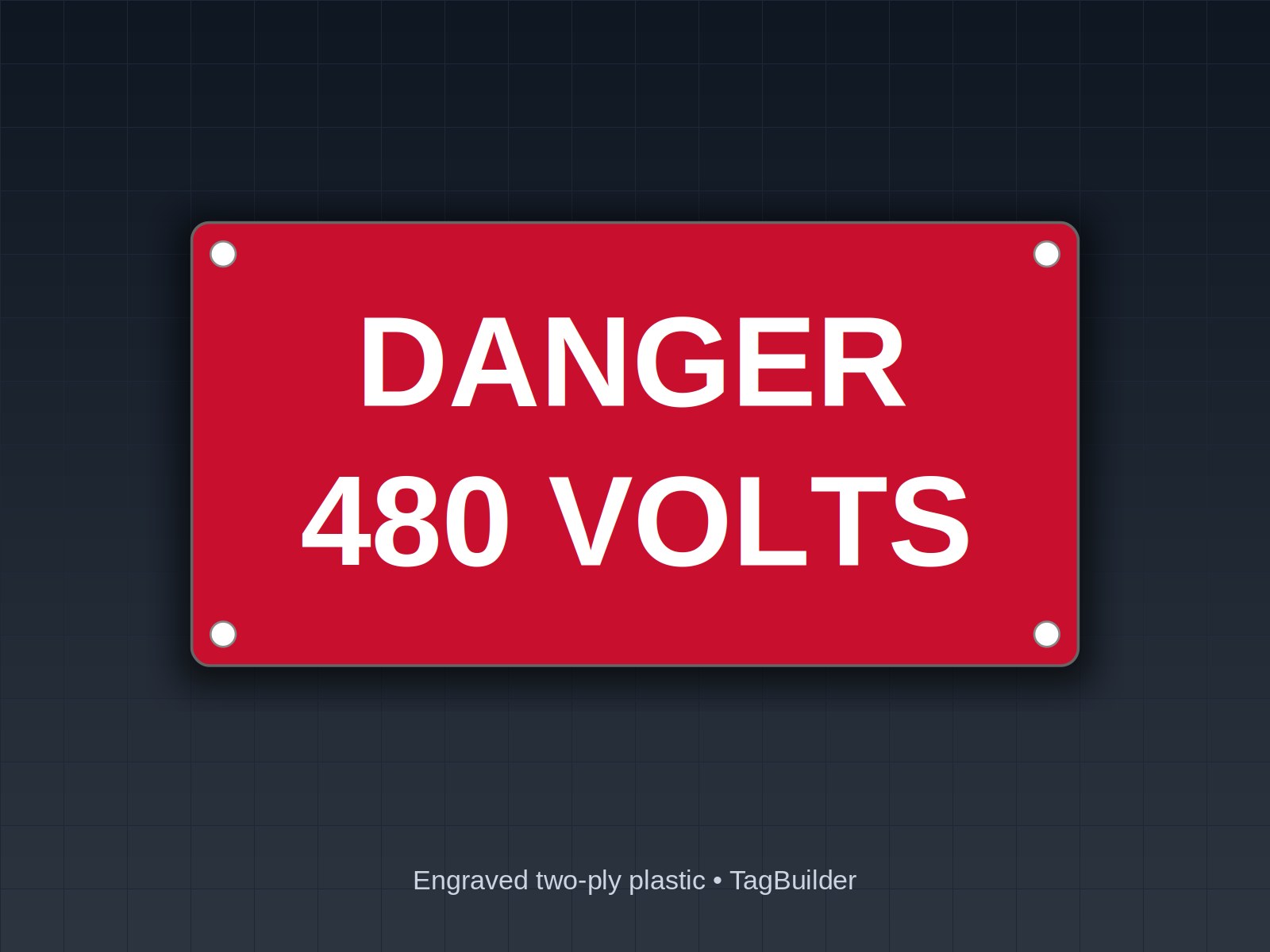
If you are also marking nominal voltage at the same equipment, the voltage warning label guide covers what to engrave there.
Frequently Asked Questions
Does 110.24 apply to every panelboard in the building?
No. It is written for service equipment in other than dwelling units. Downstream panels have their own ratings and markings, and many specifications ask for the study results to be documented separately, but the 110.24 field marking is aimed at the service.
Can I put the available fault current on the same plate as the arc flash label?
It is cleaner to keep them separate. The two markings serve different purposes, and the arc flash label has its own content expectations. A separate plate also makes it simple to replace one without disturbing the other.
Who provides the available fault current number?
Typically the utility supplies transformer data or an available value at the service point, and an engineer or qualified contractor completes the calculation to the service equipment. The person who performed the calculation should be named on the plate or in the referenced document.
How often does the plate need to be replaced?
There is no fixed interval in the section as it is commonly read. It needs to be updated when modifications change the available fault current, and any time a recalculation produces a different value. Many owners also re-verify the number when the utility makes changes upstream.
What if the calculation shows less fault current than the old plate says?
Replace the plate anyway. The plate should reflect the current verified value and the current calculation date, whether the number went up or down. Keep the old study with the facility records.
Does the 42 kA value have to match the equipment's SCCR?
No, they are separate values with a relationship: the equipment ratings should be at least equal to the available fault current. If they are not, that is an engineering problem to resolve, not something a plate can fix.
Order engraved fault-current plates with your kA value and calculation date already laid out.
If you are marking a whole service lineup, you can pair the fault-current plate with disconnect labels and equipment ID plates, or lay out a custom size in the rectangle plate configurator.
Disclaimer. This article is provided for general informational purposes only and does not constitute legal, safety, or professional compliance advice. Regulations, standards, and codes are subject to change and may be interpreted differently by authorities having jurisdiction (AHJ). Always consult with qualified safety professionals, licensed engineers, or legal counsel to determine the specific requirements applicable to your facility. TagBuilder is not responsible for any actions taken based on this information.
UL, NFPA, NEC, ASME, CEMA, TIA, ANSI and OSHA are names or marks of their respective organizations; TagBuilder is not affiliated with or endorsed by any of them. Requirements above are paraphrased summaries, not the text of any standard. Always work from the current published edition and your AHJ.