Generator Nameplate and Data Plate Requirements: NEC 445.11 and NFPA 110 Marking
The generator set shows up with a manufacturer nameplate, and then the inspector asks where the disconnect label, the emergency stop plate and the fuel shutoff marking are. Knowing which plates come from the factory and which ones you add in the field saves a failed walk-through.
Important Disclaimer
This article is provided for general informational purposes only and does not constitute legal, safety, or professional compliance advice. Regulations, standards, and codes are subject to change and may be interpreted differently by authorities having jurisdiction (AHJ). Always consult with qualified safety professionals, licensed engineers, or legal counsel to determine the specific requirements applicable to your facility. TagBuilder is not responsible for any actions taken based on this information.
Two Kinds of Plates on a Generator Set
Every standby or emergency generator carries two separate groups of markings, and they are not interchangeable.
- The manufacturer nameplate is applied at the factory. It describes what the machine is and what it is rated to do. NEC 445.11 is the section that governs it.
- Field-applied plates are added by the installer or owner. They identify the disconnect, the shutdown devices, the fuel and battery components, and the system as a whole. These come from NEC 445.18, NEC 110.21(B), NEC Articles 700 and 701 where they apply, and NFPA 110 where the AHJ or the project specification adopts it.
This article covers the generator set itself. For the transfer switch side of the system, see the separate generator and ATS labeling article on this site.
What NEC 445.11 Expects on the Manufacturer Nameplate
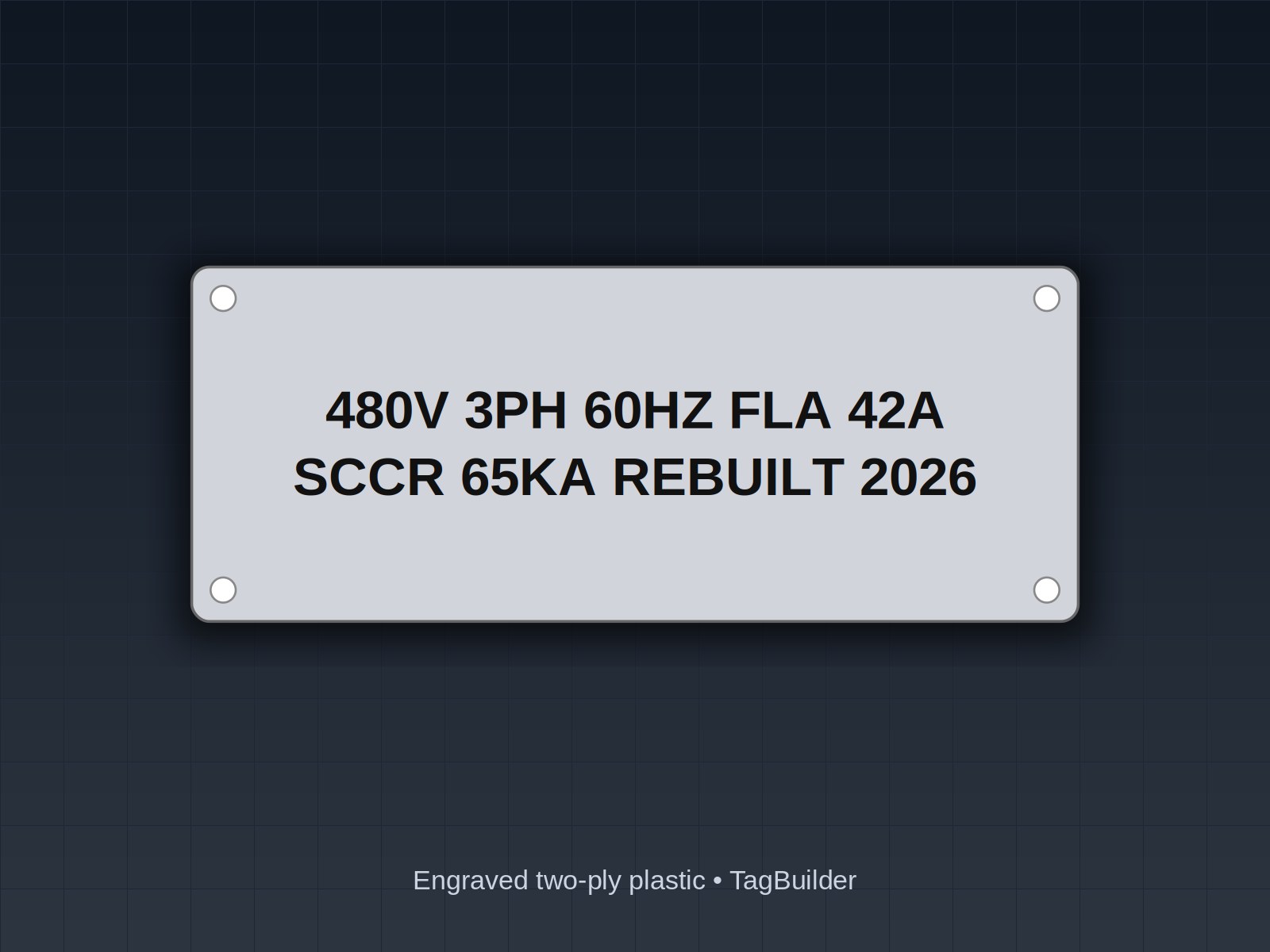
NEC 445.11 asks the manufacturer to provide a nameplate on each generator. In general terms, the plate carries the following information. The exact list and wording vary by edition, so check the one your jurisdiction has adopted.
| Item | What it tells the reader |
|---|---|
| Manufacturer name | Who built the generator end |
| Rated output in kW or kVA | Capacity at the stated rating |
| Rated frequency and number of phases | For example 60 Hz, three phase |
| Power factor | The power factor the rating is based on |
| Rated volts and amps | The voltage and current that correspond to the rating |
| Rated ambient temperature | The ambient the rating assumes |
| Temperature rise and insulation system class | Thermal limits of the windings |
| Time rating | Continuous, standby or other duty |
The key point for installers is simple. You do not make this plate and you do not replace it. If it is missing, damaged or painted over, go back to the manufacturer. A field-applied plate that repeats the numbers is a convenience for the operator, not a substitute for the original.
Keep the Nameplate Readable
The nameplate has to stay visible after installation. Check that enclosures, sound attenuation panels, exhaust piping and conduit do not hide it, and that it is not covered by a coat of paint during touch-up. If the engine and generator end carry separate plates, both should be reachable.
Disconnect and Shutdown Markings: NEC 445.18 and 110.21(B)
NEC 445.18 deals with the means to disconnect the generator and shut down the prime mover. In general, the generator needs a disconnecting means so it can be isolated from the circuits it supplies, and it needs a way to shut down the engine. Some editions also add requirements for emergency shutdown devices on certain installations, and the subsection lettering has moved between cycles. Read the edition your AHJ enforces.
The code does not hand you the label wording. That is where NEC 110.21(B) comes in. It covers field-applied hazard markings: they need to be clear about the hazard, durable enough for the environment, and not handwritten in most cases. A generator yard sees sun, rain, diesel vapor and cleaning solvents, so engraved plates fastened with screws or rated adhesive hold up better than printed stickers. Engraved text does not rub off like printed ink.
Disconnect identification has its own detail. The article on NEC 110.22 disconnect identification labels covers what the plate should say about the equipment served and the source of supply, and the disconnect compliance labels page has ready-made starting points.
Source Signs at the Service Equipment
Articles 700 and 701 commonly call for a sign at the service equipment, or at the normal source, that tells people where the on-site emergency or standby source is and what type it is. Treat that as a field plate you need to plan, and confirm the current wording expectations with the AHJ.
NFPA 110: Identifying the Emergency Power Supply System
NFPA 110 classifies an emergency power supply system by three terms. The point of the classification is that anyone reading the documentation or the plate knows what the system is designed to do.
- Level 1 or Level 2. Level 1 is for systems where failure could cause loss of life or serious injury. Level 2 is for less critical loads.
- Type. The maximum time, in seconds, the system takes to restore power after a loss of the normal source. A Type 10 system is designed to restore power within 10 seconds.
- Class. The minimum time, in hours, the system is designed to run at its rated load without refueling. A Class 48 system has 48 hours of fuel at rated load.
NFPA 110 does not hand you a fixed plate layout. What many AHJs and specifications expect is that the generator set identifier, the load it serves and the classification are findable on a durable plate near the set or in the documentation. NFPA 110 also contains expectations for remote manual stop stations and annunciation on Level 1 systems. Those requirements depend on the edition and the project, so confirm them before ordering plates.
Worked Example: 150 kW Diesel Standby Set
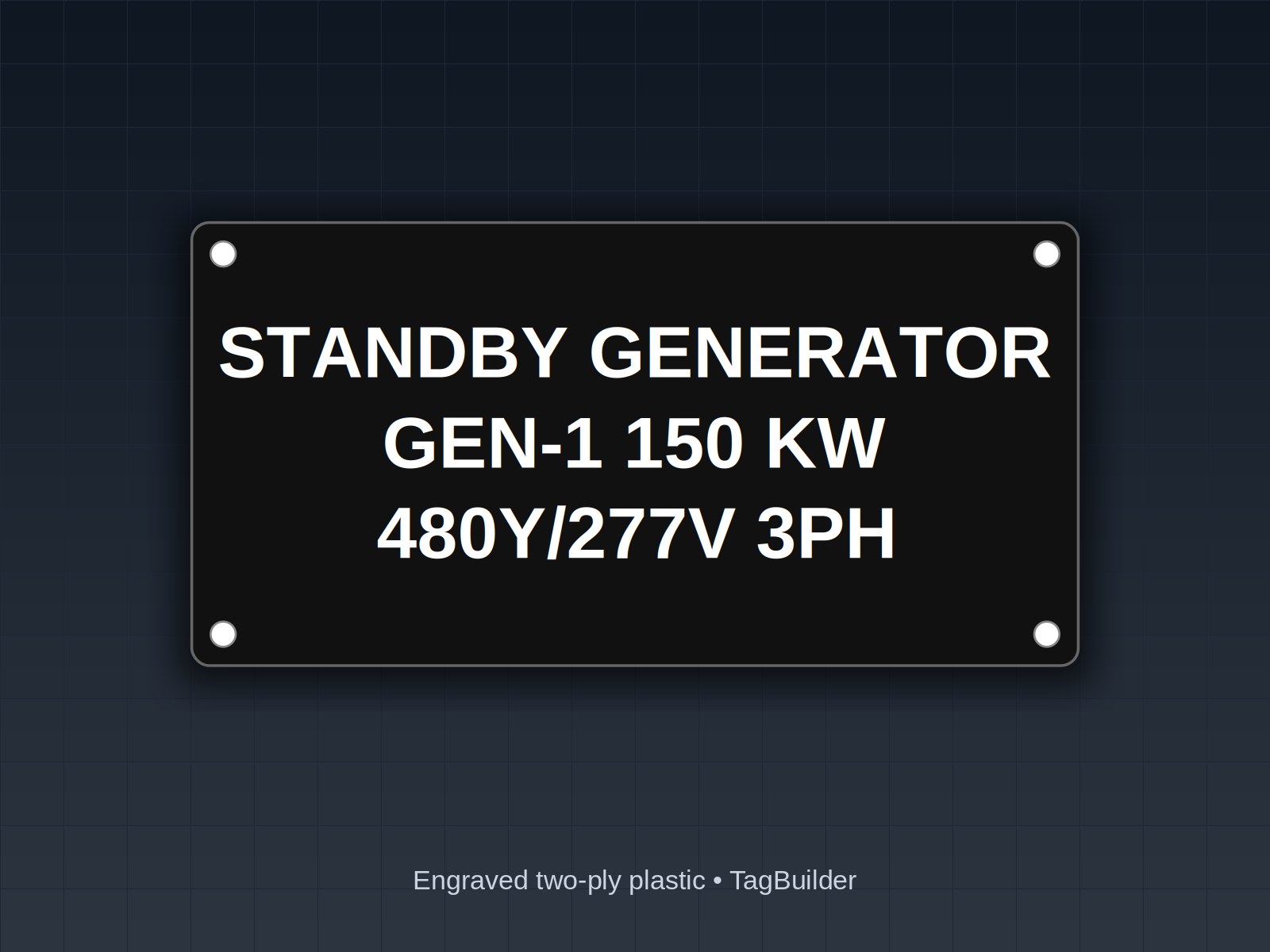
Take a 150 kW, 480Y/277 V, three-phase diesel generator set feeding one transfer switch, installed outdoors on a pad with an integral sub-base fuel tank and a small day tank for an adjacent equipment room. The manufacturer nameplate is already on the set. These are the field plates to add:
| Location | Wording | Size | Color |
|---|---|---|---|
| Generator enclosure door | GEN-1 150 KW DIESEL STANDBY FEEDS ATS-1 | 4 x 2 in. | White on black |
| Generator disconnect | GENERATOR DISCONNECT GEN-1 TO ATS-1 | 4 x 1.5 in. | White on black |
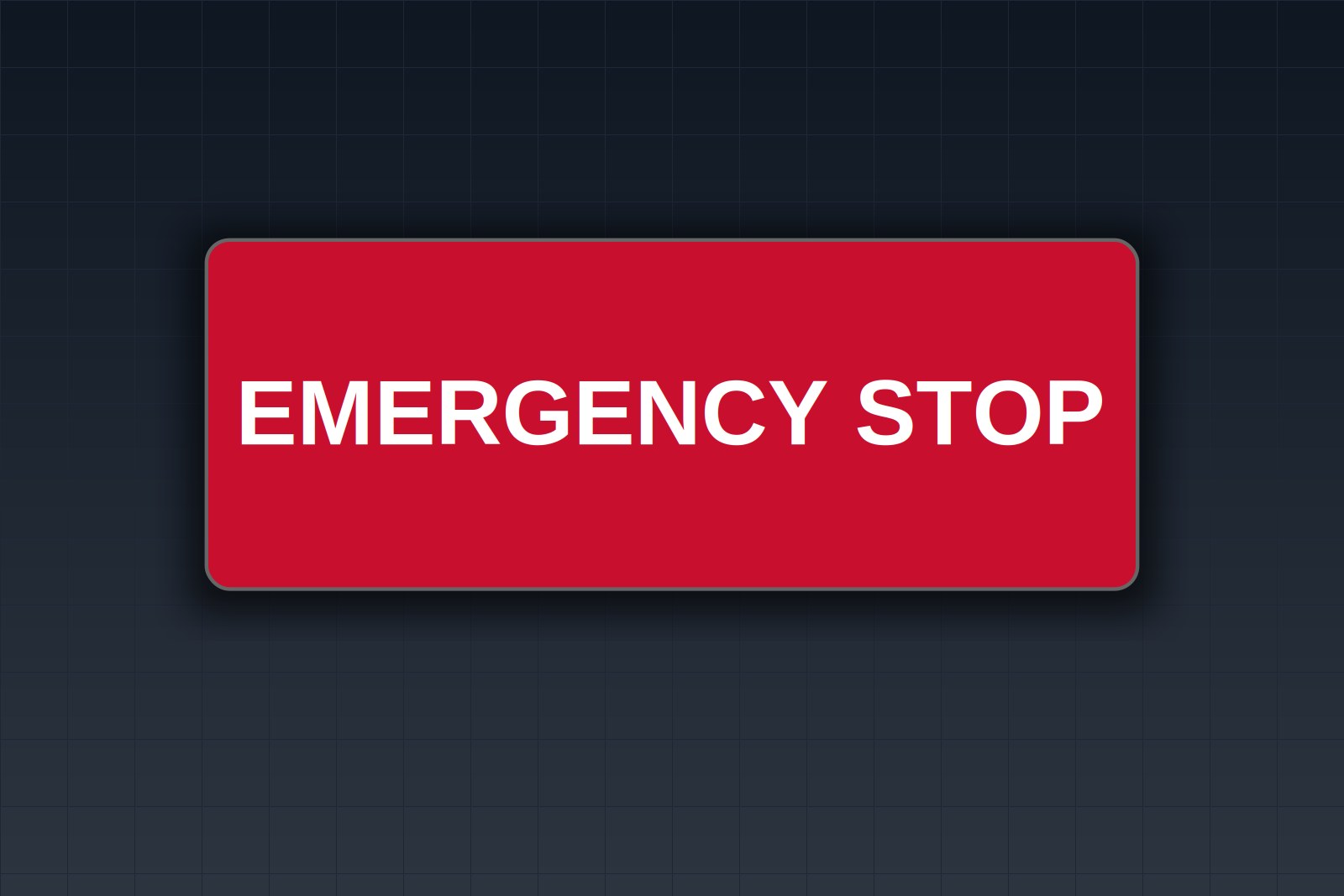
| Local emergency stop | EMERGENCY STOP GEN-1 | 4 x 2 in. | White on red |
| Remote emergency stop station | REMOTE EMERGENCY STOP GEN-1 | 4 x 2 in. | White on red |
| Fuel supply valve | EMERGENCY FUEL SHUTOFF GEN-1 | 4 x 1.5 in. | White on red |
| Battery charger | BATTERY CHARGER SOURCE: PANEL EM-1, CKT 12 | 3 x 1.5 in. | White on black |
| Day tank | DAY TANK - DIESEL FUEL NO OPEN FLAME | 4 x 2 in. | Black on yellow |
| System classification | EMERGENCY POWER SUPPLY LEVEL 1 - TYPE 10 - CLASS 48 | 4 x 2 in. | White on black |
| Service equipment | EMERGENCY POWER SOURCE GEN-1, NORTH YARD | 4 x 2 in. | White on black |
Two notes on this table. First, the Level, Type and Class wording is only an example. Use the values from the project documents, not ours. Second, the identifier GEN-1 repeats on every plate on purpose. When a site has two generators, matching identifiers on the disconnect, stop button and fuel valve are what keep someone from shutting down the wrong set.
Practical Details
- Use mechanical fasteners on the generator enclosure where vibration is heavy. Adhesive alone can let go on a panel that hums every time it runs.
- Place the emergency stop plate directly above or beside the device, not on a nearby wall where it can be misread.
- Put the battery charger source on the plate so a technician can find the breaker that feeds it before the batteries go flat.
- Match the circuit and panel names to the as-built drawings, and update both if either changes.
Inspector Walk-Through Checklist
- Manufacturer nameplate is present, readable and shows the rating information for the set.
- Field plates did not replace or cover the manufacturer nameplate.
- Generator disconnect is identified and the label names the circuit it serves.
- Engine shutdown means, local and remote, are marked and match the project drawings.
- Fuel shutoff and day tank are marked.
- Battery charger source is identified at the charger.
- Source sign at the service equipment is in place if the AHJ expects one.
- System classification information is available where the specification calls for it.
- Plate wording uses the same identifiers as the drawings, ATS and panel schedules.
- The edition of the NEC and NFPA 110 in use is the one the local AHJ has adopted.
Frequently Asked Questions
Can a field-applied plate replace the manufacturer nameplate?
No. NEC 445.11 puts the nameplate in the manufacturer's hands. A field plate may repeat key ratings for the operator's convenience, but if the original is missing or unreadable the correct fix is a replacement from the manufacturer.
Does NEC 445.18 tell me what the disconnect label must say?
It addresses the need for a disconnecting means and for shutting down the prime mover, not the exact wording. Most installers follow NEC 110.21(B) for durability and legibility and use clear text that names the equipment and the circuit. Ask the AHJ if there is a local preference.
What do Level, Type and Class mean on an NFPA 110 system?
Level reflects how critical the loads are, Type is the maximum time to restore power, and Class is the minimum run time at rated load without refueling. Take the values from the design documents rather than choosing them at the plate shop.
Do I need a plate on a portable or small residential standby unit?
Smaller units still carry the manufacturer nameplate, and the disconnect and shutdown provisions may apply in a different form. Requirements for one- and two-family dwellings have changed between editions, so check the edition your AHJ enforces.
What color should an emergency stop plate be?
White text on a red background is common for emergency stop and fuel shutoff plates, and white on black is common for disconnect and identification plates. Your specification or the AHJ may ask for something different, so confirm before ordering.
Order engraved generator nameplates, disconnect labels and emergency stop plates cut to your wording.
If you already have your plate list, the emergency stop plates and equipment nameplates pages are the quickest places to start, and the rectangle plate builder lets you set size, color and wording for anything that is not a stock item.
UL, NFPA, NEC, ASME, CEMA, TIA, ANSI and OSHA are names or marks of their respective organizations; TagBuilder is not affiliated with or endorsed by any of them. Requirements above are paraphrased summaries, not the text of any standard. Always work from the current published edition and your AHJ.