Labeling a Machine During a Retrofit or Rebuild: Nameplate, Panel Legends and E-Stop Labels
You swapped the drives, replaced the PLC and deleted half the pushbuttons, but the labels on the machine still describe the way it ran in 1998. Operators and maintenance techs read those labels, not your drawings.
Short answer: when you change a machine's controls, the labels have to describe the machine as it now stands. At minimum, review the electrical nameplate, the disconnect identification, every operator station legend, the E-stop plates, the motor and device tags, and add a retrofit revision label inside the panel. Which of these your project must update depends on the edition of NFPA 79 your customer or AHJ works from, so confirm that early.
Important Disclaimer
This article is provided for general informational purposes only and does not constitute legal, safety, or professional compliance advice. Regulations, standards, and codes are subject to change and may be interpreted differently by authorities having jurisdiction (AHJ). Always consult with qualified safety professionals, licensed engineers, or legal counsel to determine the specific requirements applicable to your facility. TagBuilder is not responsible for any actions taken based on this information.
Why old labels become a problem after a retrofit
Labels are the cheapest part of a rebuild and the part most often skipped. The panel work is done, the machine runs, and the old plates are still bolted on. The mismatch causes concrete trouble:
- A button legended STOP now triggers a different function, and an operator presses it expecting the machine to halt.
- The nameplate still lists the old supply voltage, so an electrician sizes a replacement feeder or breaker from the wrong number.
- A tech services M-2 on the drawings, but the tag on the motor says M-3 because the numbering changed.
- A pilot light legend refers to a function that no longer exists, so people learn to ignore the lights.
A legend that contradicts what the device does is a common audit finding, and it is the one most likely to hurt someone. Treat the labels as part of the retrofit scope and put them on the same checklist as terminations and I/O checks.
1. The machine nameplate
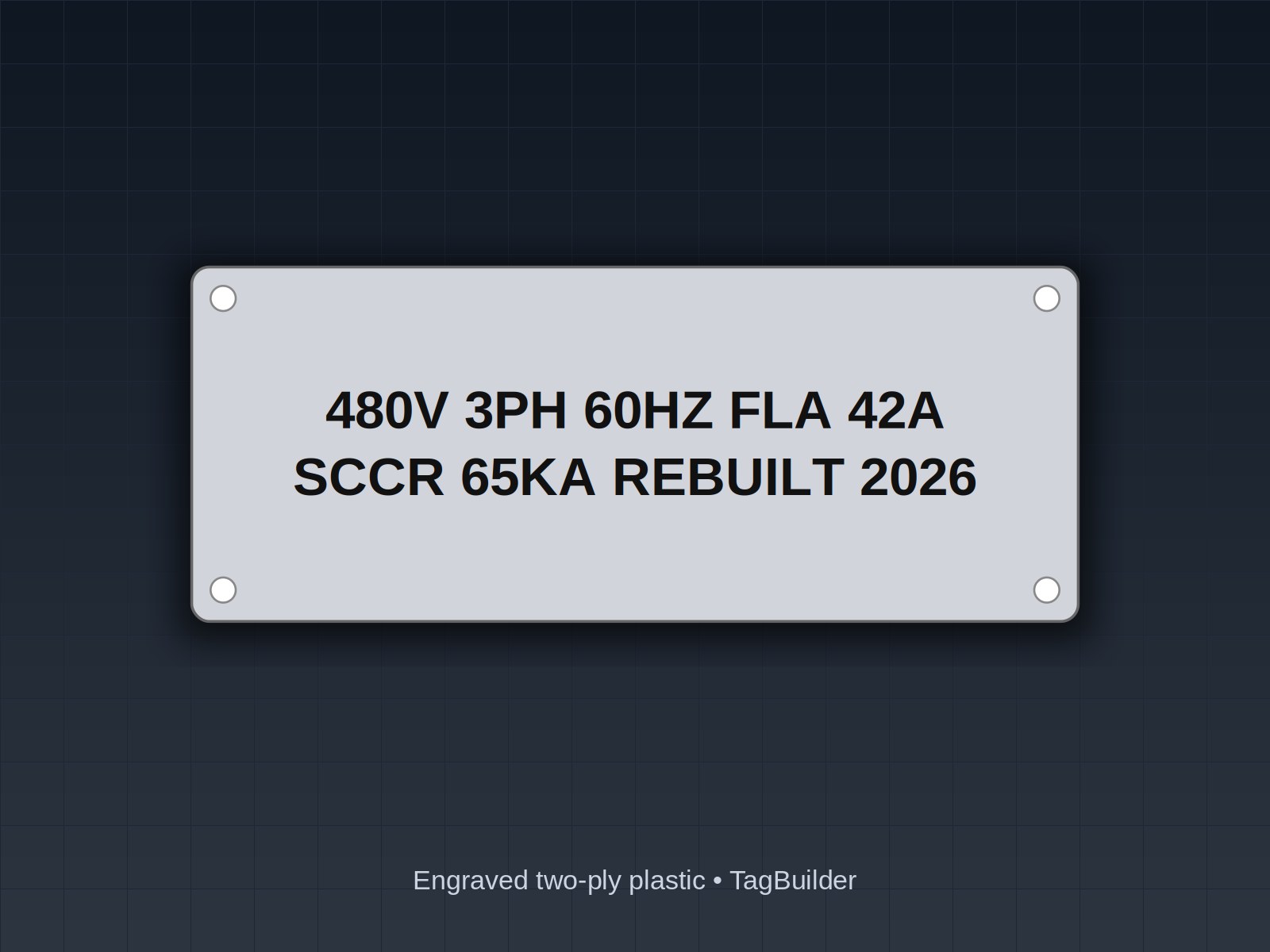
NFPA 79 describes a nameplate carrying the key electrical data for the machine. Paraphrased, that commonly includes the builder or supplier name, supply voltage, number of phases, frequency, full-load current, the rating of the largest motor or load, the short-circuit current rating of the control equipment, and the electrical diagram number. The exact list and the section it lives in vary by edition, so check the one you are working from. Our NFPA 79 marking guide goes through the items in more detail, and the equipment nameplate guide covers general nameplate content.
If the retrofit changes any of those values, the plate should show the machine as modified. A new supply voltage, a larger main motor, different SCCR after a component change, or a new drawing set all count. Many rebuilders add a second plate that identifies the rebuilder and the year, rather than overwriting the original builder's data.
Keep the original plate. Plant policy varies, but a common approach is to leave the original manufacturer's plate in place if it is still true for the mechanical data, or to remove it and archive it with the machine file if the electrical data on it is now wrong. Do not leave a plate in service that lists values the machine no longer has.
2. Disconnect identification and multiple-source warnings
If you added a second power source, such as a separate control transformer feed, a 24 V supply from another panel or a hydraulic unit with its own disconnect, the panel generally needs a warning that more than one source is present and where the other disconnects are. Also check that each disconnect is identified for what it feeds. Use text like MACHINE MAIN DISCONNECT and WARNING: MULTIPLE POWER SOURCES. SEE DISCONNECT LIST. The wording required by your edition or AHJ may differ, so use it where it is specified.
3. Operator station legends
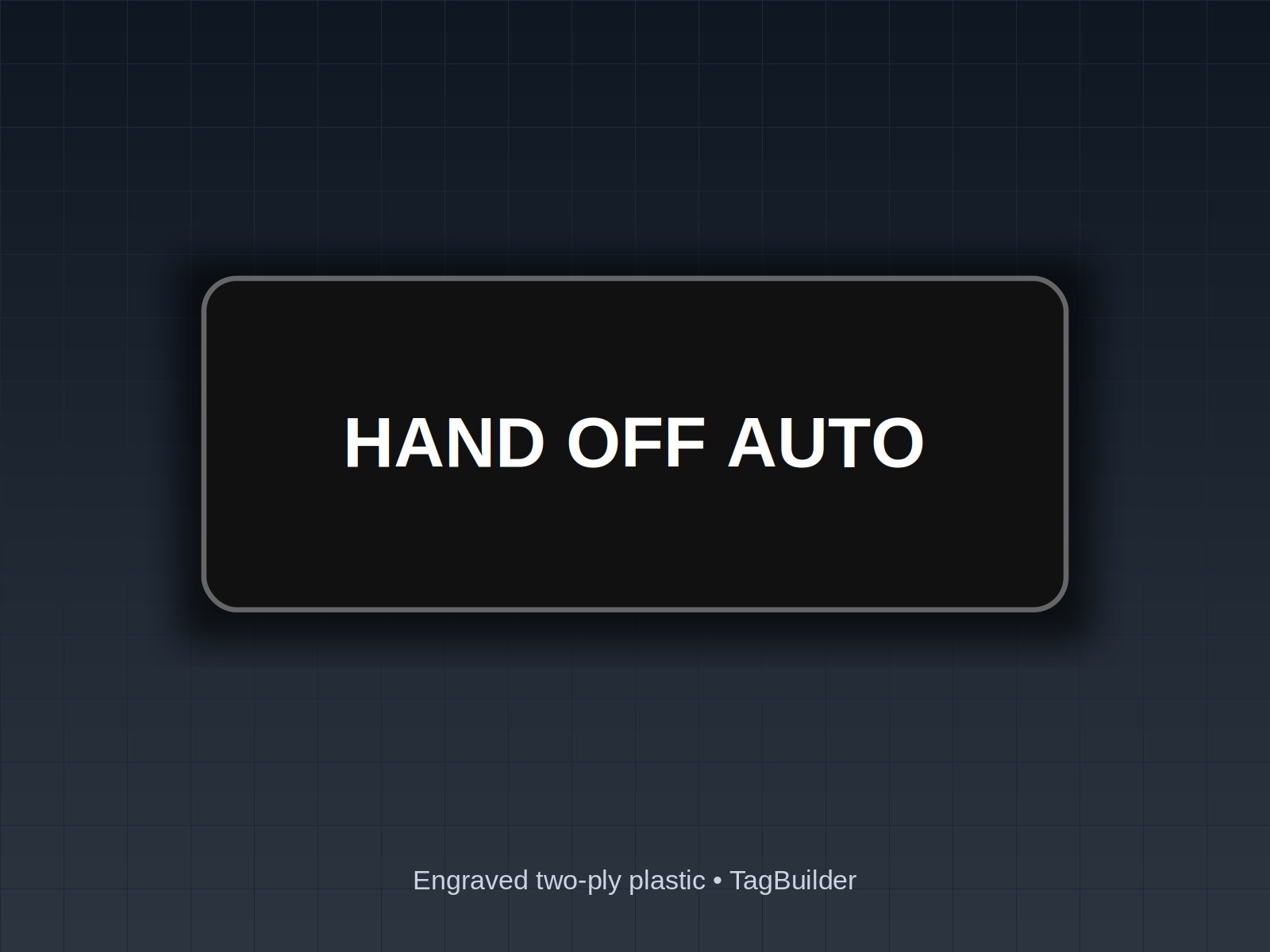
Re-legend every pushbutton, selector switch and pilot light that changed function, and remove legends for deleted functions. Do not leave a blank button with a ghost of the old legend. Match the wording to the new HMI: if the screen says CYCLE START, the button should not say AUTO RUN. For wording and color conventions, see the legend wording guide.
For 22 mm stations, ring-style legends are the usual fit. Two examples of that item are the 22 mm START ring tag, white on green and the 22 mm CONTROL POWER ring tag, white on black. Stock legends cover the common wording. Anything specific to your machine, such as FEED HOLD or TAILSTOCK RETRACT, can be made to order.
4. E-stop devices and their legend plates
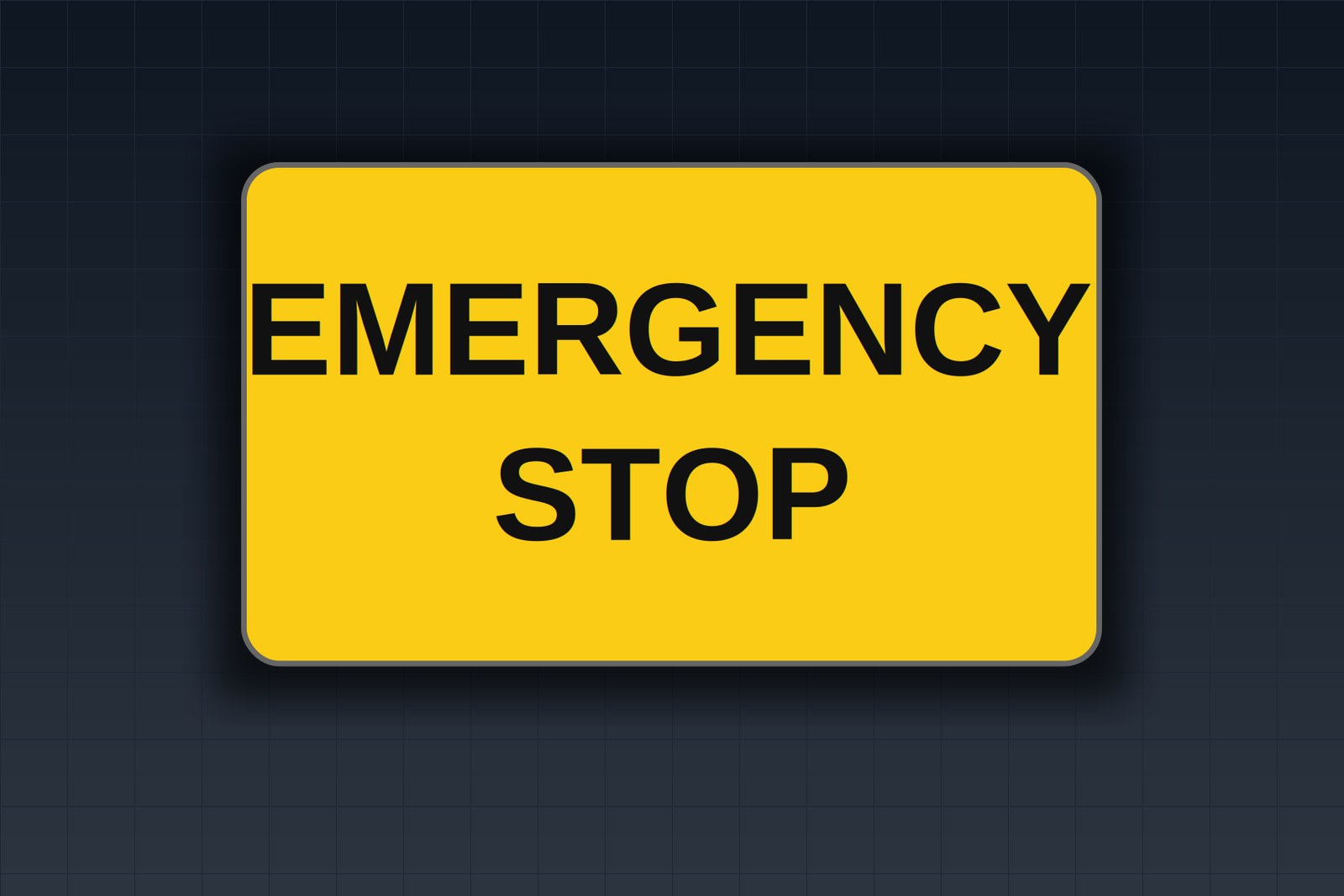
If the retrofit adds, moves or replaces an E-stop, the device and its plate should be reviewed together. NFPA 79 commonly calls for a red actuator on a yellow background, and the plate behind the operator is where the yellow comes from. A stock option is the 60 mm EMERGENCY STOP legend plate, yellow, for a 22 mm device. Browse the rest at E-stop panels.
Also relabel new guard or interlock reset buttons. A reset that clears a safety circuit should say what it resets, for example GUARD RESET, so no one mistakes it for a fault reset.
5. Motor and device ID tags
Tag every motor, drive, contactor and major device with the same identifiers that appear on the new drawings. Use short, consistent schemes such as M-1 for motors and VFD-1 for drives. Where a motor has a name nearby, add the function: M-1 SPINDLE. A tag like this, placed on the device and again on the enclosure door, keeps a tech from servicing the wrong unit. A stock example for motors is the 4 x 2 inch motor label, white on black, with mounting holes.
6. The retrofit date and revision label
Inside the panel, add a small label that says what was changed, when, and which drawing revision applies. It lets the next person know immediately whether the drawings in the pocket match the machine. Update it on every later modification.
Summary table
The table below lists each label item, when it should change, and what to put on it.
| Item | When it should change | What to put on it |
|---|---|---|
| Machine nameplate | Supply voltage, FLA, largest motor, SCCR or drawing set changes | As-modified electrical data, drawing number, name of the party that did the work |
| Disconnect and source warnings | A disconnect or power source is added, moved or removed | Disconnect identity, multiple-source warning, location of other disconnects |
| Pushbutton, selector and pilot legends | Any change in function, or removal of a function | Short verb legend that matches the HMI wording |
| E-stop plates | New or moved E-stop, or a device replaced | EMERGENCY STOP, red actuator on a yellow plate |
| Guard and interlock resets | New guard or safety circuit added | What the button resets, for example GUARD RESET |
| Motor and device tags | Numbering changes on the new drawings | Tag from the drawings plus function |
| Panel revision label | Every modification | Retrofit description, date, drawing revision |
Worked example: a lathe controls retrofit
This is a copyable label list for a lathe where the controls were replaced and the spindle drive was upgraded. The electrical values are sample numbers; substitute your own.
| Qty | Label | Text | Color |
|---|---|---|---|
| 1 | Machine nameplate | 480 V 3 PH 60 HZ / FLA 38.5 A / LARGEST MOTOR 27 A / SCCR 10 kA / ELEC DWG E-1042 REV B / CONTROLS REBUILT 2026 | White on black |
| 1 | Legend plate | SPINDLE START | White on green |
| 1 | Legend plate | SPINDLE STOP | White on red |
| 1 | Legend plate | CYCLE START | White on green |
| 1 | Legend plate | FEED HOLD | Black on yellow |
| 1 | Legend plate | FAULT RESET | White on blue |
| 1 | Legend plate | COOLANT OFF / ON | White on black |
| 1 | Legend plate | JOG / AUTO | White on black |
| 1 | Legend plate | CONTROL POWER | White on black |
| 2 | E-stop plate | EMERGENCY STOP | Black on yellow |
| 3 | Device tags | M-1 SPINDLE, M-2 COOLANT, VFD-1 | White on black |
| 1 | Panel revision label | CONTROLS RETROFIT REV B / DWG E-1042 REV B / DATE ____ | White on black |
That comes to 8 legend plates, 2 E-stop plates, 3 device tags, 1 nameplate and 1 revision label. Hand it to the person ordering, and have the machine's drawing revision on the revision label match the one in the cabinet.
Frequently Asked Questions
Do I need a new nameplate after a machine rebuild?
If the rebuild changes anything the nameplate reports, such as supply voltage, full-load current, largest motor or short-circuit current rating, then the plate should show the new values. Many rebuilders add a second plate rather than overwrite the original. Confirm the exact items with the edition of NFPA 79 your customer uses.
Can I remove the original manufacturer's nameplate?
It depends on plant policy and on what the plate still says. If its electrical data is now wrong, many shops remove it and archive it with the machine file, or leave it and add a clearly marked as-modified plate. Do not leave misleading data in service, and ask your customer before removing anything.
What labels change when you retrofit controls?
Typically the machine nameplate, disconnect and source warnings, pushbutton, selector and pilot light legends, E-stop plates, guard reset legends, motor and device tags, and an internal revision label. Any label that describes a function or value that changed needs to be replaced.
Does a retrofit have to meet the current NFPA 79?
It is commonly read that the standard applies to the new or modified portion of the machine, but how much of an existing machine must be brought up to date is a judgment for your customer, the AHJ and your safety professional. Check the current edition and ask early, before the labels are ordered.
Who is responsible for the nameplate on a rebuilt machine?
Generally the party that performed the modification and certifies the as-modified electrical data is the one named on the plate, but contracts differ. Settle it in the scope of work, and make sure the drawing number on the plate matches the drawing set you deliver.
Send the new nameplate text, or one legend from the operator station, and we'll engrave a free sample before you order the full set.
If you are working from a panel shop spec, the UL 508A nameplate guide covers the panel-side data, and you can see stock options on the nameplates page or start a free sample with the text from your own machine.
UL, NFPA, NEC, ASME, CEMA, TIA, ANSI and OSHA are names or marks of their respective organizations; TagBuilder is not affiliated with or endorsed by any of them. Requirements above are paraphrased summaries, not the text of any standard. Always work from the current published edition and your AHJ.