Fire Apparatus Pump Panel Labels: What Each Plate Needs to Say
A pump operator has seconds to find the right valve in the dark, in gloves, with water already moving, and a missing or faded plate turns that into a guess.
Important Disclaimer
This article is provided for general informational purposes only and does not constitute legal, safety, or professional compliance advice. Regulations, standards, and codes are subject to change and may be interpreted differently by authorities having jurisdiction (AHJ). Always consult with qualified safety professionals, licensed engineers, or legal counsel to determine the specific requirements applicable to your facility. TagBuilder is not responsible for any actions taken based on this information.
What the standard expects at the pump panel
The apparatus standard, NFPA 1901, has long covered pump operator panel identification. It is being consolidated into NFPA 1900, so the section numbers you remember from one edition may have moved. Check the current edition and the purchase specification for the apparatus in front of you, because the exact wording and the applicable edition depend on the build date and the contract.
In general terms, the standard expects the pump operator to be able to identify the function of each control and the location of each connection without guessing. Paraphrased, that commonly means:
- Every discharge and intake is identified by a label at or near the valve control or the connection, usually including the size or the hose it feeds.
- Gauges and indicators carry a label saying what they read.
- Controls for tank fill, tank-to-pump, primer, pressure governor or relief valve, and foam system are labeled with their function and, where it matters, the direction or position.
- Rating and test information is displayed on plates that stay legible for the life of the apparatus.
The standard does not draw your artwork for you. Wording, abbreviations and layout are decisions for the builder, the department and the AHJ.
Typical pump panel plates and legends
The table below lists plates found on most midship pump panels. Legend text is an example only. Departments abbreviate differently, and your specification may call for something else.
| Plate location | Example legend | Notes | |
|---|---|---|---|
| Discharge valve control | XLAY 1 – 1-3/4 IN | Name the line or hose, add size where it helps | |
| Large-diameter discharge | LDH DISCH – 5 IN | Often matched to a cap color | |
| Suction intake | DRIVER SIDE INTAKE – 6 IN | Place beside the connection, not only at the control | |
| Large intake | LDH INTAKE – 5 IN | Include side of the apparatus | |
| Tank fill | TANK FILL | Valve or control that refills the tank from the pump | |
| Tank to pump | TANK TO PUMP | Keep apart from tank fill, similar words get confused | |
| Primer | PRIMER | Add pull or push direction if the control is not obvious | |
| Pressure governor or relief valve | PRESSURE GOVERNOR / RELIEF VALVE | Label the controls and the indicator lights separately | |
| Foam system | FOAM PUMP / FOAM TANK FILL / FOAM FLUSH | One plate per control, per the system maker's terms | |
| Gauges | MASTER INTAKE / MASTER DISCHARGE / TANK LEVEL | Fit the plate to the bezel, do not cover the dial | |
| Rating and test plates | Rated capacity and pressure, test information | Content is set by the standard and the pump data, check the current edition |
Matching plate color to the discharge cap
A very common practice is to color-code each discharge so the plate, the cap or the valve handle, and sometimes the hose bed or crosslay all agree. It lets an operator find the right control by color before reading a word. It is a convention and not a universal rule, and the color assignments vary from one department to the next. Follow the scheme your department already uses, because a mixed scheme across a fleet is worse than a plain one.
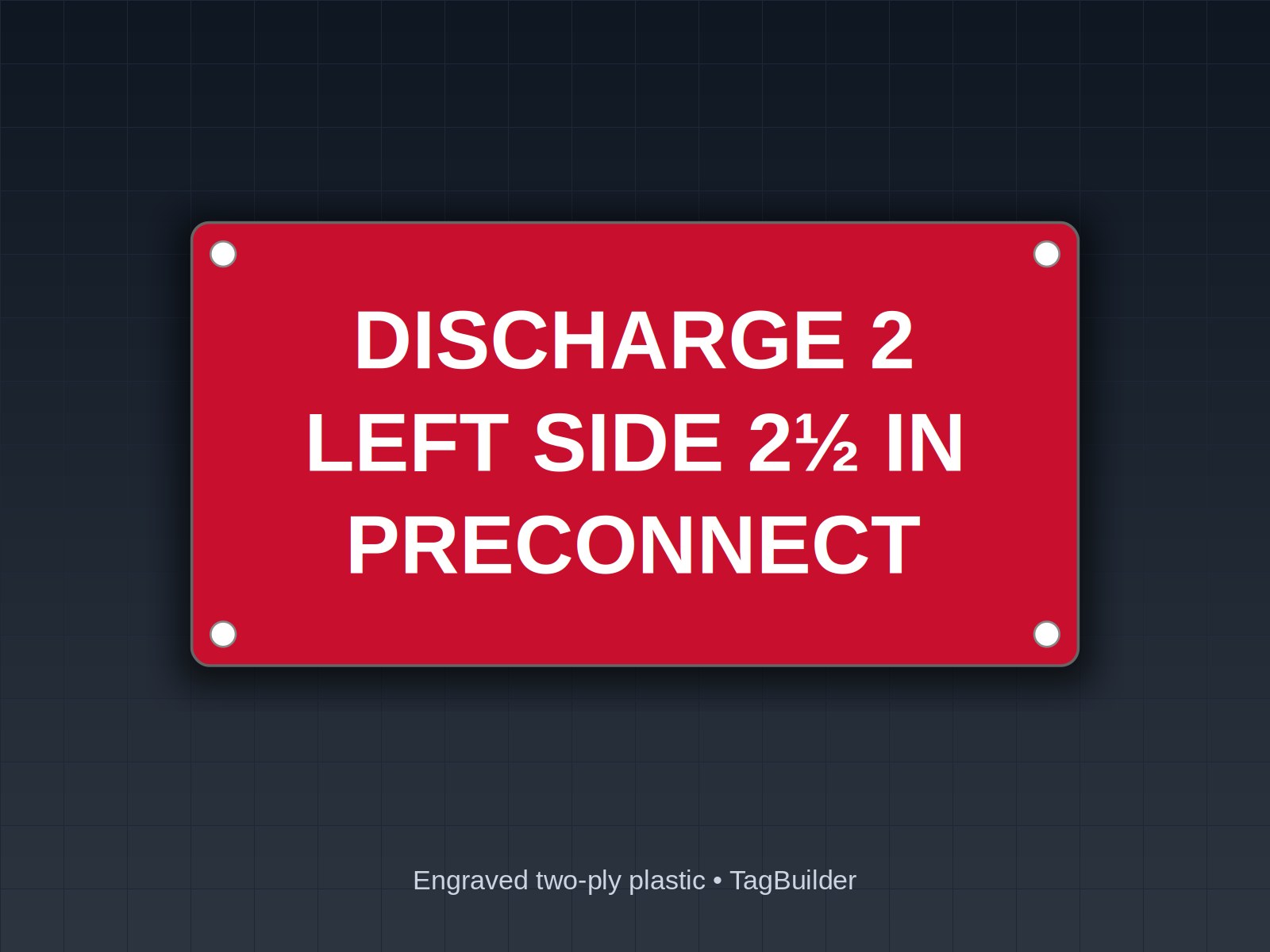
Two-ply engraved plastic suits this well. The face color shows the code and the engraved legend shows the core color beneath, so a red plate with white text and a yellow plate with black text stay readable without a separate print layer. Keep the number of colors small, and keep the legend text the same on every plate regardless of color.
Text size and legibility at night
Pump panels are lit by panel lighting, scene lights and sometimes a flashlight. Operators wear turnout gear and gloves, and may stand at an angle to the panel. Practical guidance:
- Use capital letters in a plain, heavy sans-serif face. Thin or ornate fonts disappear in glare.
- Make characters large enough to read from where the operator stands, not from where the builder holds the plate. Many builders use roughly a quarter inch character height as a floor for control labels and go larger for the main discharges. Confirm against your specification.
- Use strong contrast. Black on white or yellow, white on black, red or dark blue. Avoid mid-tone pairings.
- Keep legends short. Two lines at most. A long legend forces small type.
- Leave space around the plate so it does not run into the next control's label.
Mounting on stainless and polished panels
Pump panels are typically stainless steel or polished aluminum, often with a brushed or bright finish that shows every mark. That affects how you attach a plate.
Adhesive
Adhesive mounting leaves the panel unmarked and suits most plates. It depends on surface prep: clean the area with a solvent that leaves no film, work to the adhesive maker's temperature range, and press the plate down firmly across the full face. Polished metal and low-energy surfaces are the hard cases. Keep plate corners rounded, which resists lifting where hose and gloved hands catch an edge.
Screws or rivets
Fasteners hold on plates that get handled hard, such as near the discharge valves where hose couplings swing. The cost is holes in the panel. For a new build that is a drilling layout decision. For a refurbishment, an old hole pattern may or may not line up with the new plate, so measure before you order. Stainless fasteners avoid rust streaks and galvanic problems against a stainless panel.
Many shops combine both: adhesive for the panel field and screws for the few plates in the highest-contact positions.
Engraved plates versus printed decals
Hose abrasion, boot scuffs, pressure wash, foam concentrate, road deicing salt and brake dust are hard on anything that sits on the surface of a plate. Printed decals depend on a thin ink layer and a clear cover. Once a corner lifts or the cover is scratched through, the legend wears away from the edge in.
An engraved two-ply plate carries its legend as cut depth through the face into a contrasting core, so the text does not rub off like printed ink. It will still scratch and can still fade at the surface if left in constant direct sun, so for exterior panel doors and outdoor exposure see our indoor versus outdoor materials guide. Stainless engraved plates are an option for the harshest positions. Neither type is permanent, and a good refurbishment plan includes checking pump panel plates at each service interval.
Worked example: a 1500 gpm pumper
Here is a sample plate list for a midship-mount 1500 gpm pumper. The colors are examples of a typical scheme, and you should substitute your department's.
| Location | Plate legend | Plate color / text |
|---|---|---|
| Driver side intake | DRIVER INTAKE 6 IN | White / black |
| Officer side intake | OFFICER INTAKE 6 IN | White / black |
| Front or rear LDH intake | LDH INTAKE 5 IN | White / black |
| Crosslay 1 | XLAY 1 – 1-3/4 IN | Red / white |
| Crosslay 2 | XLAY 2 – 1-3/4 IN | Yellow / black |
| Rear 2-1/2 inch discharge | DISCH 3 – 2-1/2 IN | Blue / white |
| Large discharge | LDH DISCH – 5 IN | Green / white |
| Deck gun | MONITOR | Orange / black |
| Tank fill | TANK FILL | Black / white |
| Tank to pump | TANK TO PUMP | Black / white |
| Primer | PRIMER | Black / white |
| Governor | PRESSURE GOVERNOR | Black / white |
| Foam | FOAM SYSTEM | Black / white |
The order matters as much as the legends. Top to bottom and left to right, group the plates the way the valves are grouped on the panel: intakes together, discharges together, system controls together. The plate beside each valve should name that valve and no other. If you would like to build a list like this, our rectangle plate builder lets you set size, color and text for each one.
PTO and aerial device nameplates
A pumper's pump panel gets the most attention, but power take-off controls and aerial devices carry their own identification. A PTO engagement control usually wants a plate stating its function and any operating limit the maker specifies. An aerial device carries operating, capacity and warning data supplied by the device manufacturer, and those plates should be replaced to match the manufacturer's information and not reworded locally. When refurbishing, photograph every existing plate before removal so the wording and position can be reproduced.
Frequently Asked Questions
Does NFPA 1901 specify the exact legend wording?
Generally it sets what must be identified and leaves most wording to the builder and the purchaser. Because the standard is being consolidated into NFPA 1900, check the current edition and your build specification instead of relying on a remembered section number.
Do plate colors have to match discharge cap colors?
Not as a general rule. Matching is a widespread practice that helps operators, but the scheme comes from the department, not a single national code. Use whatever your fleet already follows.
Adhesive or screws on a stainless panel?
Adhesive keeps the panel intact and works well with clean surface prep. Screws or rivets suit high-contact positions. Many apparatus use a mix. Check the adhesive maker's data for the panel finish you have.
Will engraved plates outlast decals?
Under hose abrasion and road salt, engraved text does not wear off the way printed ink can, but any plate can be scratched or damaged. Plan periodic inspection and replacement regardless of type.
Can you reproduce the rating and test plates?
The content of those plates is set by the pump data and the standard, so work from the original plate or the maker's information and your AHJ's requirements. Do not change figures during a copy.
What is a sensible text size?
Larger than seems necessary on the bench. Many builders treat about a quarter inch character height as a minimum for control labels and go bigger for discharges, but your specification governs.
Send one discharge or intake legend from your pump panel and we'll engrave a sample plate and mail it, no charge.
If you are planning a refurbishment, start with the pump and equipment plates we already make, read how ordering works, and request a free sample to check size and contrast on your own panel before committing to a full set.
UL, NFPA, NEC, ASME, CEMA, TIA, ANSI and OSHA are names or marks of their respective organizations; TagBuilder is not affiliated with or endorsed by any of them. Requirements above are paraphrased summaries, not the text of any standard. Always work from the current published edition and your AHJ.