NEC 110.22 Disconnect Labels: What to Engrave on Each One
You are standing at a row of gray safety switches and none of them say what they shut off. Here is what 110.22 expects, and what to put on each plate.
Important Disclaimer
This article is provided for general informational purposes only and does not constitute legal, safety, or professional compliance advice. Regulations, standards, and codes are subject to change and may be interpreted differently by authorities having jurisdiction (AHJ). Always consult with qualified safety professionals, licensed engineers, or legal counsel to determine the specific requirements applicable to your facility. TagBuilder is not responsible for any actions taken based on this information.
What 110.22(A) actually asks for
In plain terms, each disconnecting means has to be legibly marked to indicate its purpose, unless it is located and arranged so the purpose is evident. That covers disconnects required for motors and appliances, and each service, feeder and branch circuit at the point where it originates.
Two things in that sentence matter for the person holding the engraving order.
- "Purpose" is the requirement. The section does not dictate wording, font, or size. It wants someone to be able to tell what the device controls.
- "Unless the purpose is evident" is a judgment call. A single switch on the wall right next to the one machine it feeds may be obvious. A bank of six identical switches on a roof is not. Many AHJs lean toward labeling everything, because the cost of a plate is small next to the cost of opening the wrong switch.
On durability, the markings need to hold up in the environment they sit in. Field-applied markings are addressed in 110.21(B), and the disconnect section carries its own durability wording in recent editions. The exact paragraph layout changes between editions, so check the one your jurisdiction has adopted. Engraved text is cut into the plate, so it does not rub off the way printed ink can, which is a practical reason shops use it outdoors and in washdown areas.
The related sections you will run into
110.22 is the general rule. Several other sections add specific marking or location requirements. This is a quick map, not a code review, and the details vary by edition.
| Section | Where it applies | What it adds, paraphrased |
|---|---|---|
| 230.70(B) | Service disconnects | Each service disconnect is marked as such, permanently and visibly. |
| 230.2(E) | Buildings with more than one service | A plaque or directory at each service disconnect location showing the other services and where they are. |
| 225.37 | Buildings fed by multiple feeders or branch circuits | A permanent plate or directory at each supply disconnect location listing the other supplies to that building. |
| 430.102 | Motors and motor controllers | Disconnect location relative to the controller and the motor, and identification where it is not obvious which motor it serves. |
| 440.14 | HVAC and refrigeration equipment | Disconnect within sight of the equipment and readily accessible, so the unit disconnect usually lives next to the unit it labels. |
| 690.13(B) | Photovoltaic systems | PV disconnects are marked as such, and the wording and placement requirements shift with the edition. |
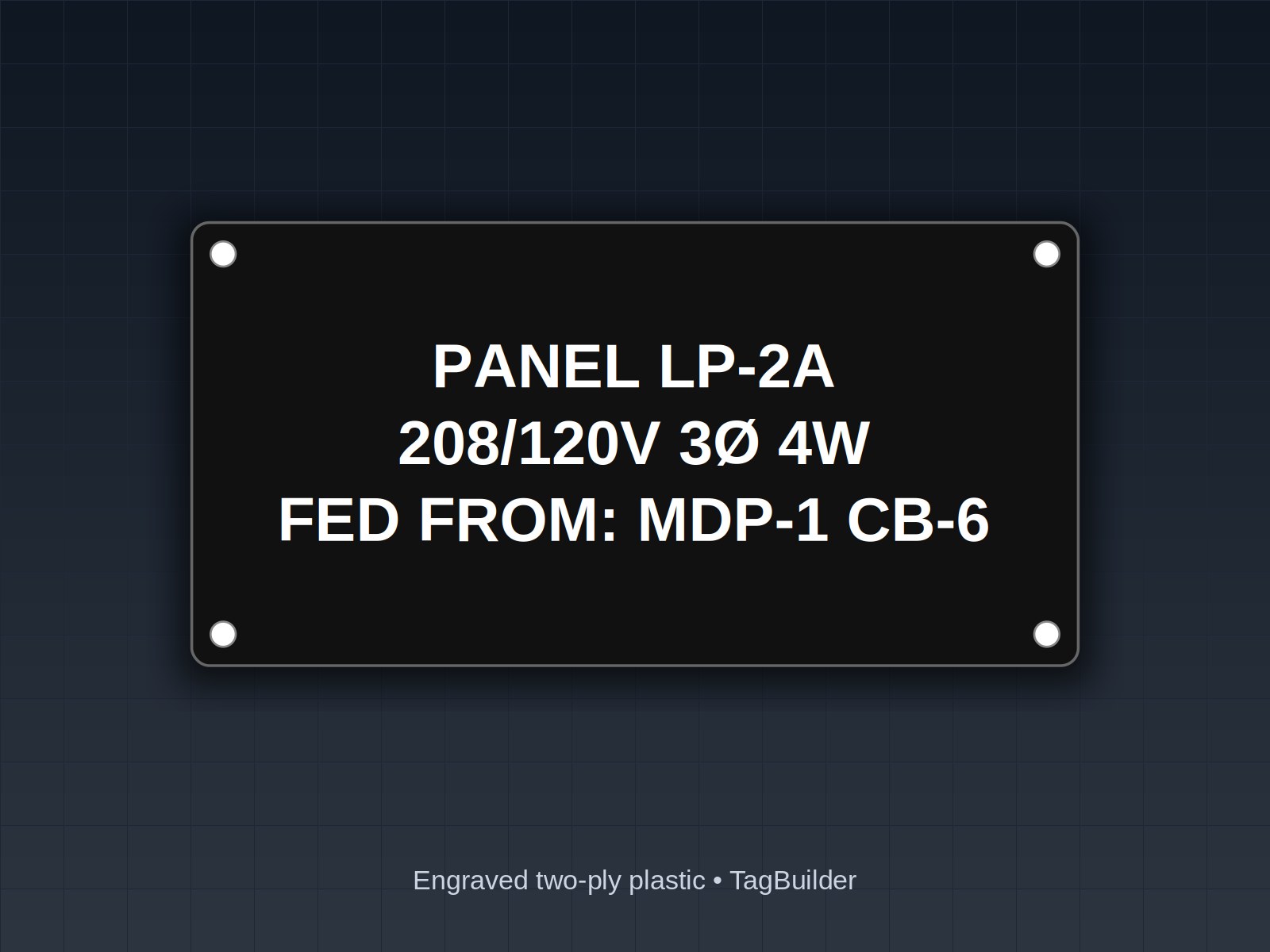
If the panel behind the disconnect needs its own directory, that is a separate job. The NEC 408 panel labeling guide covers it.
What to engrave on each disconnect
A disconnect plate does three jobs for the next person: tell them what they are about to kill, tell them where it gets its power, and tell them what is on the other side of the blades. Four lines handle most of it.
1. Purpose or load served
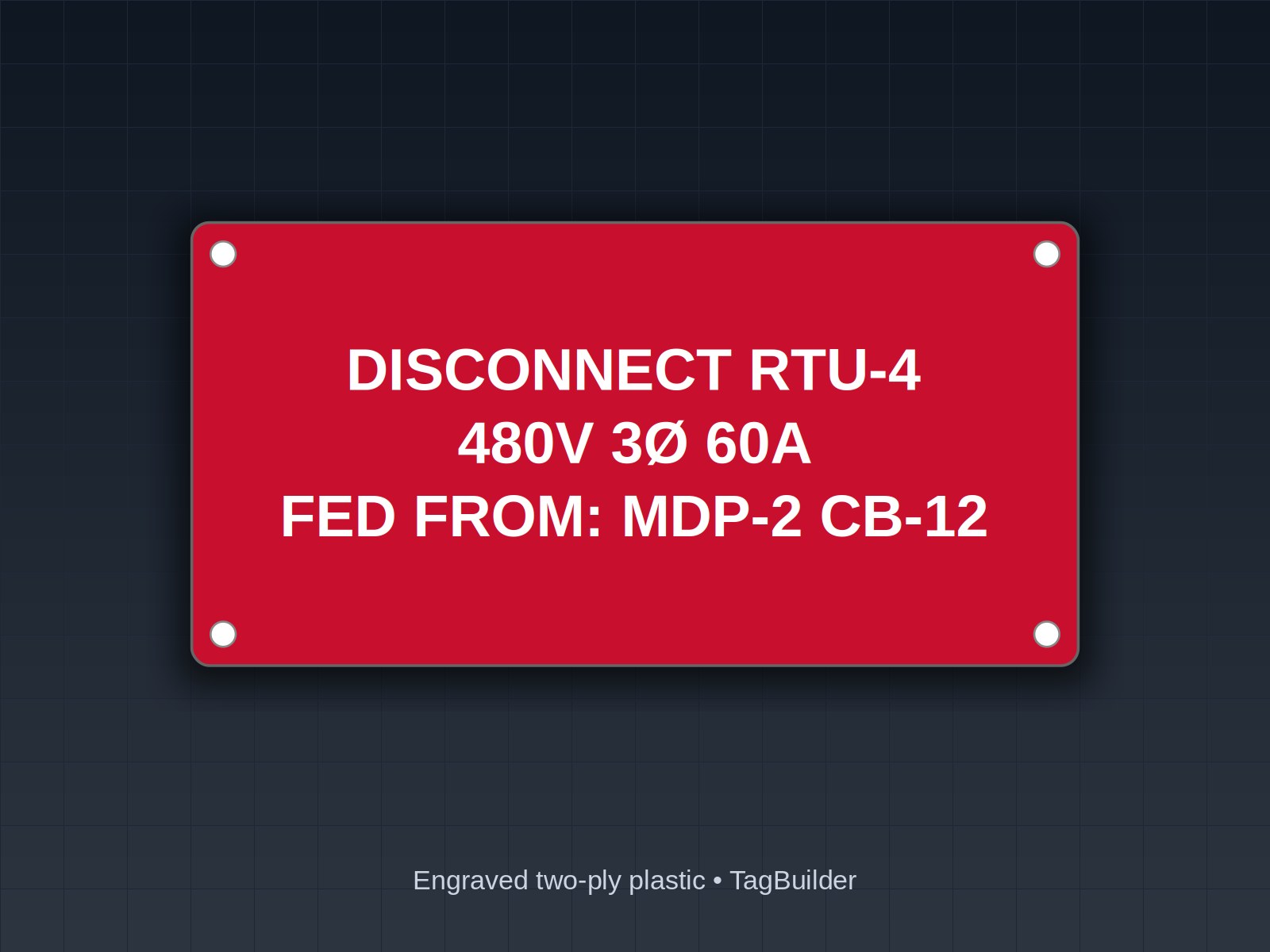
This is the line that answers 110.22(A). Use the equipment's own tag, the same one on the drawings and on the equipment nameplate. RTU-3 beats "roof unit". If one switch feeds two loads, name both.
2. Source (FED FROM)
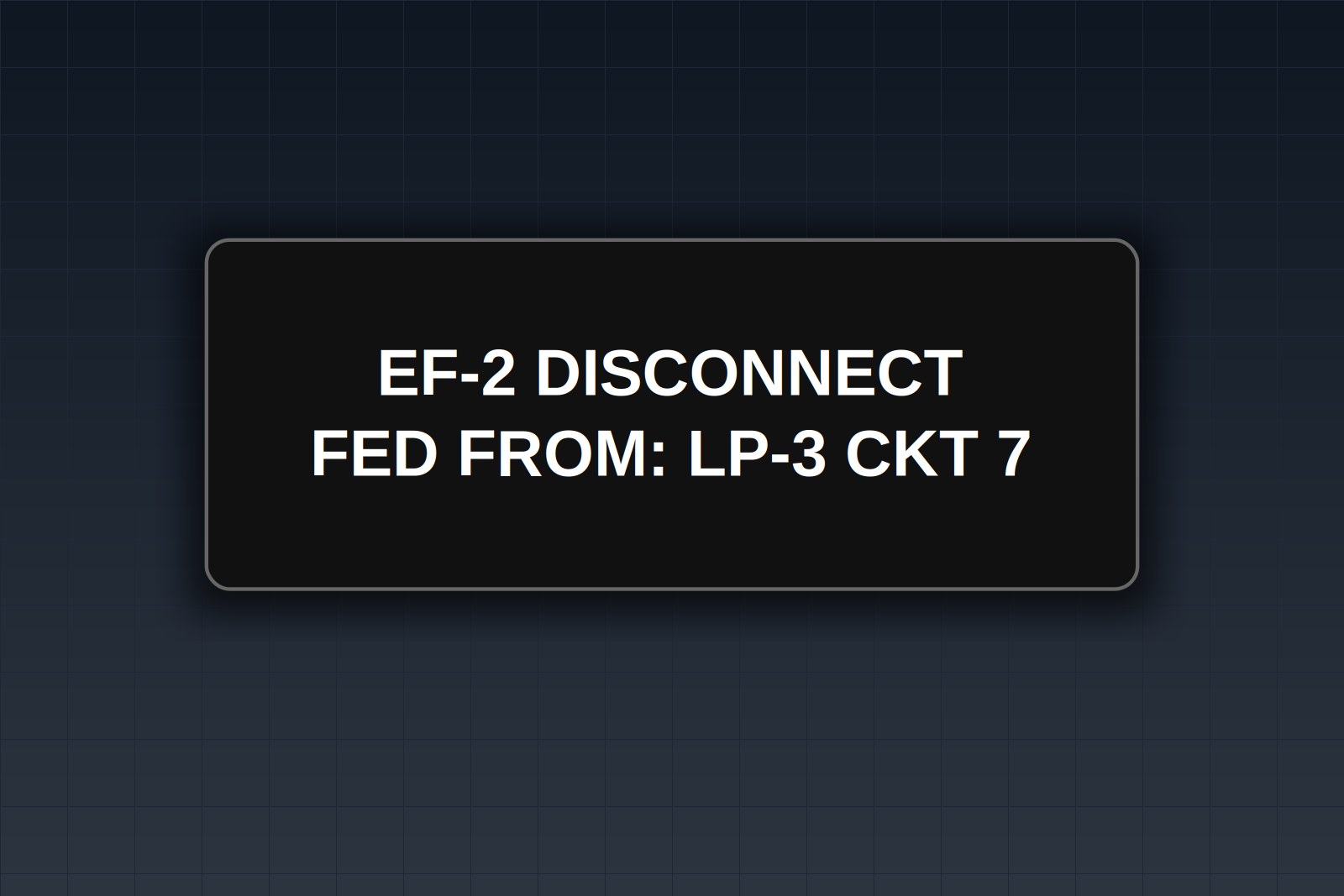
Panel name and circuit number, for example FED FROM LP-R CKT 14. This line is not what 110.22(A) calls out by name, but it is what electricians actually want when they are tracing a feeder at 2 a.m. Keep the panel name matching what is engraved on the panel itself.
3. Voltage and phase
Something like 480V 3PH. Add the disconnect rating if you have room, for example 60A. The switch's own nameplate already shows amps and fuse class, so do not copy every detail and risk it going stale after a fuse change.
4. A separate warning plate when there is more than one source
If a disconnect leaves some conductors live from another source (a control circuit from a different panel, a second feed, a generator or PV tie), do not squeeze the warning onto the identification plate. Put a second plate beside it that says what stays energized and where that power comes from. Keeping the two plates separate stops the warning from being lost in the routine ID text. Check the current edition and your AHJ for any wording they expect.
Plate size: 30 A safety switch vs. 400 A fused switch
110.22 does not set a plate size. It is a matter of what reads cleanly from where a person will stand, and how much door you have to work with.
| 30 A safety switch | 400 A fused switch | |
|---|---|---|
| Door space | Small, often crowded by the handle and the nameplate | Large flat door, room for a full set of lines |
| Typical plate | About 3 x 1 in, two or three short lines | About 4 x 2 in or larger, four lines |
| Character height | Roughly 1/8 to 3/16 in | Roughly 3/16 to 1/4 in, with the load name larger |
| Content | Load name, FED FROM | Load name, FED FROM, voltage and phase, extra notes |
These are working sizes shops commonly use, not figures from the code. A 4 x 2 inch plate is a good default for larger switches, and you can see one in the 4 x 2 inch disconnect label with mounting holes. Mount it on the door, not the box body, if the door is the part facing the person standing there. Use screws or rivets where the surface allows, or adhesive on clean, dry metal.
Worked example: a rooftop with six RTUs and two exhaust fans
Here is a label list you can copy and edit. Assume each RTU has its own disconnect within sight of the unit (see 440.14), the exhaust fans have their own switches, and everything is fed from one roof panel, LP-R, at 480V 3 phase. Change the names and circuits to match your drawings.
| Switch | Line 1 (purpose) | Line 2 (source) | Line 3 (rating) |
|---|---|---|---|
| 1 | RTU-1 DISCONNECT | FED FROM LP-R CKT 2/4/6 | 480V 3PH |
| 2 | RTU-2 DISCONNECT | FED FROM LP-R CKT 8/10/12 | 480V 3PH |
| 3 | RTU-3 DISCONNECT | FED FROM LP-R CKT 14/16/18 | 480V 3PH |
| 4 | RTU-4 DISCONNECT | FED FROM LP-R CKT 20/22/24 | 480V 3PH |
| 5 | RTU-5 DISCONNECT | FED FROM LP-R CKT 26/28/30 | 480V 3PH |
| 6 | RTU-6 DISCONNECT | FED FROM LP-R CKT 32/34/36 | 480V 3PH |
| 7 | EF-1 DISCONNECT | FED FROM LP-R CKT 38 | 480V 3PH |
| 8 | EF-2 DISCONNECT | FED FROM LP-R CKT 40 | 480V 3PH |
Two notes on this list. First, if an RTU has a separate control power feed from another panel, add a second plate under its disconnect: CONTROL CIRCUIT FED FROM LP-1 CKT 9. THIS SWITCH DOES NOT DE-ENERGIZE IT. Second, match each plate to the tag on the unit itself. The roof is a bad place to find out the drawings call a unit RTU-4 while the equipment says RTU-D. For more rooftop labeling ideas, see the rooftop unit and refrigeration labeling guide.
Mistakes that cause rework
- Labeling the switch with the panel's name instead of the load's. The panel name belongs on the FED FROM line.
- Using nicknames. "North unit" means nothing after a tenant change.
- Putting the plate on a removable cover that can end up on the wrong switch.
- Skipping the second plate where a second source exists.
- Assuming a plate is not needed because the purpose is obvious. That is the AHJ's call, not yours.
Frequently Asked Questions
Do I have to label a disconnect if it is right next to the equipment?
110.22(A) allows an exception where the disconnect is located and arranged so the purpose is evident. Whether a given install meets that is up to the inspector, and many AHJs expect a label anyway. A short plate is cheap insurance.
Does a label on the door count, or does it have to be on the enclosure?
The code asks that the marking be legible and durable, not that it sit in a particular spot. Most installers put it on the door where it is seen when the switch is operated. Confirm with your AHJ if the door is likely to be swapped or removed.
Should the plate list the ampere rating?
It is common but not required by 110.22. The switch already carries its own rating, so many installers list only voltage and phase, or leave the rating out to avoid a mismatch after a fuse change.
What about a breaker used as a disconnect?
The same idea applies. If a circuit breaker in a panel serves as the disconnecting means for a unit, mark the breaker's purpose through the panel directory, and label the unit end as well where the equipment is not in sight of the panel. Check how your edition and AHJ treat the location rules.
Is engraved plastic acceptable outdoors?
Engraved two-ply plastic is widely used on rooftop and outdoor equipment, and engraved stainless is an option for harsher spots. Which one fits depends on the site and what your AHJ expects, so confirm before ordering a large batch.
Send one disconnect ID and what it serves and we'll engrave a sample plate and mail it, no charge.
If you already have your list, the rectangle plate builder lets you set text and size for a whole schedule at once, and how it works explains what happens after you submit. If you want to see a plate in hand first, the free sample page is the quickest route.
UL, NFPA, NEC, ASME, CEMA, TIA, ANSI and OSHA are names or marks of their respective organizations; TagBuilder is not affiliated with or endorsed by any of them. Requirements above are paraphrased summaries, not the text of any standard. Always work from the current published edition and your AHJ.