Labeled Kits Per Machine Build vs Engraving In-House: The Real Cost
Every machine that leaves the shop needs a nameplate, a run of legend plates, device labels and at least one warning plate, and somebody has to stop what they're doing to make them.
Important Disclaimer
This article is provided for general informational purposes only and does not constitute legal, safety, or professional compliance advice. Regulations, standards, and codes are subject to change and may be interpreted differently by authorities having jurisdiction (AHJ). Always consult with qualified safety professionals, licensed engineers, or legal counsel to determine the specific requirements applicable to your facility. TagBuilder is not responsible for any actions taken based on this information.
How Most Shops Handle Labels Today
Most panel shops and OEM machine builders that make their own tags do it the same way: one person on the floor owns the label side of the job along with everything else on their plate. They pull tag numbers off the drawing, lay out each plate, load stock, swap colors when the legend calls for two, and fit the whole thing in between the work that's actually billable. It works, and for a long time it's the only option anyone considers, because the capability already exists on-site and every build is a little different anyway.
The friction shows up slowly. A control panel label kit made in-house is really a side project bolted onto a build schedule, and side projects are the first thing that slips when the schedule gets tight.
Counting the Real Hours Per Build
The cost of engraving labels in house rarely gets counted as its own line item, which is exactly why it's easy to underestimate. Shops that do sit down and add it up usually find four buckets:
- Artwork setup — reading the drawing, pulling every tag number, and laying out each plate so the legend matches the panel, one at a time, for every build.
- Material handling — loading stock, changing colors between white-on-black and other combinations, cutting blanks to size before anything gets marked.
- Re-dos — a revision comes back from engineering after the plates are already made, a tag number gets transposed, a legend has a typo nobody caught until final inspection.
- The single point of failure — the one person who knows the label setup takes a sick day, a vacation, or leaves for another job, and the whole step stalls until they're back or someone relearns it from scratch.
None of these show up on a quote. They show up as hours pulled off other work, and over a year of builds they add up to more than most shops expect.
Overflow: When Shops Send It Out Anyway
Panel shop label overflow is common even at shops that never plan to give up in-house capability. The pattern is consistent:
- Rush weeks — three builds due the same day and the label step is the one that gets bumped.
- Long multi-line legends — a device label with a full description, a setpoint, and a warning line doesn't fit the quick layout the in-house process was built around.
- Two-color plates — a color change mid-run breaks the flow of a batch that was otherwise moving fast.
- Big runs — an OEM with a multi-unit order needs the same kit repeated ten or twenty times, and that volume is better handled as one outside order than ten interruptions to the floor.
Shops that outsource panel labels vs in-house production for these specific cases usually keep their own capability for everything else — it's not an either/or decision, it's routing the overflow to wherever it fits the schedule.
What a Per-Build Kit Actually Is
An engraved label kit per machine covers every nameplate, legend plate, device label and warning plate that one build needs, bagged together and marked to the same tag numbers used on the drawing. The panel builder opens one bag, matches each plate to its tag number, and mounts them in order. Nothing gets laid out on the floor, nothing gets sorted after the fact.
For shops weighing plate material for a given application, the lamacoid vs. vinyl label comparison is a useful starting point, since engraved two-ply plastic behaves differently than printed labels over the life of a panel — engraved text doesn't rub off the way printed ink can.
Specifying a Kit So It Drops Onto the BOM
A lamacoid kit per build is specified the same way any other purchased part is: as one line on the bill of materials, not a dozen scattered entries. The pattern that works:
- One BOM line per machine, referencing the kit rather than each individual plate.
- Tag numbers pulled straight from the drawing's device and nameplate schedule, so there's no re-keying and no room for a transposed number.
- One bag per panel or enclosure when a build has more than one, so the person mounting plates never has to sort a mixed pile.
- A revision note on the BOM line so a late drawing change is caught before the kit ships, not after.
Once labels per BOM is treated as a routine purchased item instead of a shop-floor task, it stops competing with the rest of the build schedule for a tech's time.
| Factor | Per-build kit | In-house |
|---|---|---|
| Hours per build | Order placed from the drawing; minimal shop-floor time | Artwork, setup, and handling repeated on every build |
| Consistency | Same layout and tag-number match every time | Varies with whoever is on the task that day |
| Lead time | Set by the order, planned into the schedule | Fits around whatever else the floor is doing |
| Rework | Caught against the drawing before mounting | Found after the fact, often at final inspection |
| Who's tied up | Nobody — plates arrive ready to mount | The one tech who knows the label setup |
Worked Example: One Machine, One Kit
A typical mid-size machine build might carry a kit like this, each item keyed to the drawing's tag numbers:
- NP-1 — one machine nameplate (model, serial, build date fields)
- LP-101 through LP-114 — fourteen legend plates for pushbuttons, selector switches, and pilot lights on the operator panel
- DL-201 through DL-206 — six device labels for VFDs, breakers, and terminal blocks inside the enclosure
- WP-301 and WP-302 — two warning plates for the disconnect and the point of operation
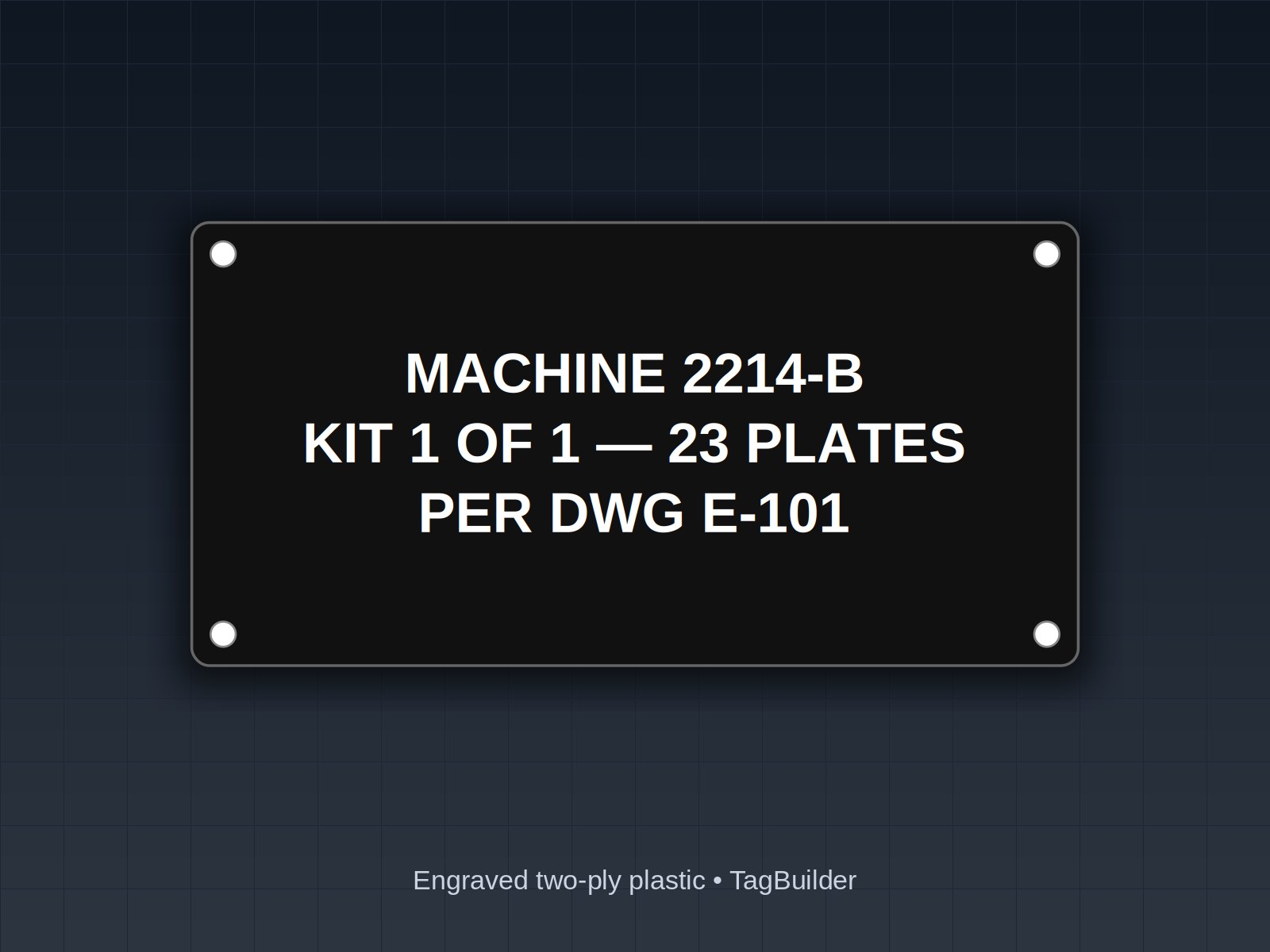
That's one BOM line, one bag, twenty-three plates matched to twenty-three tag numbers before the panel builder ever picks one up. For builds with arc-flash or hazard marking requirements, it's worth reviewing the machinery marking guidance alongside the drawing so warning plate wording is decided once, at the drawing stage, rather than re-argued on the floor.
When In-House Still Wins
A per-build kit isn't the right call for every job. In-house production still makes sense when:
- A build needs a handful of tags — a couple of nameplates, one or two legend plates — where the setup overhead of an outside order outweighs the time saved.
- A change has to happen the same day, on the floor, because a device swap or a last-minute customer request can't wait for an outside turnaround.
Shops that do both usually draw the line around volume and lead time: small, same-day jobs stay in-house; everything that fits a planned build schedule moves to a kit.
Frequently Asked Questions
How long does a per-build kit take to turn around?
Turnaround depends on plate count, colors, and how many lines are on each legend, so it's best confirmed per order rather than assumed. Shops that plan the kit into the BOM at the same time as the rest of the build generally find it fits the existing schedule without adding a rush step.
Do we lose control over exact wording if we send it out?
No — the wording comes from the drawing's tag schedule, the same source the in-house process would use. The kit follows what's specified; it doesn't substitute its own language.
What happens if the drawing revises after the kit is ordered?
This is why a revision note on the BOM line matters. Flagging the drawing revision before the kit ships lets the order get corrected before plates are made, rather than after they've already been mounted.
Can we mix a kit for most tags with in-house for a few?
Yes. Many shops keep in-house capability specifically for same-day changes and small jobs, and route the rest of the build's labels to a kit. It's a routing decision per build, not a one-time switch.
How does a kit handle two-color or reversed-color plates?
Color and reverse-color calls are specified per tag number on the same list used for everything else, so a mixed-color kit is ordered the same way as a single-color one — it's a spec on the line item, not a separate process.
What if our tag numbering scheme doesn't match a standard format?
A kit is built from whatever numbering scheme the drawing already uses. There's no requirement to convert to a different format first — the tag numbers on the plates match the tag numbers on the drawing, whatever convention that follows.
Send one panel ID or device legend from your next build and we'll engrave a sample plate and mail it, no charge.
If your panels also need to satisfy a listing shop's marking requirements, the UL 508A nameplate guide covers what's commonly expected on the panel nameplate itself, and the how it works page walks through how a kit order moves from drawing to bagged plates. Either is a reasonable next stop before deciding how much of your next build's labels stay on the floor.
UL, NFPA, NEC, ASME, CEMA, TIA, ANSI and OSHA are names or marks of their respective organizations; TagBuilder is not affiliated with or endorsed by any of them. Requirements above are paraphrased summaries, not the text of any standard. Always work from the current published edition and your AHJ.