Gas Meter and Gas Valve Tags: What to Engrave for Shutoff, Meter and Appliance Identification
Get this made: TagBuilder (Solid Ideas Engraving, Waterford, PA) engraves Design your own (from $2.99). No minimum order, no setup fees, most orders ship in 2–3 business days, rush available. Custom text and size: open this design in the configurator. Or email the spec to support@tagbuilder.net for a written quote and PDF proof the same business day.
When a gas smell is reported, whoever responds needs to know which meter feeds which unit and where the shutoff is, and a bare valve handle does not tell them.
Disclaimer: general information, not legal or compliance advice. Codes change and inspectors interpret them differently, so confirm requirements with a qualified professional. Full disclaimer
Why gas identification gets its own approach
Most valve tagging is about maintenance. Gas tagging is about response time. The person reading the tag may be a firefighter, a utility technician, a maintenance tech on their first day, or a tenant who has never seen the meter room.
That changes how you write the tag. Legends should be short, unambiguous and readable at arm's length in a poor-light meter room. If you are new to tagging in general, start with the valve tag color codes guide and then come back here for the gas-specific details.
What the codes and standards say, in general terms
Three sources come up most often, and each has limits on what it tells you.
- NFPA 54 (National Fuel Gas Code) and the International Fuel Gas Code (IFGC) cover fuel gas piping, appliance connections and shutoff valve locations. Which one applies depends on the state or city that adopted it, and which edition. Many AHJs expect shutoff valves to be accessible and easy to identify, but the exact wording differs, so check the adopted edition rather than relying on a summary.
- ASME A13.1 is a scheme for identifying piping contents. It commonly assigns yellow to flammable fluids, with contrasting lettering. It is a widely used practice for pipe markers, not a law by itself, and some owners follow it while others use their own convention.
- The gas utility's own rules govern everything on its side of the meter. Many utilities restrict what may be attached to the meter set, the regulator and the service piping.
Where these disagree, the local jurisdiction and the utility win. A short call to the utility's service planning or inspection group before you order anything is cheaper than redoing a set of tags.
The typical tag set
A practical gas identification set for a commercial or multi-tenant building usually has five parts.
1. Meter identification
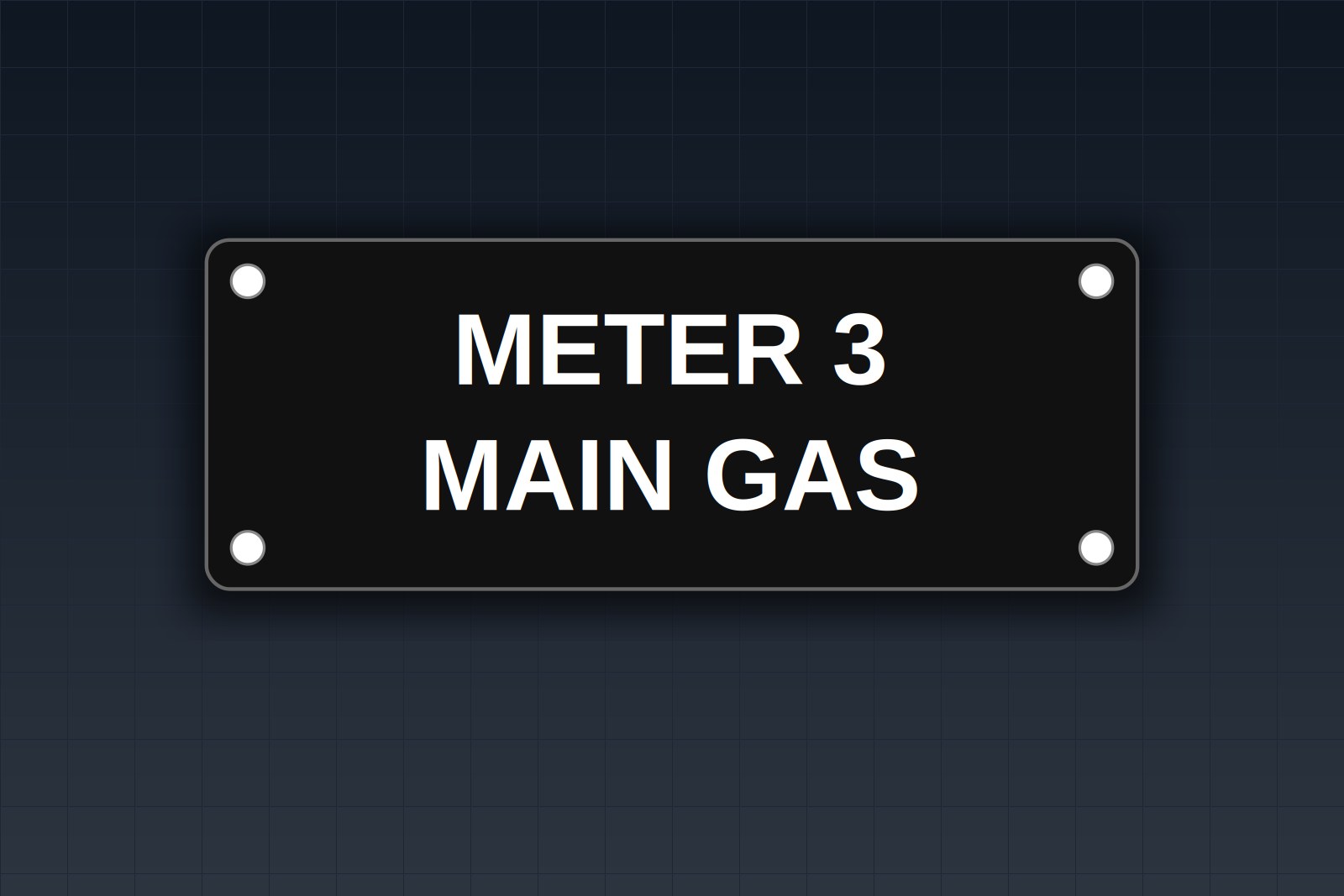
One tag per meter showing the meter number and the unit or tenant it serves. In a meter bank this is the tag that prevents the wrong unit from being shut off.
2. Main gas shutoff
A tag on the main building shutoff, if the building has one downstream of the meters. Say what it controls, for example MAIN GAS SHUTOFF, and add the building or area if there is more than one.
3. Appliance shutoff valves
Each appliance usually has its own shutoff valve close to the appliance. Tag the valve with the appliance it serves: RTU-2, BOILER 1, WATER HEATER WH-1, RANGE LINE, FRYER LINE. Match the identifier to the equipment ID on your drawings so the tag and the schedule agree. Our equipment ID plates follow the same numbering.
4. Emergency gas shutoff
Commercial kitchens and some other occupancies have a dedicated emergency shutoff, often tied to a hood or suppression system. Tag it clearly as EMERGENCY GAS SHUTOFF and note what resets it if that is not obvious.
5. Pressure notes where they apply
If the building runs an elevated pressure upstream of a regulator, a tag stating the pressure helps anyone opening a line. Only engrave a pressure value you have confirmed from the design documents or the utility.
Suggested legends, shapes and mounting
The table below is a starting point. Adjust sizes to your valve handles and the room, and confirm mounting with the utility wherever the tag is near its equipment.
| Location | Suggested legend | Tag shape and size | Mounting |
|---|---|---|---|
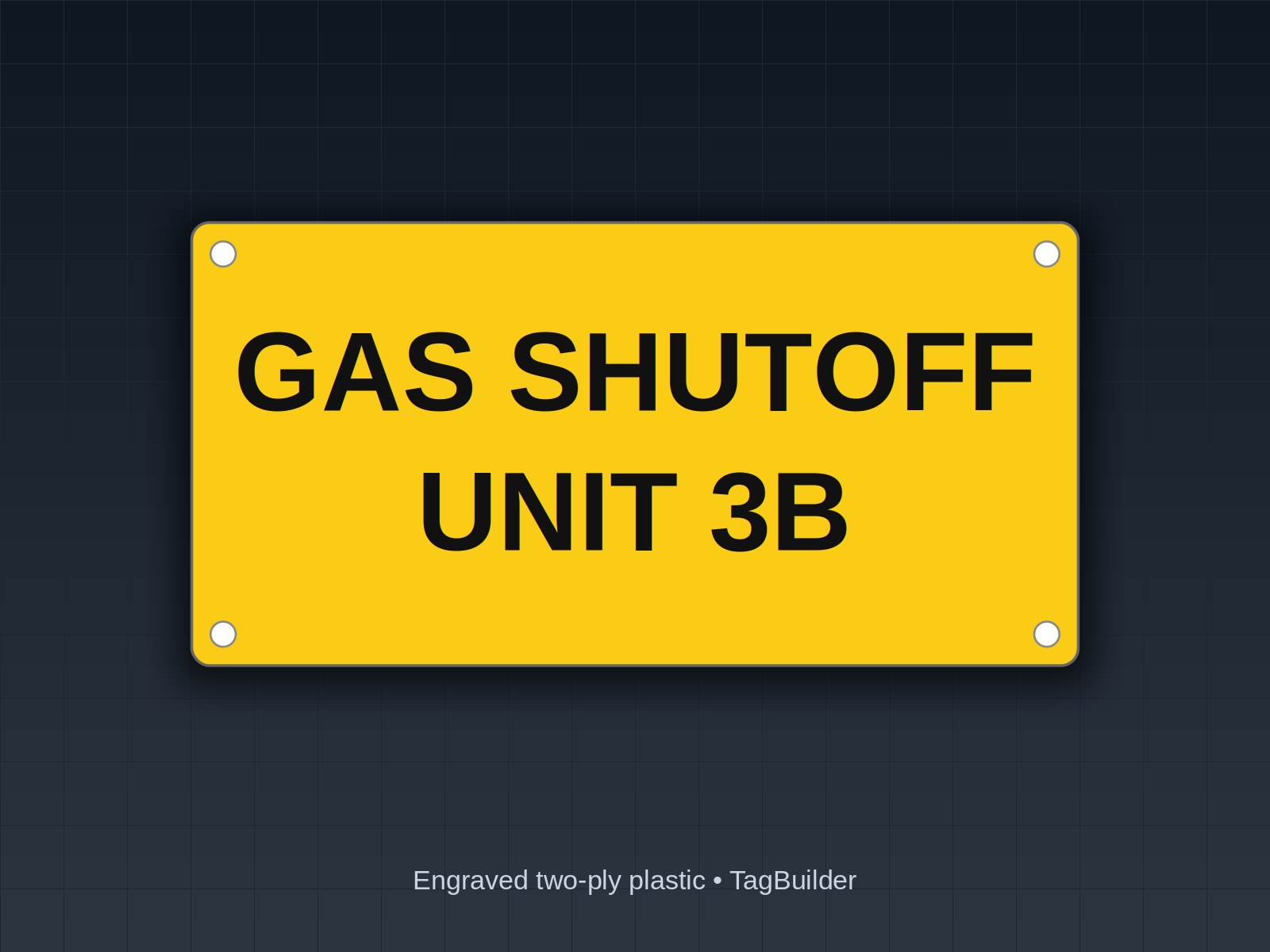
| Each meter in a bank | METER 3 / UNIT 3B | Rectangle, about 3 x 1 in, two lines | Screws on the building-owned plate or wall behind the meter, not on the meter |
| Main building shutoff | MAIN GAS SHUTOFF | Rectangle, about 4 x 1.5 in, or 2 in round | Chain on the valve handle, or screws on a plate beside it |
| Appliance shutoff, RTU or boiler | RTU-2 GAS | 2 in round or 3 x 1 in rectangle | Chain on the handle, or screws on a plate on the nearby structure |
| Water heater shutoff | WH-1 GAS SHUTOFF | 2 in round | Chain on the handle |
| Kitchen equipment | FRYER LINE GAS | Rectangle, about 3 x 1 in | Screws on a plate or wall surface away from heat |
| Emergency shutoff | EMERGENCY GAS SHUTOFF | Rectangle, about 5 x 2 in | Screws on the wall beside the valve or control |
| Pressure note | PRESSURE value and units, as confirmed | Rectangle, about 3 x 1 in | Screws on a plate near the regulator, as the utility allows |
For color, many owners use black text on a yellow background for gas to follow the flammable-fluid convention, and others choose white on red for emergency shutoffs. Pick one scheme for the whole building and write it down.
Worked example: a 12-unit apartment building
Picture a three-story building with 12 apartments and a gas meter bank on the side wall. Each tenant has their own meter. The landlord owns the house boiler and a rooftop make-up air unit, and each unit has a gas range.
The tag list looks like this:
- 12 meter tags, one per meter, in a consistent format: METER 1 / UNIT 1A, METER 2 / UNIT 1B, and so on through METER 3 / UNIT 3B and the rest of the bank.
- 1 main shutoff tag: MAIN GAS SHUTOFF / HOUSE BOILER if the boiler is fed from its own branch, or MAIN GAS SHUTOFF / BUILDING if it controls the whole supply.
- 1 appliance tag at the boiler: BOILER 1 GAS.
- 1 appliance tag at the roof unit: RTU-1 GAS.
Two choices make this set work. First, the meter number in the legend is the number the utility uses on its meter, so a responder reading either one gets the same answer. Second, the unit identifier matches the lease and mailbox numbering rather than a maintenance nickname. Keep a one-page index that lists every tag and its location and give a copy to the property manager and the fire department if they ask for it.
Cautions near the meter
- Ask the gas utility first. Do not attach anything to its meter, regulator or service piping without confirming that it allows it. Many utilities want tags mounted on the building wall or a building-owned plate instead.
- Never block the meter dials. The reader needs a clear view of the index and any tamper seals. Keep tags clear of the face, the seals and the vent.
- Use metal or rated tags where the utility requires it. Some utilities specify a material near the meter set. Our guide to brass, stainless and plastic valve tags compares the options, and engraved stainless is the usual choice for outdoor meter locations.
- Tag the valve, not the pipe. A pipe marker tells you what the pipe carries. A valve tag tells you what the valve shuts off. Responders need the second one, so put it where the handle is.
- Do not rely on color alone. The legend must make sense in black and white, in poor light and to someone who cannot see the color.
- Keep tags off hot surfaces. Mount them where flue pipes, burners and hot equipment will not soften or discolor them.
Choosing chain or screws
A chain on the handle works well for ball valves in a mechanical room, because the tag stays with the valve even if the handle is moved. A screw-mounted tag on a nearby plate or wall suits meter banks and anywhere the handle is hard to reach or turns often. Each method has tradeoffs, and the valve tag attachment methods guide walks through them. Whichever you choose, check that the tag does not stop the handle from turning to the full open or closed position.
Frequently Asked Questions
Do I have to use yellow for gas tags?
Not necessarily. ASME A13.1 commonly uses yellow for flammable fluids and many owners follow it, but it is a recognized practice and not a universal legal requirement. Check your AHJ, your insurer and your own facility standard.
Can I attach a tag directly to the utility's meter?
Only if the utility says so. Many do not allow anything on the meter set, so mount the tag on the building side and ask first.
What should a meter tag say?
The meter number as the utility labels it, plus the unit or tenant served. A format such as METER 3 / UNIT 3B keeps both visible in two short lines.
Should I tag every appliance shutoff?
It is common practice and helps anyone responding to a problem. Tag the shutoff valve at each appliance with the appliance ID, and keep the ID the same as on your drawings.
Which edition of the fuel gas code applies?
That depends on what your state or city has adopted, and it can change. Look up the adopted edition with the building department or your AHJ rather than assuming.
Does an engraved tag hold up outdoors?
Engraved text does not rub off the way printed ink can, but the substrate still matters. For exposed meter locations, many owners choose engraved stainless. Confirm what your utility specifies.
Order engraved gas valve and meter tags with your unit numbers.
If you are labeling a whole building, browse our valve tags for stock shapes and sizes, or lay out custom legends such as METER 3 / UNIT 3B in the rectangle tag builder. Before you order, send your tag list to the utility and your AHJ so the legends and mounting are settled in advance.
Disclaimer. This article is provided for general informational purposes only and does not constitute legal, safety, or professional compliance advice. Regulations, standards, and codes are subject to change and may be interpreted differently by authorities having jurisdiction (AHJ). Always consult with qualified safety professionals, licensed engineers, or legal counsel to determine the specific requirements applicable to your facility. TagBuilder is not responsible for any actions taken based on this information.
UL, NFPA, NEC, ASME, CEMA, TIA, ANSI and OSHA are names or marks of their respective organizations; TagBuilder is not affiliated with or endorsed by any of them. Requirements above are paraphrased summaries, not the text of any standard. Always work from the current published edition and your AHJ.