Exhaust Fan Control Labels: EF Switch Plates, Disconnects and Fan-to-Room Tags
Get this made: TagBuilder (Solid Ideas Engraving, Waterford, PA) engraves EXHAUST Push Button Legend Plate – 22mm White on Black ($5.50). No minimum order, no setup fees, most orders ship in 2–3 business days, rush available. Order it: https://tagbuilder.net/shop/product/22mm-ring-tag-exhaust-single-line-slim-white-on-black. Custom text and size: open this design in the configurator. Or email the spec to support@tagbuilder.net for a written quote and PDF proof the same business day.
The fan is running, or it should be and is not, and nobody can tell which switch, button or disconnect belongs to it. The fans were numbered, but the things a person actually touches were never labeled.
Disclaimer: general information, not legal or compliance advice. Codes change and inspectors interpret them differently, so confirm requirements with a qualified professional. Full disclaimer
The Short Answer
Label the control with the same ID that is on the fan nameplate (for example EF-3), the word EXHAUST, and the area the fan serves. Put the same ID on the disconnect. Then anyone can match the switch, the disconnect and the fan by reading, without opening a drawing or tracing conduit.
This article assumes you have already numbered the fans. If you have not, start with the HVAC equipment abbreviations and tagging scheme, which covers the abbreviation chart, the numbering rules and the fan nameplates. What follows covers the control side: wall switches, push buttons and selectors, disconnects, and the link between a fan and the room it serves.
What Goes on the Control
A switch plate has very little room, so every word has to earn its place. A control legend for an exhaust fan needs three things, in this order:
- Fan ID: EF-3, exactly as it appears on the nameplate and the schedule.
- Function: the word EXHAUST. It tells a stranger this is not a light or a supply fan.
- Area served: RESTROOM, DISH ROOM, KITCHEN HOOD. Use the name people use on site, not the name on the drawings if the two differ.
Wall switches
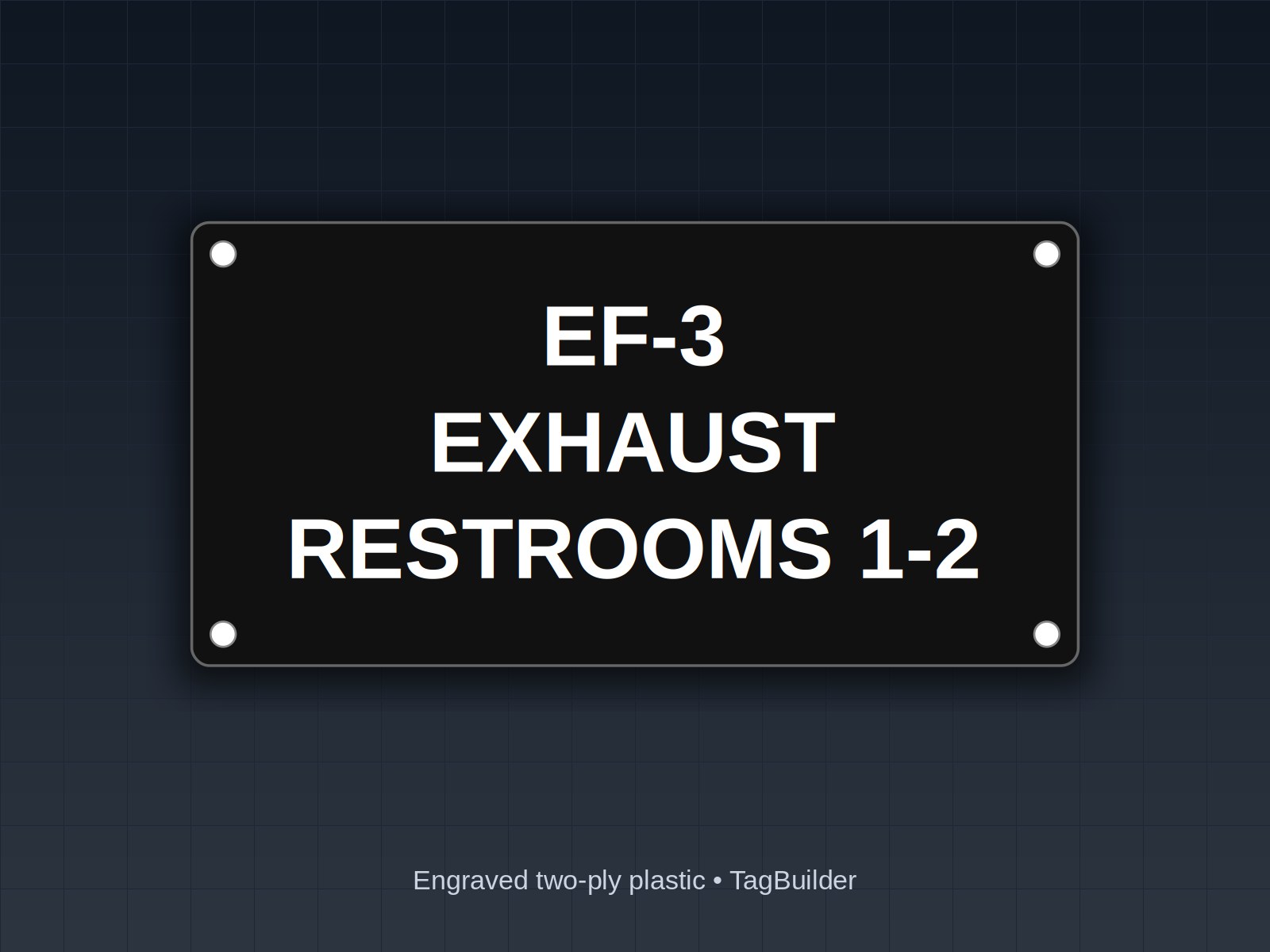
A wall switch plate is usually a two-line or three-line label. A restroom example reads EF-3 EXHAUST on the first line and MEN’S RESTROOM on the second. Keep the ID on its own line so it can be read at a glance and searched by eye.
Push buttons, selectors and pilot lights
On a control panel, the standard 22 mm devices take a small round or square legend plate. Space is tight, so shorten the wording but keep the ID. A selector might read EF-1 HAND-OFF-AUTO, with the area served on a larger plate below or beside the device. A pilot light can read EF-1 RUN. If you are labeling a bank of devices, one legend per device is easier to read than one long strip, and it survives rearranging the panel later. The 22 mm exhaust ring tags in the shop, such as the slim single-line exhaust tag, are a starting point for these.
The Disconnect Plate
Disconnects are where most of the trouble starts. They sit on the roof, on the curb or above a ceiling, and the person opening one is often a service tech who has never seen the building.
Paraphrasing the NEC, a disconnecting means must be legibly marked to indicate its purpose, and the marking must be durable enough for the environment it is in (see 110.22, and check the current edition). Motor disconnects are also covered by Article 430, including 430.102, which deals with where the disconnecting means must be located relative to the motor and controller. Details and exceptions vary by edition and by AHJ, so confirm what applies to your installation before you decide what to mount and where.
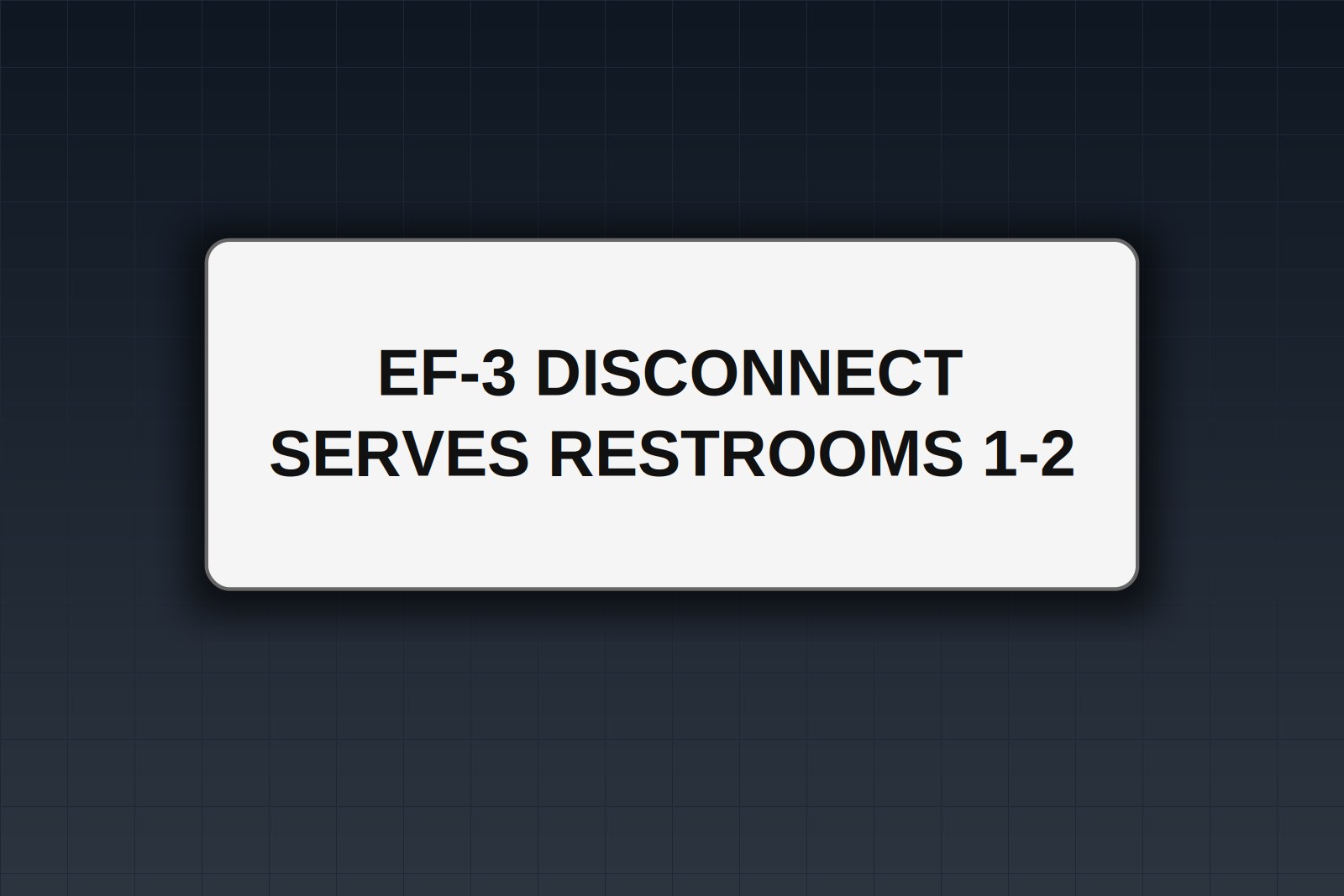
For labeling, the practical point is that the disconnect plate should carry the same ID as the fan. A good plate has three lines: EF-3 EXHAUST FAN, MEN’S RESTROOM, and DISCONNECT. If the circuit is known, add the panel and circuit number on a fourth line. That one line saves the most time when someone has to find the breaker that feeds a fan. The disconnect label section has plates sized for this.
Outdoor and rooftop disconnects see sun, rain and cleaning chemicals. Engraved text does not rub off the way printed ink can, which is why engraved plates are the usual choice for exposed locations. Use mechanical fasteners or a suitable adhesive for the surface, and check that the plate material suits the environment.
Linking the Fan to the Room
The question techs actually type into a search box is some version of “which room does this fan serve?” The answer should be on the equipment, not in a drawing set that may be a drawer away or a revision behind.
Put the area served in three places: on the fan nameplate or tag, on the disconnect, and on the control. When the same words appear on all three, the chain is complete. A few habits help:
- Use one name per room. If the drawings say TOILET RM and the staff say RESTROOM, pick the one people say and use it everywhere.
- Name the room, not the duct. A tech standing in a dish room can read DISH ROOM. They cannot read “zone 4 exhaust.”
- Match the fan schedule. If a fan ID changes during a renovation, change all three plates, not just the nameplate.
The equipment ID plates are the natural match for the fan end of this chain.
Interlocked Fans
Some fans should not run alone. The usual case is a commercial kitchen, where a hood exhaust fan and a makeup air unit are tied together so the hood does not pull the building under negative pressure. NFPA 96 covers ventilation control and fire protection for commercial cooking operations, and the local mechanical code often adds its own rules about makeup air and interlocks. Which ones apply depends on the edition your jurisdiction has adopted and how the AHJ reads it, so confirm before you finalize wording.
Whatever the interlock is, label it where people will see it. Short, plain wording works best:
- EF-1 ON WITH MAU-1 on the hood exhaust control
- MAU-1 ON WITH EF-1 on the makeup air control
- DO NOT RUN EF-1 WITH MAU-1 OFF where the sequence matters and a person could break it by hand
Do not label a fan as interlocked unless it really is. A legend that says one thing while the wiring does another is worse than no legend. Have the person who owns the controls sequence confirm the wording first.
Worked Example: A Small Restaurant
Here is a complete set for a small restaurant with a kitchen hood fan (EF-1), a dish room fan (EF-2), two restroom fans (EF-3 and EF-4) and a makeup air unit (MAU-1) serving the kitchen. The plate sizes are suggestions. Adjust them to the device and the space available.
| Fan ID | Location | Switch or button legend | Disconnect plate | Interlock note | Suggested plate size |
|---|---|---|---|---|---|
| EF-1 | Kitchen hood, roof | EF-1 EXHAUST / KITCHEN HOOD | EF-1 EXHAUST FAN / KITCHEN HOOD / DISCONNECT | EF-1 ON WITH MAU-1 | Control: 1 x 3 in; disconnect: 2 x 4 in |
| MAU-1 | Kitchen makeup air, roof | MAU-1 MAKEUP AIR / KITCHEN | MAU-1 MAKEUP AIR UNIT / DISCONNECT | MAU-1 ON WITH EF-1 | Control: 1 x 3 in; disconnect: 2 x 4 in |
| EF-2 | Dish room, ceiling | EF-2 EXHAUST / DISH ROOM | EF-2 EXHAUST FAN / DISH ROOM / DISCONNECT | None | Control: 1 x 3 in; disconnect: 1.5 x 3 in |
| EF-3 | Men’s restroom, ceiling | EF-3 EXHAUST / MEN’S RESTROOM | EF-3 EXHAUST FAN / MEN’S RESTROOM / DISCONNECT | None, or ON WITH LIGHTS if wired that way | Control: 1 x 2.5 in; disconnect: 1.5 x 3 in |
| EF-4 | Women’s restroom, ceiling | EF-4 EXHAUST / WOMEN’S RESTROOM | EF-4 EXHAUST FAN / WOMEN’S RESTROOM / DISCONNECT | None, or ON WITH LIGHTS if wired that way | Control: 1 x 2.5 in; disconnect: 1.5 x 3 in |
Two things are worth copying from this table. First, every fan ID appears on the control and on the disconnect, so a tech can go either direction. Second, the interlock wording is written once for each end, so the hood switch and the makeup air switch tell the same story.
Material and Mounting Notes
Two-ply engraved plastic is the usual choice indoors: black letters on white or white letters on black, depending on the background. For roof disconnects, wet areas or washdown zones, consider engraved stainless or a plate with mechanical fasteners instead of adhesive alone. Keep letter height readable from where a person will stand. Small switch plates can use 1/8 in letters; disconnect plates are better with larger text. A free sample lets you check size and contrast before you order a full set.
Frequently Asked Questions
What should an exhaust fan control label say?
The fan ID, the word EXHAUST and the area served, for example EF-3 EXHAUST / MEN’S RESTROOM. Add an interlock note such as EF-1 ON WITH MAU-1 only if the controls are actually wired that way.
How do I label which room an exhaust fan serves?
Put the room name on the control, on the disconnect and on the fan nameplate, using one consistent name per room. The words should match what the people who work there call the space.
Does the disconnect need its own label?
The NEC generally expects a disconnecting means to be marked with its purpose and for the marking to hold up in its environment (110.22 and Article 430). How that applies to a specific fan depends on the edition and your AHJ, so confirm locally.
What size plate fits a 22 mm push button or selector?
Legend plates for 22 mm devices are small, so abbreviate to the ID and a short function such as EF-1 RUN. Put the longer room name on a larger plate nearby. Check the mounting hole and the device style before ordering.
Should the label say the fan is interlocked?
Only if it is. Label the sequence the controls actually perform and have the person responsible for the controls confirm the wording. Kitchen hood fans are commonly tied to makeup air, but the requirements come from the adopted codes and the AHJ.
Do I label the kitchen hood fan differently from other fans?
The label format can stay the same. The difference is in the extras: hood fans often carry interlock wording, and NFPA 96 and the local mechanical code may call for additional instructions, so check the current edition.
Send us your fan schedule and we'll quote matching switch plates, disconnect labels and fan nameplates as one set.
If you are working from a fan schedule, the abbreviation and numbering guide is the place to confirm IDs before anything is engraved. For custom wording on a switch plate or disconnect, the rectangle legend plate builder lets you set the lines and size, and you can ask for a free sample to check the fit and contrast on your own equipment.
Disclaimer. This article is provided for general informational purposes only and does not constitute legal, safety, or professional compliance advice. Regulations, standards, and codes are subject to change and may be interpreted differently by authorities having jurisdiction (AHJ). Always consult with qualified safety professionals, licensed engineers, or legal counsel to determine the specific requirements applicable to your facility. TagBuilder is not responsible for any actions taken based on this information.
UL, NFPA, NEC, ASME, CEMA, TIA, ANSI and OSHA are names or marks of their respective organizations; TagBuilder is not affiliated with or endorsed by any of them. Requirements above are paraphrased summaries, not the text of any standard. Always work from the current published edition and your AHJ.