Control Panel SCCR Marking: Working Out the Rating and Wording the Nameplate
Get this made: TagBuilder (Solid Ideas Engraving, Waterford, PA) engraves Design your own (from $3.82). No minimum order, no setup fees, most orders ship in 2–3 business days, rush available. Custom text and size: open this design in the configurator. Or email the spec to support@tagbuilder.net for a written quote and PDF proof the same business day.
You know the nameplate needs a short-circuit current rating, but the drawings only give you a pile of component data sheets, and a wrong number on the plate is worse than a blank line.
Disclaimer: general information, not legal or compliance advice. Codes change and inspectors interpret them differently, so confirm requirements with a qualified professional. Full disclaimer
The short answer
A control panel's short-circuit current rating (SCCR) is set by the weakest component in the power circuit, or by the lowest rating left after a current-limiting device or other protection permitted by the standard raises it. The plate shows that final value, in kA, together with the voltage it applies at.
That is the whole idea. The work is in finding each component's number, knowing which parts count, and writing the result so the next person reading the plate does not have to guess. If you have not read the parent piece on what the nameplate must carry overall, start with the UL 508A control panel nameplate requirements guide. This article takes one line of that plate and goes deep.
Where the number comes from
UL 508A handles panel SCCR in its Supplement SB. In plain terms, the approach has four steps:
- Identify the power circuit components. Disconnects, fuse holders, circuit breakers, motor controllers, drives, terminal blocks, power distribution blocks and bus. Control circuit parts and low-energy devices are generally treated differently, so check how your edition scopes this.
- Find a rating for each one. Use the SCCR marked on the part or published by the manufacturer. Many parts carry one rating when used alone and a higher rating when paired with specified upstream fuses or breakers.
- Use default values for unmarked parts. The supplement includes a table of assumed ratings for certain component types that carry no marking. These are low, often in the single-digit kA range for devices like unmarked motor controllers, so they usually drag the panel down.
- Apply any permitted rating increase. A current-limiting fuse or breaker on the line side can allow downstream parts to be treated at a higher level, but only under the conditions the standard sets out for that device and those parts.
The edition in force and your local AHJ can change the details, including the default table values and how a given device is treated. Pull the current edition of the supplement and confirm with the AHJ before you settle the number.
The lowest-component rule in practice
Walk the power circuit from the line side to the load side and write down each rating. The panel cannot be rated higher than the lowest entry unless a permitted current-limiting arrangement covers it. Three points trip people up:
Only the power circuit counts
A 24 V control relay or a PLC input card does not set the panel SCCR. A terminal block carrying 480 V to a motor does.
Combination ratings depend on the exact upstream device
A starter marked 65 kA "when protected by Class J fuses, 30 A max" earns that rating only with that fuse class and size. Swap in a different fuse or a breaker and the high rating no longer applies.
Unmarked does not mean unlimited
If a part has no marking and is not covered by the default table, you cannot assume a value. Get the rating from the manufacturer or replace the part. See the FAQ below.
Worked example: a 480 V panel
The panel has a fused disconnect, branch fuses, a motor starter, a VFD and a terminal block feeding the load side. The numbers below are illustrative, chosen to show the method. Use your own data sheets and your edition's default table.
| Component | Marked or default SCCR | Panel limited to (as built) | With Class J current-limiting fuses upstream |
|---|---|---|---|
| Fused disconnect | Marked 65 kA | 65 kA | 65 kA |
| Branch fuses and holders (Class J) | Marked 200 kA | 65 kA | 65 kA |
| Motor starter | Marked 5 kA alone; 100 kA with specified Class J fuses | 5 kA | 100 kA |
| VFD | Marked 5 kA alone; 100 kA with specified Class J fuses | 5 kA | 100 kA |
| Terminal block (no marking) | Default value from the table, commonly 10 kA | 5 kA | 10 kA |
| Panel SCCR | 5 kA | 10 kA |
As built, the starter and VFD are each rated 5 kA on their own, so the panel is a 5 kA panel. Adding Class J fuses of the type and size the starter and VFD data sheets call out lets those two parts count at their higher combination rating. The next weakest part is now the unmarked terminal block at its default value, so the panel moves to 10 kA, not 65 kA.
To go higher, replace the terminal block with one that has a marked rating. The limit then becomes the disconnect at 65 kA. Raising an SCCR is usually a one-part-at-a-time exercise: fix the lowest entry, then look for the next.
Wording the plate
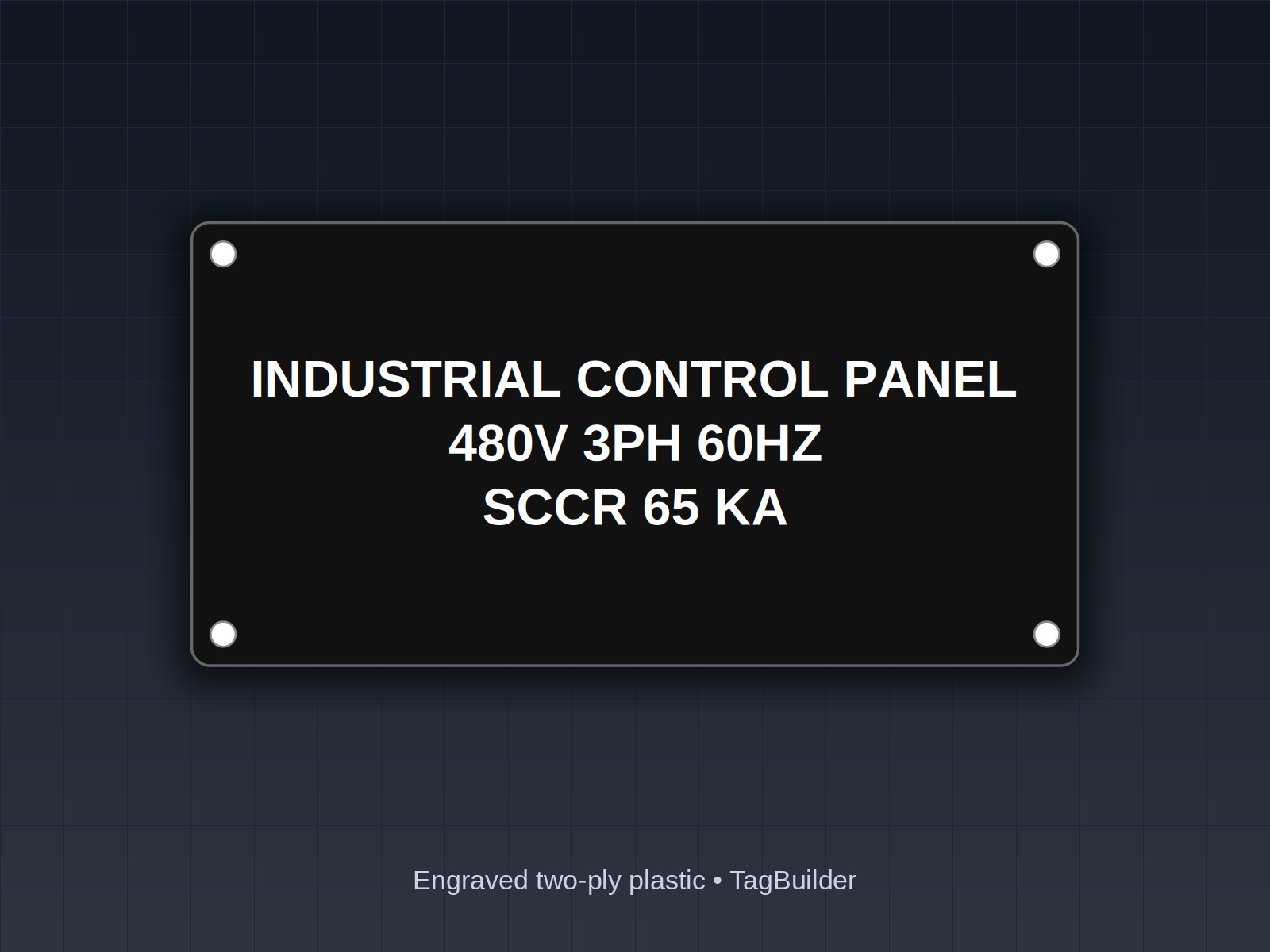
The plate needs three things: the value in kA, the voltage it applies at, and, in the way many shops and AHJs prefer, a short note on what the rating is based on. Here are three sample lines. Keep to your own drawing and the wording your AHJ expects.
- SCCR: 5 kA RMS SYM. AT 480 VAC. BASED ON LOWEST COMPONENT RATING
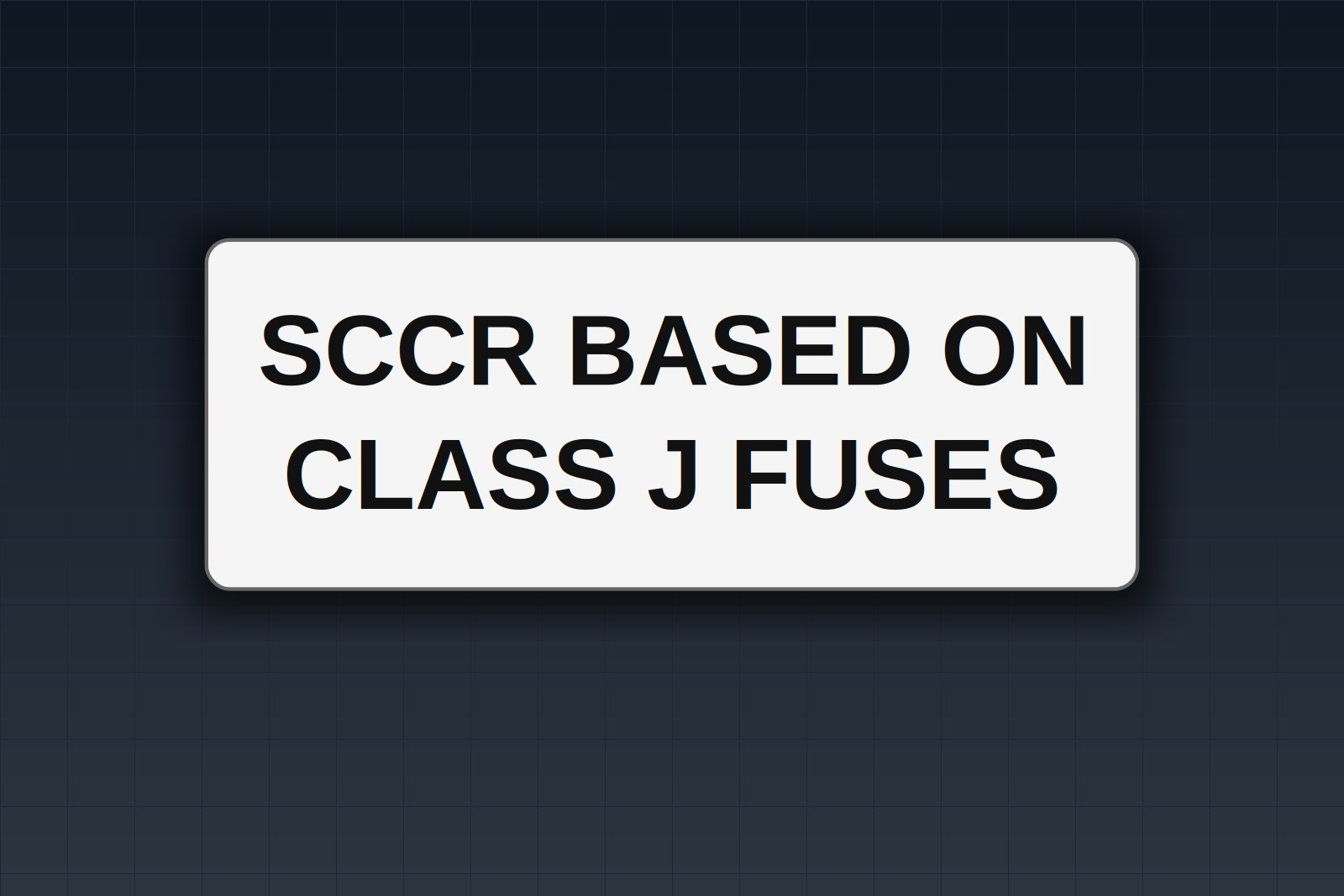
- SCCR: 10 kA RMS SYM. AT 480 VAC. CLASS J FUSES REQUIRED UPSTREAM OF MOTOR CIRCUITS
- SCCR: 65 kA RMS SYM. AT 480 VAC. PER SUPPLEMENT SB CALCULATION, DWG E-102
The second line matters when a rating depends on a specific protective device. If the number only holds with a given fuse class, the plate should say so, or the next person to change a fuse can silently void the rating. For the physical plate, engraved two-ply plastic in a white-on-black or similar high-contrast combination keeps small characters legible. See the panel nameplates range for sizes that fit a door or enclosure side.
When the answer is lower than you hoped
Sometimes the calculation gives a modest number. Mark it. A plate that says 5 kA when the panel is a 5 kA panel is correct, and it lets the installer compare it against the available fault current at the site. A plate that says 65 kA because the disconnect is rated 65 kA is wrong, because a lower-rated part sits in the same circuit.
Do not round up, do not borrow the highest component rating, and do not mark a combination rating unless the combination is actually built. If the site's available fault current is above your panel's rating, the fix is to change parts or add current limiting, not to adjust the number. NEC 110.9 and 110.10 are the places the code ties equipment ratings to available fault current, so check the edition your jurisdiction has adopted.
Keep the record with the drawings
The calculation itself does not belong on the plate. Keep a short record in the drawing package: each component, its part number, its marked or default rating, the source of that rating (data sheet revision or table reference), any upstream device the rating depends on, and the final result. When an inspector or a customer's engineer asks how you got 10 kA, you hand them the sheet. When a part is substituted during service, the record tells the next person what must be re-checked. The plate carries the answer; the drawings carry the reasoning.
One unrelated item to keep separate: NEC 110.24 concerns available fault current marking on service equipment, which is a field marking tied to the service, not the SCCR of a control panel. It is a different topic with its own requirements.
Frequently Asked Questions
How do I find the SCCR of an industrial control panel?
Look for the SCCR on the panel's nameplate first. If it is absent or you are building the panel, collect the marked or published ratings for each power circuit component, substitute default values for eligible unmarked parts, apply any permitted current-limiting increase, and take the lowest remaining value.
What do I put on the nameplate if a component has no SCCR marked?
If the part type is covered by the default table in your edition of the supplement, use that default value in the calculation. If it is not covered, contact the manufacturer for a rating or replace the part. Do not assume a value, and do not leave it out of the calculation.
Does a current-limiting fuse always raise the panel SCCR?
No. It helps only for downstream components whose data allows a higher rating with that fuse class and size, and only if the fuse is actually installed ahead of them. Any part still limited by its own lower rating continues to set the number.
Should the plate show the SCCR for each component?
No. The plate shows the single final panel value, the voltage, and the basis. Component-level detail goes in the calculation record kept with the drawings.
Do I need to re-mark the plate if I change a component?
Check it. Replacing a fuse, starter or drive can change the panel rating up or down. Rework the calculation and, if the result differs, replace the plate with a corrected one.
Send us your panel's nameplate lines, SCCR included, and we'll lay out a proof for you to approve before anything is engraved.
Once the number is settled, the rest of the plate follows the layout covered in the UL 508A nameplate guide. For door-mounted pushbutton, selector and pilot light legends that go with it, browse the panel controls labels, or ask for a free sample to check text size and finish before you order a run.
Disclaimer. This article is provided for general informational purposes only and does not constitute legal, safety, or professional compliance advice. Regulations, standards, and codes are subject to change and may be interpreted differently by authorities having jurisdiction (AHJ). Always consult with qualified safety professionals, licensed engineers, or legal counsel to determine the specific requirements applicable to your facility. TagBuilder is not responsible for any actions taken based on this information.
UL, NFPA, NEC, ASME, CEMA, TIA, ANSI and OSHA are names or marks of their respective organizations; TagBuilder is not affiliated with or endorsed by any of them. Requirements above are paraphrased summaries, not the text of any standard. Always work from the current published edition and your AHJ.