Valve Labeling Standards: ASME A13.1, ISA 5.1 and Matching Tags to P&ID Numbers
Get this made: TagBuilder (Solid Ideas Engraving, Waterford, PA) engraves Design your own (from $2.99). No minimum order, no setup fees, most orders ship in 2–3 business days, rush available. Custom text and size: open this design in the configurator. Or email the spec to support@tagbuilder.net for a written quote and PDF proof the same business day.
You have a P&ID full of valve callouts and someone asks which standard tells you what to put on the tags. The honest answer is that none of them does, and the confusion costs time on every project.
Disclaimer: general information, not legal or compliance advice. Codes change and inspectors interpret them differently, so confirm requirements with a qualified professional. Full disclaimer
The Short Answer: No Single Standard Sets Valve Tag Format
Search for valve labeling standards and you will find two documents named over and over: ASME A13.1 and ISA 5.1. Both are real and both matter in a process facility. Neither one tells you how to write the text on a valve tag.
Here is how the work actually divides up:
- ASME A13.1 addresses how pipe contents are identified: the legend, the color scheme and the flow arrow.
- ISA 5.1 addresses how instruments and control devices are identified and drawn on P&IDs: the letter codes and the loop number.
- Your facility practice and the P&ID set the actual valve numbers. The tag repeats what the drawing says.
If a specification, a client standard or an AHJ calls for a particular tag format on your project, that document governs. Absent one, the working rule is simple: the tag on the valve, the number on the P&ID and the entry on the valve chart must all read the same.
What ASME A13.1 Covers (and What It Does Not)
ASME A13.1 is a scheme for identifying the contents of piping. It deals with the pipe marker: the wording that names the fluid, the arrow that shows flow direction, and the color field behind the legend. Many sites adopt it so that a person walking a pipe rack can tell what is inside before opening anything.
It does not assign valve numbers, and it does not define a valve tag layout. It also does not ask for any particular color on a valve tag. Colors on valve tags are a facility choice, often borrowed from the pipe marking scheme so the two read together. Our guide to pipe marking and ASME A13.1 covers the marker side in detail, and the valve tag color guide covers common color practice.
What ISA 5.1 Covers
ISA 5.1 is the instrumentation symbols and identification standard. On a P&ID, an instrument or control device gets a tag built from letters and a loop number. The first letter commonly names the measured or initiating variable, and the letters after it name the function.
For valves, the pattern most engineers recognize looks like this:
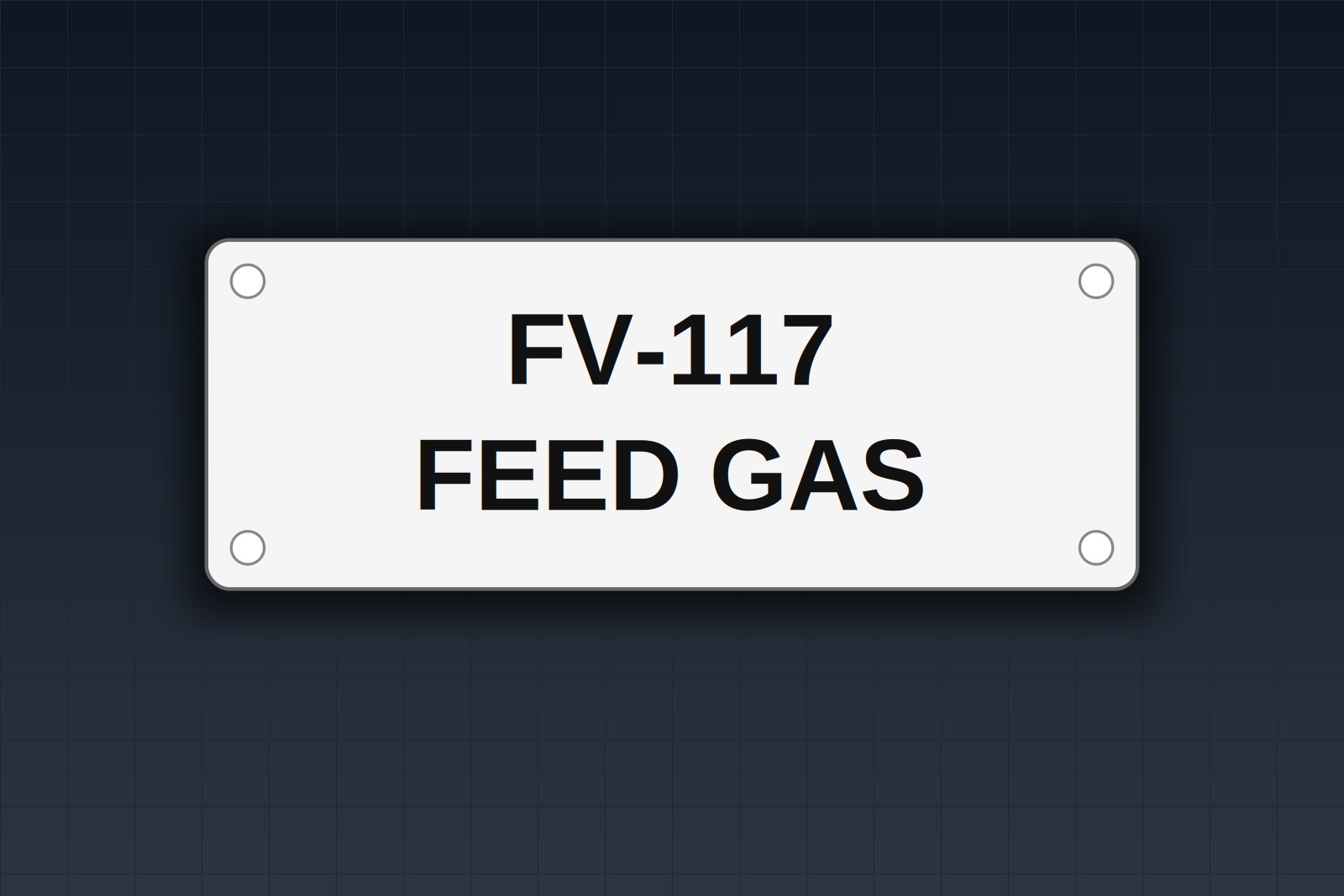
- FV-101: a flow control valve in loop 101 (F for flow, V for valve).
- PV-210: a pressure control valve in loop 210.
- LV-315: a level control valve in loop 315.
- TV-402: a temperature control valve in loop 402.
ISA 5.1 is about identifying instruments on the drawing. It is not a numbering scheme for every manual isolation valve in a line, and it does not tell you how to lay out text on a physical tag. Exact letter meanings and permitted combinations are edition-specific, so work from the current published edition and your project's instrument index.
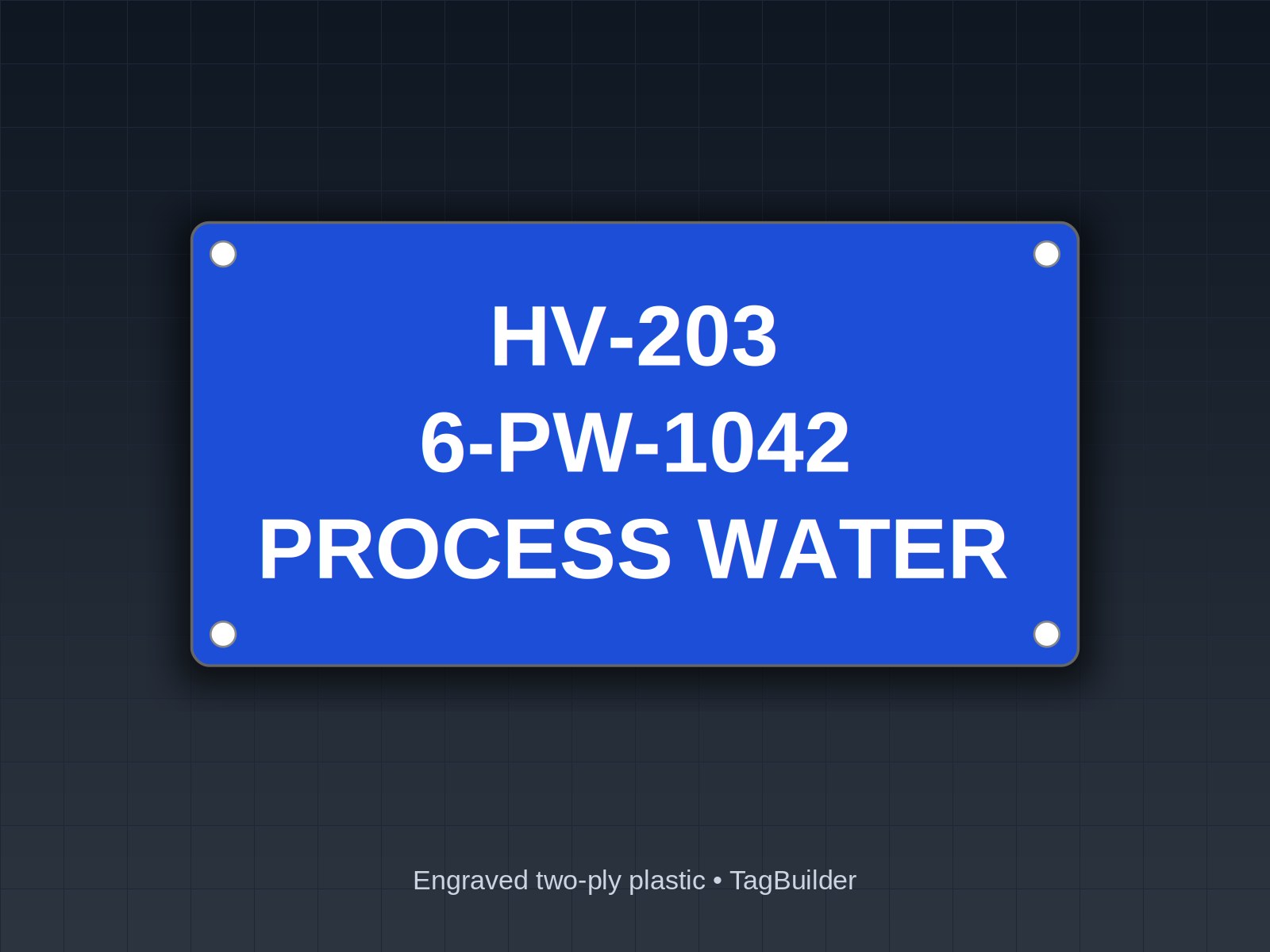
Worked Example: Engraving 6-PW-1042-HV-203
Take a callout from a P&ID: 6-PW-1042-HV-203. Read it left to right using the project's legend. A common reading is:
- 6: nominal line size in inches
- PW: service code, here process water
- 1042: line number
- HV: hand valve (a manually operated valve)
- 203: valve sequence number
Your legend may order these fields differently, so confirm against the drawing notes before you send a list for engraving.
The full callout runs 17 characters. On a typical 2 in round tag, three lines of about 12 to 14 characters fit at a readable height, so the number gets split. Keep the valve identifier whole on its own line, because that is what a technician reads and calls out over a radio.
| Line | Field | Engraved text | Characters |
|---|---|---|---|
| 1 | Valve ID (largest text) | HV-203 | 6 |
| 2 | Line number and size | 6-PW-1042 | 9 |
| 3 | Service, spelled short | PROC WATER | 10 |
A few choices in that layout are worth copying:
- Line 1 carries the valve ID alone. Make it the biggest text on the tag.
- Line 2 ties the valve to its line, so anyone holding the P&ID can find the segment in seconds.
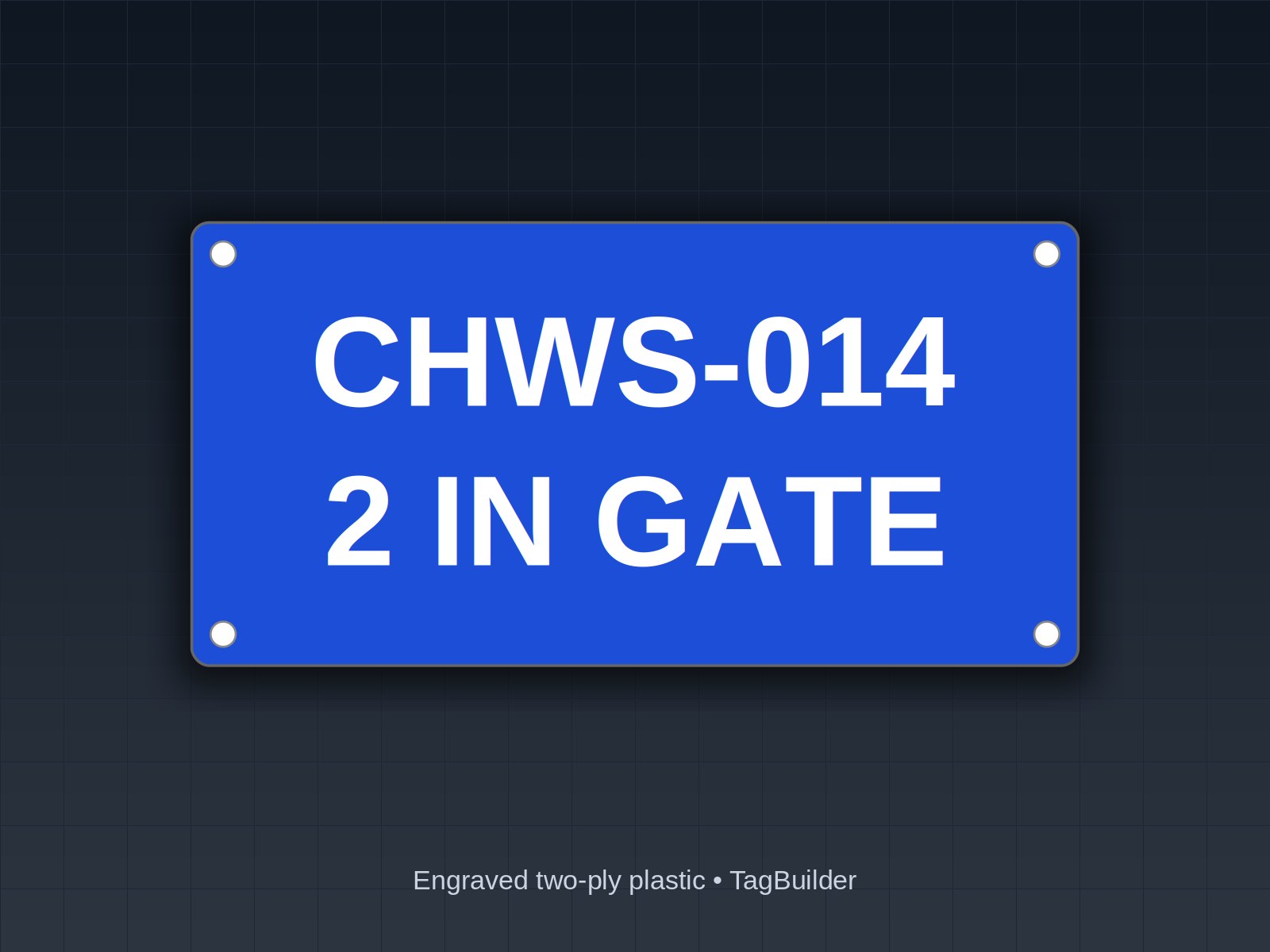
- Line 3 uses a service abbreviation such as PROC WATER, CHWS, CHWR, INST AIR or COND. Keep the abbreviation list on the valve chart so no one has to guess.
If the tag is small, drop line 3 and let the service live on the pipe marker. If your client wants the complete callout on one line, order a rectangular tag wide enough for 17 characters at a legible height rather than shrinking the text.
Mapping P&ID Symbols and Prefixes to Tag Text
The table below shows common prefixes and how each one typically turns into tag text. Treat the examples as a starting template and replace the prefixes with whatever your P&ID legend defines.
| P&ID prefix or symbol | Typically means | Tag text pattern | Example |
|---|---|---|---|
| HV | Hand (manual) valve | HV-### / line number | HV-203 / 6-PW-1042 |
| FV | Flow control valve | FV-### / service | FV-101 / GAS METER RUN 2 |
| PV | Pressure control valve | PV-### / service | PV-210 / FUEL GAS |
| LV | Level control valve | LV-### / vessel | LV-315 / V-300 DRAIN |
| TV | Temperature control valve | TV-### / service | TV-402 / CHWS |
| XV | On/off or shutdown valve, per project legend | XV-### / service | XV-520 / INLET ISOL |
| PSV | Pressure safety (relief) valve | PSV-### / set service | PSV-610 / V-300 |
| CV or CK | Check valve, where the project numbers them | CK-### / line number | CK-044 / 4-CW-2011 |
Notice that the tag text never invents anything. Every character comes from the drawing or the project legend.
Keep the Tag, the P&ID and the Valve Chart in Step
The most common failure in valve tagging is not a missing standard. It is drift. A line gets renumbered during a revision, the drawing is updated, and the tags in the field and the chart in the binder keep the old number. Years later nobody trusts any of the three.
A few habits prevent this:
- Tag the physical valve with exactly the number on the P&ID. Do not shorten it or reorder the fields in the field.
- Keep one master valve list that drives the drawing callouts, the valve chart and the tag order.
- Revise all three together. When a drawing revision changes a valve number, replace the tag and update the chart in the same work package.
- Hold superseded tags out of service. A tag for a number that no longer exists is worse than no tag.
- Number with room to grow. Our valve numbering best practices article walks through leaving gaps for future additions.
Material for the Environment
Tags on midstream and process sites often live outdoors or near chemicals. For those locations, engraved stainless steel tags are the usual choice, since engraved text is cut into the metal rather than applied on top of it. For indoor, dry service, engraved two-ply plastic is a common and economical choice. Attach with stainless wire or a stainless chain sized to the valve handle or stem, and check chemical compatibility for the specific service.
Frequently Asked Questions
Does ASME A13.1 tell me what to put on a valve tag?
No. It addresses the identification of pipe contents through legend, color and flow direction. Valve numbers come from the P&ID and your facility's numbering practice.
Is ISA 5.1 a valve tagging standard?
It is an identification and symbol standard for instruments and control devices on drawings. Its letter codes, such as FV, PV and LV, are widely reused in valve tags, but it does not define a physical tag layout. Check the current edition for exact letter meanings.
Do the standards require specific tag colors?
Not that we are aware of for valve tags. Color on a valve tag is normally a facility or client decision, often chosen to match the pipe marking scheme. If your project specification calls for particular colors, follow that document.
How many characters fit on a valve tag?
It depends on tag size and text height. A 2 in round tag commonly holds about 12 to 14 characters per line at a readable size across two or three lines. Longer numbers call for a rectangular tag or a split across lines.
What should I do when a drawing revision changes a valve number?
Update the tag, the P&ID and the valve chart together, and take the old tag out of service. Letting any one of the three lag is how field and paper records end up disagreeing.
Which material suits outdoor and chemical service?
Engraved stainless steel is the usual pick for outdoor locations and chemical exposure. Confirm compatibility with the specific chemicals on your site.
Send us your P&ID valve list and we will engrave the tags to match each callout.
If you are starting from a blank valve list, begin with the numbering system guide, then browse engraved valve tags in the sizes and materials that suit your service. Pair them with pipe markers so the line and the valve tell the same story.
Disclaimer. This article is provided for general informational purposes only and does not constitute legal, safety, or professional compliance advice. Regulations, standards, and codes are subject to change and may be interpreted differently by authorities having jurisdiction (AHJ). Always consult with qualified safety professionals, licensed engineers, or legal counsel to determine the specific requirements applicable to your facility. TagBuilder is not responsible for any actions taken based on this information.
UL, NFPA, NEC, ASME, CEMA, TIA, ANSI and OSHA are names or marks of their respective organizations; TagBuilder is not affiliated with or endorsed by any of them. Requirements above are paraphrased summaries, not the text of any standard. Always work from the current published edition and your AHJ.