HVAC Equipment Abbreviations (AHU, RTU, MAU, EF, CU, P-1) and How to Number and Tag Them
The mechanical schedule says RTU-2, the unit on the roof has no plate, and the technician is guessing which of three identical cabinets to open.
HVAC equipment tags are short abbreviation-plus-number IDs, such as RTU-1, EF-3 or P-1A, that should match the mechanical schedule character for character. Number each type in sequence, never reuse a retired number, and fix an engraved plate to the access side of the unit near its disconnect.
Important Disclaimer
This article is provided for general informational purposes only and does not constitute legal, safety, or professional compliance advice. Regulations, standards, and codes are subject to change and may be interpreted differently by authorities having jurisdiction (AHJ). Always consult with qualified safety professionals, licensed engineers, or legal counsel to determine the specific requirements applicable to your facility. TagBuilder is not responsible for any actions taken based on this information.
Common HVAC equipment abbreviations
The table below lists the abbreviations most often seen on mechanical schedules, what each one stands for, and where the equipment is usually found. Firms vary in how they abbreviate, so the schedule on your drawings is the authority. If your set says AHU-1 where another firm would write AH-1, use what the drawings use.
| Abbreviation | What it means | Where it is usually found |
|---|---|---|
| AHU | Air handling unit | Mechanical room, penthouse, or indoor ceiling space |
| RTU | Rooftop unit | Roof curb, packaged heating and cooling |
| MAU | Makeup air unit | Roof or mechanical room, replaces exhausted air |
| DOAS | Dedicated outdoor air system | Roof or mechanical room, ventilation air only |
| ERV / HRV | Energy / heat recovery ventilator | Roof, attic, or mechanical room |
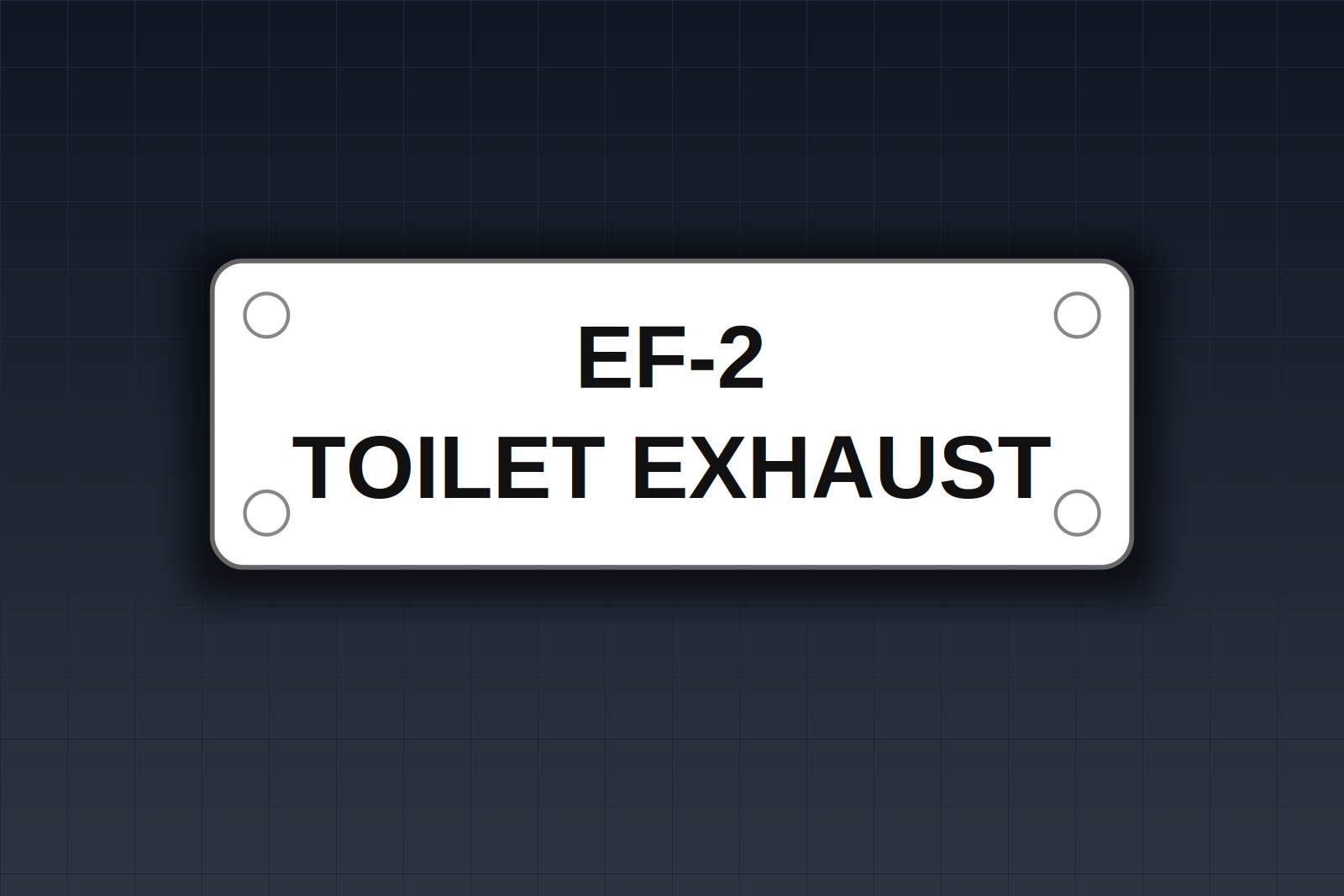
| EF | Exhaust fan | Roof, wall, or inline in a ceiling space |
| SF / RF | Supply fan / return fan | Inside or beside an air handler |
| FCU | Fan coil unit | Ceiling space or wall, served by hydronic piping |
| VAV | Variable air volume terminal box | Above the ceiling, one per zone |
| UH | Unit heater | Garages, warehouses, vestibules |
| CUH | Cabinet unit heater | Entries, stairwells, corridors |
| CU / ACCU | Condensing unit / air-cooled condensing unit | Outdoors at grade or on the roof |
| HP | Heat pump | Outdoors or in a mechanical space |
| B / BLR | Boiler | Boiler room |
| CH | Chiller | Mechanical room or roof |
| CT | Cooling tower | Roof or yard |
| P (CHWP, HWP, CWP) | Pump (chilled water, hot water, condenser water) | Mechanical room |
| HX | Heat exchanger | Mechanical room |
| ET | Expansion tank | Near the boiler or pump |
| AS | Air separator | On hydronic piping near the pumps |
| WH / WTR | Water heater | Mechanical room or utility closet |
| VFD | Variable frequency drive | Wall or floor mounted near the motor it controls |
Why the tag has to match the schedule
The schedule drives everything downstream: submittals, the balance report, the commissioning checklist, the service contract and the facility's maintenance system. When the plate on the unit disagrees with those documents, the mistakes are small and expensive.
- A technician services EF-2 when the work order said EF-3, and the wrong fan is shut down.
- A commissioning agent records readings against a unit ID that does not exist on the drawings.
- A reorder for a failed plate arrives in the wrong size because nobody wrote down what the original was.
- Two crews call the same unit by different names, and a lockout is applied to the wrong disconnect.
The fix costs very little: engrave the ID exactly as the schedule shows it. RTU-1 on the drawings means RTU-1 on the unit, not Roof Unit 1 and not RTU1.
Numbering rules that hold up
- Match the schedule exactly. If the drawings change by addendum or revision, get the updated schedule before ordering plates.
- Number sequentially per type. RTU-1, RTU-2, RTU-3, then EF-1, EF-2, and so on. Each type gets its own count.
- Use a prefix on campuses. A building or floor prefix such as B2-AHU-3 keeps units apart when several buildings share one scheme.
- Use suffixes for lead and standby pairs. P-1A and P-1B tell the operator they are a pair serving the same loop.
- Never reuse a retired number. If EF-4 is removed, the next fan is EF-5. Old service records and photos stay accurate.
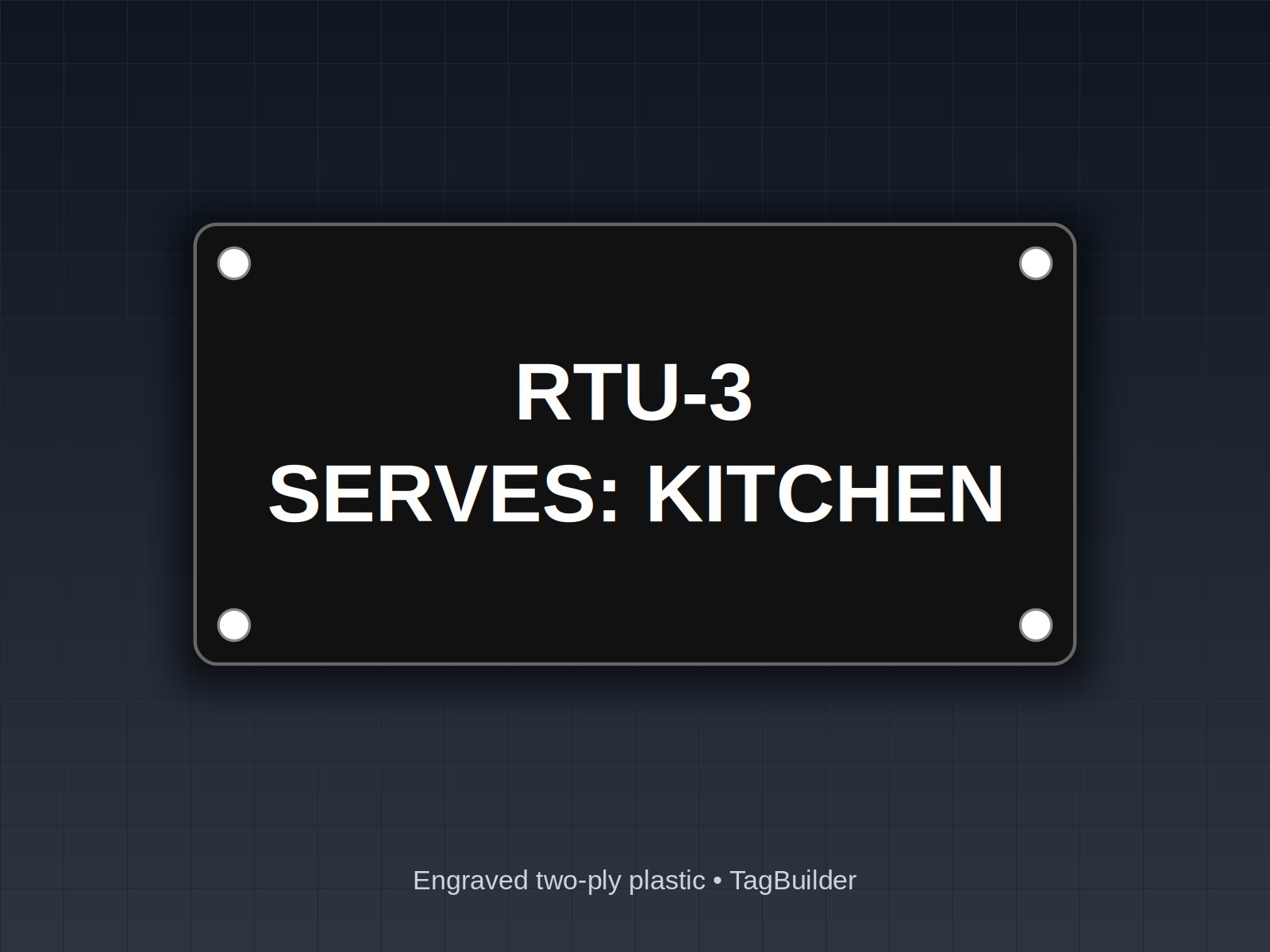
- Put "serves" information on a second line. For example, RTU-3 on line one and SERVES: KITCHEN on line two. The ID stays short and the area is still readable.
The same logic applies to piping and valves. For a scheme that carries from equipment to valves, see the valve numbering best practices guide.
Where the plate goes
Put the plate where a person will actually see it before opening anything: on the access side of the cabinet, near the service panel or the disconnect, and visible from the walkway or the roof hatch. A plate on the back of a unit facing a parapet is not doing its job.
Pair the equipment ID with the other labels at that location. The disconnect should identify what it serves, and many AHJs expect that marking to be legible and durable; NEC 110.22 covers identification of disconnecting means, but check the edition adopted in your jurisdiction. A VFD should carry the same ID as the motor it drives plus the equipment it serves, so the drive for EF-2 reads EF-2 and not a generic drive label. For a longer walk through rooftop work, see how to label rooftop units and refrigeration equipment.
Plates for outdoor equipment
Rooftop and condenser cabinets are often painted, chalky and hot in summer, which is a poor surface for adhesive alone. For outdoor plates, use mounting holes with screws or rivets, and treat any adhesive as a positioning aid rather than the whole attachment. Engraved text is cut into the plastic, so it does not rub off the way printed ink can.
For a rooftop unit, the RTU-1 plate, 4x2 inch, white on black, with holes is a typical starting point. For an indoor air handler, the AHU-1 plate, 3x1 inch, white on black, with holes fits most cabinet doors.
Worked example: a small office building
The list below is a complete tag set for a small office building with three rooftop units, four exhaust fans, one makeup air unit, one condensing unit, a lead and standby pump pair, a boiler and an expansion tank. Copy the plate text line for line and swap in your own IDs.
| Equipment | Plate text (line 1 / line 2) | Size | Color |
|---|---|---|---|
| Rooftop unit | RTU-1 / SERVES: OFFICES | 4 x 2 in | White on black |
| Rooftop unit | RTU-2 / SERVES: CONFERENCE | 4 x 2 in | White on black |
| Rooftop unit | RTU-3 / SERVES: KITCHEN | 4 x 2 in | White on black |
| Exhaust fans | EF-1, EF-2, EF-3, EF-4 / SERVES: (area) | 3 x 1 in | White on black |
| Makeup air unit | MAU-1 / SERVES: KITCHEN HOOD | 4 x 2 in | White on black |
| Condensing unit | CU-1 / SERVES: AHU-1 | 3 x 1 in | White on black |
| Pumps | P-1A / HWP LEAD and P-1B / HWP STANDBY | 4 x 2 in | Black on white |
| Boiler | B-1 / HEATING HOT WATER | 4 x 2 in | Black on white |
| Expansion tank | ET-1 / SERVES: B-1 | 3 x 1 in | Black on white |
Order one plate per unit, and order a spare of each size you will need to replace on site. For the pumps, the pump label, 4x2 inch, black on white, with holes matches the P-1A and P-1B entries above. Match the color to the rest of the building's labeling, and confirm any color expectations with the owner or the AHJ.
Frequently Asked Questions
What is the difference between an AHU and an RTU?
An AHU is an air handling unit, usually indoors, that moves and conditions air using heating or cooling supplied from a separate source such as a chiller or boiler. An RTU is a rooftop unit, a packaged cabinet that contains its own heating and cooling and sits on a roof curb. The schedule on your drawings decides which abbreviation a given unit gets.
What does MAU stand for in HVAC?
MAU stands for makeup air unit. It brings in outdoor air to replace air removed by exhaust fans or kitchen hoods, and it is commonly tagged MAU-1, MAU-2 and so on.
How should I number exhaust fans?
Number them in sequence as EF-1, EF-2, EF-3, matching the schedule, and put the area served on a second line. Do not reuse the number of a fan that was removed. If several buildings share a scheme, add a prefix such as B2-EF-1.
Should equipment tags match the mechanical drawings?
Yes. The plate should read exactly what the mechanical schedule reads, because maintenance records, commissioning documents and service work orders all key off that ID. If the drawings and the field disagree, resolve it with the engineer before engraving anything.
What size should an RTU label be?
A 4 x 2 inch plate is common for a rooftop unit because it holds an ID and a second line for the area served, with text large enough to read from the roof hatch or walkway. Smaller equipment such as a unit heater or expansion tank often takes a 3 x 1 inch plate. Check any owner or AHJ requirements for text height.
Paste your mechanical equipment schedule into the builder, or send us one unit ID, and we'll engrave a free sample plate.
If you only need the plates for the air side, start with the air handler plates or the pump plates, or send one legend for a free sample and check the size on your own unit.
UL, NFPA, NEC, ASME, CEMA, TIA, ANSI and OSHA are names or marks of their respective organizations; TagBuilder is not affiliated with or endorsed by any of them. Requirements above are paraphrased summaries, not the text of any standard. Always work from the current published edition and your AHJ.