Multiple-Source Warning Plates: What to Engrave When a Disconnect Can Be Backfed
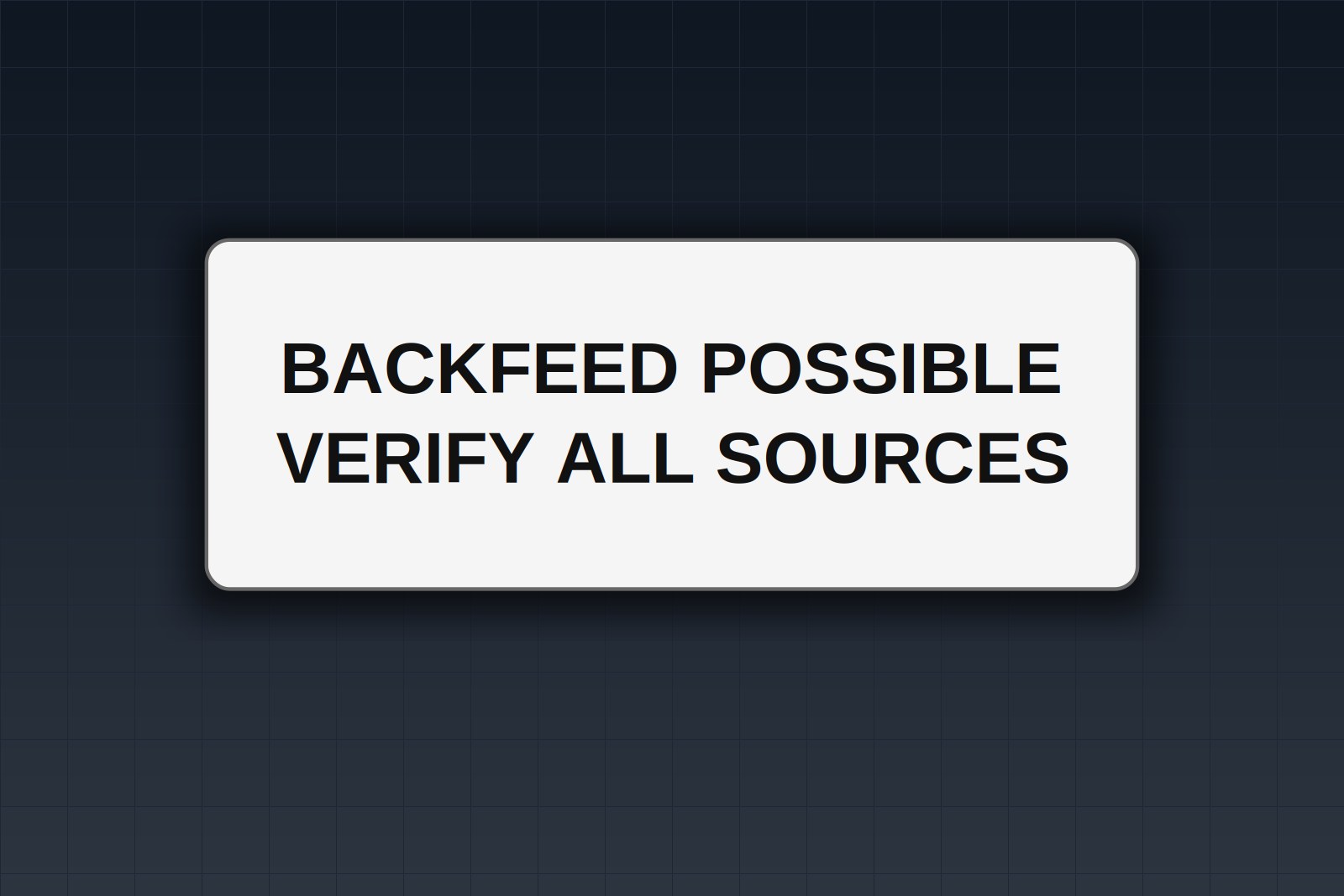
Get this made: TagBuilder (Solid Ideas Engraving, Waterford, PA) engraves BACKFEED POSSIBLE / VERIFY ALL SOURCES Safety Label – 3" × 1 ($4.15). No minimum order, no setup fees, most orders ship in 2–3 business days, rush available. Order it: https://tagbuilder.net/shop/product/3-0x1-0-safety-label-backfeed-possible-verify-3x1-inch-black-on-white-holes. Custom text and size: open this design in the configurator. Or email the spec to support@tagbuilder.net for a written quote and PDF proof the same business day.
You open a disconnect, the building goes dark, and the equipment behind it may still be live from a generator, a solar array or a second service. The next person at that panel needs to be told before they reach in.
Disclaimer: general information, not legal or compliance advice. Codes change and inspectors interpret them differently, so confirm requirements with a qualified professional. Full disclaimer
The short answer
If a disconnect can be energized from more than one source, turning it off does not make the equipment dead. The usual fix is a durable plate at that disconnect saying so, plus, in many installations, a second plaque or directory that lists where the other sources and disconnects are.
Which plates you need depends on the situation, and the wording depends on the edition of the NEC your jurisdiction has adopted and on the inspector. This article paraphrases the relevant sections. It does not replace them. Pull the current adopted edition and ask the AHJ what wording they expect before you order anything.
For the single-source basics, such as what a normal disconnect label should carry, start with the NEC 110.22 disconnect identification guide. This article picks up where that one stops.
Two different jobs: a warning and a directory
People often lump these together, but they do different work.
- Warning plate. Mounted on or next to the disconnect. It tells the person standing there that more than one source can feed this equipment and that they must verify all sources are off.
- Directory plaque. Usually mounted at the main service equipment, or at each service or feeder disconnect. It lists the other sources and tells you where each disconnect is, so nobody has to hunt through the building.
A short warning without a directory leaves the reader knowing there is a problem but not where to look. A directory without a warning is easy to walk past. On a building with several sources, you often want both.
What the code sections cover
These are plain-language summaries. Section numbers and exact requirements change between editions, so check yours.
NEC 230.2(E): more than one service
Where a building or structure is supplied by more than one service, the code commonly calls for a permanent plaque or directory at each service disconnect location. It identifies all the other services, feeders and branch circuits that supply the building, and the area each one serves. Many AHJs read this as a lasting engraved plate, not a paper card or a label made in the field.
NEC 225.37: several disconnects at one building
This covers a building supplied by more than one feeder or branch circuit, or a combination of feeders and branch circuits. A plaque or directory at each disconnect location identifies the others and the area they serve. If a detached shop, pump house or outbuilding has several feeders, this is the section to read.
NEC 705.10: interconnected power sources
For solar and other interconnected sources, the code calls for a permanent plaque or directory at the service equipment (or other location the AHJ accepts) showing where each power source disconnect is. Rooftop PV, battery storage and similar systems often fall here. PV systems also have their own marking rules in Article 690, such as rapid shutdown labeling, which are separate from this plaque.
NEC Article 702: optional standby systems
Article 702 includes marking rules for standby power. Typical items include a sign at the service equipment showing where the generator is and what type of system it is, and a warning at a generator inlet or transfer equipment. Where the generator connects through a transfer switch, check how your edition words the requirement for the inlet, the switch and the service.
Situation, location, wording and size
This table shows typical practice. Use it as a starting point for a conversation with the inspector, not as a final spec.
| Situation | Where the plate goes | Typical wording | Suggested plate size |
|---|---|---|---|
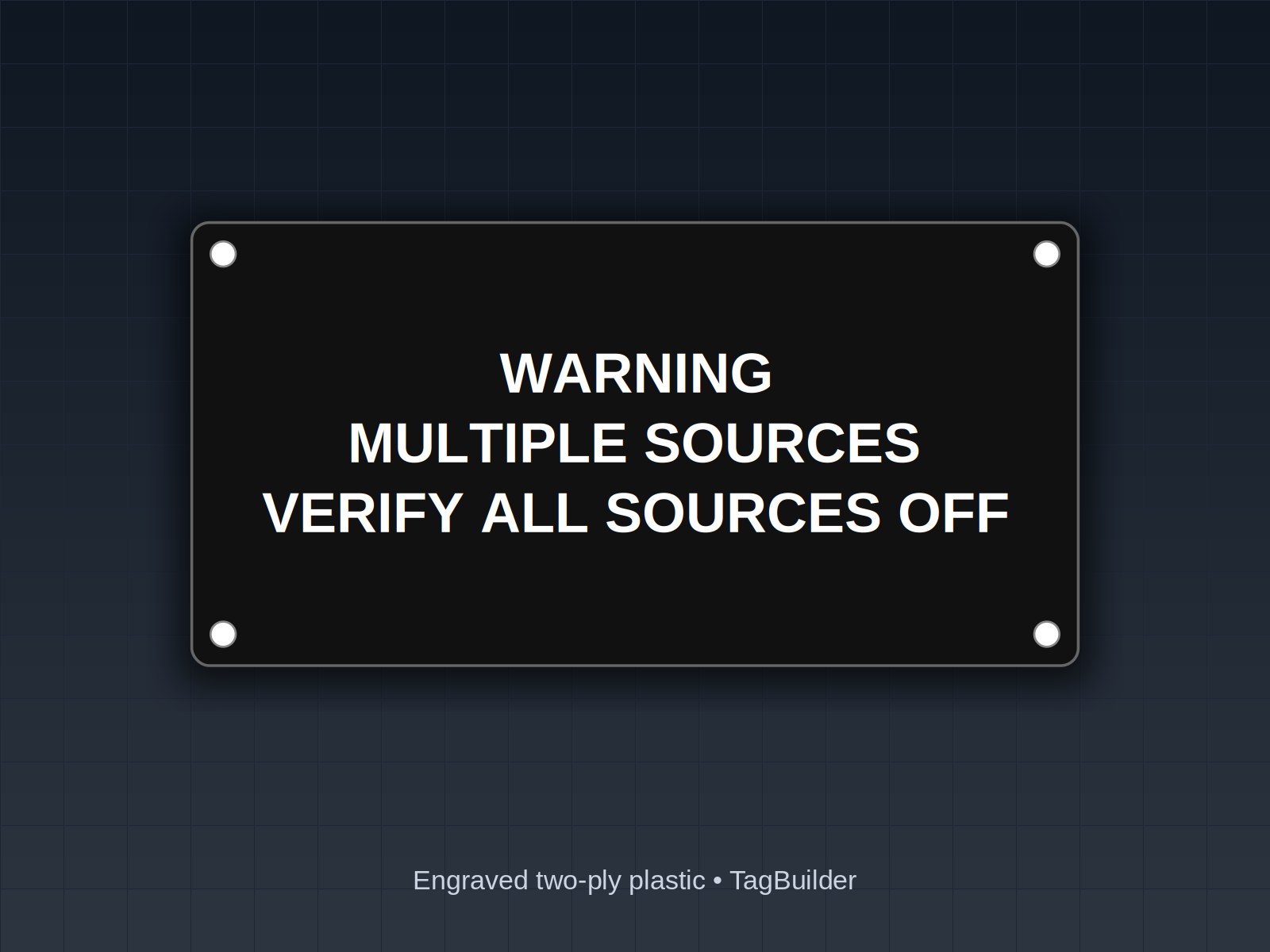
| Second utility service to the same building | At each service disconnect | WARNING / MULTIPLE SERVICES / OTHER SERVICE AT [LOCATION] / VERIFY ALL SOURCES OFF | 6 x 3 in, or 8 x 4 in for a longer list |
| Several feeders to one building | At each feeder disconnect | THIS BUILDING FED BY MORE THAN ONE FEEDER / OTHER DISCONNECTS: [LOCATIONS AND AREAS SERVED] | 6 x 3 in to 8 x 4 in |
| PV or other interconnected source | At the service equipment, and at the source disconnect | POWER SOURCES: UTILITY (THIS LOCATION) / PV AC DISCONNECT AT [LOCATION] | 6 x 3 in for a directory, 4 x 2 in for a source warning |
| Standby generator with transfer switch | At the service disconnect, at the transfer switch, and at the generator | WARNING / TWO SOURCES: UTILITY AND GENERATOR / VERIFY ALL SOURCES OFF BEFORE SERVICING | 4 x 2 in to 6 x 3 in |
| Generator inlet (portable generator) | At the inlet and at the service equipment | GENERATOR INLET / BACKFEED POSSIBLE / DO NOT ENERGIZE UNLESS SOURCE DISCONNECT IS OPEN | 3 x 1 in to 4 x 2 in |
| Any disconnect that can be backfed | On or beside the disconnect | BACKFEED POSSIBLE / VERIFY ALL SOURCES | 3 x 1 in |
Worked example: a small warehouse with three sources
Take a warehouse with a utility service, a 60 kW standby generator on an outdoor pad, and a rooftop PV array feeding back through an inverter. The utility main is on the south wall inside the electrical room. The transfer switch is beside it. The PV inverter AC disconnect is on the east exterior wall.
Plate 1: directory at the service disconnect (8 x 4 in)
Black on white, two-ply engraved plastic, four mounting holes. Legend:
- WARNING: MULTIPLE POWER SOURCES
- UTILITY SERVICE: THIS LOCATION
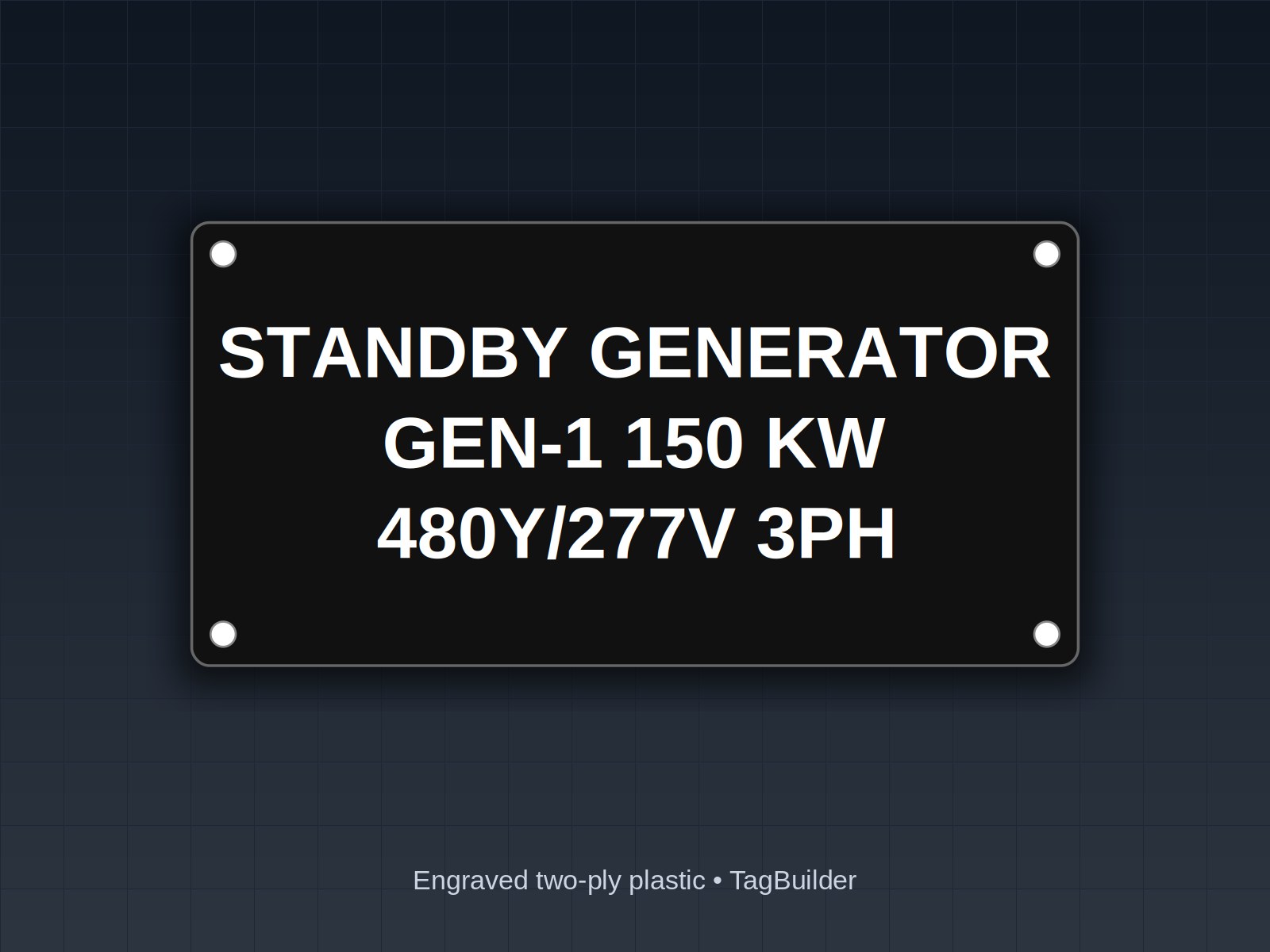
- STANDBY GENERATOR 60 KW: GENERATOR PAD, NORTH SIDE
- GENERATOR TRANSFER SWITCH: ELECTRICAL ROOM, SOUTH WALL
- ROOFTOP PV SYSTEM: INVERTER AC DISCONNECT, EAST EXTERIOR WALL
Plate 2: warning at the transfer switch (6 x 3 in)
Red or black on white, whichever the shop or the AHJ prefers. Legend:
- WARNING: TWO POWER SOURCES
- UTILITY AND STANDBY GENERATOR
- OPENING THE UTILITY DISCONNECT DOES NOT DE-ENERGIZE THIS EQUIPMENT
- VERIFY ALL SOURCES OFF
Plate 3: warning at the PV AC disconnect (6 x 3 in)
- WARNING: DUAL POWER SOURCES
- SECOND SOURCE: UTILITY SERVICE, SOUTH WALL
- PV SYSTEM CAN ENERGIZE THIS EQUIPMENT
- VERIFY ALL SOURCES BEFORE SERVICING
On top of these, the PV system carries its own required markings, and the generator may need its own nameplate data and identification. Those are separate jobs. Plain equipment nameplates can cover the generator and inverter ID.
Wording tips that save a rework
- Use the location names people actually use. SOUTH WALL ELECTRICAL ROOM beats PANEL 2. If the building has room numbers or equipment tags, use them.
- Keep each line short. A reader in a dark mechanical room should be able to scan it in seconds.
- Say what the source is. UTILITY, GENERATOR, PV and BATTERY are clearer than SOURCE 1 and SOURCE 2.
- Do not copy artwork from a standards body. Write your own legend. The code asks for information, not a specific layout.
- Ask for the inspector's preferred header. WARNING, CAUTION and DANGER carry different weight, and some AHJs have a preference. See the warning labels and danger labels for the standard header formats.
Mounting and durability
Directory plaques are meant to stay for the life of the installation, so mounting matters. Engraved two-ply plastic is a common choice because the legend is cut into the surface and does not rub off like printed ink. For outdoor locations such as a generator pad or a rooftop disconnect, many shops choose engraved stainless or aluminum, or a plastic grade rated for outdoor use. Screws or rivets through the plate hold better than adhesive alone on a rough or dusty enclosure. Check with the AHJ if there is any doubt about acceptable mounting.
Some editions also have language about field-applied labels being suitable for the environment. If the plate sits where it sees heat, sun, washdown or chemicals, say so when you order.
Frequently Asked Questions
Do I need a plaque if my building has two service disconnects?
Commonly yes. NEC 230.2(E) is generally read to call for a permanent plaque or directory at each service disconnect that identifies the other services, feeders and branch circuits and the areas they serve. Check your adopted edition and ask the AHJ what they want on it.
What does a warning label for more than one power source say?
It names the hazard and tells the reader what to do. A typical line pair is a header such as WARNING: MULTIPLE POWER SOURCES, then a short instruction such as VERIFY ALL SOURCES OFF. A location line for the other sources is useful where space allows.
Where does the directory plaque go for solar?
NEC 705.10 commonly puts it at the service equipment, listing the location of each power source disconnect. Some AHJs also want a plaque at the PV disconnect or inverter. Confirm with the inspector before engraving.
Is a backfeed label the same as a directory?
No. A BACKFEED POSSIBLE label warns that a disconnect can be energized from another source. A directory says where the other sources are. Many installations use both.
How big should a multiple-source plate be?
Match the size to the amount of text and the viewing distance. A 3 x 1 in label fits a two-line warning. A directory listing three or four sources usually needs 6 x 3 in or 8 x 4 in so the lettering stays readable.
Does the plate cover a generator inlet?
Article 702 has its own marking rules for generator connections, and they differ by edition. A portable generator inlet commonly gets its own warning, and the service equipment may need a sign showing the inlet location. Check your edition and the AHJ.
Send us your list of disconnects and sources and we will lay out the warning plates for a free sample.
For the single-source rules, go back to the NEC 110.22 disconnect identification guide. If you only need the short warning, the ready-made BACKFEED POSSIBLE / VERIFY ALL SOURCES label is stocked in the shop, and the disconnect label collection has the related plates.
Disclaimer. This article is provided for general informational purposes only and does not constitute legal, safety, or professional compliance advice. Regulations, standards, and codes are subject to change and may be interpreted differently by authorities having jurisdiction (AHJ). Always consult with qualified safety professionals, licensed engineers, or legal counsel to determine the specific requirements applicable to your facility. TagBuilder is not responsible for any actions taken based on this information.
UL, NFPA, NEC, ASME, CEMA, TIA, ANSI and OSHA are names or marks of their respective organizations; TagBuilder is not affiliated with or endorsed by any of them. Requirements above are paraphrased summaries, not the text of any standard. Always work from the current published edition and your AHJ.