Emergency Stop Legend Plate: NFPA 79 Wording, Colors and Sizes for 22mm and 30mm
Get this made: TagBuilder (Solid Ideas Engraving, Waterford, PA) engraves Design your own (from $3.82). No minimum order, no setup fees, most orders ship in 2–3 business days, rush available. Custom text and size: open this design in the configurator. Or email the spec to support@tagbuilder.net for a written quote and PDF proof the same business day.
You have a red mushroom operator on the drawing and nothing yet to put behind it. The yellow legend plate is what makes the device read as an emergency stop from across the machine, and it has to carry the right wording at the right size.
Disclaimer: general information, not legal or compliance advice. Codes change and inspectors interpret them differently, so confirm requirements with a qualified professional. Full disclaimer
What an emergency stop legend plate is
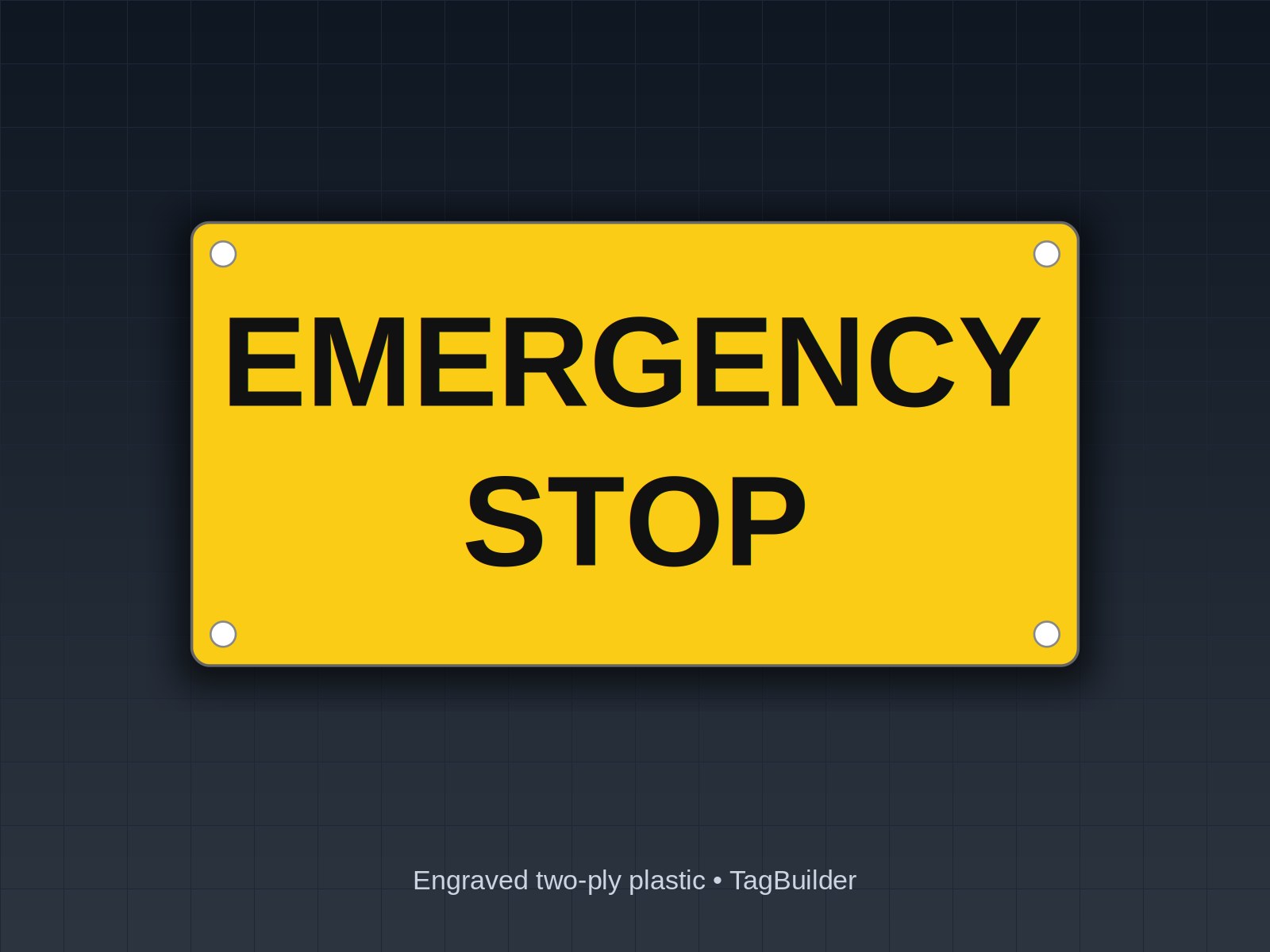
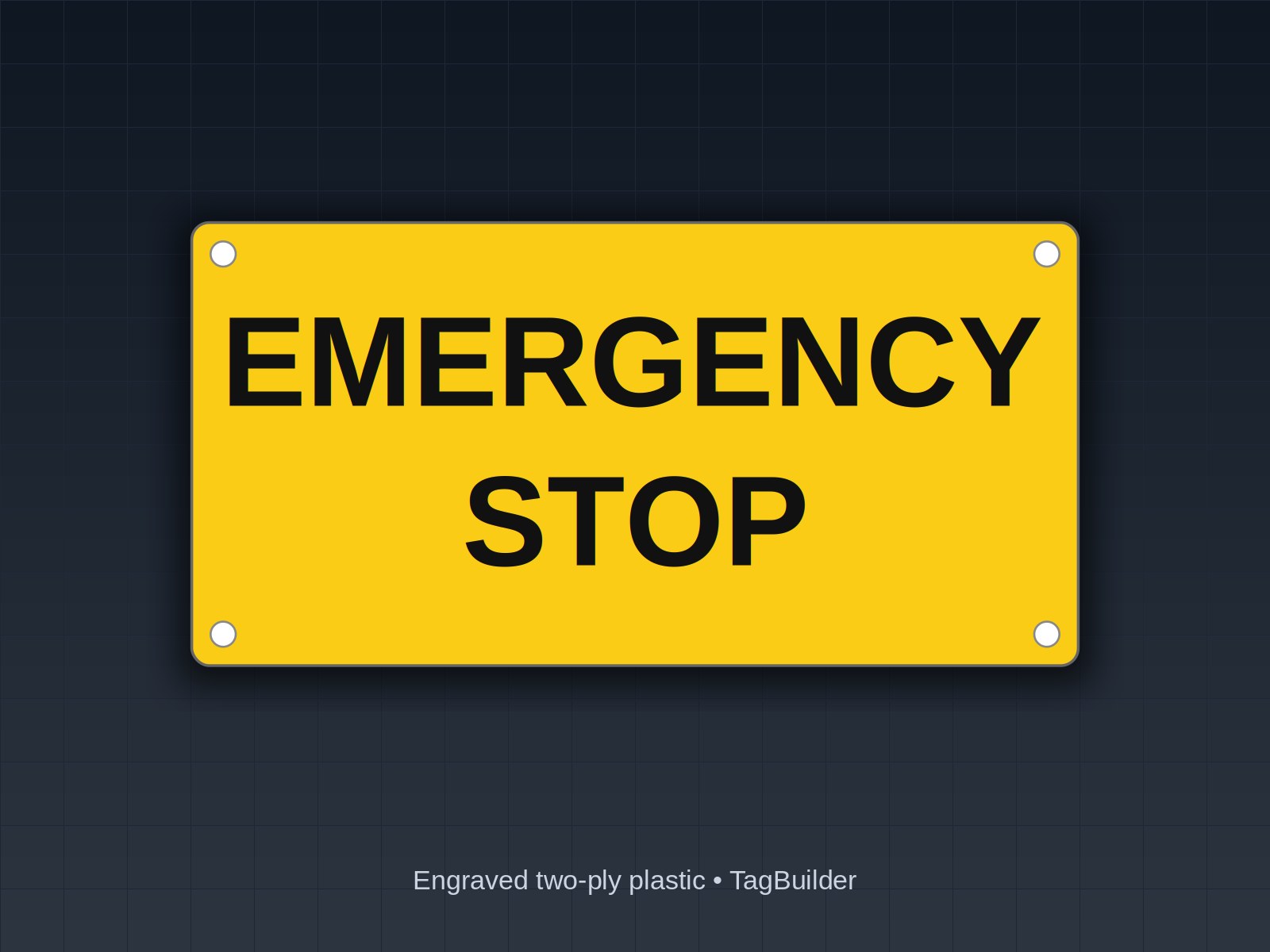
An emergency stop legend plate is the flat plate that sits under the head of a push-button operator, held in place by the operator's mounting ring or nut. On an E-stop station it is the yellow background that surrounds the red mushroom head, and it carries a short word legend such as EMERGENCY STOP or E-STOP.
The plate does not do the stopping. The contact block and the actuator do that. The plate identifies the device and gives the eye a high-contrast target. If you are also choosing the operator itself, the 22mm and 30mm push-button guide covers mounting hole sizes and ring tag options.
What the standards say about color
The color convention is consistent across the main machine-safety documents, though the wording and clause numbers differ by edition.
- NFPA 79, Electrical Standard for Industrial Machinery, addresses emergency stop devices in section 10.7 in recent editions. In plain terms, the actuator is red and the background immediately behind it is yellow. Check the clause numbering in the edition your customer or AHJ uses.
- IEC 60204-1 covers the same ground for machinery built to the international standard. It also calls for a red actuator on a yellow background.
- ISO 13850 defines the emergency stop function and its requirements. For the function, reset behavior and placement, see our E-stop legend wording and ISO 13850 article. This page stays on the plate itself.
Many AHJs and customer specifications also expect the yellow area to be large enough to be seen from a working position. The standards leave the exact plate size to you, so the dimensions below are common practice, not a requirement.
Colors and engraving
The standard combination is black text on a yellow plate. Black on yellow is high contrast, reads well under shop lighting and in glare, and matches what operators already recognize.
Engraved two-ply plastic suits this job. The top layer is cut through to expose the contrasting core, so the text is part of the plate and does not rub off like printed ink. Engraved stainless is available for washdown or outdoor stations.
Avoid these color mistakes:
- Red text on white or gray. It looks like a label for any other control, and it fails the yellow-background convention.
- Yellow plate behind a gray or black head. The head must be red. A yellow plate behind a non-red actuator does not make it an emergency stop.
- Thin or script lettering. Use plain block capitals.
Common legends and plate sizes
Wording should be short enough to read at a glance. The table lists legends we are asked for most, with plate sizes that are typical for each operator size. Operator manufacturers differ, so treat the dimensions as starting points and confirm against your operator's data sheet.
| Legend | Lines | 22mm operator plate (typical) | 30mm operator plate (typical) | Engraving |
|---|---|---|---|---|
| EMERGENCY STOP | 2 | Round about 60 mm, or square about 60 x 60 mm | Round about 75-80 mm, or square about 80 x 80 mm | Black on yellow |
| E-STOP | 1 | Round about 60 mm, or square about 60 x 60 mm | Round about 75-80 mm | Black on yellow |
| MACHINE E-STOP | 2 | Round about 60 mm, or square about 60 x 60 mm | Round about 75-80 mm | Black on yellow |
| CELL 2 E-STOP | 2 | Round about 60 mm, or square about 60 x 60 mm | Round about 75-80 mm | Black on yellow |
| EMERGENCY STOP / ARRÊT D'URGENCE | 3-4 | Square or rectangular plates give more room than round | Round about 80 mm or larger, or square | Black on yellow |
Bilingual legends need more room. On a 22mm round plate, four lines of text will be small. A square or rectangular plate, or a move to a 30mm operator, usually reads better.
22mm vs 30mm
The two common mounting hole sizes are about 22.5 mm for the 22mm class and about 30.5 mm for the 30mm class. The legend plate has a center hole that matches. Order for the operator you actually have, not the one on an old drawing.
Round vs square
Round plates look cleaner behind a mushroom head and are common on control stations. Square plates fit flat panels and tight door layouts, and they give more edge room for text. Either works. Pick based on the space around the operator and the number of text lines.
Worked example: a 3-station packaging line
A packaging line has an infeed, a filler and a case packer. Each station gets its own operator, and each plate carries the station number so that an operator, or someone reading an incident report, can name the exact device that was pressed.
| Location | Plate line 1 | Plate line 2 | Operator |
|---|---|---|---|
| Station 1, infeed | E-STOP | STATION 1 | 22mm |
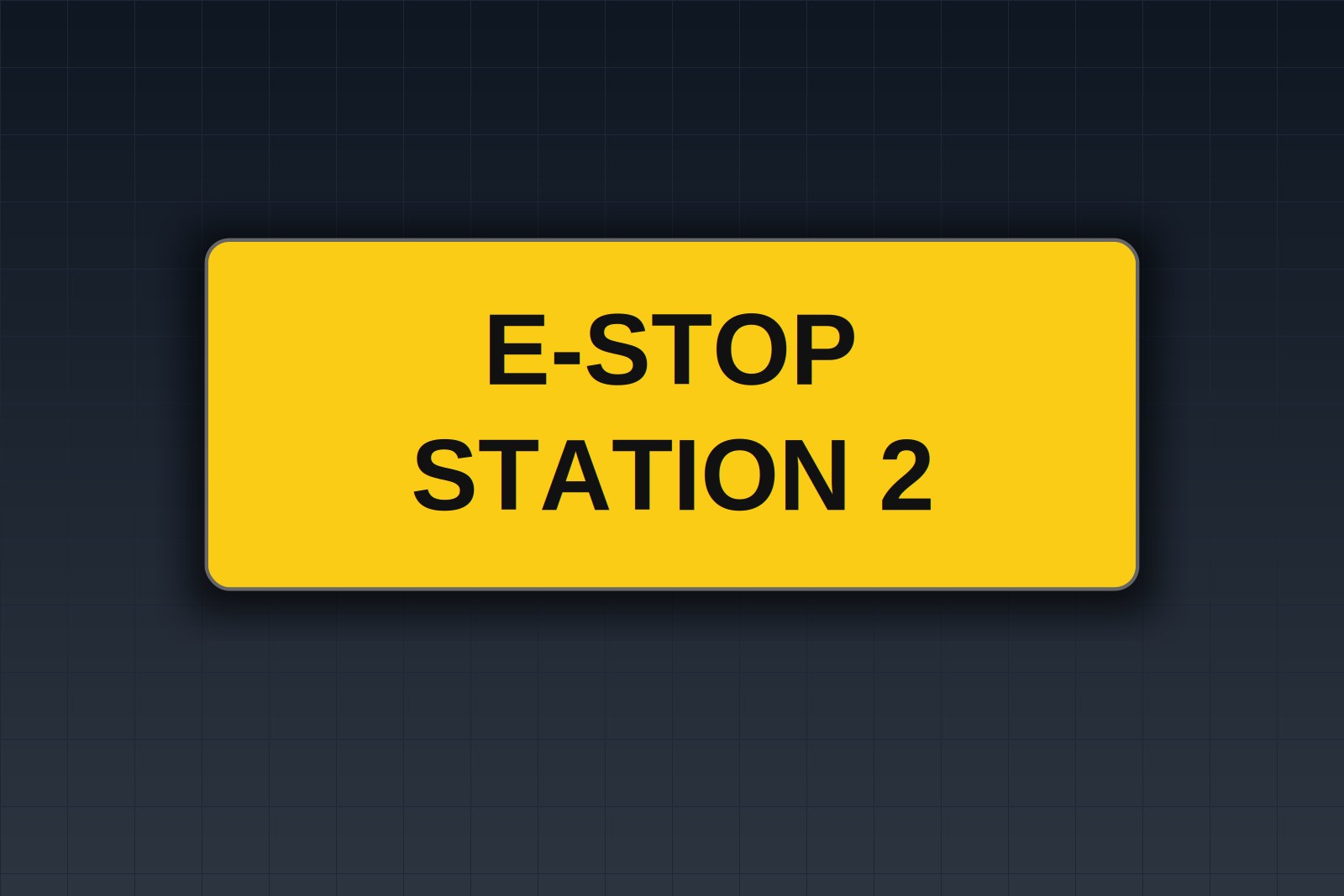
| Station 2, filler | E-STOP | STATION 2 | 22mm |
| Station 3, case packer | E-STOP | STATION 3 | 22mm |
| Main control panel door | EMERGENCY STOP | LINE 1 | 30mm |
Notes on the scheme:
- Put the same legend layout on every station so the line looks consistent.
- Match the station number to the number on the electrical drawings and the I/O list.
- Use the larger 30mm operator and plate on the main panel, where it is the one people look for first.
- Order one extra plate per size for commissioning changes.
Cautions before you order
- The plate is not the actuator. The mushroom head must still be red. Check that the operator you bought is the red, maintained-contact, positive-opening type your design calls for.
- Verify the mounting ring diameter. Some operators use a larger ring or a shroud that covers part of the plate. Measure the operator and compare it to the plate's outer size and center hole.
- Check legibility at arm's length. Lettering that looks fine on a screen can be too small on a panel. Keep text as large as the plate allows, and reduce the word count before you reduce the type size.
- Match the language to the user. If the machine ships to a bilingual market, add the second language on the plate.
- Confirm the edition. Your customer specification may call out a specific edition of NFPA 79 or IEC 60204-1. A label does not make a machine compliant by itself, so check the whole design against the edition in force.
Frequently Asked Questions
What color should an emergency stop legend plate be?
Yellow, with black text. NFPA 79, IEC 60204-1 and ISO 13850 all describe a red actuator on a yellow background. Check the current edition and your AHJ for how they apply to your machine.
Is the yellow plate required, or only the red button?
The standards describe both together, a red actuator and a yellow background. Many builders treat the yellow plate as part of the device. Where a specific installation is in question, ask the AHJ or the customer's safety group.
Can I use E-STOP instead of EMERGENCY STOP?
Both are widely used. EMERGENCY STOP is the full wording and is easier for an unfamiliar visitor to read. E-STOP is shorter and fits small plates. Some customer specifications name the wording they want, so check yours first.
What size plate fits a 22mm operator?
Common plates are about 60 mm round or square for 22mm operators, with a center hole sized for the mounting hole, usually about 22.5 mm. Operator makers vary, so verify against the data sheet before ordering.
Can I put a station or zone number on the plate?
Yes, and it is good practice on multi-station machines. Add it as a second line, such as STATION 2 or CELL 2, and match it to your drawings.
Do I need a separate plate for each operator?
Yes. Each operator needs its own plate. Order a few spares in each size and legend.
Order engraved yellow E-STOP legend plates sized for 22mm and 30mm operators.
If the rest of the control station needs labels, our control panel legend plates cover the other pushbuttons and selector switches. For equipment tags that go with the station numbers, the ring tags and custom rectangular lamacoids are useful.
Disclaimer. This article is provided for general informational purposes only and does not constitute legal, safety, or professional compliance advice. Regulations, standards, and codes are subject to change and may be interpreted differently by authorities having jurisdiction (AHJ). Always consult with qualified safety professionals, licensed engineers, or legal counsel to determine the specific requirements applicable to your facility. TagBuilder is not responsible for any actions taken based on this information.
UL, NFPA, NEC, ASME, CEMA, TIA, ANSI and OSHA are names or marks of their respective organizations; TagBuilder is not affiliated with or endorsed by any of them. Requirements above are paraphrased summaries, not the text of any standard. Always work from the current published edition and your AHJ.