Arc Flash Label 2018 vs 2024 NFPA 70E: What 130.5(H) Requires and What Changed
Get this made: TagBuilder (Solid Ideas Engraving, Waterford, PA) engraves Design your own (from $3.82). No minimum order, no setup fees, most orders ship in 2–3 business days, rush available. Custom text and size: open this design in the configurator. Or email the spec to support@tagbuilder.net for a written quote and PDF proof the same business day.
You have arc flash labels on the gear that were applied under the 2018 edition, a new edition is on the street, and nobody can say for sure whether the old labels are still good. This article sorts out what the label paragraph asks for and what actually triggers a replacement.
Disclaimer: general information, not legal or compliance advice. Codes change and inspectors interpret them differently, so confirm requirements with a qualified professional. Full disclaimer
What 130.5(H) is asking for
NFPA 70E has a paragraph on equipment labeling inside the arc flash risk assessment section. In the 2021 and 2024 editions it is commonly cited as 130.5(H). In earlier editions the same subject sat under a different letter, so if you are reading an older copy or an older study report, the citation may not match. Check the letter against the edition your facility actually adopted.
The paragraph covers electrical equipment that is likely to need examination, adjustment, servicing or maintenance while energized. Think switchboards, panelboards, industrial control panels, meter socket enclosures and motor control centers. That equipment is expected to carry a field-applied label with a short list of information. It is a data label, not a poster, and it is not the same thing as a general warning sign.
The minimum content, paraphrased
- Nominal system voltage of the equipment.
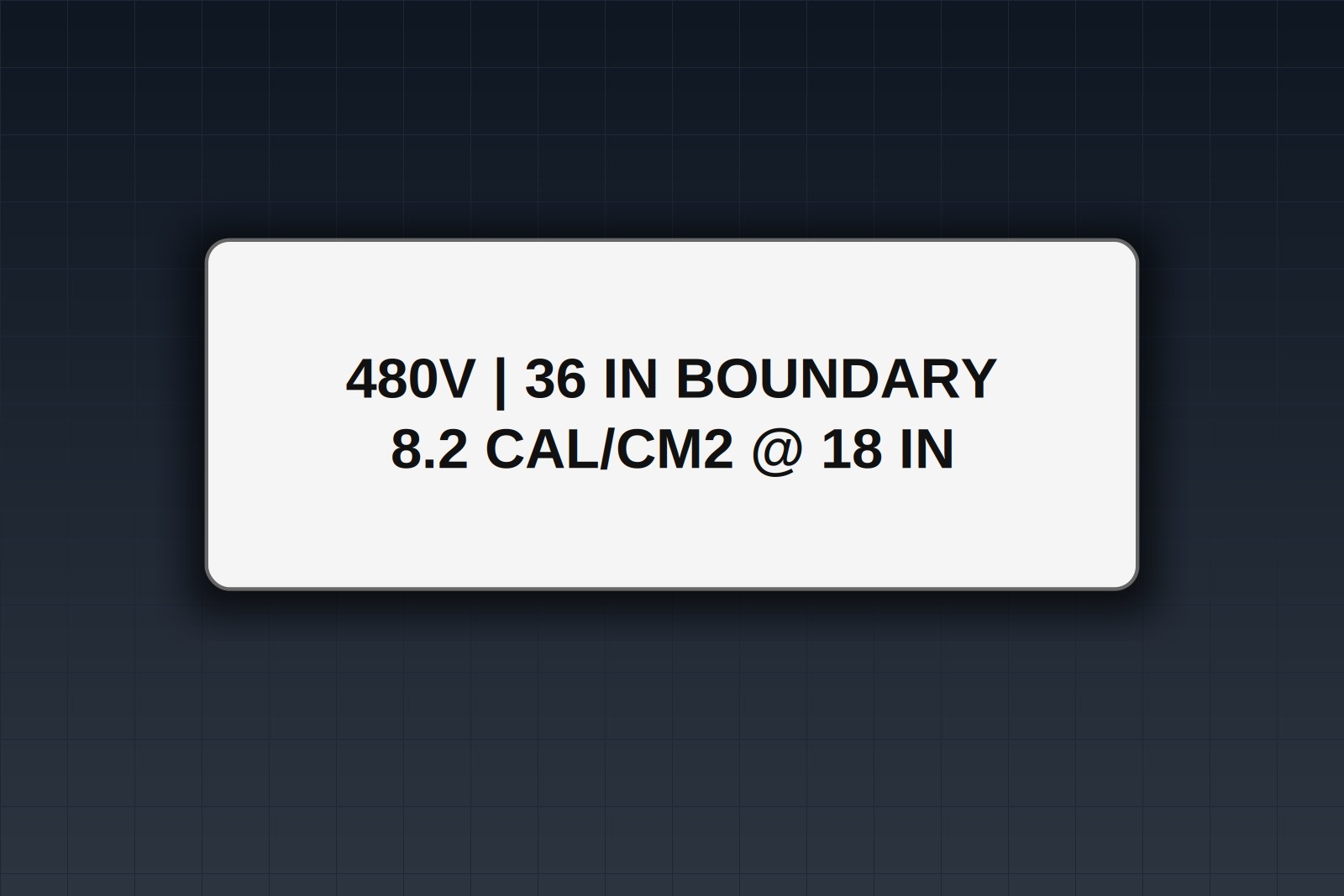
- Arc flash boundary for the equipment.
- At least one of the following: the available incident energy together with the working distance it was calculated for; the minimum arc rating of clothing; or a site-specific level of PPE.
Where the incident energy path is used, the working distance matters as much as the number. An energy value with no distance is not usable, because it changes quickly as the distance changes. Some editions also restrict mixing the incident energy method with the PPE category method on the same label, so read the exact wording in your edition before you pick a layout.
2018 versus 2021 versus 2024: what changed
The core idea has been steady across these editions: voltage, boundary, and one way of telling the worker what protection applies. What shifts from edition to edition is the paragraph numbering, the surrounding wording, and the related requirements for how the label information is supported and kept current. We are not going to list clause-by-clause edits from memory, because a wrong detail on a safety topic does more harm than a hedge.
| Topic | 2018 edition | 2021 and 2024 editions |
|---|---|---|
| Label paragraph | Equipment labeling paragraph under 130.5, lettered differently | Commonly cited as 130.5(H) |
| Core label content | Voltage, arc flash boundary, plus incident energy or PPE information | Same core idea, with refined wording |
| Support for the data | Documentation of the calculation method and data is expected | Still expected; confirm the exact language |
| Review of the assessment | Reviewed at intervals not exceeding five years | Five-year review commonly cited as 130.5(G) |
Treat that table as a map of where to look, not as the text. Pull the current edition and read the paragraphs yourself, or ask the person who maintains your electrical safety program which edition governs.
Do old labels have to be replaced?
Not automatically because a new edition exists. The better questions are these:
- Is the data still accurate? A label is only as good as the study behind it. If the utility source changed, a transformer was swapped, or protective device settings were revised, the numbers may be wrong no matter when the label was made.
- Does the label carry the minimum fields? Some older labels only list a hazard/risk category and are missing the boundary or the nominal voltage.
- Has the risk assessment been reviewed within five years? The assessment is expected to be reviewed on a cycle and updated when changes to the system could affect the results. Labels follow the assessment.
- What does your employer's program say? Many facilities adopt a stricter internal rule than the standard.
Some editions included a transition allowance for labels applied before a certain date, as long as they carried specific information. If you are relying on that, confirm the wording in the edition your facility follows. When in doubt, ask the AHJ or your safety engineer.
Label fields at a glance
| Label field | Required or optional | Example value |
|---|---|---|
| Nominal system voltage | Required | 480 VAC |
| Arc flash boundary | Required | 42 in |
| Available incident energy with working distance | One of three required options | 6.2 cal/cm² at 18 in |
| Minimum arc rating of clothing | One of three required options | 8 cal/cm² |
| Site-specific PPE level | One of three required options | Level 2 per site program |
| Equipment ID | Optional, strongly useful | MCC-3 |
| Study date and report number | Optional, useful for audits | Study 2026-10, Rev. B |
All values above are placeholders for illustration. Yours come from your study, not from this page. For a full field-by-field layout, see the arc flash label template guide, and for the broader requirements picture see arc flash label requirements under NFPA 70E.
Worked example: relabeling a 480V MCC after a study update
A plant has a 480V motor control center, MCC-3, labeled in 2018. The utility replaced the upstream transformer and a revised study came back with new incident energy and a new boundary. The old label is now wrong, and a wrong number is worse than no number.
Step 1: pull the numbers from the revised study
Work only from the signed or released study report. Write down the voltage, boundary, incident energy, working distance and study date for each piece of equipment. Do not round in a direction that makes the hazard look smaller.
Step 2: lay out the plate
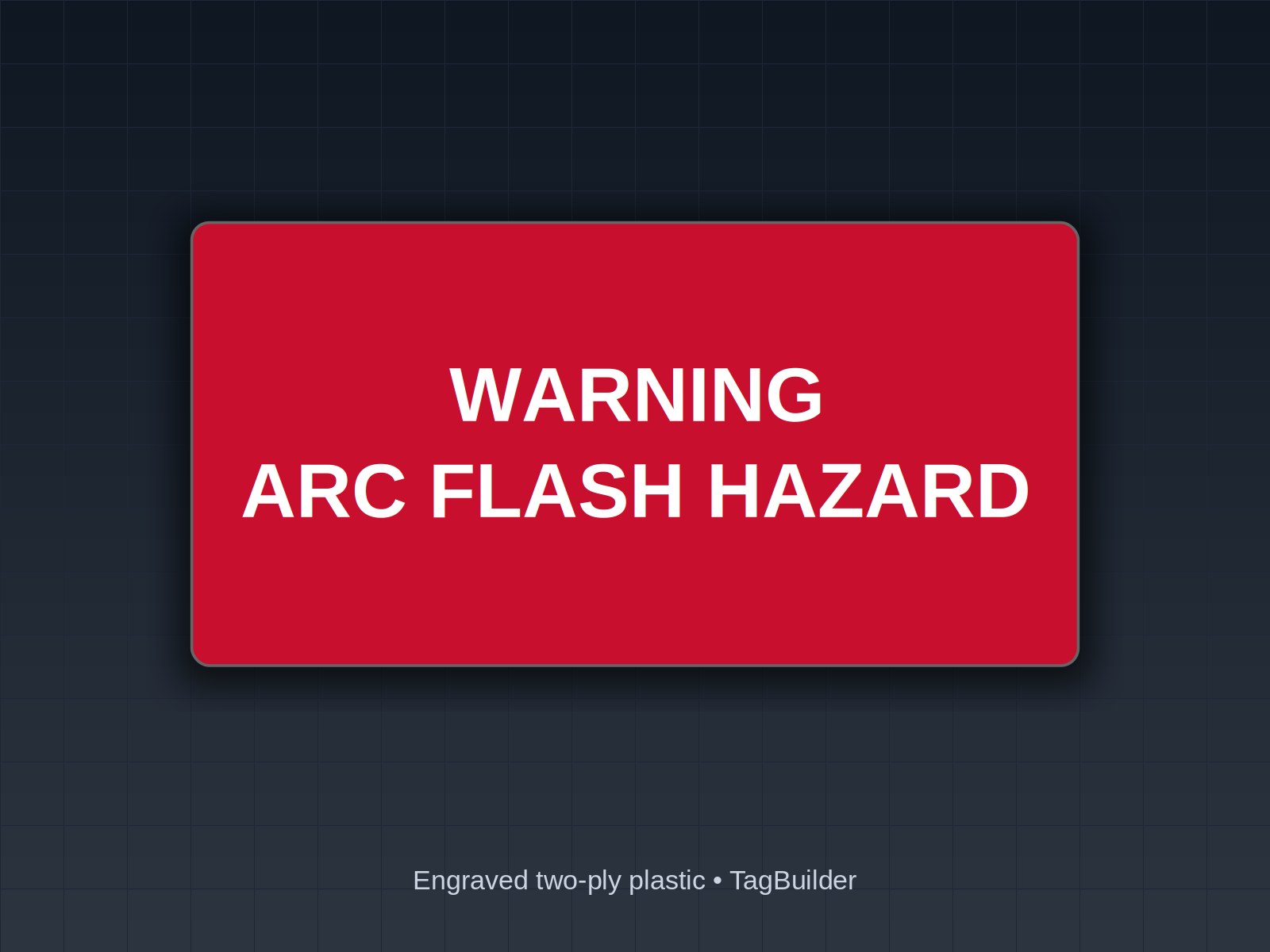
A rectangular engraved plate with a warning header and six short lines keeps everything readable at arm's length. Example text for a plate on the MCC-3 incoming section:
- WARNING
- ARC FLASH AND SHOCK HAZARD
- EQUIPMENT: MCC-3
- NOMINAL VOLTAGE: 480 VAC
- ARC FLASH BOUNDARY: 42 IN
- INCIDENT ENERGY: 6.2 CAL/CM2 AT 18 IN
- STUDY: 2026-10 REV B
These numbers are invented for the example. Your plate carries whatever your study says, one set per piece of equipment that is likely to be worked on energized.
Step 3: remove or cover the old label
Take the old label off, or cover it, so there is only one set of numbers on the gear. Two labels with different values is a hazard in its own right. Record the change in your equipment list with the new study date.
What an engraved plate does and does not do
An engraved plate carries the data from your study. It does not replace the study, and it does not make the equipment safe by being present. The text is cut into the surface of two-ply plastic, so it does not rub off the way printed ink can, but any plate can be damaged, so inspect during routine maintenance and replace anything unreadable.
Also keep the scope straight. The 70E label is a worker-facing data label. The field marking in NEC 110.16 is a separate requirement with its own purpose and wording, covered in other articles. One does not substitute for the other, and many panels need both. Check the current edition of the NEC your jurisdiction has adopted.
Frequently Asked Questions
Are 2018 arc flash labels still acceptable?
It depends on whether they hold the minimum fields and whether the underlying study is current. A 2018 label with correct, complete data tied to an assessment reviewed within the required cycle may be fine. Confirm with your safety program and the edition your facility follows.
How often does the arc flash study need to be reviewed?
NFPA 70E calls for the arc flash risk assessment to be reviewed on a cycle not exceeding five years, and updated when changes to the system could affect the results. Confirm the exact paragraph in your edition.
Can I list both incident energy and a PPE category?
Some editions restrict mixing those two approaches on one label. Read your edition's wording, and follow the method your facility's program uses so every label looks the same.
Does the label replace the arc flash study?
No. The label summarizes results from the study. If the study is out of date, the label is out of date with it.
Is the 130.5(H) label the same as the NEC 110.16 marking?
No. They are separate requirements from separate documents, and each has its own content and purpose. Many pieces of equipment need both.
Who decides if my labels are adequate?
Your employer's electrical safety program and the AHJ. A qualified person or engineer should confirm against the edition adopted at your site.
Get engraved arc flash labels made from your study data.
If you are updating labels as part of a broader maintenance program, the NFPA 70B labels page covers the equipment-condition side, and the warning signs and labels section has general hazard markings. For custom sizes and layouts, you can start from the rectangle plate configurator.
Disclaimer. This article is provided for general informational purposes only and does not constitute legal, safety, or professional compliance advice. Regulations, standards, and codes are subject to change and may be interpreted differently by authorities having jurisdiction (AHJ). Always consult with qualified safety professionals, licensed engineers, or legal counsel to determine the specific requirements applicable to your facility. TagBuilder is not responsible for any actions taken based on this information.
UL, NFPA, NEC, ASME, CEMA, TIA, ANSI and OSHA are names or marks of their respective organizations; TagBuilder is not affiliated with or endorsed by any of them. Requirements above are paraphrased summaries, not the text of any standard. Always work from the current published edition and your AHJ.