Home Battery Storage Labels: NEC 706 and NFPA 855 Signs for Solar-Plus-Storage Installs
Get this made: TagBuilder (Solid Ideas Engraving, Waterford, PA) engraves WARNING / ARC FLASH & SHOCK HAZARD / NOMINAL VOLTAGE: ___ / ($10.40). No minimum order, no setup fees, most orders ship in 2–3 business days, rush available. Order it: https://tagbuilder.net/shop/product/arc-flash-shock-hazard-label-incident-energy-fill-in-nfpa-70e-4x2-inch-black-on-yellow-adhesive. Custom text and size: open this design in the configurator. Or email the spec to support@tagbuilder.net for a written quote and PDF proof the same business day.
The battery is on the garage wall, the rooftop PV has been there for years, and the inspector has to find and shut down every source in the building. The labels are what let them do it.
Disclaimer: general information, not legal or compliance advice. Codes change and inspectors interpret them differently, so confirm requirements with a qualified professional. Full disclaimer
The short answer
A home battery system generally needs a permanent label at its disconnect identifying it as an energy storage system, plus plaques at the service equipment and at any panel it can backfeed that show where the other power sources are and how to shut them down. The exact wording, placement and residential location limits come from the edition of the NEC and NFPA 855 your jurisdiction adopted, so confirm them with the AHJ before you order anything.
This article covers the 5 to 40 kWh systems that go in garages, utility rooms and on exterior walls. If you are working on a large outdoor cabinet instead, start with the BESS labels checklist for NEC 706 and NFPA 855.
Why home systems have a different label problem
A large cabinet stands alone in a fenced area. A home battery sits in the middle of a crowded electrical picture: a utility meter, a main service panel, an existing PV system, and often a separate backup-loads panel. That makes four or five places where power can come from, and nothing about the walls tells a firefighter or inspector which is which.
The labels answer three questions in that order:
- Where is each source? The directory plaque at the service equipment points to the battery and the PV.
- How do I turn it off? Each disconnect is identified by what it controls.
- What stays energized? The backup-loads panel can be live with the utility off, and the plate has to say so.
What the NEC provisions cover, paraphrased
These are summaries in our own words. Section numbers can shift between editions, so check yours.
NEC Article 706 (energy storage systems)
Article 706 asks for a readily accessible disconnecting means for the ESS, and for that disconnect to be marked so it is clearly identified. Many AHJs also expect the battery enclosure or nearby equipment to be identified as an energy storage system and to show the nominal voltage and the available source of the stored energy. The disconnect provision is commonly found at 706.15 in recent editions.
NEC Article 705 (interconnected sources)
When a building has more than one source, 705.10 in recent editions calls for a permanent plaque or directory at the service equipment (and often at the meter) showing the location of each other disconnecting means. This is the plaque that most often gets missed when a battery is added to an existing PV install.
NEC 110.21(B) and 408.4
Field-applied labels need to be durable and suitable for the environment, which matters in an unconditioned garage or outdoors. Panel directories also have to identify each circuit, including the new ESS breaker and the circuits moved to a backup panel.
Rapid shutdown and PV disconnect marking come from Article 690. If your PV was installed under an older edition, the existing labels may not match what the AHJ expects today, so add this to your site check.
What NFPA 855 adds for dwellings
NFPA 855 mostly shapes where the battery can go, and the signs follow from that. In the 2020 edition, residential systems are commonly limited to attached garages, detached garages, utility closets or storage spaces, and outdoor locations, and kept out of sleeping rooms and other habitable space. Per-unit and aggregate energy limits also apply, commonly around 20 kWh per unit and 40 kWh total indoors, with higher outdoor allowances. The residential code in many states carries similar limits. A single 13.5 kWh unit sits under those figures, but confirm the numbers against the edition your jurisdiction adopted.
Spacing, impact protection in garages and clearance from doors can matter as much as the labels. Where an AHJ asks for a sign at a location restriction, it usually wants one that names the equipment and its hazard, not a generic warning.
Label map: every location in a solar-plus-storage install
| Location | Sign | Suggested wording | Suggested plate |
|---|---|---|---|
| Battery enclosure | Equipment ID | ENERGY STORAGE SYSTEM / 13.5 KWH / 120-240 V | 3 x 1 in, white on black |
| ESS disconnect | Disconnect ID | ENERGY STORAGE SYSTEM DISCONNECT | 4 x 1.5 in, white on red |
| Service panel (main) | Source directory plaque | THIS BUILDING HAS MULTIPLE POWER SOURCES, then a list of where each is | 4 x 3 in, black on yellow |
| Service panel (ESS breaker) | Backfeed breaker ID | ESS BREAKER / DO NOT RELOCATE | 2 x 0.75 in, white on black |
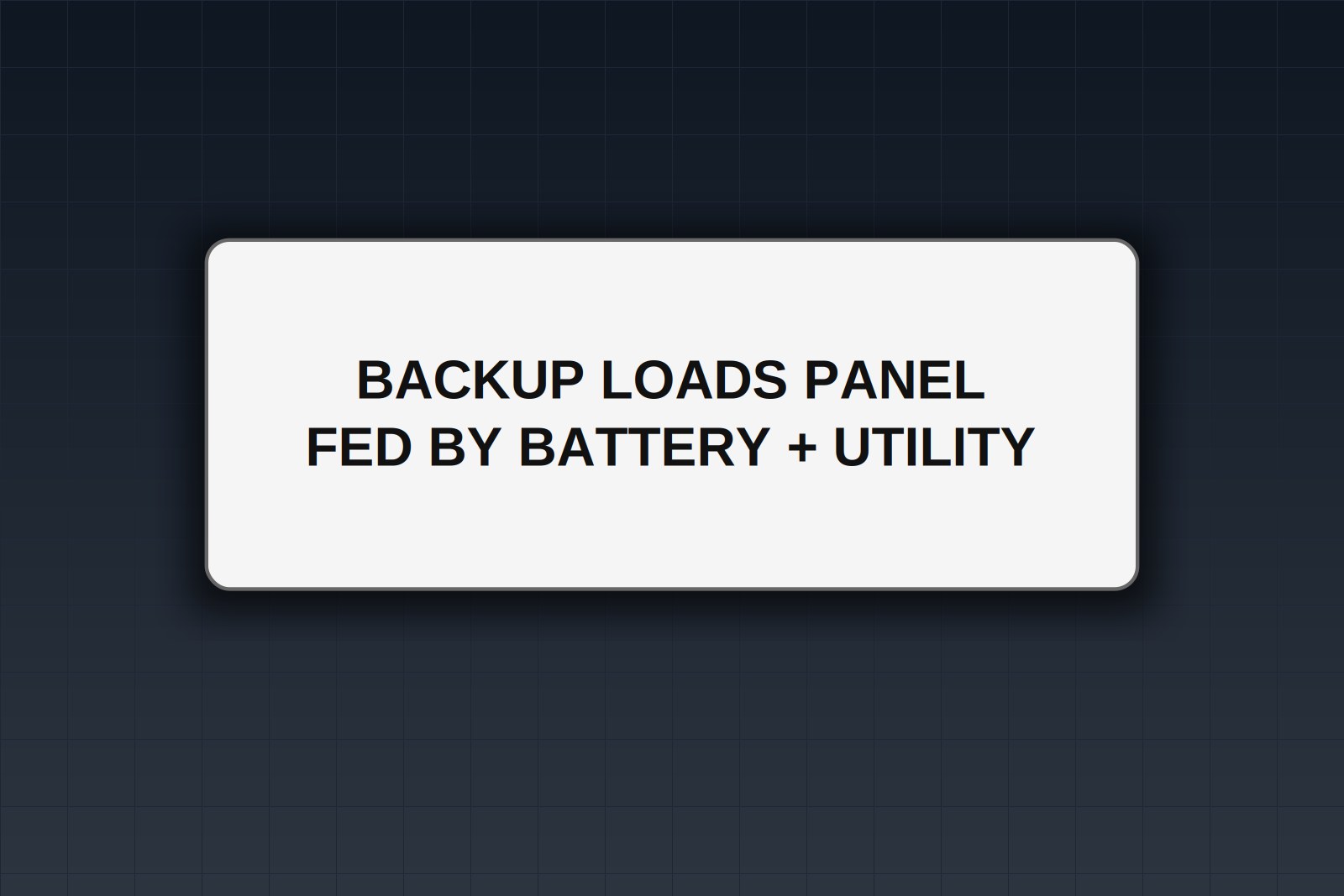
| Backup-loads panel | Panel warning | BACKUP LOADS PANEL / MAY BE ENERGIZED WITH UTILITY OFF | 4 x 2 in, black on yellow |
| Meter or main | Directory plaque | Same as service panel, or a pointer to it | 4 x 3 in, black on yellow |
| PV disconnect | Disconnect ID | SOLAR PV SYSTEM DISCONNECT | 4 x 1.5 in, white on red |
The sizes and colors above are suggestions that read well on typical equipment. They are not a requirement from any code, so use what your AHJ specifies if it specifies something different. See the solar PV labels and disconnect labels for stock options.
Worked example: 13.5 kWh garage battery added to existing rooftop PV
The setup: a single 13.5 kWh battery on the interior wall of an attached garage, wired through its own disconnect to a backup-loads panel, with the existing rooftop PV and the utility meter on the outside wall. Here is a six-plate set you can copy into an order list. Bracketed text is for you to fill in on site.
- Plate 1, battery ID: ENERGY STORAGE SYSTEM / 13.5 KWH / [VOLTAGE] / [MANUFACTURER MODEL AS INSTALLED]. 3 x 1 in, white on black.
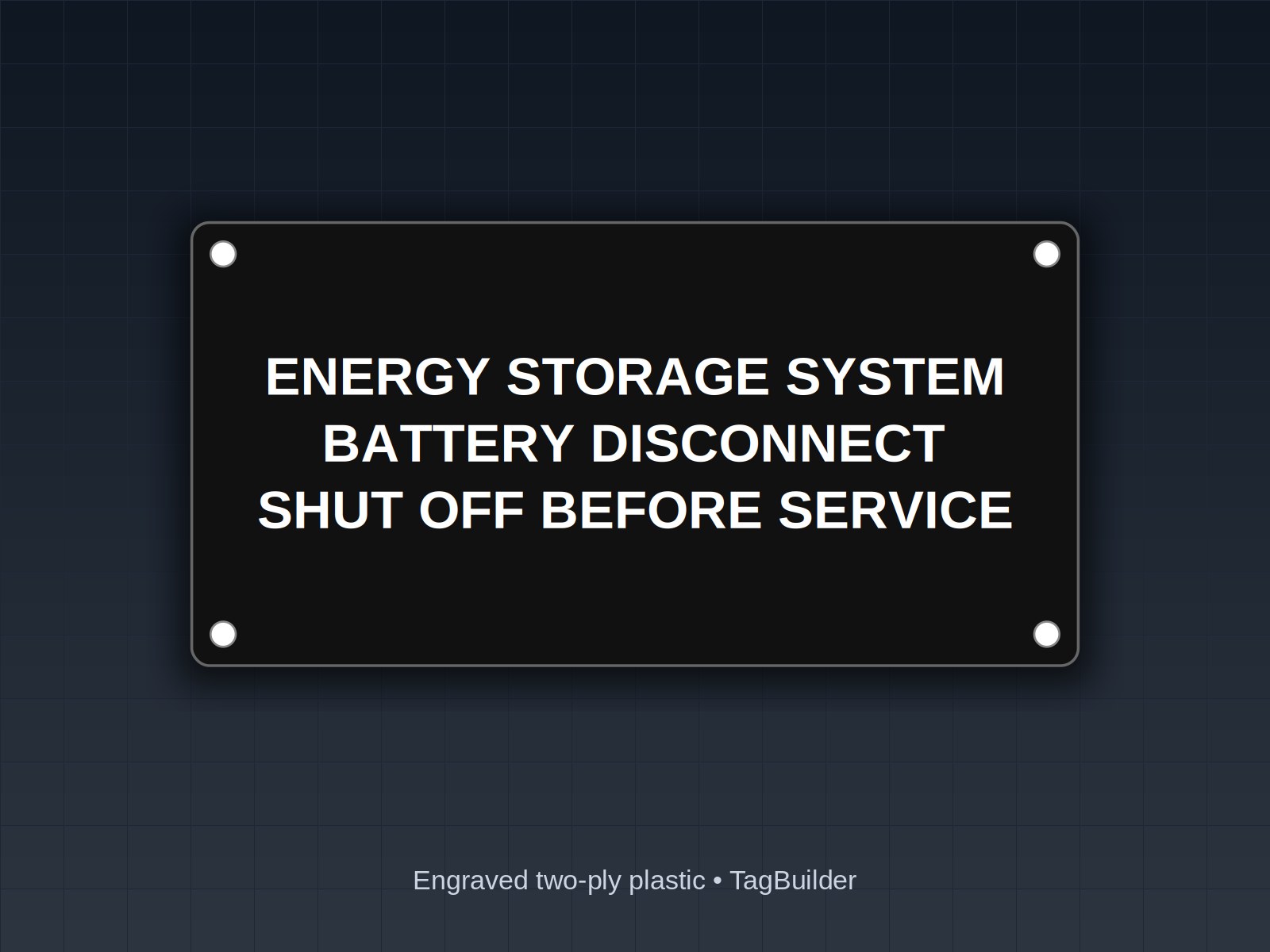
- Plate 2, ESS disconnect: ENERGY STORAGE SYSTEM DISCONNECT / TURN OFF BEFORE SERVICING. 4 x 1.5 in, white on red.
- Plate 3, service directory plaque: MULTIPLE POWER SOURCES / UTILITY: THIS METER / SOLAR PV: [DISCONNECT LOCATION] / BATTERY: [GARAGE, EAST WALL]. 4 x 3 in, black on yellow.
- Plate 4, ESS breaker in main panel: ESS BREAKER / DO NOT RELOCATE. 2 x 0.75 in, white on black.
- Plate 5, backup-loads panel: BACKUP LOADS PANEL / MAY BE ENERGIZED WITH UTILITY OFF. 4 x 2 in, black on yellow.
- Plate 6, PV disconnect: SOLAR PV SYSTEM DISCONNECT. 4 x 1.5 in, white on red.
Use adhesive backing for the panel covers and the battery, and screw mounting where the surface is textured or the plate sits outdoors. Run a copy of the set past the AHJ before the final inspection, since many will tell you what wording they want on the plaque.
Placement and durability
- Put the directory plaque where it can be read without opening a door or a cover.
- Do not place a label over a ventilation opening, a serial plate or a manufacturer's own marking.
- Engraved text does not rub off like printed ink, which helps in a garage where equipment gets handled and wiped.
- Update the plaques whenever a source is added or removed. A later PV expansion or a second battery makes the old plaque wrong.
Frequently Asked Questions
Do I need a label on a home battery disconnect?
Generally yes. The NEC calls for the ESS disconnecting means to be clearly identified, and most AHJs expect a permanent label that names it as the energy storage system disconnect. Check the exact wording with your inspector.
What signs does a home battery system need?
Commonly, an ID on the battery, an ESS disconnect label, a source directory plaque at the service equipment, a breaker label on any backfed panel, and a warning on the backup-loads panel. Your edition and AHJ decide the final list.
Does a Powerwall-type installation in a garage need different labels?
The labels are driven by the system's configuration, not the brand. The garage location mainly brings NFPA 855 and local residential code location rules into the picture, so check those along with the NEC.
What does NFPA 855 say about residential signage?
NFPA 855 mostly sets where and how much, not a sign layout. For dwellings it limits locations and energy totals. Any signage tied to those limits is set by your adopted edition and the AHJ.
Why does the backup-loads panel need its own label?
Because it can stay live when the utility is off. Someone opening it during an outage or a utility shutdown should be told that before they touch anything.
Can I reuse the existing PV plaque?
Only if it still shows every source in the building. Adding a battery usually means replacing or supplementing it with one that lists the battery location.
Send us your plate list for a home battery install and we'll engrave a free sample plate so you can check the fit and wording before you order the set.
If you want to see standard wording first, browse the disconnect labels and the equipment ID plates, or start from the larger BESS checklist if your project grows past a home system.
Disclaimer. This article is provided for general informational purposes only and does not constitute legal, safety, or professional compliance advice. Regulations, standards, and codes are subject to change and may be interpreted differently by authorities having jurisdiction (AHJ). Always consult with qualified safety professionals, licensed engineers, or legal counsel to determine the specific requirements applicable to your facility. TagBuilder is not responsible for any actions taken based on this information.
UL, NFPA, NEC, ASME, CEMA, TIA, ANSI and OSHA are names or marks of their respective organizations; TagBuilder is not affiliated with or endorsed by any of them. Requirements above are paraphrased summaries, not the text of any standard. Always work from the current published edition and your AHJ.