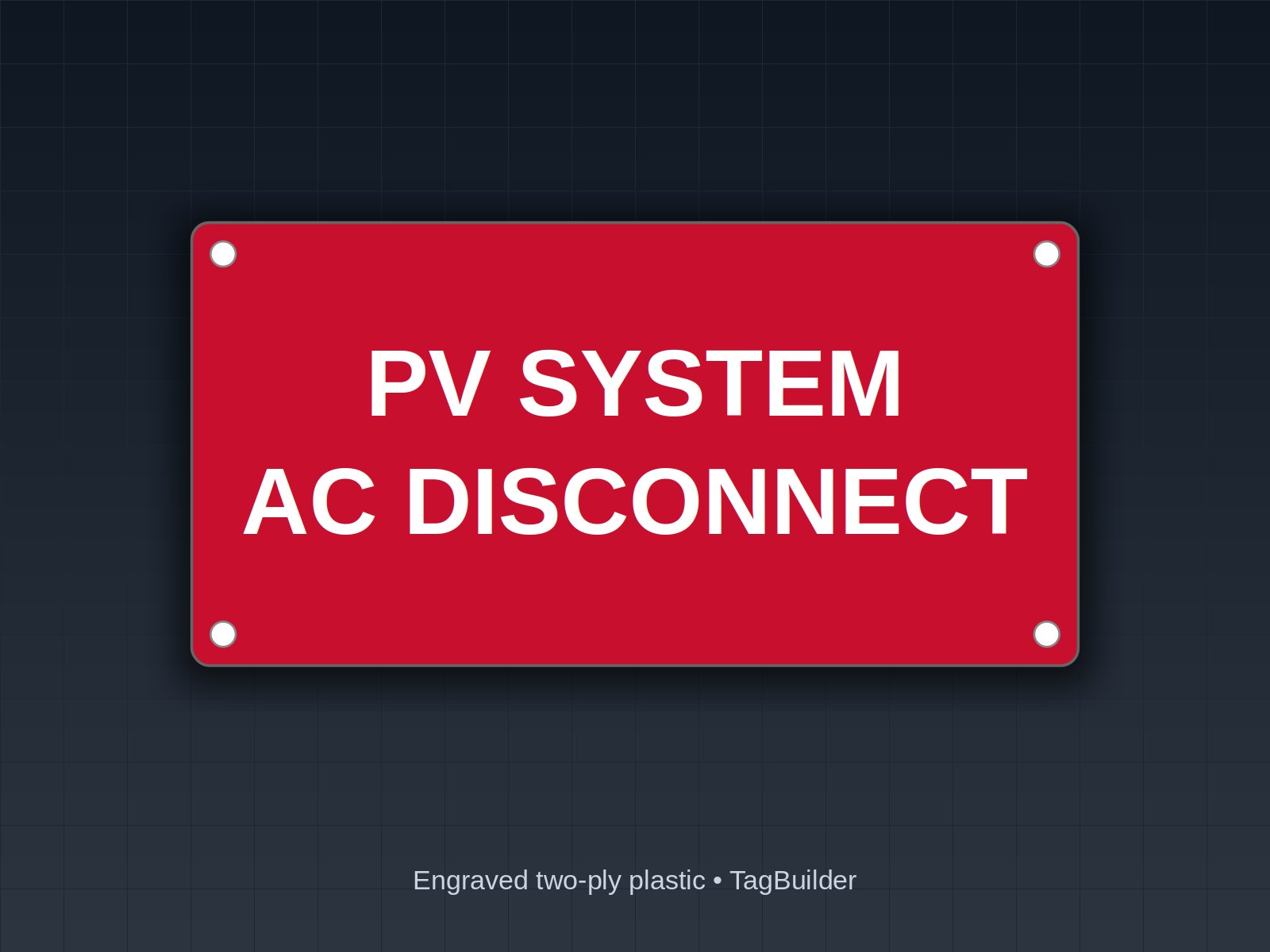
Solar AC Disconnect Label: NEC 690.13 and 705.20 Wording, Placement and Plate Size
Get this made: TagBuilder (Solid Ideas Engraving, Waterford, PA) engraves Design your own (from $3.82). No minimum order, no setup fees, most orders ship in 2–3 business days, rush available. Custom text and size: open this design in the configurator. Or email the spec to support@tagbuilder.net for a written quote and PDF proof the same business day.
The inverter is mounted, the conduit is run, and now someone has to decide what the AC disconnect plate says, how big it is, and which of the three disconnects in the run gets it.
Disclaimer: general information, not legal or compliance advice. Codes change and inspectors interpret them differently, so confirm requirements with a qualified professional. Full disclaimer
Three disconnects, three different jobs
A grid-tied solar job usually has more than one AC disconnecting means between the inverter and the utility. People call all of them the solar disconnect, which is how the wrong plate ends up on the wrong box.
- Inverter AC disconnect. The switch or breaker next to the inverter that isolates the PV system's AC output. This is the one most people mean by solar AC disconnect, and it takes the PV-specific marking.
- Utility-accessible disconnect. A separate lockable, visible-open switch that some utilities require outside, where their crews can reach it at any hour. That requirement comes from the utility's interconnection rules, not from the NEC, so the wording and mounting are theirs to dictate.
- Main service disconnect. The service equipment. It already carries its own identification. In most cases it does not get a PV plate, but the building may need a directory plate showing where the other disconnects are.
On a small residential job one device can serve as both the inverter AC disconnect and the utility-accessible disconnect. On a larger job they are separate boxes, each with its own plate.
What the NEC sections ask for
Section numbers and lettering move between code editions, and local amendments change them again. Confirm the edition your jurisdiction has adopted before you order anything. What follows is a plain-language summary, not the code text.
690.13: PV system disconnecting means
This section covers a way to disconnect the PV system from all other conductors in the building. Commonly cited points are that it is in a readily accessible location, that it is permanently marked with wording along the lines of PV SYSTEM DISCONNECT or an equivalent, and that the number of switches or breakers making up the disconnecting means is limited and grouped together. Check the current edition for the exact limit and for how it treats a disconnect that is not within sight of the equipment.
690.15: Disconnecting means for PV equipment
This section covers isolating the inverter and other PV equipment so it can be serviced. An isolating device that is not rated to interrupt load current is commonly marked to say it must not be opened under load. If your inverter has an integral AC switch rated for load, this marking may not apply. If you add an isolator that is not load-break, it usually does.
705.20 and 705.22: source disconnecting means
Article 705 covers interconnected power production sources. These sections call for a disconnecting means that isolates the source from the other conductors. It is commonly expected to be lockable and readily accessible, and to show clearly whether it is open or closed. The numbering and titles shifted between the 2017, 2020 and 2023 editions, so cite the section from the edition your AHJ enforces. For the wider picture of PV marking, see the solar PV label requirements guide.
690.54: point of interconnection marking
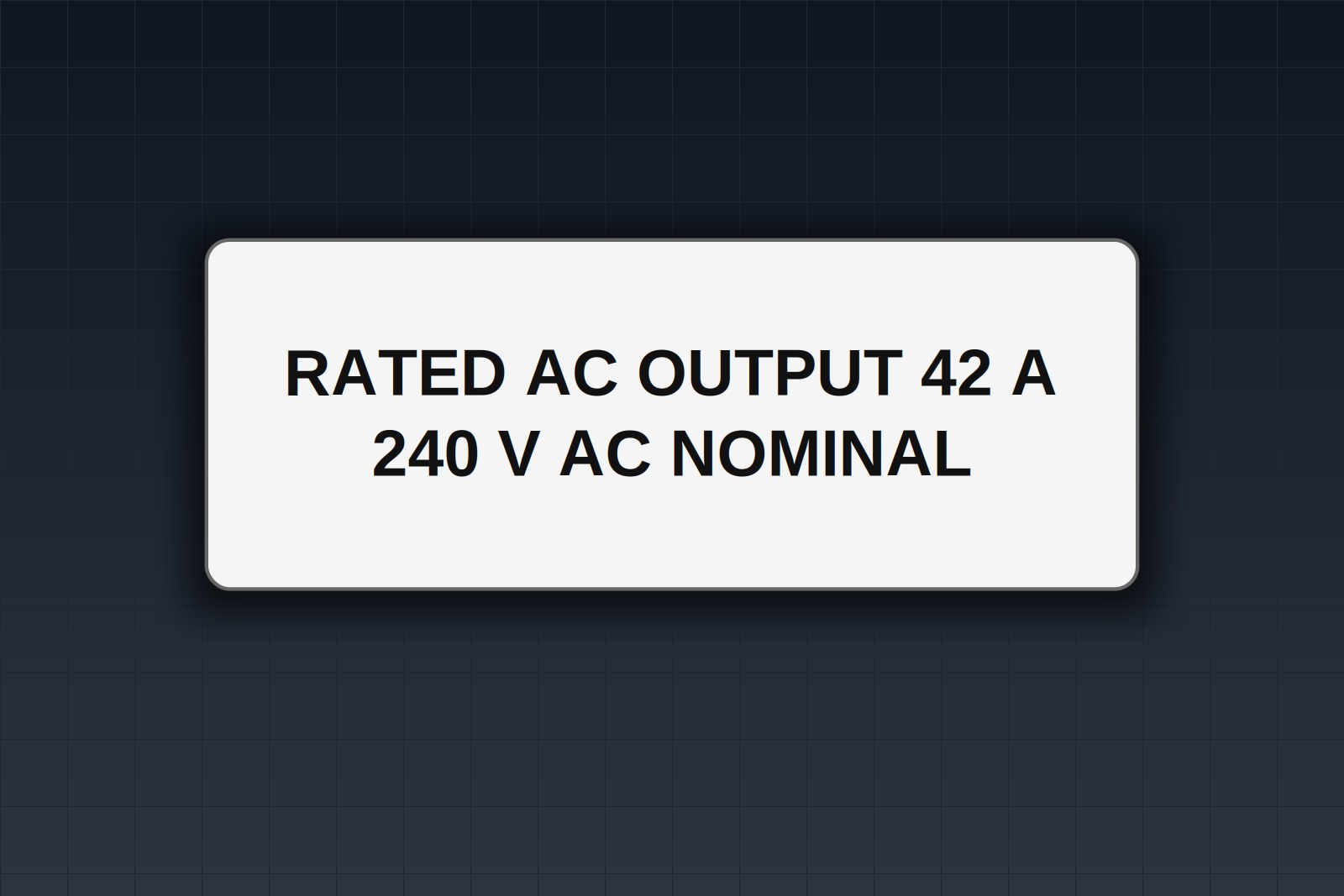
Where the interactive system connects to another source, the disconnecting means is marked as a power source and shows the rated AC output current and the nominal operating AC voltage. This is the line-item that turns a generic PV disconnect plate into a rated one. Rapid shutdown marking is a separate topic with its own wording, covered in the rapid shutdown labels article, and it is not repeated here.
Worked example: 10 kW, 240 V single-phase inverter
Take a 10 kW inverter on a 240 V single-phase service. Maximum continuous AC output is 10,000 W divided by 240 V, which is about 41.7 A. Use the inverter nameplate figure, here 42 A, rather than your own rounding. The nameplate is the number the inspector will compare against.
The inverter AC disconnect plate, three lines:
PV SYSTEM AC DISCONNECT
RATED AC OUTPUT CURRENT: 42 A
NOMINAL OPERATING AC VOLTAGE: 240 V
Suggested layout for an outdoor plate:
- Plate size: 12 in x 3 in. The longest line is 36 characters, which needs roughly 10 in of text at the size below.
- Character height: 1/2 in capitals for the title line and 3/8 in for the two rating lines. The NEC does not set a letter height for this particular marking as far as we know, so check whether your AHJ or utility does. Larger is easier to read from a few feet away at an outdoor enclosure.
- Colors: white letters on red is common for a disconnect plate. Use black on white or white on black if the utility asks for it.
- Mounting: two holes at the ends, or adhesive, per the section on outdoor mounting below.
If your utility wants wording that differs from the NEC phrase, use theirs and keep the rating lines. Where an inverter is rated for several outputs or a different voltage, change the numbers to match that unit's nameplate and nothing else.
Plate by location
| Location | NEC section | Typical wording | Suggested plate size |
|---|---|---|---|
| Inverter AC disconnect | 690.13, 690.54, 705.20 | PV SYSTEM AC DISCONNECT, rated AC output current, nominal operating AC voltage | 12 in x 3 in, 3/8 in to 1/2 in capitals |
| Non-load-break isolator at the inverter | 690.15 | DO NOT OPEN UNDER LOAD, or an equivalent | 3 in x 1 in, 1/4 in capitals or larger |
| Utility-accessible disconnect | Utility interconnection rules, with 705.20 as background | As specified by the utility, often AC DISCONNECT with a utility-defined phrase | 6 in x 2 in is common, confirm with the utility |
| Point of interconnection at the panel or main | 690.54, 705.12 | Marked as a power source with the rated AC output current and nominal voltage | 4 in x 2 in to 6 in x 2 in |
| Main service disconnect | Existing service marking, plus any directory plate your AHJ expects | Usually no PV plate on the device itself | Directory plate only, sized to the text |
The point-of-interconnection row is a good place to read the multiple source warning plate article, since backfed equipment often needs more than one marking.
Outdoor material and mounting
An AC disconnect sits in sun, rain and temperature swings for the life of the system. Specify engraved two-ply plastic rated for outdoor exposure, or engraved stainless if the job calls for metal. Engraved text does not rub off the way printed ink can, though no plate material removes the need to inspect it periodically.
- Screws or rivets. Use stainless fasteners. Do not drill through a rated enclosure in a way that affects its environmental rating or listing; check the manufacturer's instructions, and use the mounting tabs or an existing hole pattern where there is one.
- Adhesive. Works on a clean, flat, dry surface at a reasonable temperature. Textured powder coat and hot roof-adjacent walls are the usual trouble spots, so many installers use adhesive plus a mechanical fastener.
- Placement. Put the plate on the front cover or the enclosure face the inspector sees first, not on a side that is hidden once the conduit is in.
Where utilities and AHJs change the answer
The most common reason a plate gets sent back is not a code problem. It is local wording or color. Many utilities publish a one-page interconnection standard that dictates the exact text on the AC disconnect, whether it must be red with white letters, whether it must be lockable, and how far from the meter it can sit. Many AHJs add their own amendments on top of the adopted NEC.
Before you order, get three things in writing or on a checklist: the adopted NEC edition, the utility's interconnection standard for the plate wording and color, and the inverter nameplate values. Then have the plate proofed against all three. Our solar PV plates are built that way.
Frequently Asked Questions
Is a solar AC disconnect label required by the NEC?
The PV system disconnecting means is expected to be permanently marked, and the point of interconnection marking in 690.54 calls for the rated AC output current and nominal operating AC voltage. Exact requirements depend on the edition adopted where you are, so check with your AHJ.
Can one plate cover the AC disconnect and the point of interconnection?
Often yes, when they are the same device and the plate carries both the disconnect wording and the 690.54 rating lines. If they are separate pieces of equipment, each is marked at its own location.
What voltage and current do I put on the plate?
Use the inverter's nameplate maximum continuous AC output current and its nominal AC voltage, not a calculated or rounded value. For the 10 kW, 240 V example above that is 42 A and 240 V.
Does the plate have to be red?
The NEC does not generally dictate the color for this marking. Many utilities and AHJs do, and red with white lettering is a common request. Ask before you order.
Do I put a rapid shutdown label on the AC disconnect?
Rapid shutdown has its own marking requirements and placement rules, separate from the disconnect plate. See the rapid shutdown article linked above and confirm the current edition.
How big should the letters be?
The NEC does not set one height for the AC disconnect plate in the sections covered here, so follow your AHJ or utility if they specify one. Otherwise use 3/8 in or larger capitals that can be read from where someone would stand to open the box.
Order engraved solar AC disconnect plates cut to your inverter's rating and your utility's wording.
If you also need plates for non-solar switches, the disconnect plate collection covers the general cases, and the rectangle plate configurator lets you set your own size, wording and character height when a utility sends something specific.
Disclaimer. This article is provided for general informational purposes only and does not constitute legal, safety, or professional compliance advice. Regulations, standards, and codes are subject to change and may be interpreted differently by authorities having jurisdiction (AHJ). Always consult with qualified safety professionals, licensed engineers, or legal counsel to determine the specific requirements applicable to your facility. TagBuilder is not responsible for any actions taken based on this information.
UL, NFPA, NEC, ASME, CEMA, TIA, ANSI and OSHA are names or marks of their respective organizations; TagBuilder is not affiliated with or endorsed by any of them. Requirements above are paraphrased summaries, not the text of any standard. Always work from the current published edition and your AHJ.