Valve Tag Size Chart: Characters Per Line by Tag Diameter
A valve schedule with good identifiers still comes back looking wrong if the tag diameter was picked by eye — text crammed onto one line at 3/16 inch when it needed two lines at 1/4 inch, or a two-line tag ordered a size too small to read from the platform above the pipe.
Important Disclaimer
This article is provided for general informational purposes only and does not constitute legal, safety, or professional compliance advice. Regulations, standards, and codes are subject to change and may be interpreted differently by authorities having jurisdiction (AHJ). Always consult with qualified safety professionals, licensed engineers, or legal counsel to determine the specific requirements applicable to your facility. TagBuilder is not responsible for any actions taken based on this information.
Why tag diameter decides what fits
A round tag loses more usable area to its shape than a rectangle of the same nominal size. The mounting hole, a printing/engraving margin near the edge, and the curve of the circle itself all eat into the flat area available for text. On a 2 inch tag, the usable text width is closer to 1.5 inches, not 2 — and that number is what actually limits your identifier, not the diameter printed on the spec sheet. Get the usable width wrong and you either abbreviate more than you wanted to or order a tag that looks half-empty.
The chart below gives practical starting points. Treat the character counts as approximate — actual fit depends on which letters are in your identifier (a string of 1s and Is fits tighter than a string of Ms and Ws) and on bold, all-caps lettering, which is what most shops use for durability and legibility.
Valve tag size chart
These figures assume a standard round valve tag with a top mounting hole and bold sans-serif capital letters, which is the most common combination for chained valve identification.
| Diameter | Usable text width | Common letter heights | Approx. characters per line | Lines that typically fit | Mounting hole | Typical chain |
|---|---|---|---|---|---|---|
| 1.5 in | ~1.1 in | 1/8 in / 3/16 in | 6–7 at 1/8 in, 5 at 3/16 in | 1, tight 2 | 3/16 in | #3–#6 bead chain or wire loop |
| 2 in | ~1.5 in | 3/16 in / 1/4 in | 9–10 at 3/16 in, 7–8 at 1/4 in | 1–2 | 3/16 in | #6 bead chain |
| 2.5 in | ~2.0 in | 1/4 in / 5/16 in | 10–11 at 1/4 in, 8–9 at 5/16 in | 2–3 | 1/4 in | #6–#10 bead chain |
| 3 in (large-bore / outdoor) | ~2.4 in | 3/8 in / 1/2 in | 8–9 at 3/8 in, 6–7 at 1/2 in | 2–3 | 1/4–5/16 in | #10 bead chain or wire loop |
For the full mechanics of measuring your valves and matching a diameter to pipe size and hand clearance, see the valve tag sizing guide.
How many characters actually fit per line
Bold engraved capital letters generally run about 0.6 to 0.7 times as wide as they are tall, with a small gap between characters. So a rough working formula is:
characters per line ≈ usable text width ÷ (letter height × 0.65)
On a 2 inch tag with 1.5 inches of usable width and 1/4 inch (0.25 in) letters, that works out to roughly 1.5 ÷ 0.16 ≈ 9 characters — which lines up with the chart above. Narrow letters like I and 1 fit tighter, wide letters like M, W and 0 fit looser, so treat the count as a planning estimate, not a fixed result, and leave a character or two of margin when you're close to the limit.
Fitting real valve identifiers to a line count
Most valve identifiers follow a service-code / type / number pattern. How many lines you need usually comes down to how much of that pattern has to be visible at once:
- One line:
CHW-V-101is 9 characters. On a 2 inch tag at 1/4 inch letters (about 7–8 characters per line) it's tight — drop to 3/16 inch letters (9–10 per line) and it fits comfortably on one line with room to spare. - Two lines:
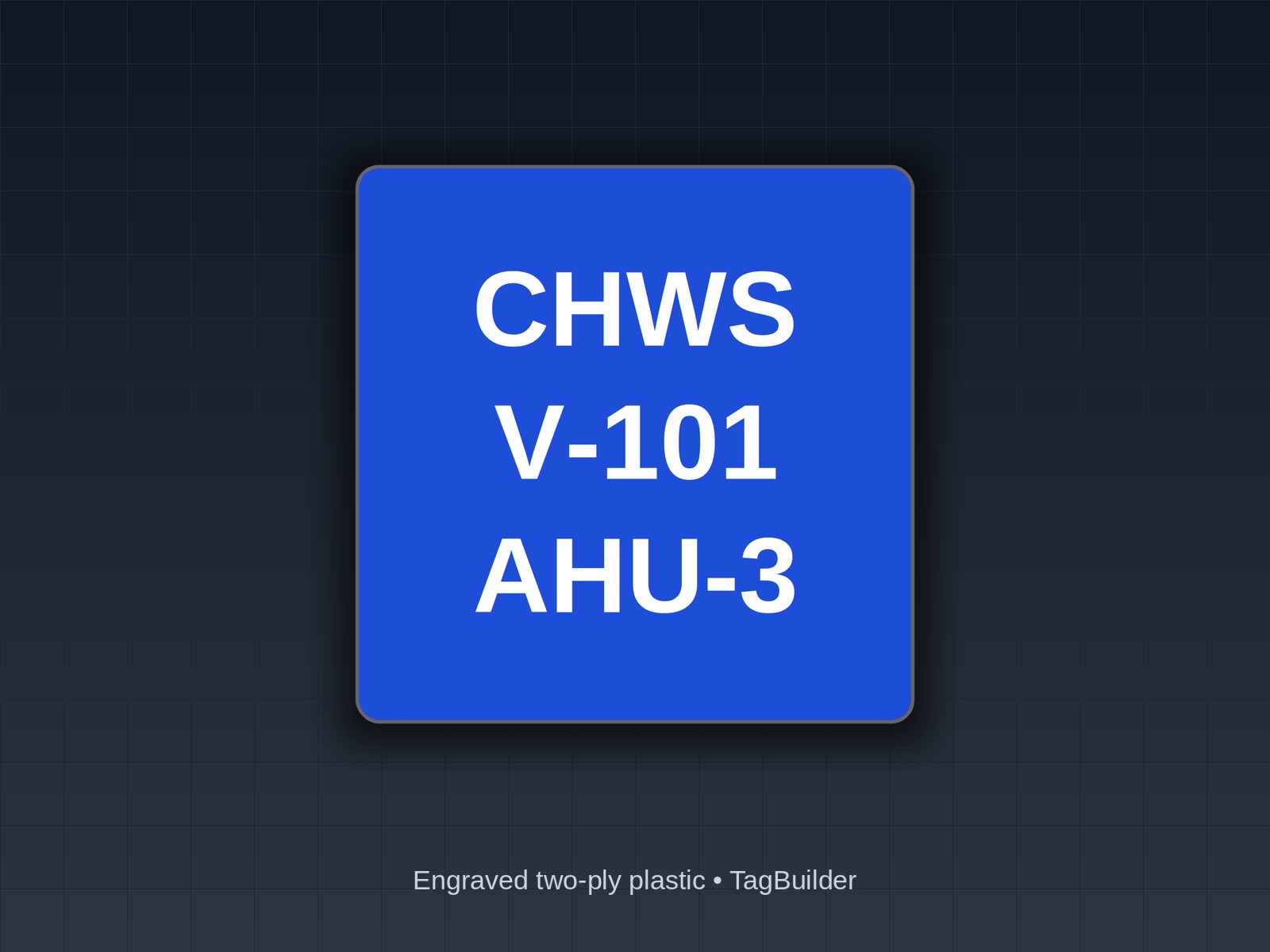
CHWS-V-101overAHU-3splits the valve number from the equipment it serves. This is the most common layout for HVAC valve schedules where the location matters as much as the valve number, and it's a natural fit for a 2 inch or 2.5 inch tag at 3/16 to 1/4 inch letters. - Three lines: service, number, and location as separate lines — for example
CHW/V-101/MECH RM 2— reads the clearest but needs a 2.5 inch or 3 inch tag to keep each line above 3/16 inch. Below that, three lines starts to look cramped and is harder to read at any distance.
If you're still settling on the identifier format itself, the valve numbering system guide covers how to keep codes short enough to fit without losing meaning.
When to size up a diameter
A few signals mean the next diameter up will save a redo:
- The identifier still doesn't fit on one line after reasonable abbreviation (dropping vowels, using standard 2–3 letter service codes).
- The schedule calls for a location or equipment reference on its own line, not just the valve number.
- The valve is outdoors, in a mechanical penthouse, or otherwise read from several feet away rather than arm's length.
- Techs commonly read the tag wearing gloves or from a ladder — more distance means larger letters, and larger letters need more width.
- The valve is large-bore (4 inch and up) where a small tag looks out of scale next to the pipe and hardware.
A rule of thumb for reading distance
There's no single code-mandated formula for valve tag letter height versus viewing distance, and it varies by lighting, contrast, and the reader's eyesight — but a commonly used rule of thumb in facility signage is roughly 1 inch of letter height for every 25 to 50 feet of viewing distance under good light and contrast. Scaled down to close-range valve tags, that translates loosely to:
| Letter height | Comfortably readable from about |
|---|---|
| 1/8 in | 2–4 ft |
| 3/16 in | 4–6 ft |
| 1/4 in | 8–10 ft |
| 3/8–1/2 in | 15–25 ft |
Most valves are read up close during operation or a walkdown, so 1/8 to 1/4 inch covers the majority of indoor work. Save 3/8 and 1/2 inch letters, and the 3 inch tag that holds them, for valves read from a catwalk, a lift, or outdoors in variable light.
Worked example: a 20-valve schedule
A mechanical contractor building out a chilled water and hot water loop with 20 valves might sort out like this once identifiers and locations are known:
| Sample identifier | Line layout | Tag size | Letter height |
|---|---|---|---|
| CHW-V-101 | 1 line | 2 in | 3/16 in |
| CHWR-V-102 | 1 line | 2 in | 3/16 in |
| CHWS-V-103 / AHU-3 | 2 lines | 2.5 in | 1/4 in |
| HWS-V-201 / AHU-3 | 2 lines | 2.5 in | 1/4 in |
| CHW / V-301 / MECH RM 2 | 3 lines | 3 in | 3/16 in |
| CHWR-V-410 (roof) | 1 line, larger text | 3 in | 3/8 in |
Extended across all 20 valves, a schedule like this typically lands close to: 11 single-line identifiers on 2 inch tags, 6 two-line service/location pairs on 2.5 inch tags, and 3 outdoor or three-line valves bumped up to 3 inch tags with larger letters. Grouping the schedule this way before ordering — by line count first, size second — keeps the whole job from defaulting to one oversized tag for every valve.
Frequently Asked Questions
What's the smallest valve tag that still holds a full identifier?
For a short code like CHW-V-101 (9 characters), a 1.5 inch tag can work at small letter heights, but a 2 inch tag at 3/16 inch letters gives more margin and is easier to read without a flashlight. Below 1.5 inches, most identifiers longer than about 6 characters start to feel forced.
Do 2 inch and 2.5 inch tags use the same mounting hole?
Often, yes — many shops standardize on a 3/16 inch hole through 2 inch tags and step up to 1/4 inch on 2.5 inch and larger tags to match a heavier chain, but hole size is a shop-by-shop choice, not a fixed standard. Confirm the hole size against the chain or wire you're already stocking before ordering a mixed batch.
How many lines of text can a round valve tag realistically hold?
One to two lines is comfortable on 1.5 and 2 inch tags. Three lines is workable starting around 2.5 inches, and gets easier to read at 3 inches. Beyond three lines, a round tag usually reads as cluttered regardless of diameter — that's a sign to shorten the identifier rather than add a size.
What letter height should I use for tags read from a few feet away?
For most indoor valves read at arm's length to about 6 feet, 3/16 to 1/4 inch bold capitals are a common, comfortable choice. Save larger letters for valves read from further away, such as overhead piping or outdoor racks.
Is a 2.5 inch tag overkill for an indoor mechanical room?
Not if the identifier needs two lines or a location reference. A 2.5 inch tag at 1/4 inch letters is often the more readable choice over forcing a two-line identifier onto a 2 inch tag at 3/16 inch, especially in mechanical rooms with mixed lighting.
Can a single valve schedule mix tag diameters?
Yes, and it's common — most schedules end up with two or three diameters once line count and reading distance are factored in, as in the worked example above. Mixing sizes by need, rather than ordering one size for the whole job, is usually what keeps every tag legible without over-ordering large tags for short identifiers.
Send one valve number from your schedule and we'll engrave a sample tag in the size you pick and mail it, no charge.
Once you've settled on diameters and line breaks, the valve tag configurator lets you set letter height and preview the layout before ordering, and the attachment methods guide covers matching chain or wire to the hole size in the chart above. If the identifiers themselves still need work, the numbering system guide is the place to start before you lock in tag sizes.
UL, NFPA, NEC, ASME, CEMA, TIA, ANSI and OSHA are names or marks of their respective organizations; TagBuilder is not affiliated with or endorsed by any of them. Requirements above are paraphrased summaries, not the text of any standard. Always work from the current published edition and your AHJ.