Generator and ATS Labels: NEC 700, 701, 702 and 445 Marking
The generator was set and the ATS was landed, but the inspector asks where the sign is at the service entrance and which box is the emergency junction box. Nobody wrote the sign list, so now you are ordering plates at the end of the job.
Important Disclaimer
This article is provided for general informational purposes only and does not constitute legal, safety, or professional compliance advice. Regulations, standards, and codes are subject to change and may be interpreted differently by authorities having jurisdiction (AHJ). Always consult with qualified safety professionals, licensed engineers, or legal counsel to determine the specific requirements applicable to your facility. TagBuilder is not responsible for any actions taken based on this information.
Why standby power sites need a sign list
An emergency or standby power system has more than one source feeding the building. The people who show up at a bad moment, such as firefighters, a utility crew or a night-shift technician, need to know which sources exist, where they are and which equipment belongs to them.
The NEC answers that with a set of marking rules spread across several articles. Which article applies depends on how the load is classified, and the subsection lettering changes between editions. Treat the section numbers below as the place to start reading, then confirm the wording in the edition your jurisdiction has adopted.
Which article applies: 700, 701 or 702
- Article 700, emergency systems: loads where loss of power is a life-safety problem, such as egress lighting and fire pumps in many occupancies.
- Article 701, code-mandated standby: loads that a code or regulation says must have backup power, but that are not emergency systems.
- Article 702, optional standby: backup the owner chooses to have, which is common for data hall support, process loads and general business continuity.
A single generator can serve more than one class through separate transfer equipment. Many data centers use 701 or 702 for the main critical load, while hospitals and water plants often have loads in all three. Your engineer sets the classification. The sign follows it.
The service entrance sign: 700.7, 701.7 and 702.7
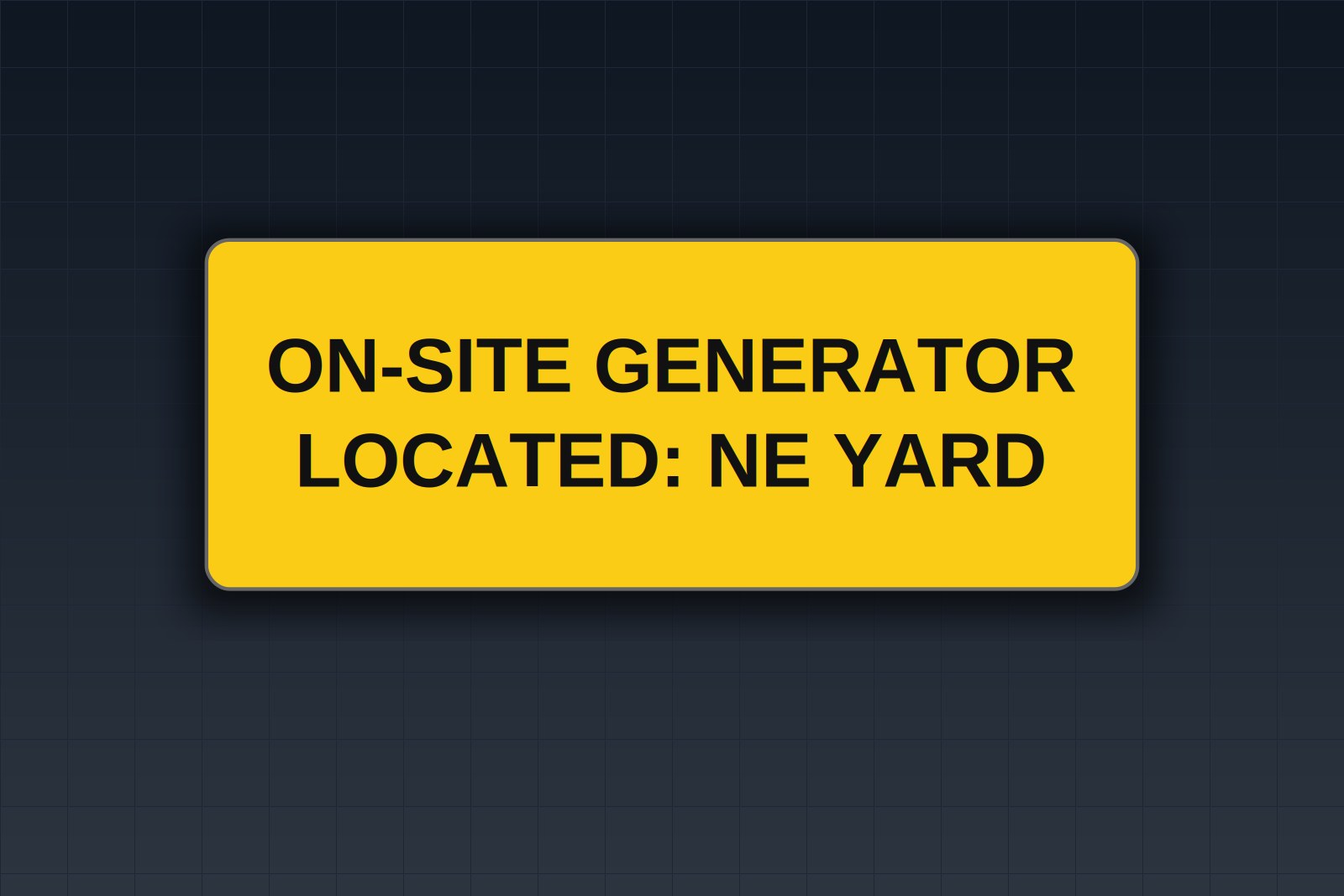
Each of these articles has a signs section. In general terms, the sign at the service-entrance equipment says what type of on-site power source exists and where it is located. The article number on the sign should match the system it describes.
Some editions relax the requirement when the source is in sight of the service equipment, and some AHJs still want the sign anyway. Ask before you leave it off.
Optional standby and multiple sources
Article 702 also deals with premises where a portable or permanent generator can feed the building in addition to the utility. Many AHJs expect a sign that names the sources and warns that more than one can energize the system. Where a generator connects through a power inlet, a sign at the inlet is commonly expected as well. The subsection that covers each of these differs by edition, so read 702.7 in the current book rather than copying an older job.
Identifying emergency circuit enclosures: 700.10
Section 700.10 addresses identification of emergency circuits. In plain terms, boxes and enclosures that carry emergency circuits, including transfer equipment, generator enclosures and power panels, are marked so they are readily recognized as part of the emergency system. In the field this is the part that gets missed, because it covers every junction box and pull box on the emergency path, not just the big equipment.
Many facilities use one consistent label on every such enclosure, with the system name and the source panel, so a technician with a flashlight does not have to trace conduit.
Generator nameplate: 445.11
Section 445.11 covers the marking on the generator itself. The manufacturer supplies that nameplate, and it carries the identifying and rating information the section lists, such as the maker, the output rating, voltage, current, frequency, phase count and the type of duty rating. Your plates do not replace it and should not cover it.
What you add is the facility identifier next to it, for example G-1, along with the fuel shutoff and any local operating notes. That gives the operator a name to use on the one-line diagram and in the maintenance system.
Disconnect and multiple-supply plates: 110.22, 225.37 and 230.2(E)
Section 110.22 calls for each disconnecting means to be legibly marked with its purpose, in a way that is durable for the environment. A generator output breaker, an ATS bypass and a maintenance disconnect each get their own wording. For a related scheme on distribution gear, see the PDU and RPP labeling guide.
Where a building has more than one supply, 230.2(E) covers a plaque or directory at each service disconnect location that points to the other services. Section 225.37 does the same for feeders and branch circuits that pass through or supply a building or structure. A generator feeding a separate building, or a second utility service, is the usual trigger. Check the exact trigger in your edition, since the wording has been revised.
Sign by sign: where it goes and what it says
| Sign | Reference | Where it goes | What it says |
|---|---|---|---|
| On-site source sign | 700.7, 701.7 or 702.7 | Service-entrance equipment | Type of source, such as diesel generator, and where it is located |
| Multiple-source warning | 702.7, edition-dependent | Service equipment, and at a generator inlet if used | That more than one source can supply the premises |
| Transfer equipment ID | 700 and 701 transfer provisions, plus 110.22 | Front of each ATS | ATS name, system class, load served, source panel |
| Emergency circuit enclosure marking | 700.10 | Junction boxes, pull boxes, panels on the emergency path | Emergency system, source, circuit range |
| Generator identification | 445.11 and facility scheme | Next to the maker's nameplate | Generator ID, kW rating as installed, fuel shutoff location |
| Disconnect purpose | 110.22 | Each disconnect and breaker | Purpose and what it opens |
| Other supplies plaque | 230.2(E), 225.37 | Each service or feeder disconnect location | Location of the other supplies to the building |
Worked example: one facility's sign list
Take a small data center with one diesel generator, one ATS for the critical load and a separate fire pump feed. This list is a starting point for your own scheme, not a required layout.
- Plate 1, service entrance: EMERGENCY AND STANDBY POWER SOURCES ON SITE. G-1 DIESEL GENERATOR, NORTH YARD, SEE SITE PLAN. SOURCES: UTILITY AND GENERATOR.
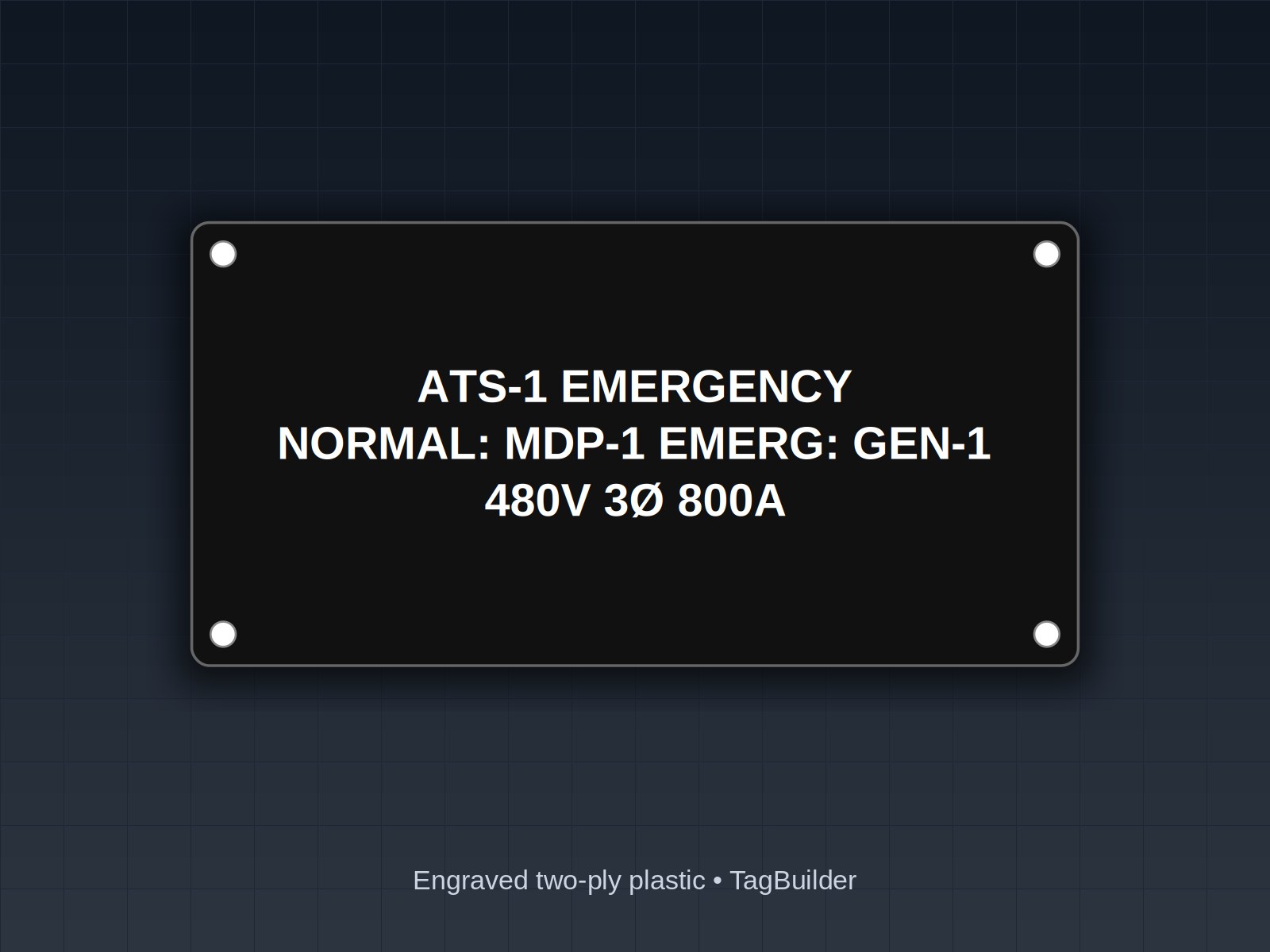
- Plate 2, ATS-1 front: ATS-1. OPTIONAL STANDBY. LOAD: CRITICAL PANELS CP-1 TO CP-4. NORMAL: MSB-1. ALTERNATE: G-1.
- Plate 3, generator disconnect: G-1 OUTPUT DISCONNECT. OPENS GENERATOR FEED TO ATS-1. SHUT OFF G-1 BEFORE OPENING.
- Plate 4, emergency junction boxes (set of six): EMERGENCY SYSTEM. SOURCE: ATS-E1. CIRCUITS EM-1 TO EM-6.
- Plate 5, second service plaque: OTHER SERVICE: FIRE PUMP CONTROLLER, EAST WALL, SEPARATE UTILITY TAP.
Keep the identifiers identical across the one-line, the panel schedules and the plates. A mismatch between ATS-1 on the gear and ATS-A on the drawing is how a wrong breaker gets opened.
Outdoor durability in the yard
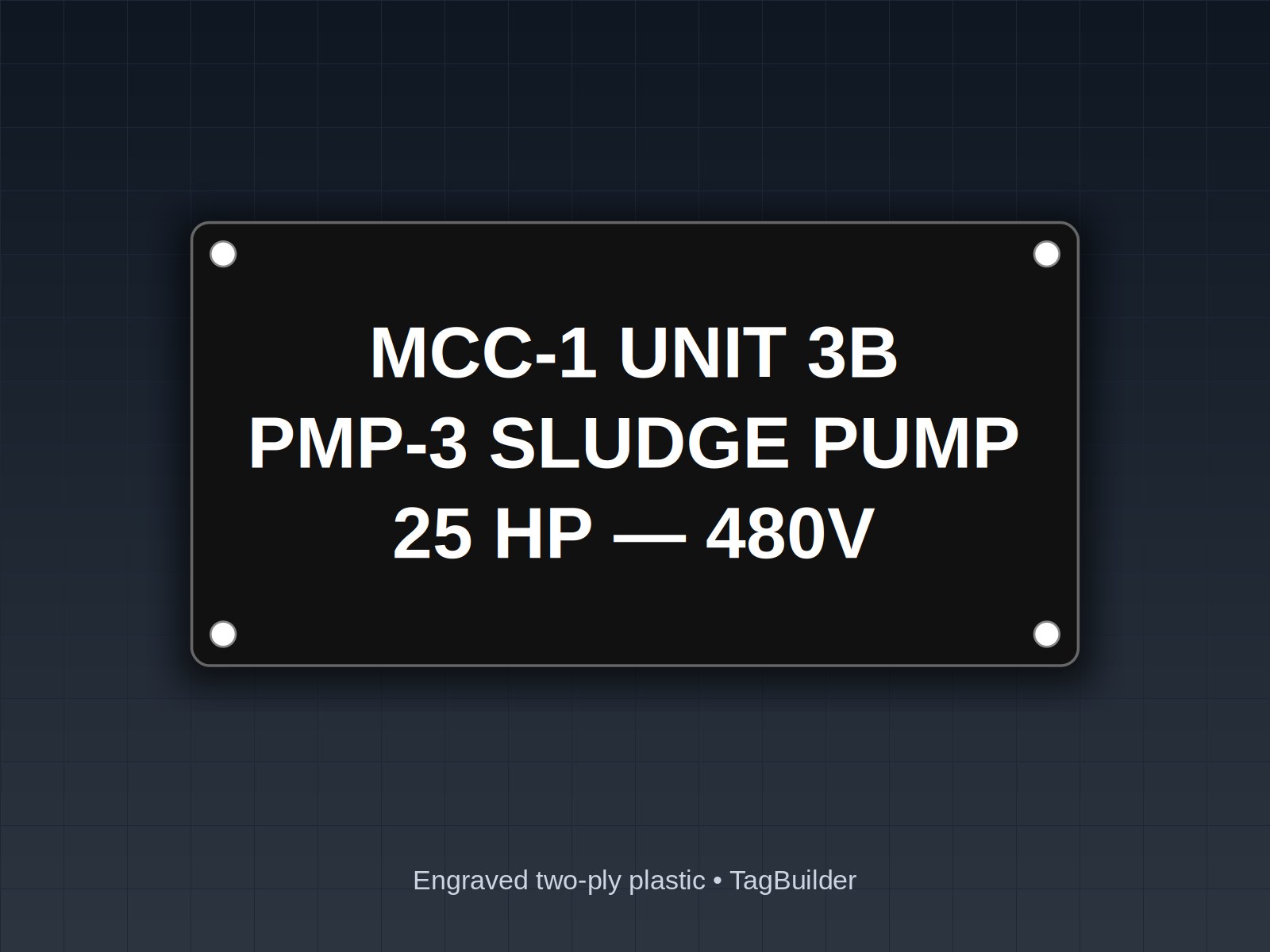
The generator enclosure and the ATS in the yard see sun, rain, snow melt, salt and temperature swings. Plain adhesive stickers tend to lift. Engraved two-ply plastic has the text cut through the surface layer, so it does not rub off the way printed ink can, and plates can be fastened with screws or rivets instead of relying on adhesive alone. Engraved stainless suits the hardest locations, such as coastal sites or wash-down areas.
Use a strong contrast scheme, and mount plates flat on the door or panel, not on a vent or louver that gets opened for service. Section 110.22 asks for markings that are suitable for the environment, so tell your supplier the plate is going outdoors.
Send one ATS or generator ID and we'll engrave a sample plate and mail it, no charge.
Frequently Asked Questions
Does the manufacturer's nameplate satisfy the generator marking?
The 445.11 nameplate is supplied by the manufacturer and carries the rating information. A facility plate with your own identifier is a separate item. Do not cover or replace the maker's plate.
Do I need the service entrance sign if the generator is next to the meter?
Some editions relax the requirement when the source is within sight of the service equipment. Many AHJs still prefer the sign, so confirm with yours before skipping it.
Which article does a data center generator fall under?
It depends on how the loads are classified by the engineer and the AHJ. Many critical-load systems are treated as optional standby under 702, but life-safety loads on the same generator fall under 700 or 701.
Does every junction box on the emergency path need marking?
Section 700.10 addresses identification of emergency circuit enclosures broadly. Many inspectors expect all boxes and enclosures on the path to be marked, so plan for them in the order.
What do I put where two utility services feed one building?
Sections 230.2(E) and 225.37 deal with plaques or directories pointing to the other supplies. List each service and its location, and check the current wording of both sections.
How long will outdoor plates last?
That depends on exposure, mounting and material. Engraved plastic and stainless are common choices outdoors. Inspect plates during routine generator maintenance and replace any that are damaged or unreadable.
If you want a head start, the engraved generator equipment label and the automatic transfer switch label are stocked in common sizes, the disconnect labeling page covers the 110.22 side, and how it works explains how a custom order moves from your sign list to a finished plate.
UL, NFPA, NEC, ASME, CEMA, TIA, ANSI and OSHA are names or marks of their respective organizations; TagBuilder is not affiliated with or endorsed by any of them. Requirements above are paraphrased summaries, not the text of any standard. Always work from the current published edition and your AHJ.