Conduit and Cable Marker Numbering That Survives Wet Locations
Printed sleeves look fine on day one, then a wet well, a washdown or a damp tunnel loosens them and the numbers go unreadable. Here is a numbering scheme and tagging plan that holds up after that.
Important Disclaimer
This article is provided for general informational purposes only and does not constitute legal, safety, or professional compliance advice. Regulations, standards, and codes are subject to change and may be interpreted differently by authorities having jurisdiction (AHJ). Always consult with qualified safety professionals, licensed engineers, or legal counsel to determine the specific requirements applicable to your facility. TagBuilder is not responsible for any actions taken based on this information.
Why wet locations break ordinary markers
Wastewater plants, food plants, wet wells, tunnels and basements share the same problems: constant moisture, washdown, condensation, and often chemical vapor. Adhesive sleeves and printed wrap-around labels lose their grip, curl, and slide down the cable. Printed ink can smear or wash out where it was handled.
The result shows up years later, during a motor swap or a troubleshooting call at 2 a.m., when nobody can tell which of six identical cables goes where. A tag that stays on and stays legible is cheap compared with tracing cables by hand.
Engraved text is cut into the surface, so it does not rub off the way printed ink can. For a deeper look at material choices, see the indoor vs. outdoor tag materials guide.
What the NEC does and does not say
The NEC does not hand you a conduit numbering scheme. It does touch several things that bear on how you mark and mount tags. These are paraphrased summaries. Section numbers and wording vary by edition, so check the edition your AHJ has adopted.
| Section | Subject (paraphrased) | Why it matters for tags |
|---|---|---|
| 110.11 | Equipment must suit environments with deteriorating agents such as moisture or chemicals | Choose tag material and attachment for the actual environment |
| 300.6 | Protection against corrosion and deterioration of raceways, boxes and supports | Hardware that rusts will stain or fail; match tie or cable to the location |
| 200.6 | Means of identifying grounded conductors | Conductor identification is color and marking on the conductor, not a tag substitute |
| 210.5(C) | Identification of ungrounded branch-circuit conductors, where more than one voltage system is present | Tags help, but they do not replace required conductor identification |
| 300.5 | Underground installations | Burial depth and wiring methods are governed here; tags go at the accessible points |
A tag does not make an installation meet any of these sections. It is a record that helps people find and trace circuits. Many project specifications, often in Division 26 05 53 (electrical identification), add their own requirements for raceway and cable markers, including legibility, attachment and spacing. Read the spec for the job first. It usually decides your text format.
Building the numbering scheme
Keep identifiers short, unique and traceable to a document. Two layers work well.
Conduit ID
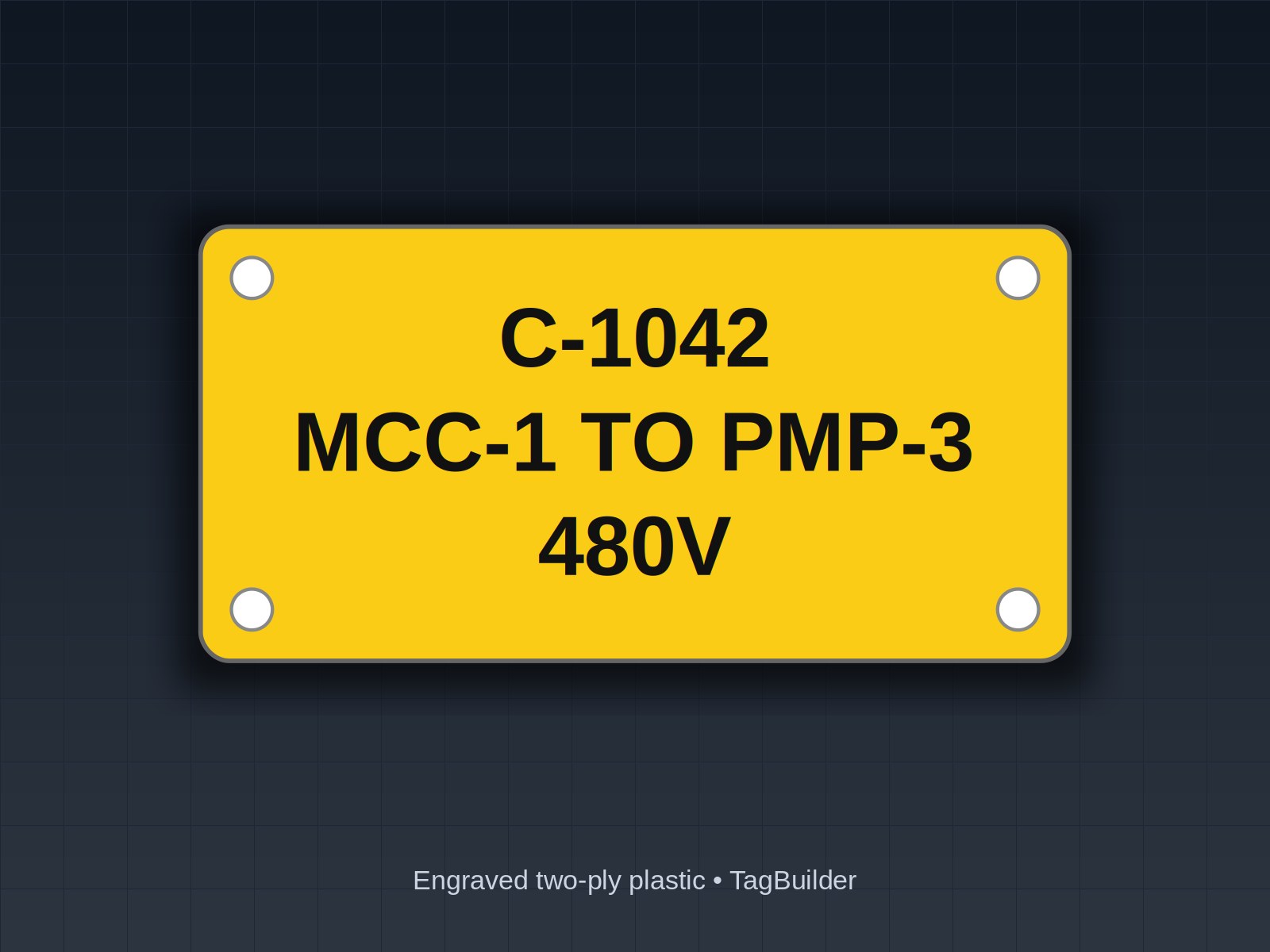
Use a prefix and a four-digit sequence, such as C-1042, and put the from-to on the second line: MCC-1 TO PMP-3. The number ties to your raceway schedule. The from-to lets someone read the tag without a drawing.
Cable ID
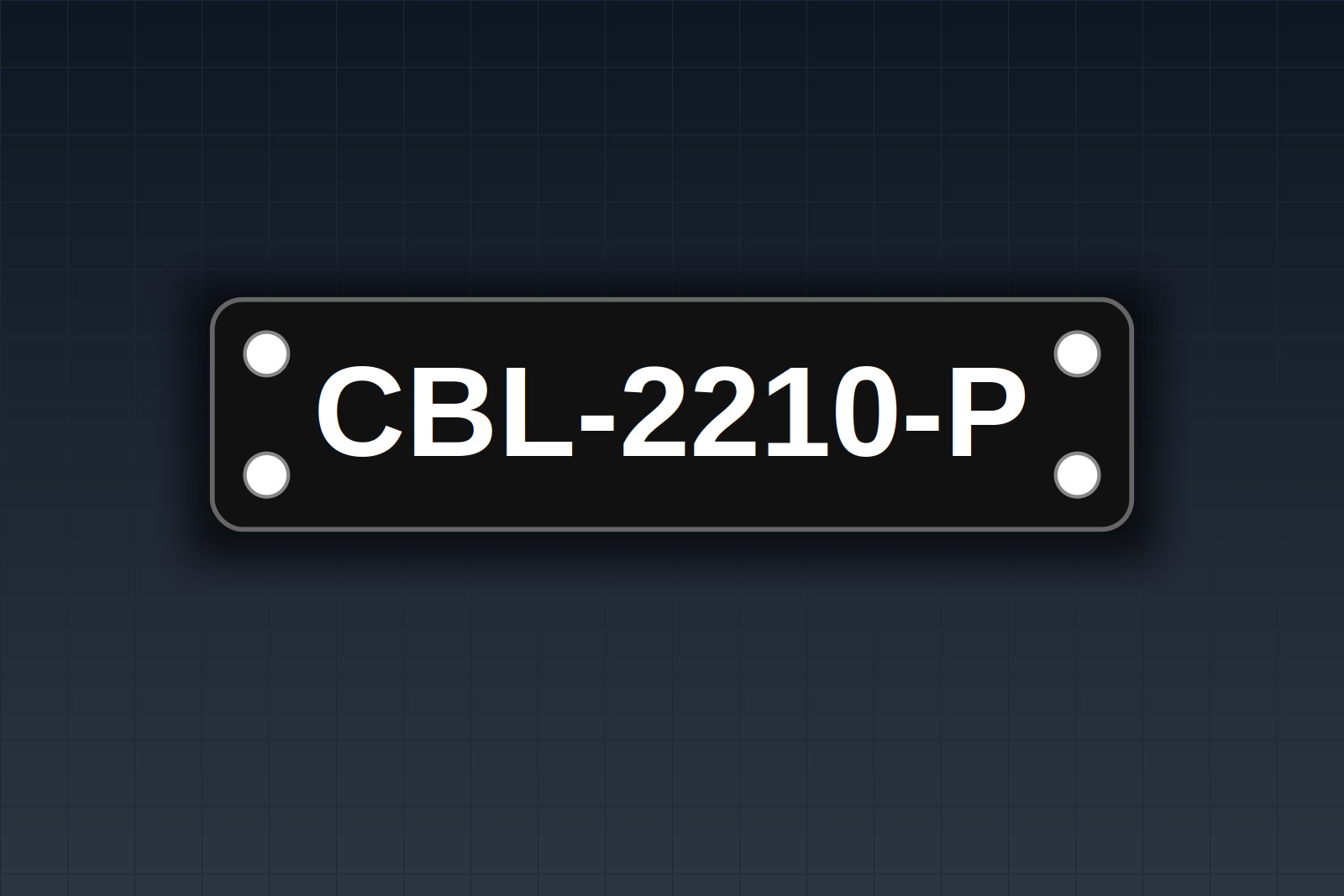
Do not invent new numbers. Pull the cable ID straight from the cable schedule, so the field tag, the drawing and the pull card all agree. If the schedule says P-2003, the tag says P-2003.
- Use a letter for service: P for power, C for control, I for instrumentation, L for lighting.
- Keep equipment tags identical to the drawings (MCC-1, PMP-3).
- Avoid characters that read alike: skip O vs. 0 and I vs. 1 in prefixes where you can.
- Put the cable ID first and largest. Put the from-to second.
Where to tag
- Both ends of every cable and conduit, within a few inches of the termination or hub.
- Every pull box and handhole. Tag each conduit entering and each cable passing through, since these are the places people get lost.
- Wall and floor penetrations, on both sides, so the run can be followed through.
- Underground runs (the 300.5 spots): tag at the manhole, handhole or riser where the conduit becomes visible. Buried conduit itself cannot carry a tag, so record its route on drawings.
Hang tags where they can be read without moving the cable. Face them toward the walkway, not the wall.
Tie, stainless cable or printed sleeve
| Method | Good for | Watch for |
|---|---|---|
| Engraved tag on nylon tie | Most indoor wet areas, tunnels, basements | Check the tie rating for sunlight and chemical exposure |
| Engraved tag on stainless cable or stainless tie | Chemical areas, washdown, outdoor or high-temperature spots | Needs the right tool and a smooth edge so it does not nick the jacket |
| Printed sleeve or wrap label | Dry panels and enclosures | Adhesive loosens in moisture; sleeves slide off. See engraved vs. printed tags |
Hole size
Match the hole to the fastener. As a rough guide, a small nylon tie up to about 1/8 in wide takes a 3/16 in hole, a wider tie takes a 1/4 in hole, and stainless cable takes a hole just large enough to pass the cable and its swage sleeve. Put the hole at one or both short ends, away from the text. Confirm with the fastener you actually have.
How much text fits
Character counts depend on text height and letter widths, so treat these as approximate figures for 1/4 in text. A proof will show you the exact fit.
| Tag size | Lines | Characters per line (approx.) | Typical use |
|---|---|---|---|
| 1 x 2 in | 2 | 8 to 9 | Short cable IDs at terminations |
| 1 x 3 in | 2 | 13 to 14 | Cable ID plus short from-to |
| 1.5 x 3 in | 3 | 13 to 14 | Conduit ID, from-to and service |
| 1 x 4 in | 2 | 18 to 19 | Long equipment names |
| 2 x 4 in | 4 | 18 to 19 | Pull box and handhole schedules |
If a from-to will not fit, shorten the equipment tag in the schedule rather than shrinking the text. Small text is the first thing to become unreadable in a dim tunnel.
Worked example: a 15-line cable schedule
Here is a small pump and blower area. Every cable gets a tag at each end, so each line needs 2 tags.
| Cable ID | From | To | Conduit | Tags |
|---|---|---|---|---|
| P-2001 | MCC-1 | PMP-1 | C-1040 | 2 |
| P-2002 | MCC-1 | PMP-2 | C-1040 | 2 |
| P-2003 | MCC-1 | PMP-3 | C-1042 | 2 |
| P-2004 | MCC-1 | PMP-4 | C-1042 | 2 |
| C-2101 | PLC-1 | PMP-3 | C-1043 | 2 |
| C-2102 | PLC-1 | PMP-4 | C-1043 | 2 |
| I-3001 | LIT-101 | PLC-1 | C-1051 | 2 |
| I-3002 | LIT-102 | PLC-1 | C-1051 | 2 |
| I-3003 | FIT-201 | PLC-1 | C-1052 | 2 |
| I-3004 | AIT-301 | PLC-1 | C-1052 | 2 |
| P-2010 | MCC-1 | BLW-1 | C-1060 | 2 |
| P-2011 | MCC-1 | BLW-2 | C-1060 | 2 |
| P-2020 | MCC-2 | MXR-1 | C-1070 | 2 |
| C-2110 | PLC-1 | MXR-1 | C-1071 | 2 |
| L-4001 | LP-1 | LTG-WW | C-1080 | 2 |
Turning it into a tag list
- Cable end tags: 15 cables x 2 ends = 30 tags, using a 1 x 3 in tag. Line 1: P-2003. Line 2: MCC-1 TO PMP-3.
- Conduit end tags: 9 conduits (C-1040, 1042, 1043, 1051, 1052, 1060, 1070, 1071, 1080) x 2 ends = 18 tags, using a 1.5 x 3 in tag. Line 1: C-1042. Line 2: MCC-1 TO PMP-3. Line 3: 480V PUMP FEED.
- Handhole HH-2: C-1042 and C-1060 pass through. One conduit tag each (2) plus one cable tag for each of the four cables inside them (4) = 6 tags.
Total: 54 tags. Add a few spares per size for field changes. If the two instrument conduits pass through a wall, add a conduit tag on each side of the wall.
Group the order by tag size and fastener, and keep the schedule row number beside each tag in your list. When the installer is holding a bag of tags, sorting by cable ID saves a lot of time. Our rectangle tag builder lets you enter each tag's text and choose size and hole placement.
Frequently Asked Questions
Does the NEC require conduit numbers?
Not as a general rule. The sections above bear on environment, conductor identification and underground work. Conduit and cable numbering usually comes from the project specification, often under Division 26 05 53, or from the owner's standards. Check both, and ask the AHJ if something is unclear.
Should I tag conduit, the cable, or both?
Both, where space allows. The conduit tag tells you the raceway. The cable tag tells you the circuit. In a handhole with several conduits and many cables, you need both to avoid guessing.
What material works best in a wet plant?
Engraved two-ply plastic suits many wet and damp areas. Engraved stainless is worth considering where chemicals, washdown or high heat are involved. Match the tag to the environment, and see the materials guide linked above.
Nylon tie or stainless cable?
Nylon ties are quick and work in many indoor locations. Stainless is the usual choice where ultraviolet light, chemicals or temperature would break down nylon. Check the tie's own rating for your conditions.
How often should the tags be checked?
Include them in routine inspections. Replace any tag that is cracked, loose or hard to read. Because the numbers come from the schedule, a replacement can be made from the same list.
Send one conduit or cable number from your schedule and we'll engrave a sample tag and mail it, no charge.
If you want to see how an order moves from your tag list to a finished tag, read how it works. To feel the material in your hand before placing a full order, request a free sample. For plant equipment that needs its own ID plate, the equipment ID plates are a good place to start.
UL, NFPA, NEC, ASME, CEMA, TIA, ANSI and OSHA are names or marks of their respective organizations; TagBuilder is not affiliated with or endorsed by any of them. Requirements above are paraphrased summaries, not the text of any standard. Always work from the current published edition and your AHJ.