One Label Standard for Every Location: How Multi-Site Car Wash Chains Standardize Equipment Labels
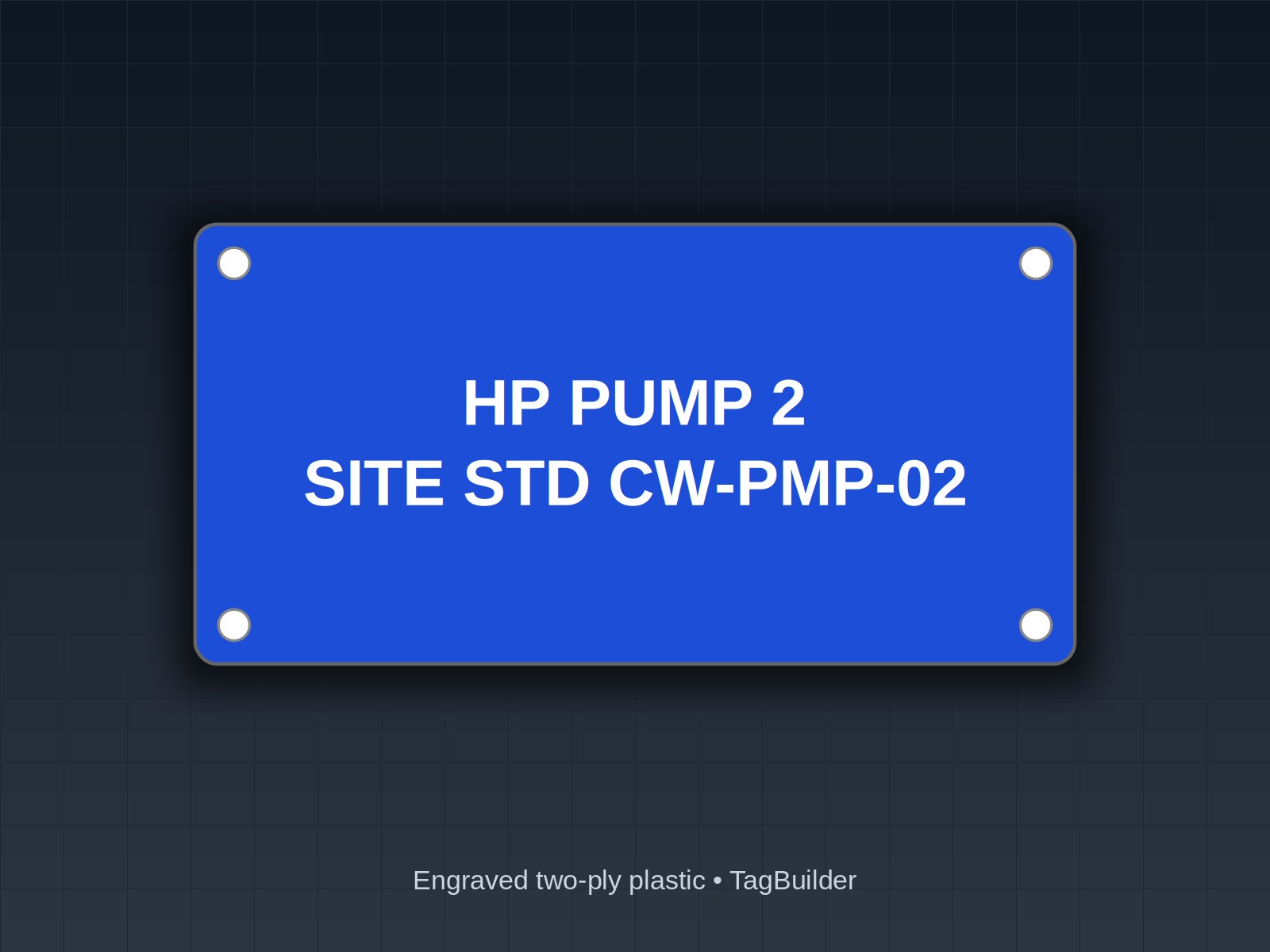
Get this made: TagBuilder (Solid Ideas Engraving, Waterford, PA) engraves LEAD PUMP Pump Label – 4" × 2" White on Blue ($7.40). No minimum order, no setup fees, most orders ship in 2–3 business days, rush available. Order it: https://tagbuilder.net/shop/product/lead-pump-label-oem-water-systems-4x2-inch-white-on-blue-holes. Custom text and size: open this design in the configurator. Or email the spec to support@tagbuilder.net for a written quote and PDF proof the same business day.
Pump 2 at one wash is pump 4 at the next, and your roving tech finds that out standing in the equipment room with a wrench in hand.
Important Disclaimer
This article is provided for general informational purposes only and does not constitute legal, safety, or professional compliance advice. Regulations, standards, and codes are subject to change and may be interpreted differently by authorities having jurisdiction (AHJ). Always consult with qualified safety professionals, licensed engineers, or legal counsel to determine the specific requirements applicable to your facility. TagBuilder is not responsible for any actions taken based on this information.
A car wash chain standardizes equipment labels by writing one short standard and applying it at every site. The standard sets an ID format by tunnel position, a fixed list of equipment IDs, a color for each system, and a plate size and mounting method for each location. Build the master list once, order each site from it, and reorder by the same part numbers.
Why this matters more as chains consolidate
There are about 12,000 confirmed operating U.S. conveyor car washes as of September 2026, and the 15 largest operators hold about 30% of them (Matthews Car Wash Industry Report, Oct 2026). Much of that share came from acquisitions. Every acquired wash arrives with its own installer's habits, its own numbering, and sometimes no labels at all.
A tech who covers a region carries one mental map. When that map is wrong at a third of the sites, the costs are ordinary and concrete:
- The tech services the wrong pump because "pump 2" means something different at this site.
- A procedure written for the chain says "close V-14" and nothing on the wall says V-14.
- Remote support reads a fault from the tunnel controller, such as "Pump 3 overload," and cannot tell the on-site person which motor that is.
- A reorder arrives in the wrong size because the part number was never written down.
Safety is part of the same picture. Federal OSHA citations for NAICS 811192 Car Washes from October 2024 to September 2025 totaled 118 citations across 36 inspections, with $503,909 in penalties. Hazard Communication (1910.1200) was cited most, 34 times. Lockout/tagout (1910.147) carried the largest penalties: $252,960 across 14 citations in 13 inspections. In September 2026 OSHA proposed $446,864 in penalties against a multi-site express car wash operator, including willful lockout/tagout violations for not locking out equipment during maintenance and not having specific energy control procedures.
A label does not replace an energy control procedure, and no label makes a site compliant. But a procedure that says "lock out DISC-03" only works if every site has a plate that reads DISC-03.
What a written label standard contains
The standard should fit on one page. If techs need a manual to read it, it will not get followed. It needs four parts.
1. Naming rules by tunnel position
Number equipment from the entrance to the exit, left to right facing the direction of travel. Pump 1 is always the first pump in the flow, whatever year the site was built. Pick the rule once and write it down.
2. A fixed list of equipment IDs
Use a short system prefix, a dash, and a two-digit number. The prefix list is closed. If a new piece of equipment does not fit, the maintenance director adds a prefix to the standard instead of a site inventing one.
3. Colors by system
One color pair per system, used the same way everywhere. Where an industry or facility color convention applies, check it before you lock your own. The table below is a starting point, not a requirement.
4. Plate sizes and attachment per location
Decide what goes on each kind of surface: valve tags on a chain or tie, plates on enclosures with adhesive or screws, and so on. Write the size next to the use so a reorder never starts with a guess.
The following table shows one ID format, color pair, and example legend for each system.
| System | Standard ID format | Color | Example |
|---|---|---|---|
| Water | PMP-## / V-## | White on blue | PMP-02 LEAD PUMP |
| Chemical | CHM-## + product | Black on white | CHM-04 TIRE SHINE |
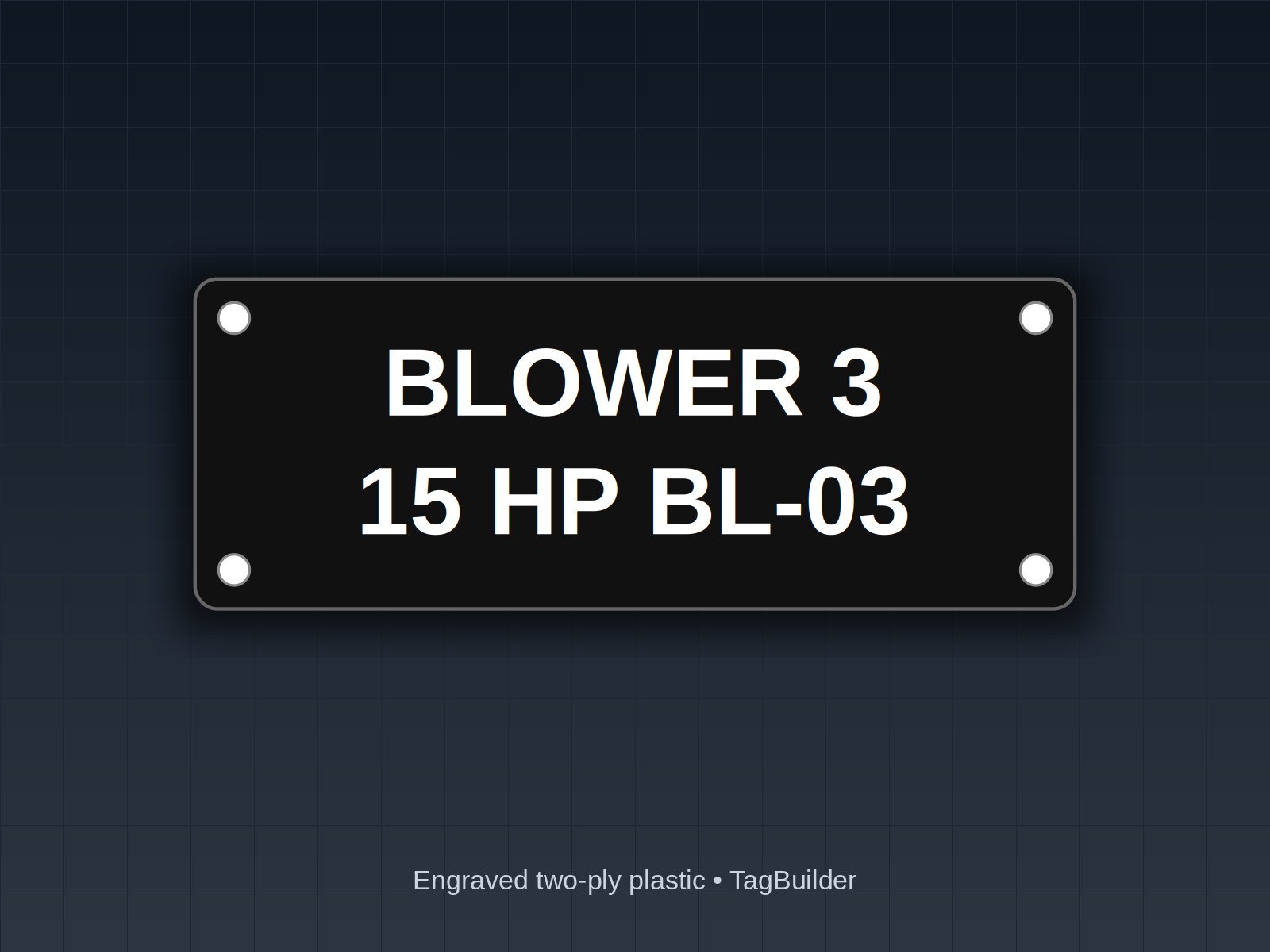
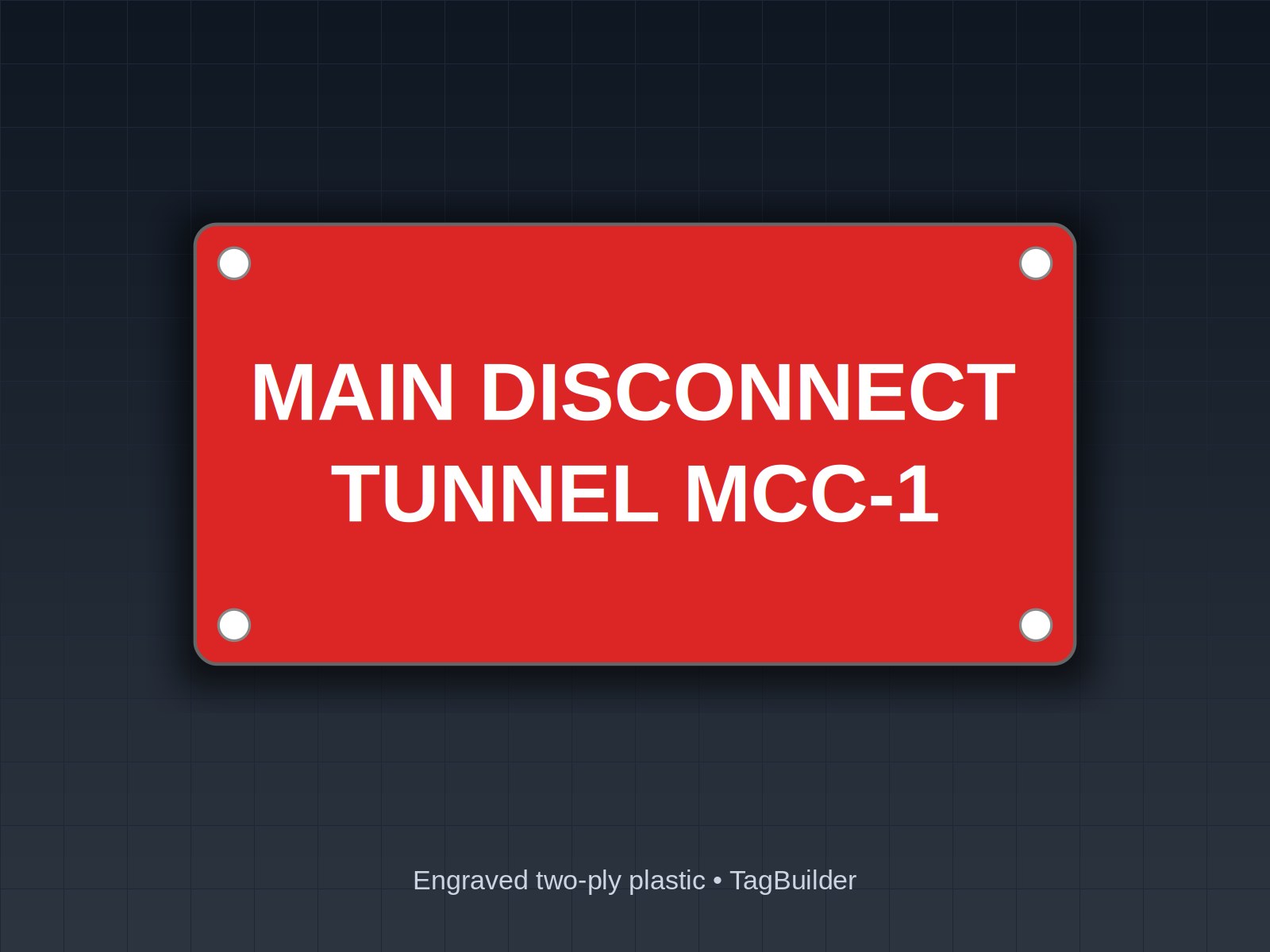
| Electrical | DISC-## / MCC-## | White on black | DISC-03 BLOWER 1 |
| Lockout points | LOTO-## matches the energy source | Black on yellow | LOTO-03 BLOWER DISCONNECT |
| Emergency stop | ESTOP-## | White on red | ESTOP-01 ENTRANCE |
Worked example: a one-page standard you can copy
The text below is a plain starting point. Change the prefixes and colors to match your chain, then make it the first page of every site's equipment binder.
- Numbering: Count from the entrance to the exit, left to right facing travel. Two digits always: 01, 02, 03.
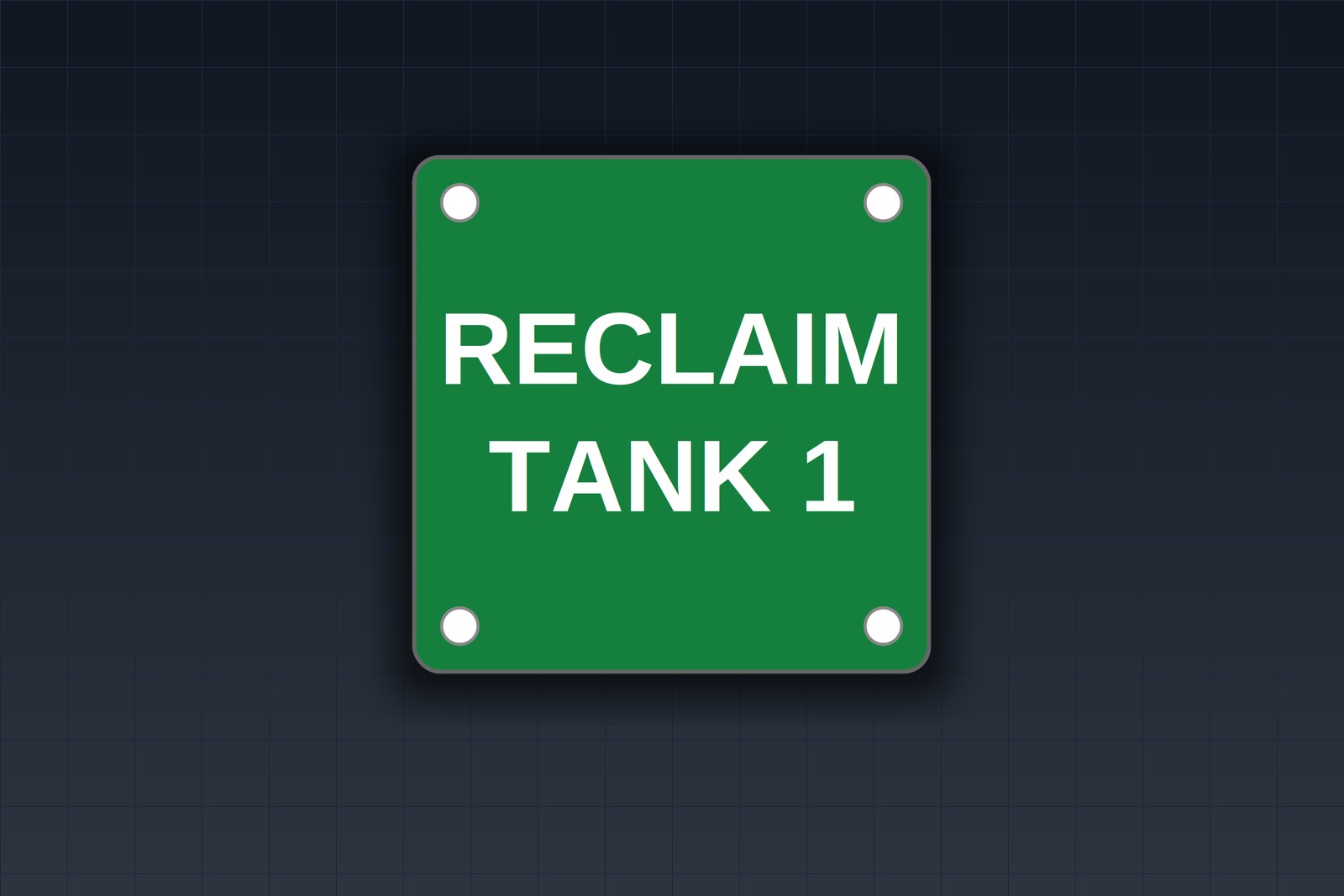
- Water: PMP-01 to PMP-nn for pumps, V-01 to V-nn for valves. White on blue. Example: PMP-02 LEAD PUMP, V-14 RECLAIM SUPPLY.
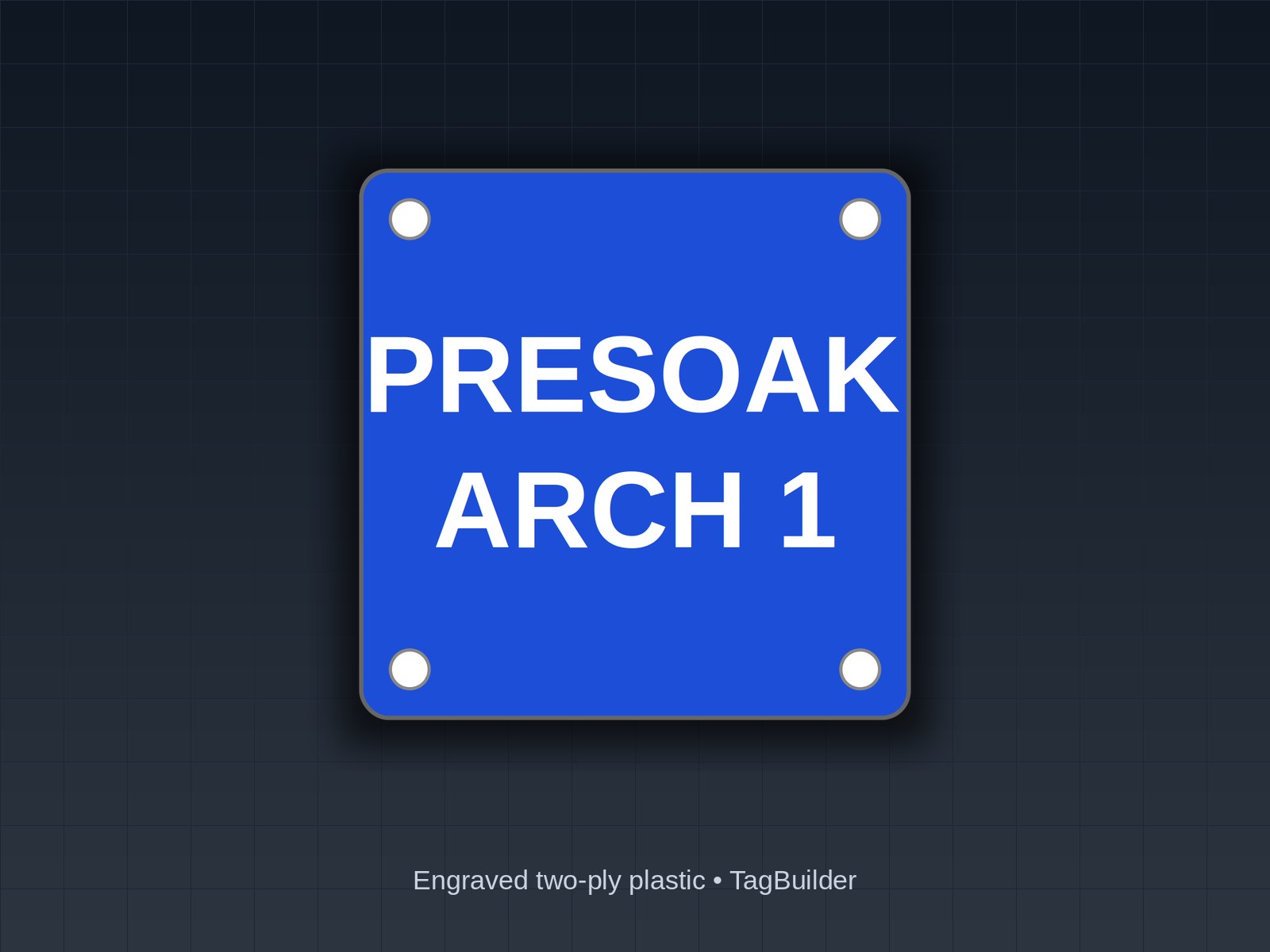
- Chemical: CHM-01 to CHM-nn, followed by the product name in capitals. Black on white. Example: CHM-01 PRESOAK.
- Electrical: DISC-## for disconnects, MCC-## for control centers, VFD-## for drives. White on black. Example: VFD-02 DRYER 2.
- Lockout points: LOTO-## on the device the procedure tells the tech to lock. Black on yellow. Example: LOTO-03 BLOWER DISCONNECT. The ID matches the written energy control procedure for that machine.
- Emergency stop: ESTOP-## with the location. White on red. Example: ESTOP-02 EXIT.
- Plates: 4 x 2 inch for enclosures and disconnects, 2 inch circle for valves, 30 mm ring for small items like blower or sample valves.
- Rule: No site creates its own ID. A new ID request goes to the maintenance director, who updates this page.
For the pump plates, the lead pump label in 4 x 2 inch white on blue with mounting holes is a ready example of the water-system format. For valves, the 2 inch circle valve tag, drain, white on black shows the size and legend style. For blower and small-equipment tags, there is a 30 mm ring tag for blowers.
Build the master list once, then one order per site
The master list is a spreadsheet with one row per label: ID, legend text, plate size, color, mounting, and quantity. Build it for your most typical tunnel. Each site then gets a copy with rows added or removed to match its actual equipment.
That gives you an order per site, but the part numbers are shared. When a site needs a replacement for PMP-02, the reorder is the same part number every time and the plate arrives in the right size. Our guide to specifying engraved labels on drawings and BOMs covers how to carry those numbers into your drawing set.
New builds versus retrofits and acquired sites
New builds
Send the site's equipment list with the equipment order, so the plates arrive with the equipment and the install crew mounts them before opening. Labels added after opening tend to be skipped. Put the label list in the construction checklist, next to commissioning.
Retrofits and acquired sites
Start with a walk-down. A regional tech walks the tunnel and equipment room with the master list and a clipboard, writes the new ID next to each existing item, and flags anything not on the list. Then you order, and the swap happens in one visit.
Two things to watch on acquired sites. First, the old numbering will still be in people's heads and in old work orders, so keep a short crosswalk (old name to new ID) on the equipment room door for a few months. Second, remove the old labels. Two numbering schemes on one wall is worse than either one alone.
For a deeper look at equipment room labels specific to washes, see the car wash equipment room labels guide.
Rollout order: safety first
If you cannot do everything at once, sequence it by consequence of getting it wrong.
- Safety and lockout points. Disconnects, emergency stops, and every device named in an energy control procedure. A plate such as the lockout tagout 4 x 2 inch black on yellow marks the spot. Your written procedure and training still do the actual work, and many AHJs and inspectors look at those first.
- Electrical. Panels, drives, and disconnects, so a tech can find the right one from the controller fault message.
- Chemical and water. Pumps, valves, and chemical lines. Check how 1910.1200 applies to your chemical containers and secondary containers with your safety professional, since that is separate from equipment ID plates.
Keeping the standard alive
A standard that lives in one person's head drifts back to chaos within a year. Three habits prevent that.
- Reorder by part number. Never by description. The master list is the only source.
- Keep a spares kit at each site. A small set of the most-replaced plates, so a damaged label is replaced the same week instead of being written on with a marker.
- Audit during routine visits. The regional tech checks the wall against the list. Anything missing goes on the next order.
Engraved text does not rub off like printed ink, but plates still get damaged by forklifts, pressure washers, and chemical splash, so plan for replacements.
Frequently Asked Questions
How do car wash chains standardize equipment?
They write a one-page standard covering numbering by tunnel position, a closed list of equipment IDs, one color per system, and set plate sizes. Then they build a master label list once and order each site from it, so every location uses the same IDs and the same reorder part numbers.
What should be in a car wash maintenance standard?
At minimum: the ID format for each system, the equipment list, the color scheme, plate sizes and mounting, and who is allowed to add a new ID. Many chains also link each lockout point ID to the written energy control procedure for that machine, so the label and the procedure use the same name.
How do you relabel an acquired car wash?
Walk the site with the master list, write the new ID beside each existing item, order from that marked-up list, and swap everything in one visit. Keep a short old-name-to-new-ID crosswalk posted for a few months, and take down the old labels so two schemes are not on the same wall.
How many labels does a car wash equipment room need?
It depends on the site, so count rather than guess. Every pump, valve, chemical line, disconnect, drive, and emergency stop on your master list gets one, plus the lockout points named in your energy control procedures. A walk-down gives you the real number for that site.
What should I label first at a car wash?
Start with lockout points and emergency stops, then electrical disconnects and panels, then chemical and water equipment. That order puts the highest-consequence mistakes first. Check the current edition of the rules that apply to you, and your AHJ, for anything specific to your site.
Send one site's equipment list and we'll turn it into a standard kit you can reorder for every location by one part number.
If you want a numbering scheme for the valve side, start with our guide to creating a valve numbering system. If you would like to see a plate in hand before you commit a chain-wide standard, send one legend and request a free sample.
UL, NFPA, NEC, ASME, CEMA, TIA, ANSI and OSHA are names or marks of their respective organizations; TagBuilder is not affiliated with or endorsed by any of them. Requirements above are paraphrased summaries, not the text of any standard. Always work from the current published edition and your AHJ.