Hazardous Location Labels: NEC 500 and 505 Class, Division and Zone Marking
The skid is wired and the enclosures are mounted, and now someone asks where the Class, Division, Group and temperature code are marked. The equipment markings come from the manufacturer, but the rest of the plate list is yours to get right.
Important Disclaimer
This article is provided for general informational purposes only and does not constitute legal, safety, or professional compliance advice. Regulations, standards, and codes are subject to change and may be interpreted differently by authorities having jurisdiction (AHJ). Always consult with qualified safety professionals, licensed engineers, or legal counsel to determine the specific requirements applicable to your facility. TagBuilder is not responsible for any actions taken based on this information.
Who marks what: equipment markings versus facility plates
On a midstream skid or compressor station, hazardous-area labeling falls into two groups. Keeping them separate prevents most of the arguments at inspection time.
- Equipment markings are applied by the manufacturer of the listed or evaluated product. They state what the device is built for.
- Facility-applied plates are added by the fabricator, panel shop or electrical contractor. They tell operators and maintenance crews what to do, where the boundaries are, and which conduit runs need attention.
NEC 500.8 covers equipment marking for the Class and Division system, and 505.9 covers it for the Zone system. Many AHJs also look at the area classification requirements in 500.5 and 505.5, but the classification itself comes from the project's area classification drawing, not from a plate.
What the equipment marking commonly includes
Paraphrasing the intent of 500.8 and 505.9, the marking on the equipment generally identifies:
- The Class (for gases and vapors, Class I).
- The Division (Division 1 or 2) or the Zone (0, 1 or 2).
- The Group (A through D for Divisions, IIA, IIB or IIC for Zones).
- The temperature class, the T-code such as T3 or T4, or an operating temperature.
- The ambient range where the equipment is rated for something other than the standard range.
Zone equipment is also commonly marked with a protection technique and an equipment protection level. Exact content varies by edition and by the type of protection, so read the current edition and the manufacturer's data rather than copying a marking from an old job.
Division versus Zone wording side by side
Many skids now mix Division-rated and Zone-rated components, especially with imported equipment. The table shows how the same idea is worded in each system. It is a plain-language comparison, not a conversion chart. Whether a Zone-marked device is acceptable in a Division-classified area is a question for the design engineer and the AHJ.
| Item | Division system (NEC 500) | Zone system (NEC 505) |
|---|---|---|
| Hazard class | Class I (gases, vapors) | Class I |
| Likelihood of hazard | Division 1 (normally present) or Division 2 (abnormal conditions only) | Zone 0, 1 or 2 |
| Gas grouping | Group A, B, C or D | Group IIC, IIB or IIA |
| Group D typical counterpart | Group D (propane, many natural gas applications) | Group IIA, commonly treated as the counterpart |
| Temperature | T-code, for example T3 | T-code, for example T3 |
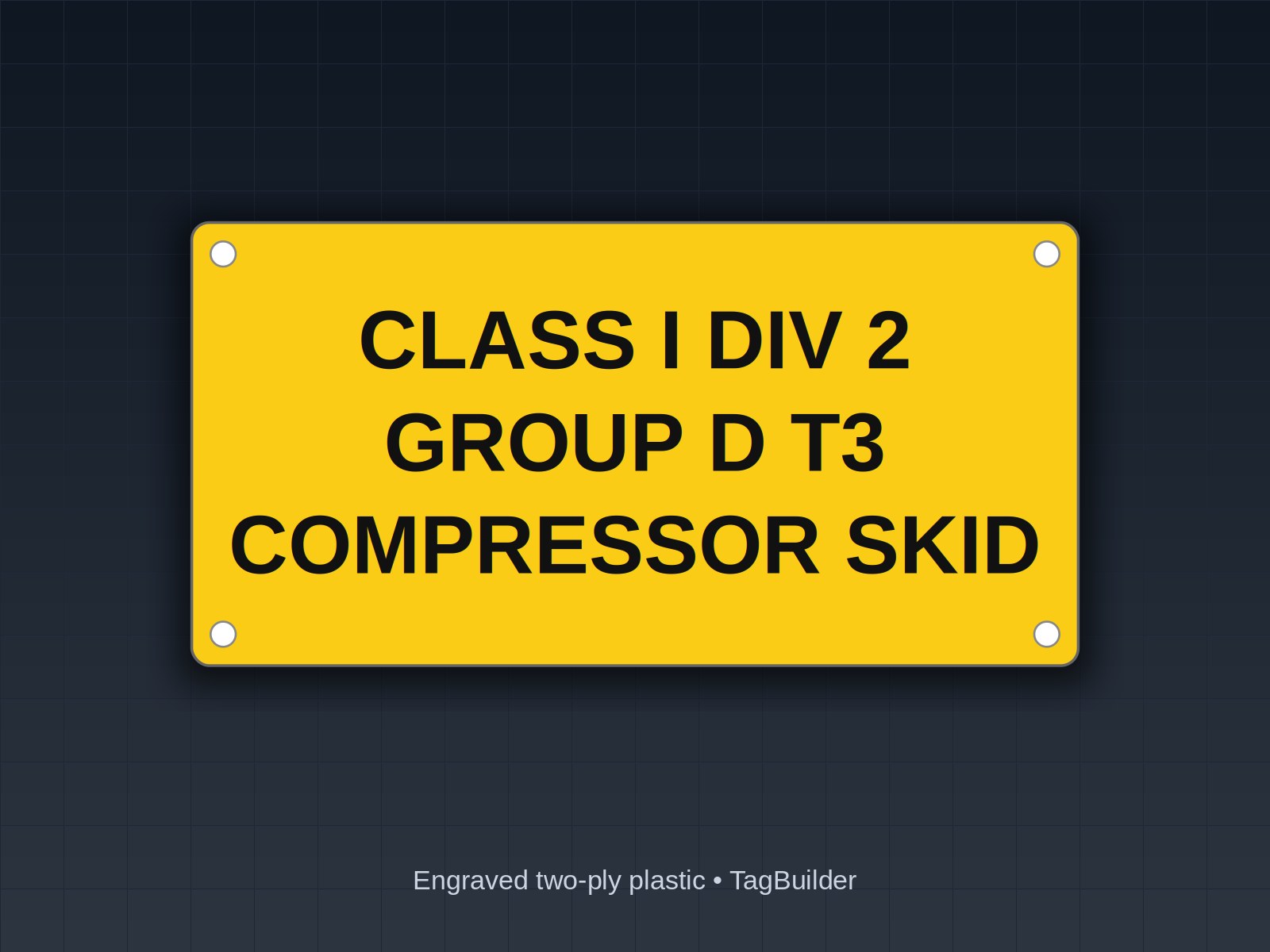
| Sample plate line | CLASS I, DIV 2, GROUP D, T3 | CLASS I, ZONE 2, GROUP IIA, T3 |
If your project drawing says Division 2 and the plate lists a Zone, stop and ask the engineer before engraving anything. A plate should repeat what the drawing says, not interpret it.
Facility-applied plates a shop adds
These are the plates that do not come from the equipment manufacturer. Wording is typically set by the project specification, so treat the examples as starting points.
Area classification boundary signs
A boundary sign marks the edge of a classified area on a fence, skid frame or building wall. It usually states the Class, Division or Zone and Group in short form, plus a plain instruction such as no ignition sources. Keep the text large enough to read from the approach path.
Seal-off (conduit seal) tags
Conduit seals limit the passage of gases and flames through raceways, and the rules sit in NEC 501.15 for Divisions and 505.16 for Zones. Many designs call for a seal within 18 inches of the enclosure, but the distance and the exceptions depend on the edition, the Division and the type of equipment. A tag at the seal fitting tells the next electrician not to open or modify it without the drawing in hand. Confirm the dimension on the project drawing, then put that same number on the tag.
Purge and pressurization panel warnings
Purged and pressurized enclosures follow NFPA 496, which describes Type X, Y and Z systems. A warning plate on the enclosure typically tells the operator to purge for the specified time before energizing and to treat loss of pressure as an alarm condition. Use the purge time and flow figures from the purge system manufacturer, not from a generic template.
Worked example: Class I, Division 2, Group D compressor skid
Here is a plate list for a gas compressor skid. The area classification drawing says Class I, Division 2, Group D, and the electrical equipment is T3 or cooler. Engrave as two-ply plastic for most items. Use engraved stainless for the exterior items that sit in weather, as described below.
| Plate | Wording | Placement |
|---|---|---|
| Area boundary sign | WARNING / CLASS I, DIV 2, GROUP D AREA / NO OPEN FLAME OR SPARK SOURCES | Skid perimeter at each access point, eye height |
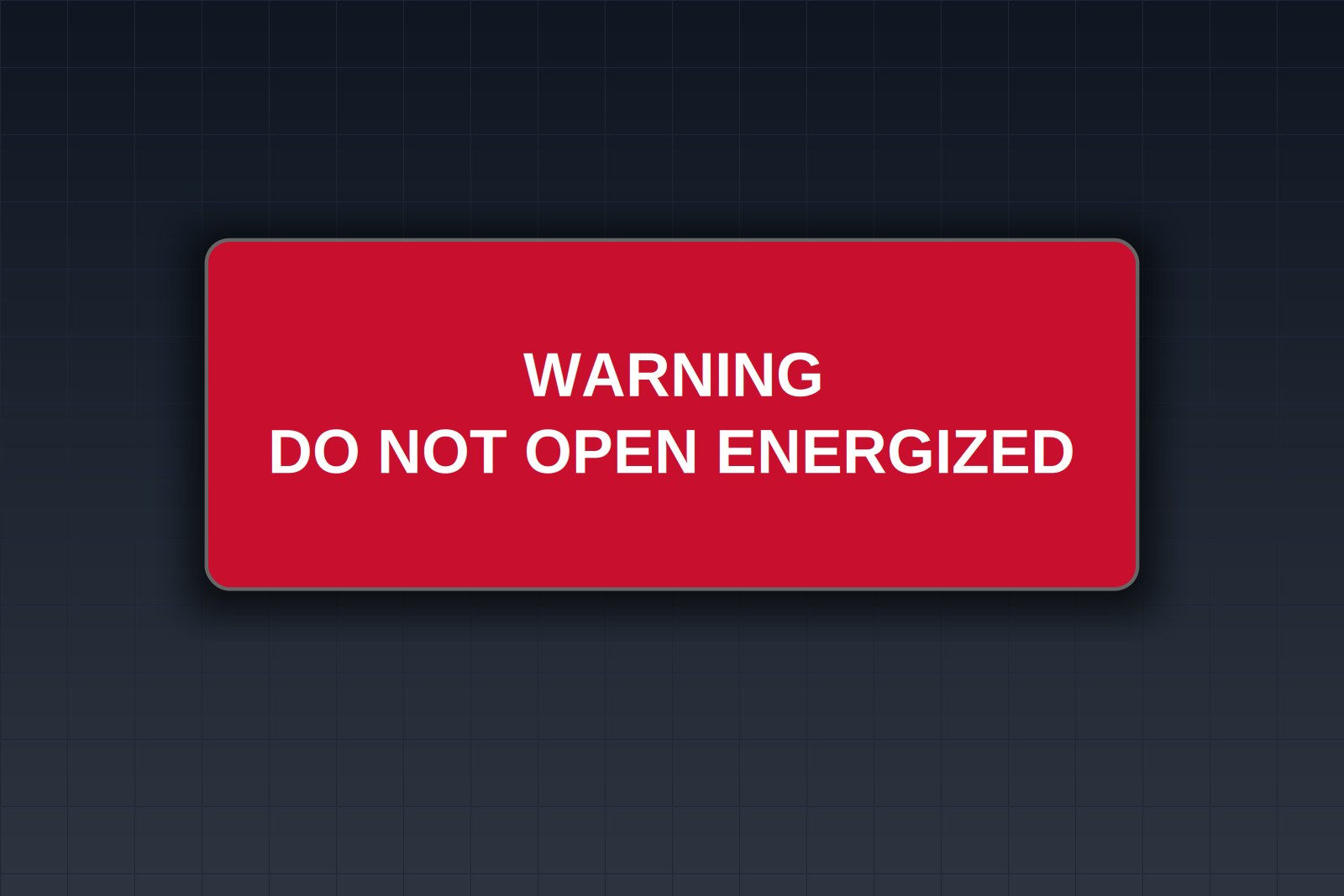
| Junction box warning | WARNING: DO NOT OPEN WHEN ENERGIZED | Cover of each junction box or enclosure not rated for opening live |
| Conduit seal tag | SEAL WITHIN 18 IN. DO NOT MODIFY. SEE DWG E-101 | On or beside each seal fitting, readable from the floor |
| Purge panel warning | WARNING: PURGE FOR SPECIFIED TIME BEFORE ENERGIZING. LOSS OF PRESSURE IS AN ALARM CONDITION | Door of the pressurized control enclosure |
| Equipment ID | CMP-101 / COMPRESSOR MOTOR / 480 V 3 PH | Motor starter enclosure door |
| Circuit tag | FEED FROM MCC-2, BKR 14 | Inside the enclosure, next to the disconnect |
Drawing numbers on seal tags are useful because they send the reader to the source document. For the equipment ID row, see our equipment ID plates.
Cautions and material choices
Three limits matter more than the wording.
- An engraved plate cannot replace the manufacturer's listing mark. If a device arrives without the markings required for the area, the answer is a different device or a documented evaluation, not a plate from a shop.
- Engraved plates never change a classification. They record it. The area classification drawing decides what applies, and if the plate and the drawing disagree, the drawing wins until the engineer says otherwise.
- Do not copy standard label artwork or layouts. Write your own concise wording and have the project engineer review it against the current edition and the AHJ.
When to specify stainless 316
For coastal sites, sour-gas service and other corrosive environments, 316 stainless is commonly chosen for exterior plates because it resists chloride and sulfide attack better than lighter metals. Fasten plates with stainless hardware, not with adhesive alone, on frames that vibrate. Engraved text does not rub off like printed ink, which helps on equipment that gets cleaned and handled. For a broader look at indoor and outdoor choices, see the indoor versus outdoor tag materials guide.
Frequently Asked Questions
Does NEC 500.8 require a plate from the shop?
No. The equipment marking requirement is about the equipment itself, and it is applied by the manufacturer. Shop-made plates cover the facility items such as boundary signs, seal tags and warnings, and the project specification usually defines them.
Can I use one plate for both Division and Zone?
Only if the drawing and the equipment support it, and only after the engineer and the AHJ agree. Mixing systems on one plate invites confusion, so most projects pick one system per area and mark to it.
What does the T-code on a plate mean?
It identifies the maximum surface temperature the equipment can reach, so it can be matched against the ignition temperature of the gas present. T3 means a lower surface temperature limit than T2, and T4 lower still. Use the figure printed on the equipment, not a figure from memory.
How far from the enclosure should the seal be?
Many designs use 18 inches, but the requirement depends on the edition, the Division and the type of equipment. Confirm it on the drawing and in the current NEC, then put that dimension on the tag.
Do purge warnings come from NFPA 496 or the NEC?
Both documents are involved. NFPA 496 covers purged and pressurized enclosures, and the NEC references it. Purge times and flow values come from the purge system manufacturer for that enclosure.
Which material should I pick for an outdoor skid?
Two-ply engraved plastic works for many indoor and sheltered locations. Engraved 316 stainless is the usual choice where salt, sour gas or heavy sun exposure is expected.
Order stainless and two-ply engraved hazardous-area plates for skids and enclosures.
If your plate list is ready, you can start with our warning plates, add panel nameplates for the control enclosures, or lay out custom wording in the rectangle lamacoid configurator.
UL, NFPA, NEC, ASME, CEMA, TIA, ANSI and OSHA are names or marks of their respective organizations; TagBuilder is not affiliated with or endorsed by any of them. Requirements above are paraphrased summaries, not the text of any standard. Always work from the current published edition and your AHJ.