Battery Room and UPS Battery Cabinet Labels: NEC 480, DC Arc Flash and Shock Warnings
The UPS battery cabinets in your electrical room have a DC disconnect and a vendor sticker, and you are not sure that is enough for a technician who has to work on a string at 2 a.m. Batteries cannot be switched off like an AC feeder, so the plates have to say what is still live.
Important Disclaimer
This article is provided for general informational purposes only and does not constitute legal, safety, or professional compliance advice. Regulations, standards, and codes are subject to change and may be interpreted differently by authorities having jurisdiction (AHJ). Always consult with qualified safety professionals, licensed engineers, or legal counsel to determine the specific requirements applicable to your facility. TagBuilder is not responsible for any actions taken based on this information.
The short answer: what a battery room or cabinet normally carries
For a stationary battery system such as a UPS, a DC plant or switchgear control power, a typical label set includes:
- A nominal DC voltage and shock / arc flash warning on each cabinet or string.
- A labeled battery disconnect that identifies which string or cabinet it serves.
- A no open flame / electrolyte caution where the battery chemistry calls for it.
- An emergency contact or procedure sign at the door.
- A note that tells the technician what stays energized after the disconnect is open.
The exact wording and placement come from the project specification, the battery manufacturer's instructions, NEC Article 480, NFPA 70E and your AHJ. Editions differ, so treat this article as a planning aid and check the current edition before you order plates.
Where the codes and standards come into it
NEC Article 480
Article 480 covers stationary storage batteries. It deals with things like battery locations, working space, overcurrent protection and a DC disconnecting means. Section numbers inside the article have moved between editions, so cite the one in force in your jurisdiction rather than a number from an older drawing. Lithium and other chemistries may be pulled into Article 706 or NFPA 855 instead. Our BESS labeling guide covers that side.
NEC 110.16 and 110.21(B)
These sections deal with arc flash warnings on certain equipment and with field-applied hazard markings. Many AHJs expect a battery cabinet that is serviced while energized to carry a hazard marking that is durable and legible for the environment. Whether 110.16 reaches your particular DC equipment is a point to confirm with your engineer or inspector.
NFPA 70E
NFPA 70E has a dedicated article on safety-related work requirements for batteries and battery rooms. It also sets out what an arc flash label commonly shows: the nominal system voltage, the arc flash boundary, and either the incident energy at a stated working distance or the required PPE information, depending on the edition and the method your facility uses. Annex material describes methods for estimating DC arc flash. The incident energy values on a label should come from a study, not from the label supplier.
Batteries are different from an AC feeder
Opening the disconnect on an AC feeder de-energizes everything downstream. With a battery string it does not. The jars, the inter-cell connectors and the conductors back to the disconnect stay at full string voltage, and a short circuit can deliver very high fault current for as long as the battery can supply it.
That is why a good battery label set does three things the AC side often does not:
- States the nominal DC voltage of the string, not just the UPS output voltage.
- Says plainly that the terminals and busbar remain energized with the disconnect open.
- Identifies which disconnect isolates which string, so a technician is not guessing in a room with several identical cabinets.
Servicing a battery string
Work on a string usually follows the manufacturer's procedure and your facility's electrical safety program. The labels support that procedure. They do not replace it.
- Before opening the cabinet: read the nominal voltage and arc flash plate on the door, and confirm the string ID matches the work order.
- Isolating the string: open the labeled disconnect, then apply a lockout device and a tag. A plain tag on a battery disconnect should name the string, not just the cabinet.
- Inside the cabinet: insulated tools and PPE chosen from your hazard assessment. Any exposed terminals are still live, so a caution plate on the inner barrier is useful.
- Return to service: remove your own lock and tag only, and log the change.
For lockout tags that suit this job, see our 6 x 3 inch lockout tag and the lockout category.
DC arc flash labeling
A DC arc is harder to extinguish than an AC arc because there is no current zero crossing. That makes the study more important, and it makes the label's data more important, too. The label should carry the numbers from your arc flash study for that string, along with the study date so the next person knows how current it is.
Because those numbers change when the battery is replaced, the string is reconfigured or the protective device is changed, many shops order a plate with the fixed text engraved and a fill-in area for the study data. A fill-in arc flash label works for that approach. More options are in the arc flash category.
Worked example: 480 V UPS with two 40-jar battery cabinets
Assume a UPS fed by two battery cabinets, each holding 40 twelve-volt jars in series, which gives a nominal 480 V DC per string. The cabinets are paralleled through a DC disconnect. The values below are an example. Your voltage, string count and wording must come from your own drawings, study and manufacturer.
| Plate | Wording | Size | Colors | Mounting spot |
|---|---|---|---|---|
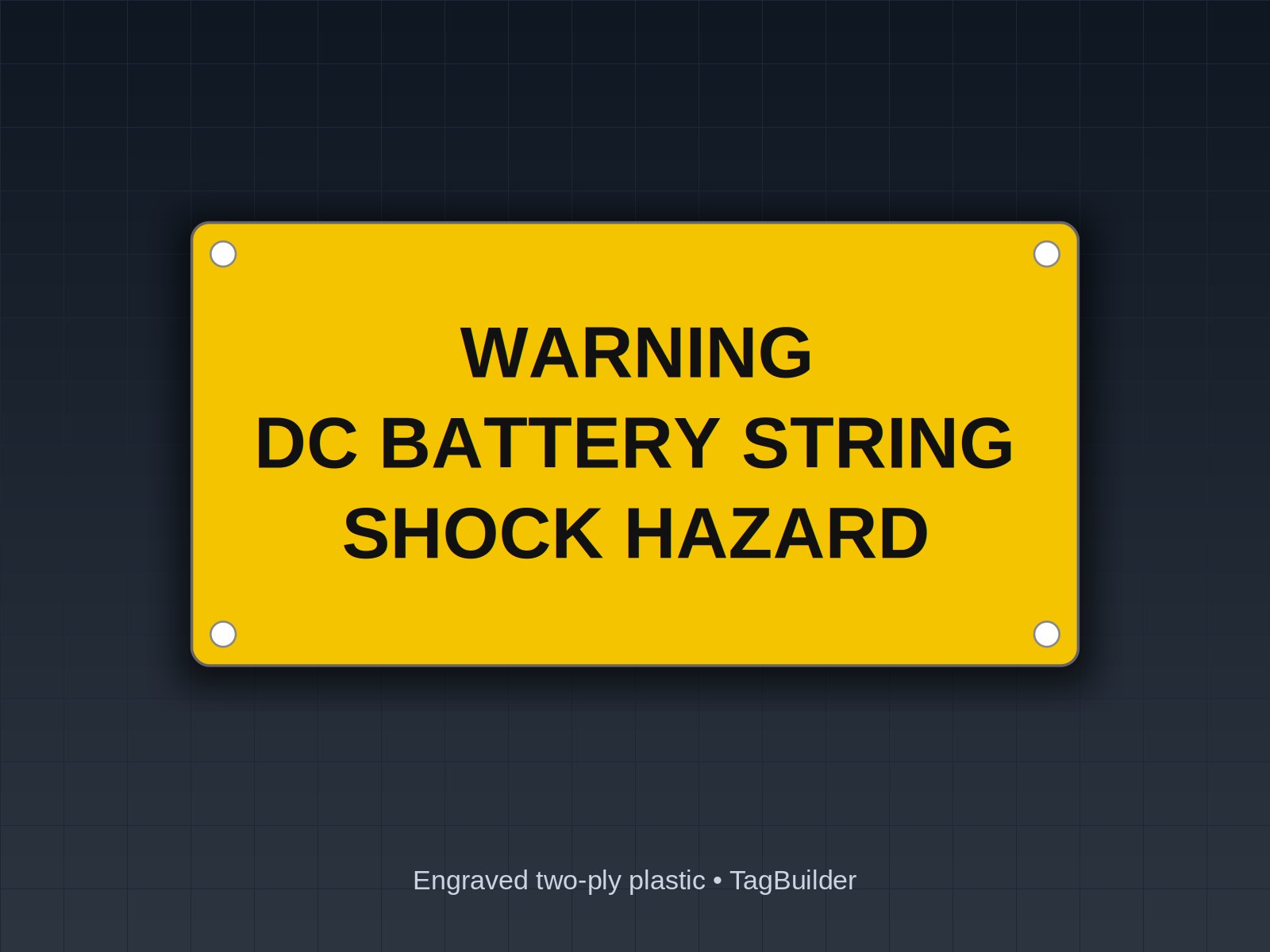
| 1. Shock warning | WARNING / SHOCK HAZARD / 480 V DC NOMINAL / BATTERY STRING | 4 x 2 in | Black on yellow | Front door of each cabinet |
| 2. DC arc flash | ARC FLASH AND SHOCK HAZARD / 480 V DC NOMINAL / BOUNDARY ___ / INCIDENT ENERGY ___ AT ___ IN / STUDY DATE ___ | 6 x 4 in | Black on yellow | Front door, beside plate 1 |
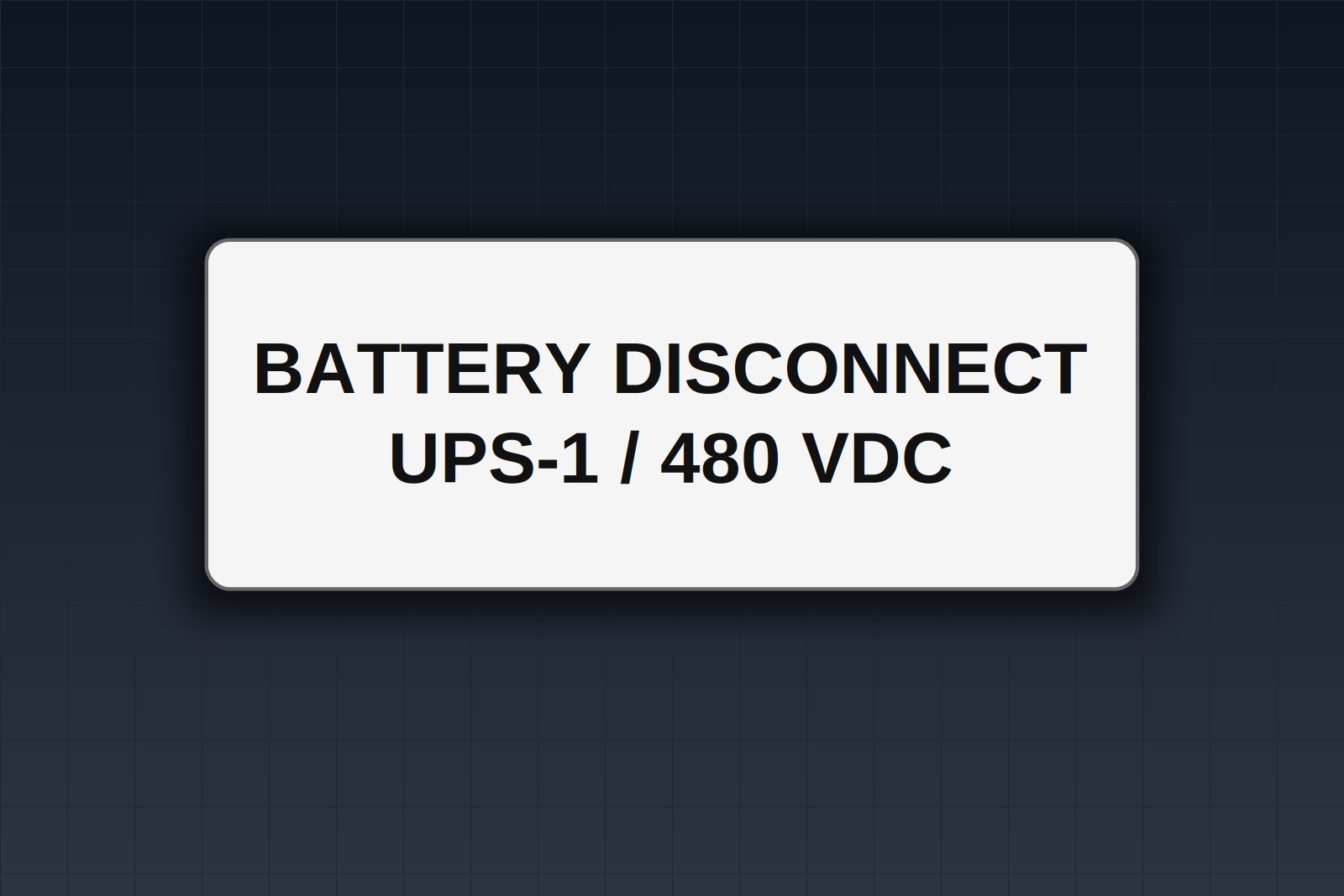
| 3. Disconnect ID | BATTERY DISCONNECT / UPS-1 / STRINGS A AND B | 4 x 2 in | White on black | On the DC disconnect enclosure |
| 4. Still energized | CAUTION / BATTERY TERMINALS REMAIN ENERGIZED WHEN DISCONNECT IS OPEN | 4 x 2 in | Black on yellow | Inside barrier or under the door, near the terminals |
| 5. Flame and electrolyte | CAUTION / NO OPEN FLAME OR SPARKS / ELECTROLYTE HAZARD | 4 x 2 in | White on red | Cabinet door and battery room door |
| 6. Lockout tags | DANGER / DO NOT OPERATE / STRING A (or B) LOCKED OUT | 6 x 3 in | Black on yellow | Hung on the disconnect at lockout, stored with the LOTO kit |
| 7. Emergency contact | BATTERY ROOM EMERGENCY / FACILITIES CONTROL / PHONE ___ | 6 x 3 in | White on blue | Outside the room door |
That is seven items for a small installation. A larger room with more cabinets simply repeats plates 1 through 5 per cabinet and adds a one-line string ID to each.
Identifier scheme you can copy
- Room: BR-1
- Cabinet: BR-1-C1, BR-1-C2
- String: BR-1-C1-S1
- Disconnect: BR-1-DC1
Use the same ID on the plate, the one-line diagram, the lockout procedure and the maintenance log. A scheme that matches in all four places prevents more errors than any extra warning text.
Material and mounting notes
Battery rooms can be humid, and cabinets may see electrolyte spray or cleaning chemicals. Engraved two-ply plastic does not rub off the way printed ink can, and engraved stainless is an option for harsher rooms. For flat cabinet doors, adhesive-backed plates are common. For textured or powder-coated surfaces, or where the plate has to survive years of wiping, screws or rivets are a better choice. Keep plates out of the path of the door hinge and away from vent openings.
Frequently Asked Questions
What labels are required on a UPS battery room?
There is no single list that applies everywhere. A set that many facilities use includes a voltage and shock warning, an arc flash label, a labeled disconnect, a no open flame caution where relevant, and an emergency contact sign. Your project spec, the manufacturer, NEC Article 480, NFPA 70E and the AHJ decide the exact requirements.
Do battery cabinets need an arc flash label?
Many AHJs and safety programs expect one when the cabinet may be worked on energized. The label's values should come from an arc flash study of the DC system. Ask your engineer whether 110.16 or your facility's program drives it in your case.
Does opening the battery disconnect make the cabinet safe?
No. It isolates the string from the load, but the jars, connectors and the conductors on the battery side stay energized. The label should say so, and the work procedure should treat the terminals as live.
What should a battery disconnect label say?
At minimum, identify the equipment it serves, such as the UPS and string IDs, and its function as a battery disconnect. Add a line about energized terminals if the disconnect does not isolate the whole battery. Match the ID to your drawings.
Can I use one label for the whole room?
A room sign at the door is useful, but it does not replace markings on each cabinet or string. A technician working in front of a cabinet needs the voltage and hazard information right there.
How do I lock out a battery string?
Open the labeled disconnect, apply your lock and tag, and then follow your facility's procedure and the manufacturer's instructions for verifying the state of the equipment. A lockout tag that names the string is more useful than a generic one.
Send us your battery room list and we will quote the full set of engraved plates, with a free sample plate on request.
If your system is grid-scale, outdoors or lithium-based, start with our guide to BESS battery energy storage labels under NEC 706 and NFPA 855. For the disconnect plates in the example above, browse the disconnect labels, and you can request a free sample plate to check size and legibility on your own cabinet.
UL, NFPA, NEC, ASME, CEMA, TIA, ANSI and OSHA are names or marks of their respective organizations; TagBuilder is not affiliated with or endorsed by any of them. Requirements above are paraphrased summaries, not the text of any standard. Always work from the current published edition and your AHJ.