Fire Sprinkler Control Valve Signs: What NFPA 13 Expects on Control, Drain and Test Valves
You open the riser room before an acceptance test or annual inspection and find five control valves, and nothing on the wall says which part of the building each one shuts down.
Important Disclaimer
This article is provided for general informational purposes only and does not constitute legal, safety, or professional compliance advice. Regulations, standards, and codes are subject to change and may be interpreted differently by authorities having jurisdiction (AHJ). Always consult with qualified safety professionals, licensed engineers, or legal counsel to determine the specific requirements applicable to your facility. TagBuilder is not responsible for any actions taken based on this information.
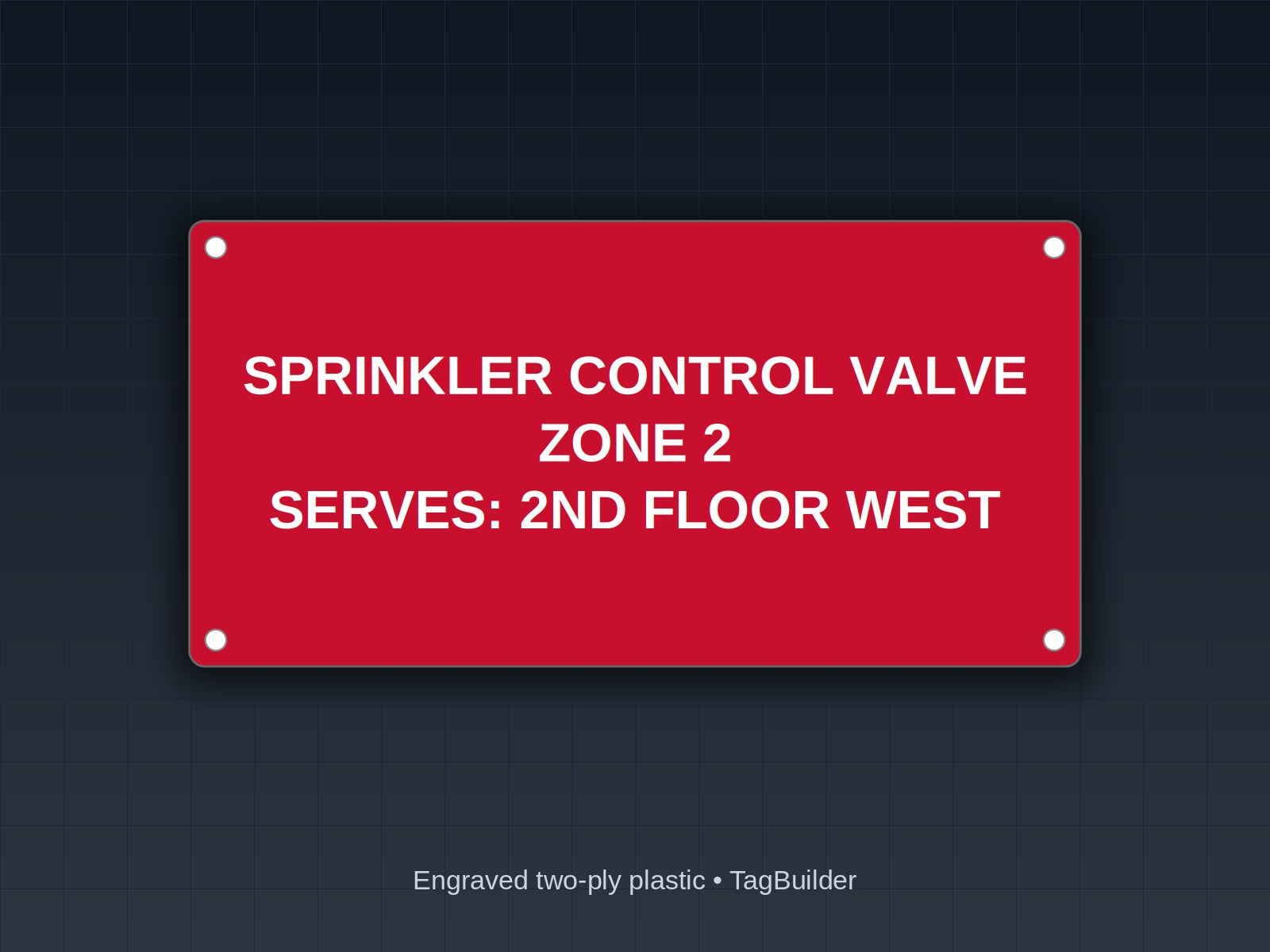
A sprinkler control valve sign should name the valve's function, the system or zone it belongs to, and the area it shuts down, for example SPRINKLER CONTROL VALVE, ZONE 2, SERVES 2ND FLOOR WEST. NFPA 13 commonly calls for permanently marked, weatherproof signs of metal or rigid plastic on control, drain, test connection and venting valves, fastened with corrosion-resistant wire, chain or another suitable method. Where a building has more than one control valve, the signs commonly need to say which portion of the system each one controls.
Why the wording matters more than the sign itself
A valve that is only labeled VALVE tells a responder nothing. During a fire, or during a planned impairment, someone has to decide in seconds which handwheel to close or leave open. If the signs are missing or vague, the usual outcomes are a wrong valve closed, an occupied area left without protection, or a valve left shut after work because nobody could tell what it fed.
The cost shows up on paper too. An inspector who finds unmarked or illegible signs writes it up, and an open write-up can hold an acceptance sign-off or a certificate of occupancy until it is corrected. Signs are cheap to fix before the visit and slow to fix after it.
What the standards commonly expect
This is a paraphrase, not the text. The identification requirement sits in the valve provisions of NFPA 13, and the section number moves between editions, so check the edition your AHJ enforces before you quote a number on a submittal.
- Which valves: control valves, drain valves, test connection valves and venting valves are commonly included.
- What the sign is: permanently marked, weatherproof, metal or rigid plastic. Paper labels and tape do not fit that description.
- How it is attached: corrosion-resistant wire, chain or another suitable method that keeps it with the valve.
- Multiple control valves: the sign commonly needs to indicate the portion of the system that valve controls.
- Ongoing checks: NFPA 25 inspections look for signs that are present, legible and still on the right valve.
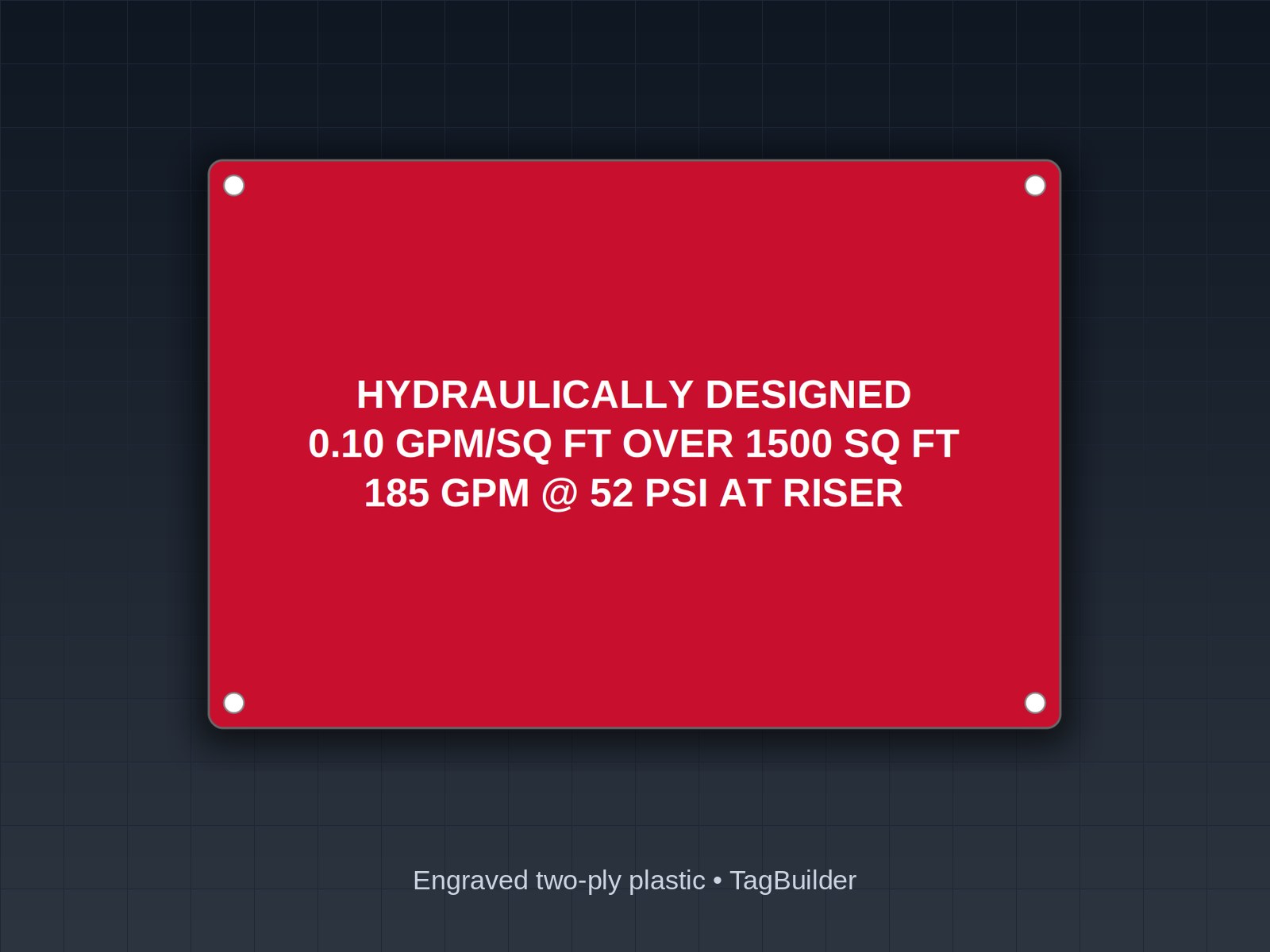
Some fire departments add their own rules on letter height, wording or color. Ask the fire marshal's office early, because a local rule overrides your habit. Hydraulic design data is a separate sign with its own content, covered in our hydraulic design information sign guide.
Sign wording by valve type
The table below lists each common sprinkler valve, the wording that tells a reader what it does and what it serves, and a suggested size. The sizes are shop suggestions for readability, not code minimums.
| Valve type | Sign wording | Suggested size |
|---|---|---|
| Zone control valve | SPRINKLER CONTROL VALVE / ZONE 2 / SERVES 2ND FLOOR WEST | 6 x 3 in, 0.5 in letters or larger |
| Main control valve | MAIN SPRINKLER CONTROL VALVE / SERVES ENTIRE BUILDING | 6 x 3 in |
| Main drain | MAIN DRAIN / SPRINKLER SYSTEM | 4 x 2 in |
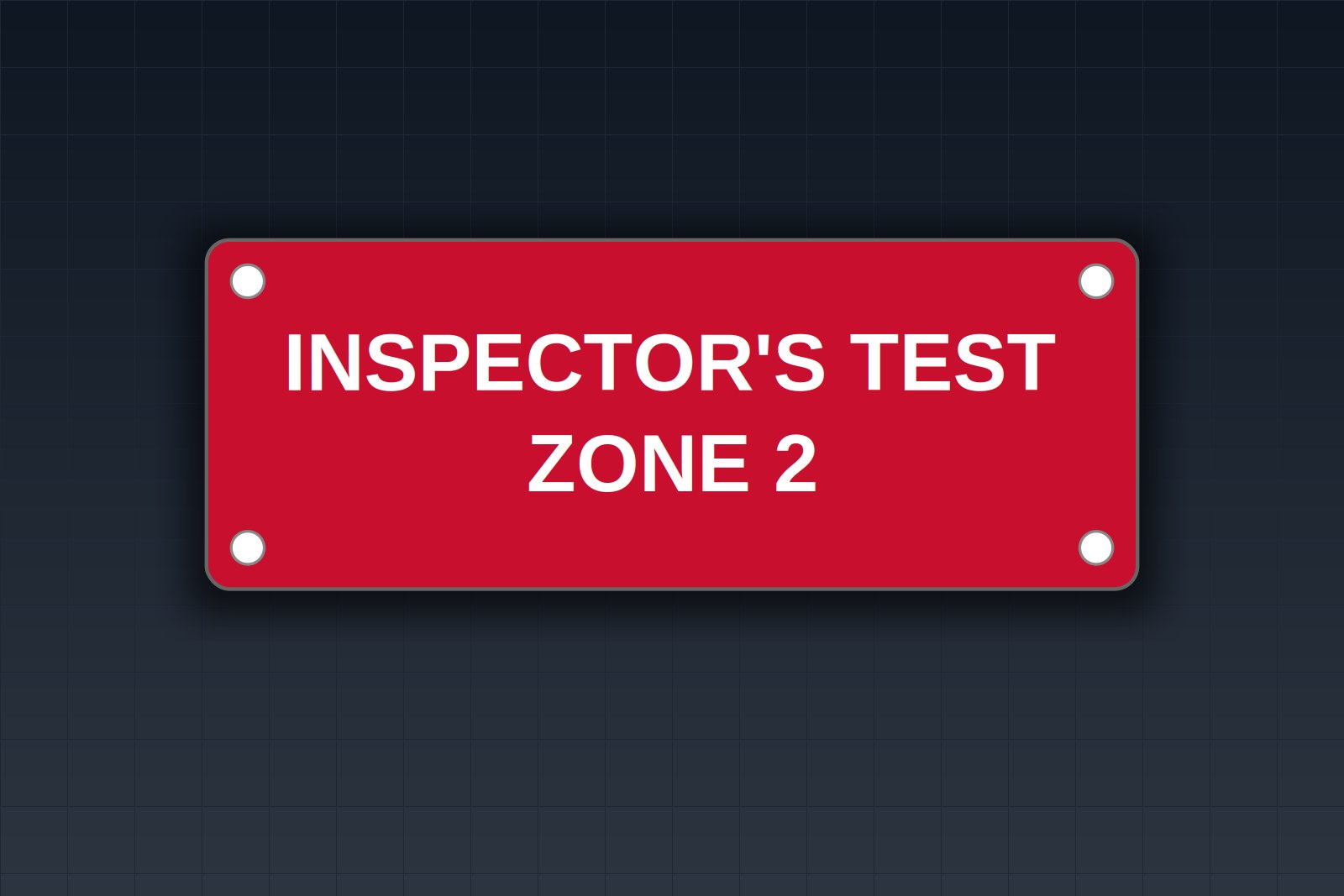
| Inspector's test | INSPECTOR'S TEST / ZONE 2 | 4 x 2 in |
| Auxiliary drain | AUXILIARY DRAIN / ZONE 2 / LOW POINT, 2ND FLOOR WEST CORRIDOR | 4 x 2 in |
| Alarm valve | ALARM CHECK VALVE / ZONE 2 | 4 x 2 in or 6 x 3 in |
| Dry-pipe valve | DRY PIPE VALVE / SERVES LOADING DOCK | 6 x 3 in |
| Fire department connection | FDC SERVES ZONES 1-4 (or the area it feeds) | 8 x 4 in, outdoors |
| Small valves (gauge, vent, test) | Short tag: ZONE 2 TEST, ZONE 2 VENT | 2 in round tag |
Control valves: system, zone and area served
Write the sign in three lines: the function, the zone or system, and the area. Use the same zone names that appear on the as-built drawings and the riser diagram, so the sign, the paperwork and the building all agree. If a floor is split east and west, say so. If the zone covers a mechanical room or a stairwell, name it, because that is what a responder will recognize.
Where the building has a numbering convention for other valves, follow it. Our valve numbering system guide covers how to build one that stays readable across several systems.
Drain, test, auxiliary drain and vent valves
These get overlooked because they are small and often behind other piping. A main drain sign should say which system it drains. An inspector's test sign should name the zone, since the test valve is what proves flow and alarm for that zone. Auxiliary drains sit at trapped low points, so add a location phrase; a person with a hose and a wrench should not have to guess which of three drains belongs to which section of pipe.
Dry-pipe and alarm valves usually carry a larger sign because the trim around them is crowded. For anything too small for a sign, use a tag: the 2-inch round FIRE PROT valve tag fits gauge and vent valves, and the attachment methods guide explains chain and wire choices.
Color, material and mounting
White on red is the common choice for fire protection, and it reads well in a dim riser room. The signs are engraved two-ply plastic, so the text is cut into the surface rather than printed on it, and it does not rub off like printed ink. Engraved stainless is available where the room is wet, outdoors or washed down.
Hang a sign where it can be read with the valve in either position, and attach it to the valve or the pipe next to it rather than to a wall that may be repainted or moved. If a valve is behind a door or above a ceiling, the sign goes where the valve is, and an access note on the door helps.
Stock signs to start with
If your wording is standard, the stock SPRINKLER RISER sign in 4 x 2 inch white on red with mounting holes covers the basics. For zone and area wording, build a custom plate in the rectangle configurator and type the lines exactly as they should read.
Worked example: a four-zone riser room
Take a two-story building with one main control valve and four zone control valves: Zone 1 first floor east, Zone 2 first floor west, Zone 3 second floor east, Zone 4 second floor west. Each zone has an inspector's test and an auxiliary drain, and the building has an FDC at the street. This list is complete enough to copy line for line; all signs are white on red.
| Qty | Line 1 | Line 2 | Line 3 | Size |
|---|---|---|---|---|
| 1 | MAIN SPRINKLER CONTROL VALVE | SERVES ENTIRE BUILDING | 6 x 3 in | |
| 1 | SPRINKLER CONTROL VALVE | ZONE 1 | SERVES 1ST FLOOR EAST | 6 x 3 in |
| 1 | SPRINKLER CONTROL VALVE | ZONE 2 | SERVES 1ST FLOOR WEST | 6 x 3 in |
| 1 | SPRINKLER CONTROL VALVE | ZONE 3 | SERVES 2ND FLOOR EAST | 6 x 3 in |
| 1 | SPRINKLER CONTROL VALVE | ZONE 4 | SERVES 2ND FLOOR WEST | 6 x 3 in |
| 1 | MAIN DRAIN | SPRINKLER SYSTEM | 4 x 2 in | |
| 4 | INSPECTOR'S TEST | ZONE 1 through ZONE 4, one each | 4 x 2 in | |
| 4 | AUXILIARY DRAIN | ZONE 1 through ZONE 4, one each | LOCATION IF REMOTE | 4 x 2 in |
| 1 | FIRE DEPARTMENT CONNECTION | SERVES ZONES 1-4 | 8 x 4 in |
That is 18 signs. Add a few 2-inch round FIRE PROT tags for gauge and vent valves, each marked with its zone. Before you order, walk the room with the drawings and confirm that every zone name on the plates matches the riser diagram.
A pre-inspection walk-through
- Every control, drain, test and vent valve has a sign or tag.
- Each zone control sign names the zone and the area served.
- Signs are on the right valve and match the drawings.
- Attachment is corrosion resistant and the sign cannot slide off.
- Text is legible from where a person would stand to operate the valve.
- Any local fire department wording or letter-height rule has been checked.
Frequently Asked Questions
What does a sprinkler control valve sign need to say?
At minimum it should say what the valve is and what it controls. In practice that means the function (SPRINKLER CONTROL VALVE), the system or zone, and the area served. Check the current NFPA 13 edition and your AHJ for any added wording.
Does NFPA 13 require valve identification signs?
NFPA 13 commonly requires permanently marked signs on control, drain, test connection and venting valves. The section number differs between editions, so confirm against the edition your AHJ has adopted.
Do I need a sign on every sprinkler valve, or just control valves?
Control valves are the priority, but drain, test connection and venting valves are commonly included in the same requirement. Small trim valves are often handled with tags. Ask your AHJ if you are unsure where the line falls.
What color should fire sprinkler valve signs be?
White on red is the common choice for fire protection equipment. Some jurisdictions have their own preferences, so verify locally.
What material should a sprinkler valve sign be made of?
The standard commonly calls for weatherproof metal or rigid plastic. Engraved two-ply plastic is typical indoors, and engraved stainless suits wet or outdoor locations.
How do I mark multiple control valves so the right one gets closed?
Give each valve a zone name and an area served, and use the same names on the riser diagram and in the impairment procedure. The wording on the sign should let someone decide without looking up a drawing.
Send us one control valve's zone and area and we'll engrave a sample sign and mail it, no charge.
If you need a quick tag for a small valve, the 2.5-inch FIRE valve tag is a larger option, and the attachment methods guide covers how to hang it. You can also request a free sample to check the lettering and fit in your own riser room.
UL, NFPA, NEC, ASME, CEMA, TIA, ANSI and OSHA are names or marks of their respective organizations; TagBuilder is not affiliated with or endorsed by any of them. Requirements above are paraphrased summaries, not the text of any standard. Always work from the current published edition and your AHJ.