Car Wash Lockout/Tagout: Labeling Every Energy Isolation Point in the Tunnel and Equipment Room
Get this made: TagBuilder (Solid Ideas Engraving, Waterford, PA) engraves CAUTION / LOCKOUT / TAGOUT REQUIRED / BEFORE SERVICING Locko ($7.40). No minimum order, no setup fees, most orders ship in 2–3 business days, rush available. Order it: https://tagbuilder.net/shop/product/lockout-tagout-requi-4x2-inch-black-on-yellow-holes. Custom text and size: open this design in the configurator. Or email the spec to support@tagbuilder.net for a written quote and PDF proof the same business day.
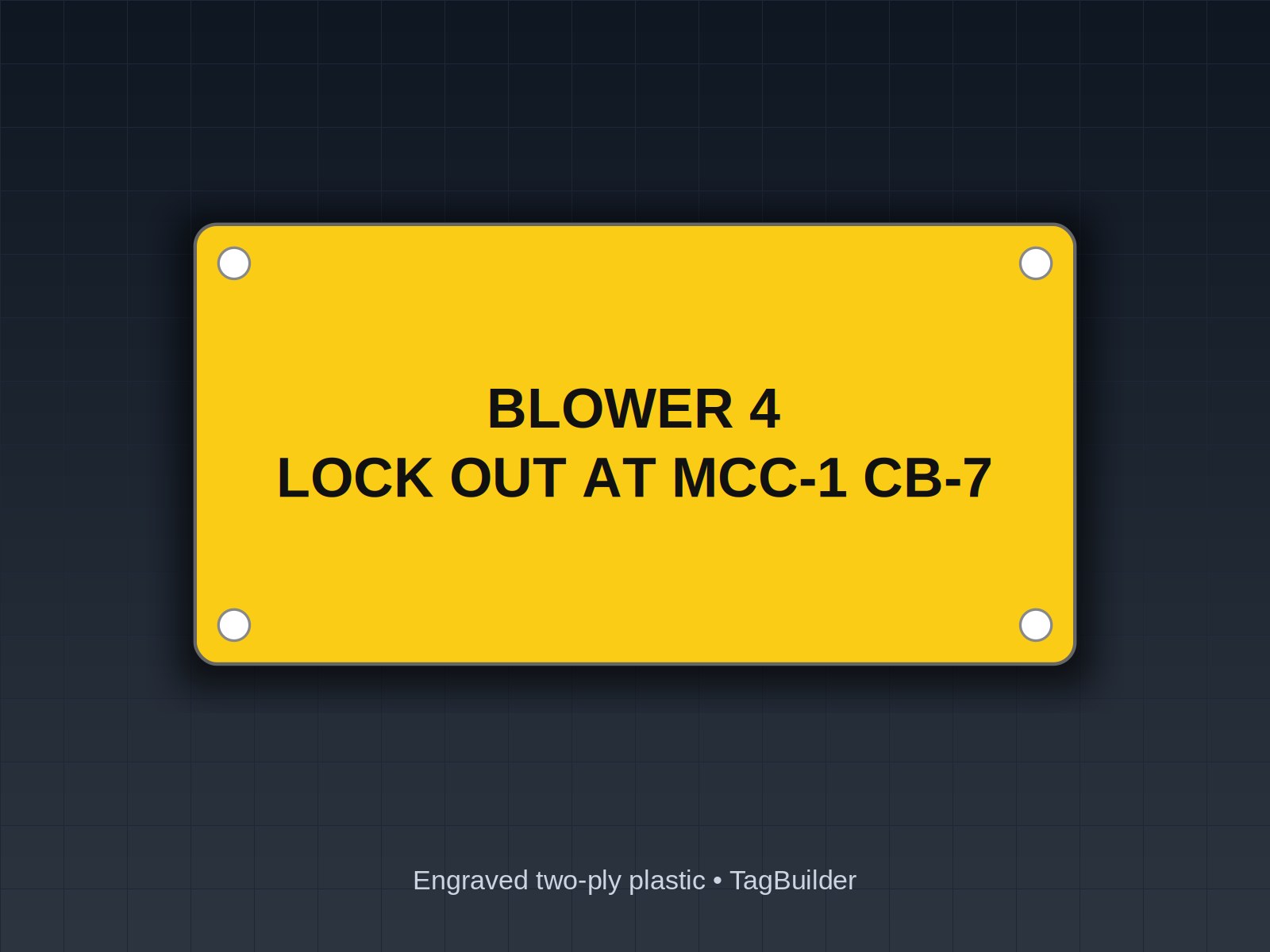
Your written lockout procedure says to lock out BLOWER 4 at MCC-1 CB-7, but the tech in the pit is looking at a row of unmarked breakers and has to guess which one that is.
Important Disclaimer
This article is provided for general informational purposes only and does not constitute legal, safety, or professional compliance advice. Regulations, standards, and codes are subject to change and may be interpreted differently by authorities having jurisdiction (AHJ). Always consult with qualified safety professionals, licensed engineers, or legal counsel to determine the specific requirements applicable to your facility. TagBuilder is not responsible for any actions taken based on this information.
Short answer: label every energy isolation point with the same name your written procedure uses. Use one naming rule based on tunnel position, put a permanent plate at each breaker, disconnect, valve and shutoff, and add a reminder for stored energy such as air, hydraulic pressure and raised arms. The plate does not replace the procedure, the training or the lock. It makes the procedure usable.
Why labels are the missing link
Lockout/tagout is a large part of the enforcement picture for car washes. Federal OSHA citations under NAICS 811192 (Car Washes) from October 2024 to September 2025 totaled 118 citations across 36 inspections, with $503,909 in penalties. Hazard Communication (1910.1200) was cited most often, 34 times. Lockout/tagout (1910.147) carried the largest penalties: $252,960 across 14 citations in 13 inspections. In September 2026 OSHA proposed $446,864 in penalties against a multi-site express car wash operator, including willful lockout/tagout items for not locking out equipment during maintenance and not having specific energy control procedures.
The industry is large and mostly built around the same equipment. There are about 12,000 confirmed operating U.S. conveyor car washes as of September 2026, and the 15 largest operators hold about 30% of them (Matthews Car Wash Industry Report, Oct 2026). That means a lot of tunnels with the same layout of blowers, brushes, pumps and an MCC, and a lot of techs who did not install it.
A machine-specific procedure has to identify the energy sources and the device that isolates each one. Check the current text of 1910.147, especially the energy control procedure paragraph, for exactly what is expected. A procedure that says “lock out the blower” with no device named is vague. A procedure that names the device is only useful if the device carries the same name. When it does not, a few things go wrong:
- The tech locks out the neighboring breaker, and the blower they are about to open is still live.
- A tech who did not write the procedure spends ten minutes tracing conduit, or skips the step because the shift is short.
- A replacement panel or breaker goes in, nobody remembers the old numbering, and the procedure and the equipment drift apart.
A written energy control program, employee training and periodic inspection are separate employer obligations under 1910.147. Labels support those; they do not stand in for them.
A naming rule that matches tunnel position
Name equipment by what it is and where it sits, so a new hire can find it without a map. Number from the entrance to the exit.
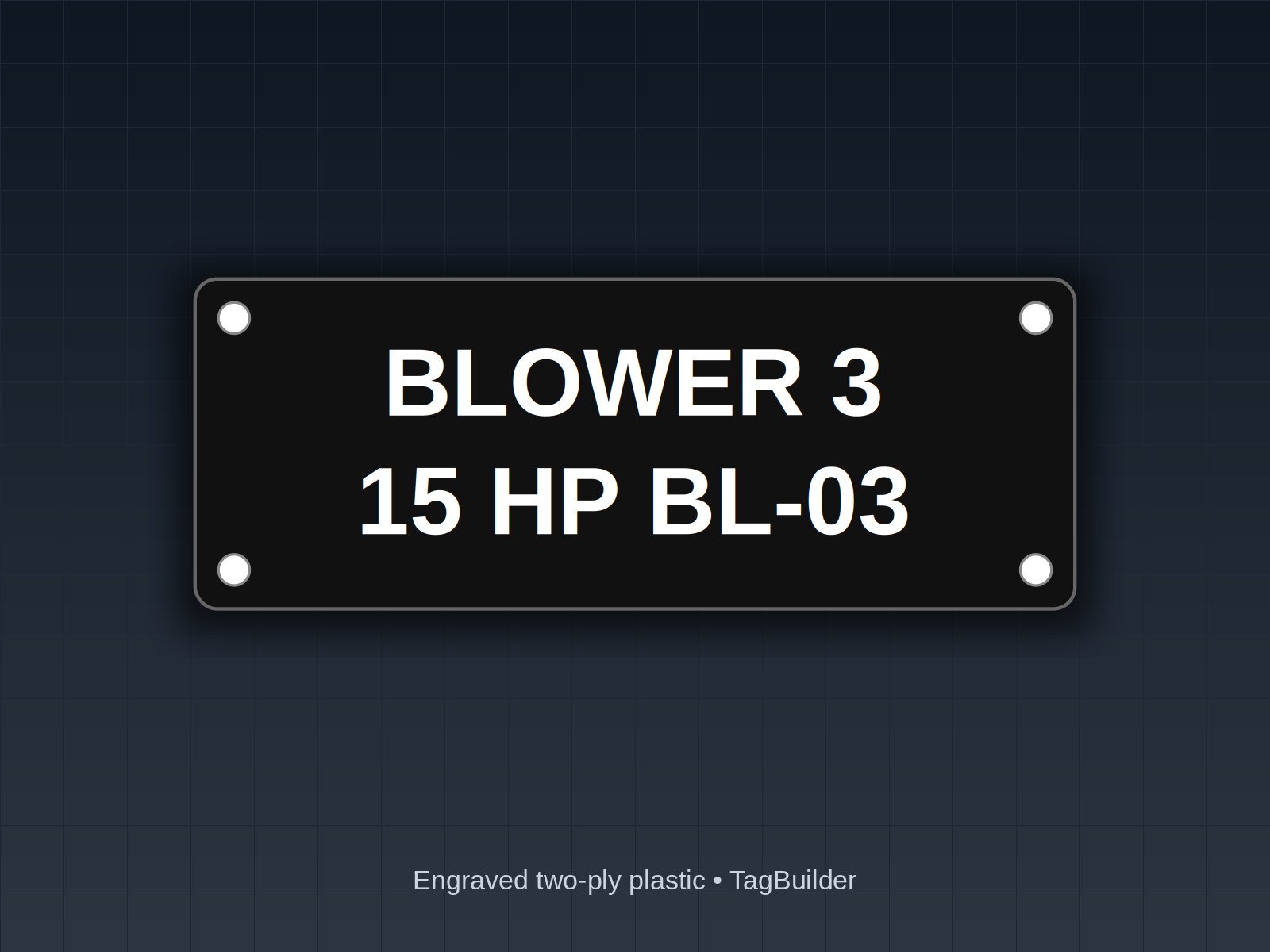
- BLOWER 1 to BLOWER 10, entrance to exit, counted the same way on the plate, the print and the procedure.
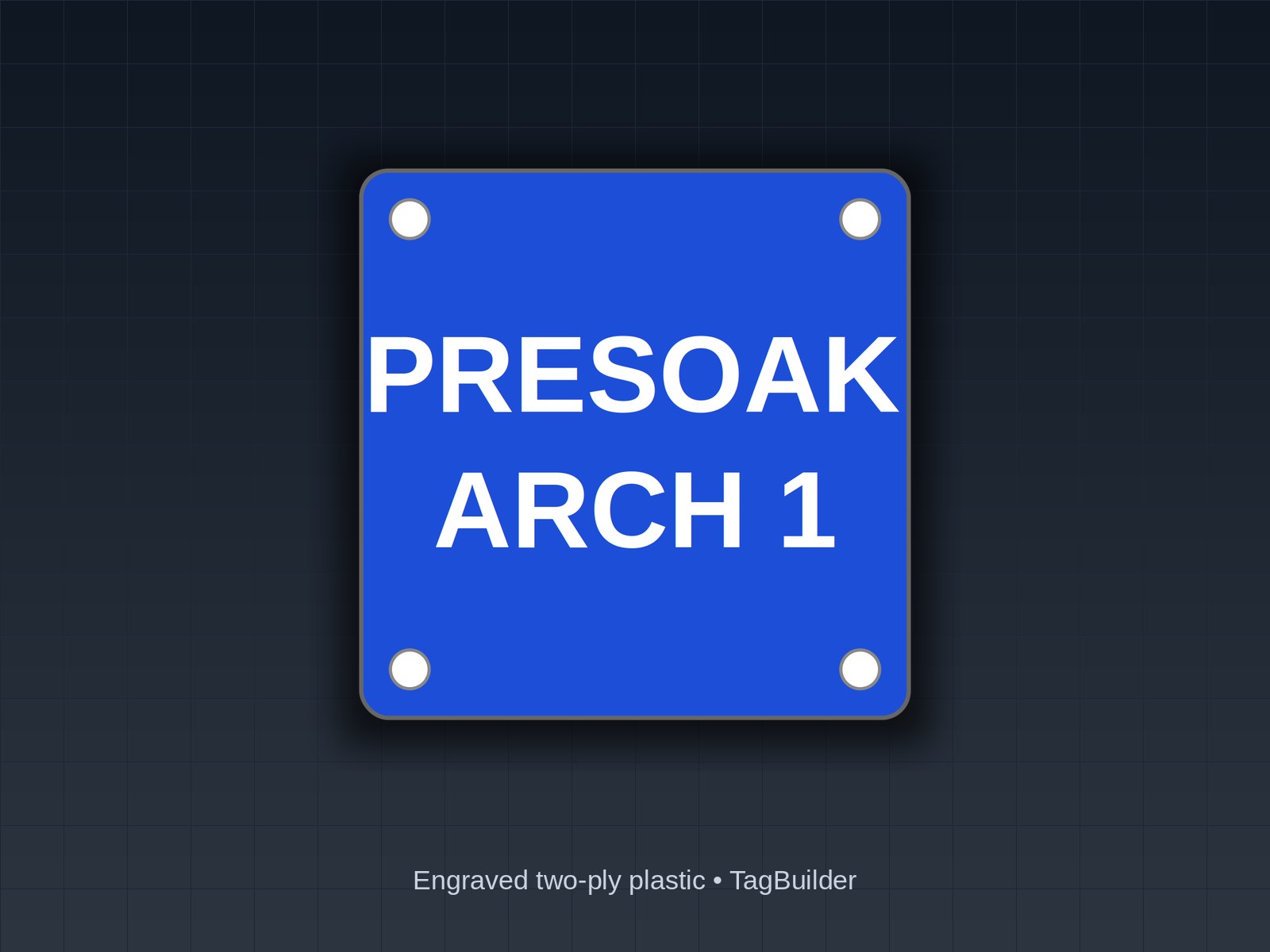
- BRUSH, MITTER, WRAP followed by a position number where there is more than one (WRAP 1, WRAP 2).
- CONVEYOR for the drive, HPU for the hydraulic power unit.
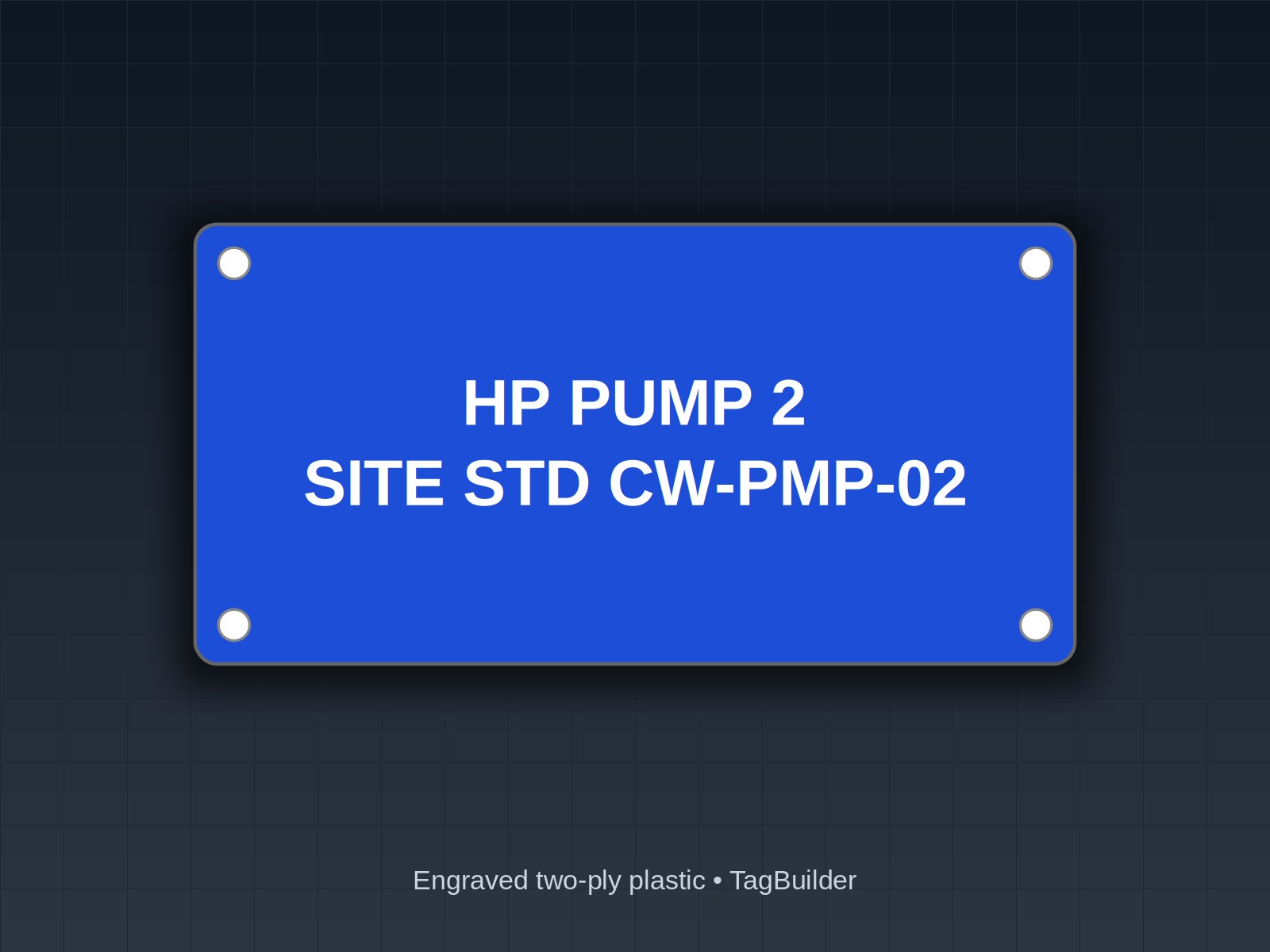
- PUMP names that match the function: HP PUMP 1, CHEM PUMP SKID.
Pick one spelling and keep it. If the procedure says BLOWER 4, the plate says BLOWER 4, not BLWR #4 or DRYER 4. Keep the MCC and breaker reference on the plate too, written the way your drawings write it.
What to label, and what the plate says
Start at the source and work toward the equipment. The table below lists the energy sources in a typical tunnel, where each is isolated, and an example of plate text.
| Energy source | Where it is isolated | Plate text example |
|---|---|---|
| Blower motor (electrical) | MCC breaker, and local disconnect at the motor | BLOWER 4 - MCC-1 CB-7 |
| Brush, mitter, wrap motors | MCC breaker or starter | WRAP 2 - MCC-1 CB-12 |
| Conveyor drive | MCC breaker, local disconnect | CONVEYOR DRIVE - MCC-1 CB-2 |
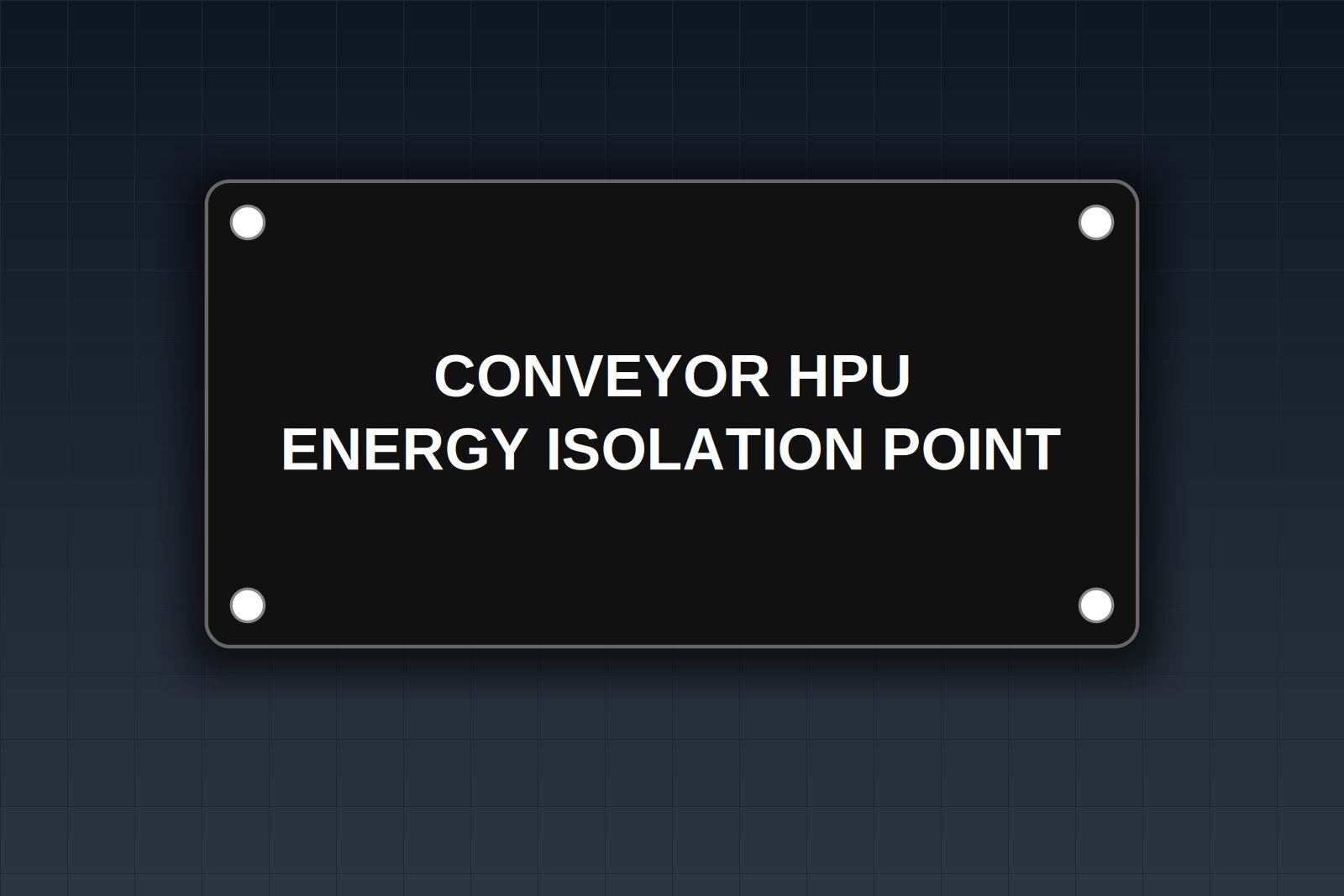
| Hydraulic power unit | Disconnect, plus bleed-down per procedure | HPU - MCC-1 CB-3 - RELIEVE PRESSURE |
| High-pressure pump | Pump disconnect and water supply valve | HP PUMP 1 - LOCK OUT AT MCC-1 CB-13 |
| Chemical supply | Pump breaker and manifold isolation valve | CHEM MANIFOLD - ISOLATION VALVE |
| Compressed air | Compressor disconnect and main air shutoff | AIR MAIN SHUTOFF - BLEED DOWN |
| Water supply | Main water isolation valve | MAIN WATER SUPPLY - ISOLATION |
Electrical points
Label each MCC breaker or starter bucket, and every local disconnect at a motor. Equipment makers commonly build blower MCCs so each blower can be locked out at its own breaker, so a plate per breaker is realistic. If a bucket serves two loads, say so on the plate. For the main service and panel disconnects, a plate such as the Main Disconnect 4 x 2 inch black on yellow works as the permanent identifier. The same reasoning is in our MCC bucket nameplate guide.
Fluid, air and chemical points
Label the main water isolation valve, each chemical line isolation valve, the compressor and the air shutoff. Valves and shutoffs in the equipment room take a tag on the handle; a small round tag such as the 30 mm BLOWER ring tag, white on black is the format, reworded to whatever device it sits on. The pit should carry its own plate pointing to the procedure.
Isolation point plates are not lockout tags
These are two different things and they should not be mixed up.
- Energy isolation point plates are permanent. They identify the device, and they stay on it whether or not anyone is working on the machine.
- Lockout tags are applied by the person doing the work, with their lock, and removed by that same person when the job is finished.
A plate that says “DO NOT OPERATE” is a permanent instruction on a device that must be operated every day, so avoid that wording. Keep the plate to identification: name, source, and a short note such as the location of the procedure. For a general reminder at the equipment, a Lockout/Tagout Required 4 x 2 inch black on yellow plate near the point is a common choice. The plate does not make the lockout happen, and it does not say a procedure has been followed.
Built for a wet, chemical tunnel
Tunnels are wet most of the day, with chemical mist, wax and hard-water scale. Printed paper and adhesive stickers lift in these conditions. Engraved two-ply plastic has the text cut into the surface, so it does not rub off like printed ink when someone wipes it down. Use these mounting guidelines:
- Fasten with stainless screws or rivets, not adhesive alone, on anything that gets sprayed.
- Use engraved stainless where chemicals are strong or the plate sits in the pit.
- Choose high-contrast colors, black on white or white on black, and keep letters large enough to read from a step ladder.
- Mount at eye level next to the device, not on a removable cover that gets swapped between units.
Residual energy reminders
An open breaker does not mean the machine has no energy left. Plates can point out what is still stored:
- Air: cylinders on gates and roller-ups hold pressure after the compressor is off. “AIR MAIN SHUTOFF - BLEED DOWN” reminds the tech to vent the line.
- Hydraulic: the HPU and its accumulators can hold pressure. “HPU - RELIEVE PRESSURE” is a short, factual prompt.
- Gravity: raised arms, rollers and curtains can drop. A plate such as “LOWER OR BLOCK ARM BEFORE SERVICE” marks the hazard.
How to release each one belongs in your written procedure. The plate only reminds the tech to look it up.
Worked example: 120 ft express tunnel
This is a sample isolation list you can copy line for line and adjust to your own breaker numbers. Entrance is left, exit is right.
MCC-1 breaker plates
- MCC-1 MAIN DISCONNECT
- CB-2 / CONVEYOR DRIVE
- CB-3 / HPU
- CB-4 / BLOWER 1
- CB-5 / BLOWER 2
- CB-6 / BLOWER 3
- CB-7 / BLOWER 4
- CB-8 / BLOWER 5
- CB-9 / BLOWER 6
- CB-10 / MITTER
- CB-11 / WRAP 1
- CB-12 / WRAP 2
- CB-13 / HP PUMP 1
- CB-14 / CHEM PUMP SKID
- CB-15 / AIR COMPRESSOR
Local plates in the tunnel and equipment room
- BLOWER 4 - LOCAL DISCONNECT - FED FROM MCC-1 CB-7
- CONVEYOR DRIVE - LOCAL DISCONNECT - MCC-1 CB-2
- HPU - RELIEVE PRESSURE BEFORE SERVICE - MCC-1 CB-3
- MAIN WATER SUPPLY - ISOLATION VALVE
- CHEM MANIFOLD - ISOLATION VALVE
- AIR MAIN SHUTOFF - BLEED DOWN
- PIT - SEE LOCKOUT PROCEDURE BEFORE ENTRY
Then write the procedure line to match: “BLOWER 4: lock out at MCC-1 CB-7 and the local disconnect.” Each line in the procedure should be findable by reading a plate.
Frequently Asked Questions
Does a car wash need lockout tagout?
If employees service or maintain equipment where unexpected startup or stored energy could injure them, 1910.147 commonly applies, and car washes have been cited under it. Confirm how it applies to your site with a qualified safety professional or your OSHA state plan, since that varies.
How do you lock out a car wash conveyor?
Follow your written, machine-specific procedure: shut the conveyor down, open its disconnect or MCC breaker, apply your lock and tag, release stored energy such as hydraulic pressure, and verify before work. The plate on the disconnect should carry the same name the procedure uses, for example CONVEYOR DRIVE - MCC-1 CB-2.
What should a lockout point label say?
The equipment name, the device or panel reference, and where useful a short residual-energy note. Keep to one naming rule, such as BLOWER 4 - MCC-1 CB-7. Leave out instructions that change from job to job; those go in the procedure.
Do car wash blowers need to be locked out individually?
Many tunnels are built so each blower has its own breaker, and a procedure that isolates only the blower being serviced is common. Your procedure decides this, so name the exact breaker for each blower and label it so a tech can find it without guessing.
What gets OSHA citations at car washes?
For October 2024 to September 2025, Hazard Communication (1910.1200) was cited most, 34 times. Lockout/tagout (1910.147) carried the largest penalties, $252,960 across 14 citations in 13 inspections, according to federal data for NAICS 811192.
Send your isolation list, like BLOWER 4 - LOCK OUT AT MCC-1 CB-7, and we'll engrave a free sample plate.
If you also run pumps and chemical lines in the equipment room, our car wash equipment room labeling guide covers the rest of the room, and the NEC 110.22 disconnect identification article explains what goes on the disconnects themselves. You can also request a free sample plate before you order a full set.
UL, NFPA, NEC, ASME, CEMA, TIA, ANSI and OSHA are names or marks of their respective organizations; TagBuilder is not affiliated with or endorsed by any of them. Requirements above are paraphrased summaries, not the text of any standard. Always work from the current published edition and your AHJ.