Forklift Data Plate and Capacity Plate: OSHA 1910.178 Marking and How to Replace a Missing One
Get this made: TagBuilder (Solid Ideas Engraving, Waterford, PA) engraves Design your own (from $3.82). No minimum order, no setup fees, most orders ship in 2–3 business days, rush available. Custom text and size: open this design in the configurator. Or email the spec to support@tagbuilder.net for a written quote and PDF proof the same business day.
You found a lift truck with a painted-over, worn or missing data plate, and you need to know what has to go back on it and where the numbers come from.
Disclaimer: general information, not legal or compliance advice. Codes change and inspectors interpret them differently, so confirm requirements with a qualified professional. Full disclaimer
Why the data plate matters more than it looks
The data plate is the only place on a powered industrial truck where the rated capacity is written down for the operator. Operators do not carry the manufacturer's spec sheet. They look at the plate to learn how much the truck can lift, at what load center and to what height.
When that plate is gone, everyone is guessing. A supervisor remembers the truck as a 5,000 lb unit. A new operator assumes the forks are the only thing that matters. Nobody remembers that a side shifter was added two years ago and changed the numbers.
This article covers what OSHA's powered industrial truck rule says about plates and markings, what a data plate carries, and how to get a replacement made without inventing a single number.
What OSHA 1910.178 says about plates and markings
The marking language sits in 29 CFR 1910.178(a), the general requirements paragraph for powered industrial trucks. Paragraph numbering and wording can change when the rule is amended, so read the current text. As the paragraphs are commonly cited, three of them matter here:
- 1910.178(a)(4) covers modifications and additions. Changes that affect capacity and safe operation are not to be made by the user without the manufacturer's prior written approval, and the capacity, operation and maintenance plates, tags or decals must be changed to match.
- 1910.178(a)(5) covers front-end attachments that were not factory installed. The user is expected to have the truck marked to identify the attachment and to show the approximate weight of the truck and attachment combined.
- 1910.178(a)(6) puts the duty on the user to see that nameplates and markings are in place and kept legible.
Some summaries, including older training materials, number these paragraphs differently. If an inspector or an auditor cites a paragraph number, match it to the current published text rather than to a handout.
The consensus standard behind most of this is ANSI/ITSDF B56.1, which sets marking expectations for low lift and high lift trucks, including a capacity plate and, where attachments are fitted, a plate reflecting the truck with the attachment. Which edition applies to a given truck depends on its build date, so check the edition the manufacturer built to.
For the broader picture of equipment marking, see the OSHA equipment labeling guide. Overhead lifting equipment follows a different paragraph; the crane and hoist capacity plate article covers 1910.179.
What a forklift data plate carries
The exact layout varies by manufacturer and by year, but most plates list some or all of the following:
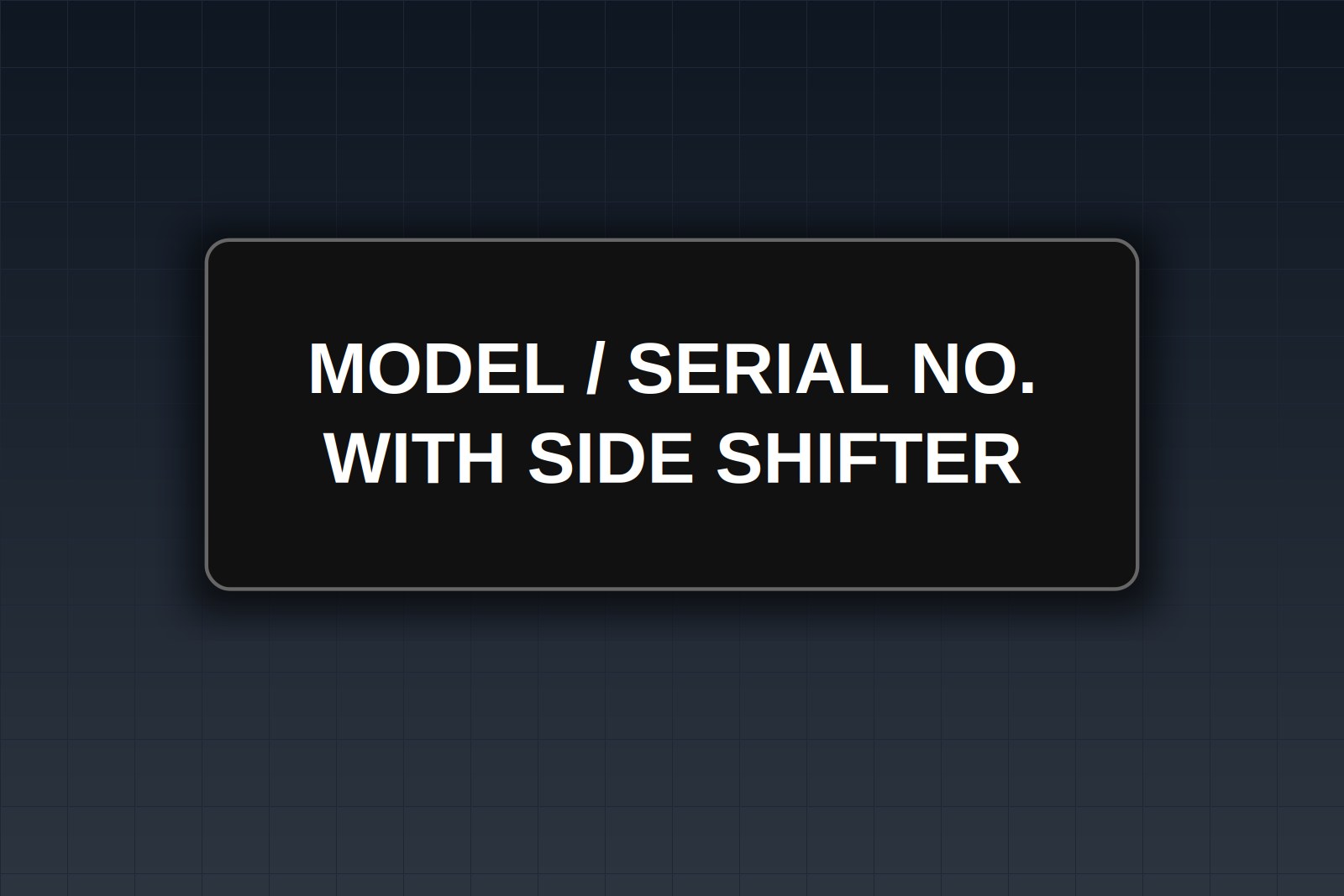
- Make, model and serial number, which tie the plate to one specific truck.
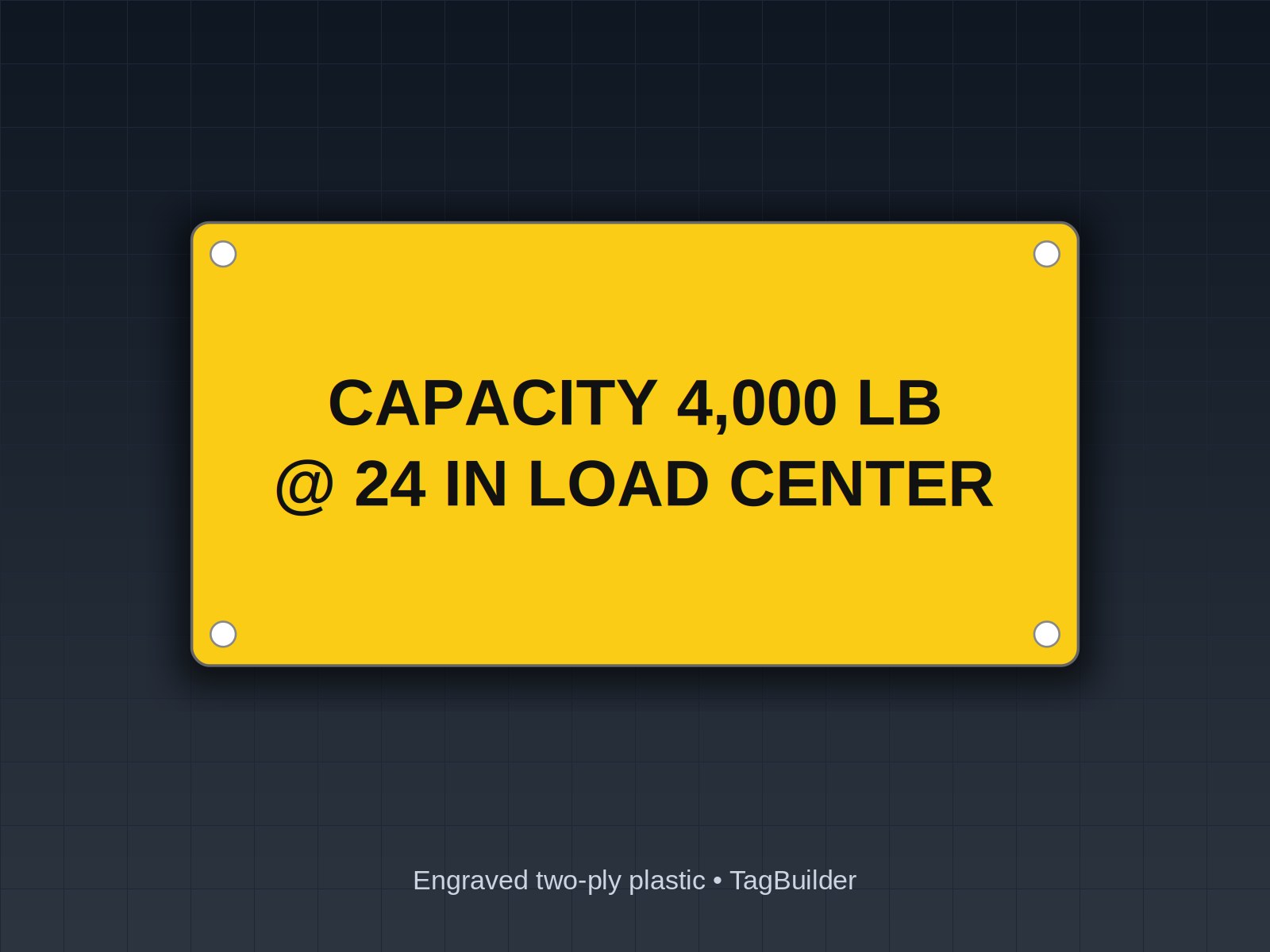
- Rated capacity in pounds at a stated load center (commonly 24 in for many trucks) and to a stated lift height.
- Attachments fitted to the truck, with the capacity that applies to that combination.
- Truck weight, often with and without battery on electric trucks.
- Voltage and battery weight range for electric trucks.
- Tire type, such as pneumatic or cushion, and sometimes mast type or lift height.
- Fuel or power type and a build date.
Every one of those values is the manufacturer's data. The plate is a record of it, not a place for estimates.
Who supplies the data and where it goes
| Marking | Who supplies the data | Where it goes |
|---|---|---|
| Make, model, serial number | Existing plate, photos, or the dealer's record for that serial | Main data plate, operator-visible location |
| Rated capacity and load center | Manufacturer or dealer, by serial number | Main data plate or separate capacity plate |
| Derated capacity with attachment | Manufacturer's written statement, or an engineer's rewrite where the manufacturer is no longer available | Attachment plate or revised capacity plate |
| Truck and attachment weight | Manufacturer, or a documented weighing | Data plate or attachment plate |
| Voltage and battery range | Manufacturer's data for that serial | Data plate, near the battery compartment on many trucks |
| Operating and maintenance instructions | Manufacturer's manual | Decals at operator position and service points |
When the numbers change after an attachment
A side shifter, fork positioner, rotator, clamp or extended fork all move the load farther forward or add weight in front of the mast. Both effects reduce what the truck can safely lift. That is why the rule ties plate changes to attachments and modifications.
The correct sequence is not to subtract a round figure and engrave it. The sequence is:
- Ask the manufacturer or the dealer for the capacity of that truck, with that attachment, by serial number.
- Get the answer in writing.
- Have the plate engraved from that letter, word for word.
- If the manufacturer cannot supply it, a qualified engineer has to determine it, and the engineer's figures are what go on the plate.
Worked example: 5,000 lb pneumatic-tire truck with a side shifter
The truck came from the factory with a rated capacity of 5,000 lb. A side shifter was added later. The manufacturer's written reply gives a reduced capacity for the truck with the attachment. The blanks below stand for the values in that reply, not for numbers to copy.
- MAKE / MODEL: [from existing plate or dealer record]
- SERIAL NO.: [from frame stamping]
- TIRES: PNEUMATIC
- BASE TRUCK CAPACITY: 5,000 LB AT [load center from OEM] IN
- ATTACHMENT: SIDE SHIFTER, [attachment make and model]
- CAPACITY WITH ATTACHMENT: [OEM value] LB AT [OEM load center] IN, TO [OEM lift height] IN
- TRUCK + ATTACHMENT WEIGHT: [OEM value] LB
- OEM LETTER DATE / REFERENCE: [date and reference number]
Putting the letter date and reference on the plate gives the next supervisor a trail to follow. If the truck had two plates before, the old base-capacity plate should not stay in view next to the new one. A reader has to see only one capacity figure.
How to replace a missing or unreadable plate
Before you remove anything
Photograph the old plate from straight on, with raking light if the text is faint, and photograph where it is mounted. Record the serial number stamped in the frame, because a painted-over plate can hide a serial that does not match the paperwork.
Get the data from the source
Send the manufacturer or an authorized dealer the serial number, the photos and a list of attachments. Ask for the capacity data in writing. Never invent capacities, never copy them from a similar truck, and never carry a number forward from memory.
Have the plate made
Send the plate text exactly as the manufacturer supplied it, with the same units and the same order of lines. A shop can duplicate the layout and add the attachment lines, but it cannot verify the figures for you. A replacement plate should not carry any listing or approval mark unless the manufacturer supplied one for that truck. Engraved text does not rub off like printed ink, but the plate is only as good as the data behind it.
Mount it where the operator will see it
Mount it in the operator's line of sight, on a clean, flat surface, in the same place or a better place than the original. Do not cover a stamped serial number.
Material choice for fork-truck service
A data plate lives in a hard environment: vibration from the mast and floor, dust, forklift exhaust and, in food plants and yards, washdown and weather. Two materials are commonly used:
- Engraved stainless or other corrosion-resistant metal suits washdown areas, outdoor trucks and heavy abuse. It is typically riveted or screwed on.
- Engraved two-ply plastic suits dry indoor trucks and decals-in-place where a rigid plate is easier to handle. With a proper adhesive and a clean surface it holds up well to dust and vibration.
Rivets or screws hold better than adhesive alone on a surface that is oily or rough. Ask for the mounting method that fits the surface.
Frequently Asked Questions
Can I make a new data plate from the old one if I can still read it?
If the old plate is fully legible and still reflects the truck as it is today, a duplicate is reasonable. If any attachment, tire or mast change has happened since it was made, the old figures may be wrong. Confirm with the manufacturer first.
Who do I contact if the manufacturer has gone out of business?
Try an authorized dealer or a successor company, because they sometimes hold the build records. If neither exists, a qualified engineer has to determine the capacity and document the basis for it.
Does adding a side shifter always require a new plate?
Under the language of 1910.178(a)(4) and (a)(5), modifications or attachments that affect capacity call for the plates and markings to be changed to match, and for the manufacturer's written approval where capacity and safe operation are affected. Check the current text and the manufacturer's instructions for the specific attachment.
Is a laminated sticker enough?
The rule asks for markings that are in place and legible. A paper sticker in a vibrating, oily environment tends to fail that test. A durable engraved plate is a more practical choice.
Where should the plate go on the truck?
Where the operator can read it from the seat or while standing beside the truck, and where it will not be hit by loads or covered by other equipment. Follow the manufacturer's location if you have it.
Send us the OEM capacity data and we'll engrave a durable replacement forklift data plate.
If you need a plate with custom text and a specific size, the rectangle plate configurator lets you lay out each line, and the nameplate shop shows standard sizes and materials. For related marking questions, the equipment labeling guide is a good next read.
Disclaimer. This article is provided for general informational purposes only and does not constitute legal, safety, or professional compliance advice. Regulations, standards, and codes are subject to change and may be interpreted differently by authorities having jurisdiction (AHJ). Always consult with qualified safety professionals, licensed engineers, or legal counsel to determine the specific requirements applicable to your facility. TagBuilder is not responsible for any actions taken based on this information.
UL, NFPA, NEC, ASME, CEMA, TIA, ANSI and OSHA are names or marks of their respective organizations; TagBuilder is not affiliated with or endorsed by any of them. Requirements above are paraphrased summaries, not the text of any standard. Always work from the current published edition and your AHJ.