How to Label a Commercial Pool Pump Room: Valve Tags, Flow Arrows and Pump Nameplates
Only one person knows which valve isolates the filter, and at 6 a.m. that person is not there. An equipment room full of unmarked PVC turns every inspection, relief shift and contractor visit into a guessing game.
Important Disclaimer
This article is provided for general informational purposes only and does not constitute legal, safety, or professional compliance advice. Regulations, standards, and codes are subject to change and may be interpreted differently by authorities having jurisdiction (AHJ). Always consult with qualified safety professionals, licensed engineers, or legal counsel to determine the specific requirements applicable to your facility. TagBuilder is not responsible for any actions taken based on this information.
To label a commercial pool pump room, put a numbered tag with a function on every valve, a flow arrow on each run of recirculation piping, and a nameplate on every pump, filter, heater and feeder that names the pool it serves. Then post a framed valve chart that uses the same numbers as the tags. Numbering and wording vary by state, county and code edition, so confirm the details with your local health department.
Why an unmarked pump room causes trouble
A pump room is a small space with a lot of identical pipe. Suction lines, discharge lines, backwash lines and chemical lines all look alike in gray or white PVC. When nothing is marked, the system lives in one person's head.
The cost shows up on a bad day. A relief operator closes the wrong valve during a backwash and the pump runs dry or deadheads. A contractor shuts off the return when the job was the heater bypass. During a chemical incident, nobody can find the isolation valve fast. On the paperwork side, an inspector writes up the room, or a new-build final is delayed while you sort it out.
Labels do not fix a poorly designed system. They make a well-designed one readable by someone who did not build it.
What codes commonly ask for
Requirements differ by jurisdiction, so treat this as a paraphrased overview and not a checklist to copy.
- California Title 24, Part 2, section 3120B.17 is commonly read as asking for flow-direction marking, such as arrows, on recirculation piping in the equipment area. It also asks for identification of which pool each piece of equipment serves when one room serves more than one pool. Valves and lines are expected to be labeled with their source or destination.
- The Model Aquatic Health Code and many state and county health codes have similar equipment-room expectations, in different words and with different numbering.
- Local health departments often add their own preferences, such as letter height, color or a posted valve chart.
Check the current edition of the code your facility falls under, and ask the local health department what it expects to see. Its answer is the one that counts.
Valve tags, flow arrows and nameplates
Valve tags
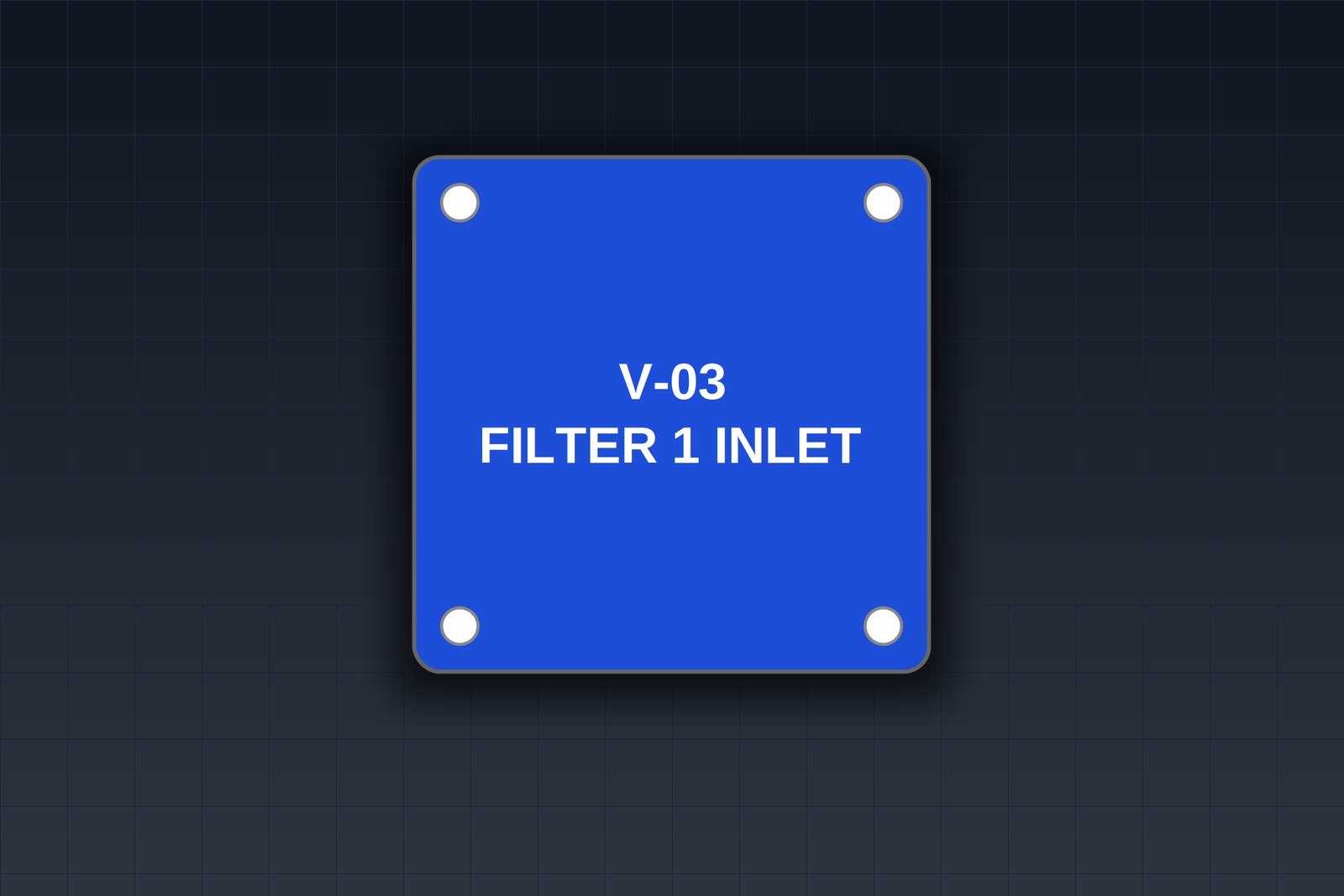
Tag every isolation valve, plus every backwash, bypass, drain and makeup valve. Each tag carries two things: a number and a function, for example V-03 FILTER 1 INLET. The number ties the valve to the chart. The function lets someone act without looking anything up.
Number in the order water travels: suction side first, then pump, filter, heater, return. If you are setting up a scheme from scratch, the valve numbering guide covers the logic. For a ready-to-buy example, the 2-inch V-001 valve tag shows the format, and the valve tag configurator lets you set pool-specific wording and numbers.
A 2-inch round tag fits most handles and pipe runs. Keep the number on the top line at roughly 1/4 inch letter height or larger, with the function below it in smaller capitals. Fasten tags with a stainless or plastic tie on the handle, not on the pipe, so a moved pipe does not strand the tag.
Flow arrows
Put a flow arrow on each straight run of recirculation piping, near every fitting that changes direction, and on both sides of a wall penetration. Where you can, add a short word next to the arrow: SUCTION, DISCHARGE, RETURN or BACKWASH. Arrows are a strong place to start because they take no code reading to justify, and they help everyone who walks in.
Pump, filter, heater and feeder nameplates
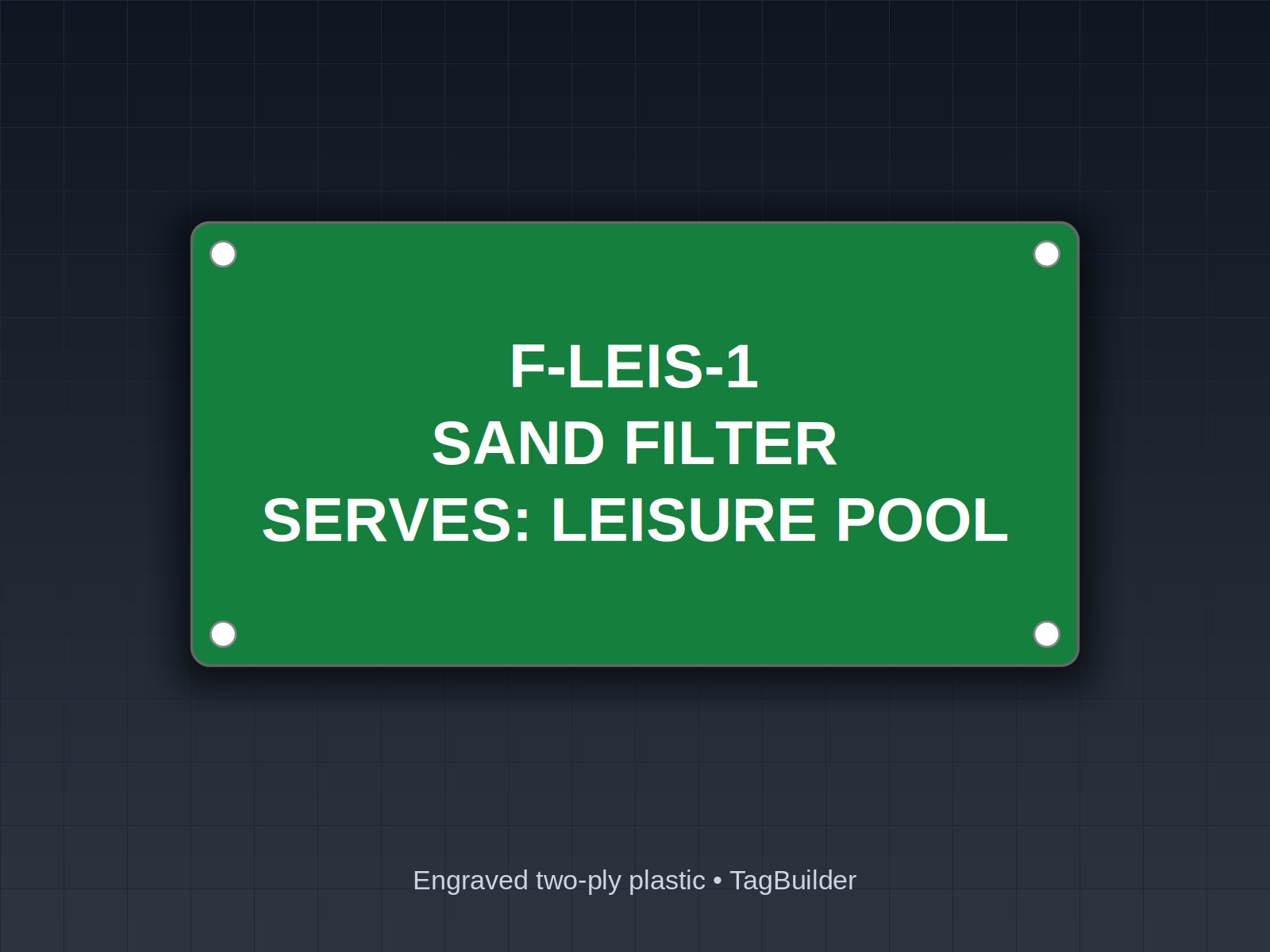
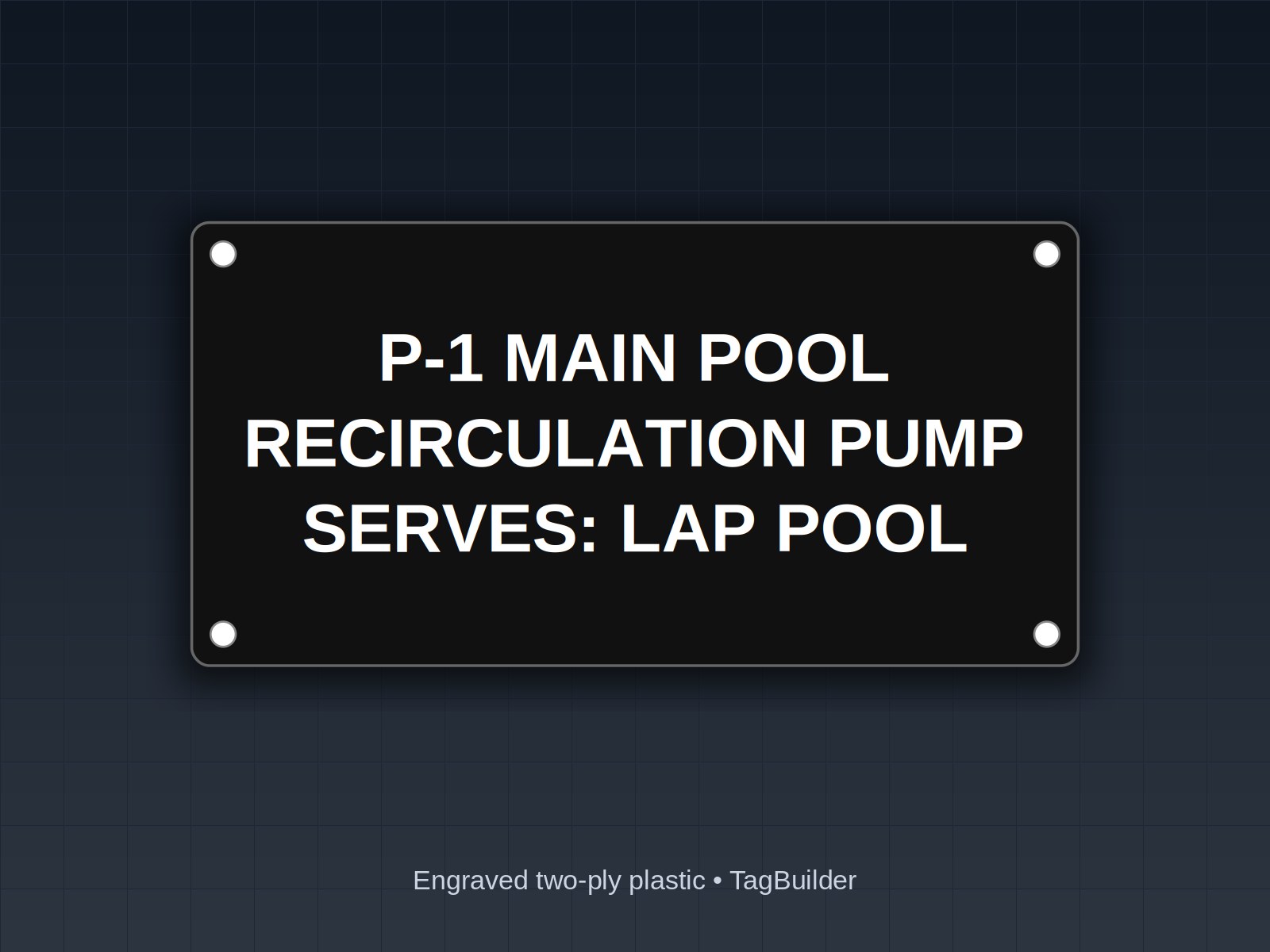
Equipment gets a rectangular nameplate with a tag number and the pool served plus the function, for example P-1 MAIN POOL RECIRC. In a multi-pool facility, the pool name is the whole point. P-1 MAIN POOL RECIRC and P-2 SPA RECIRC should never be mistaken for each other. For a stock example of the format, see the LEAD PUMP label. For custom wording, use the rectangle nameplate configurator.
The framed valve chart
Post a framed chart near the door listing every valve number, its function, and its normal position (open or closed). It must match the tags exactly. A chart that disagrees with the tags is worse than no chart, so update both whenever a valve is added or renumbered.
Materials for a damp, chlorinated room
Pump rooms are humid and the air carries chlorine and other treatment chemicals. Some metals corrode in that atmosphere, and printed labels can lift or fade. Engraved two-ply plastic is a practical choice here: the text is cut into the surface, so it does not rub off like printed ink, and the plastic does not rust. Plan to inspect any label periodically and replace it if it is damaged. If you are comparing options, the tag materials guide is a useful companion.
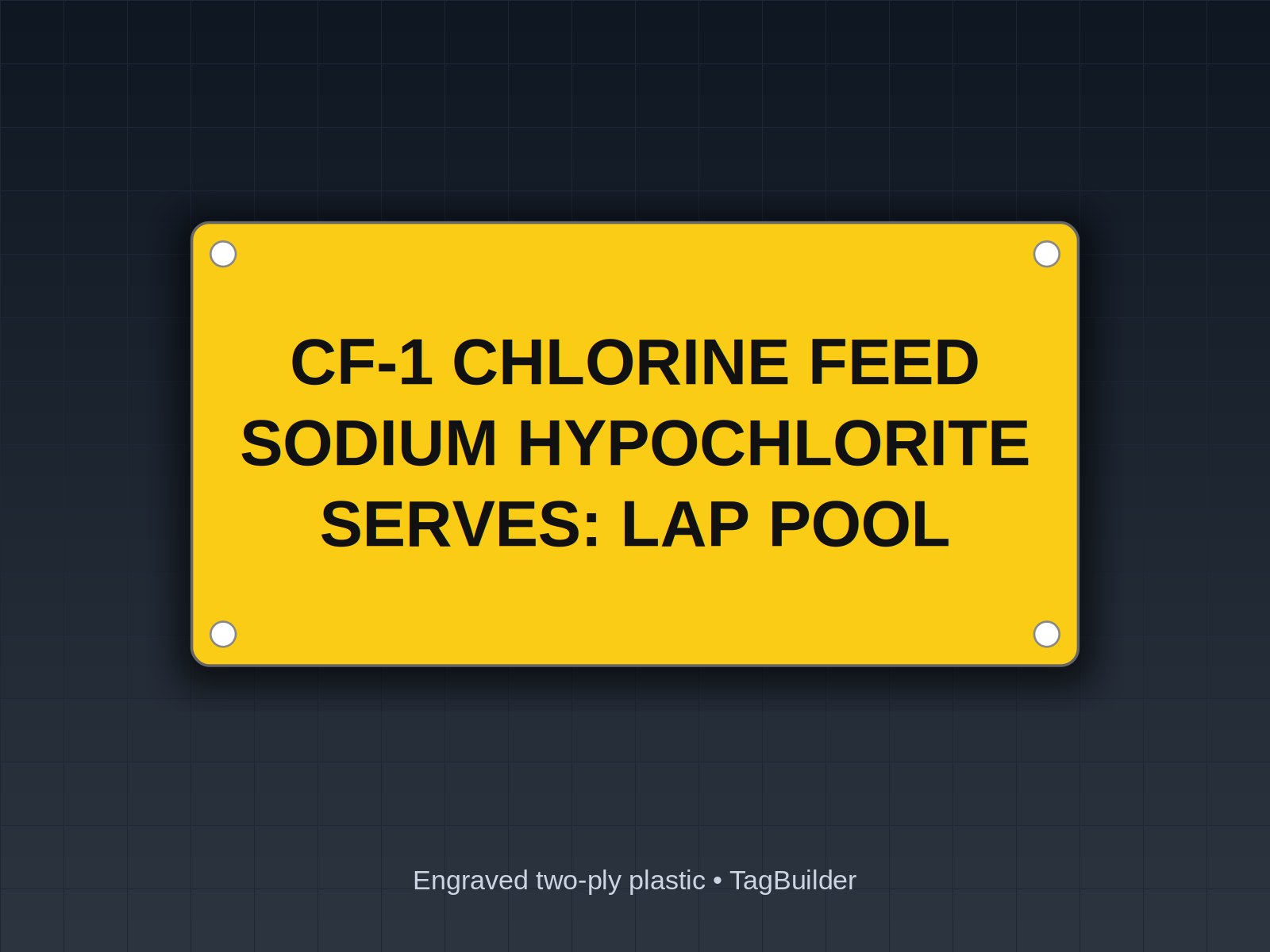
White letters on a black face read well in a dim room. For chemical feed lines, many facilities use a separate color so those lines stand apart from water lines. Ask your health department whether it has a preference.
Component label table
The table below lists each component in a typical pump room, what its tag or plate should say, and a suggested size and color. Sizes and colors are suggestions, not code requirements.
| Component | What it says | Suggested size | Suggested color |
|---|---|---|---|
| Isolation valve | V-03 FILTER 1 INLET | 2 in round | White on black |
| Backwash valve | V-07 FILTER 1 BACKWASH TO WASTE | 2 in round | White on black |
| Bypass valve | V-08 HEATER BYPASS | 2 in round | White on black |
| Drain and makeup valve | V-10 POOL DRAIN TO SEWER | 2 in round | White on black |
| Pump | P-1 MAIN POOL RECIRC | 4 x 2 in | White on black |
| Filter | F-1 MAIN POOL FILTER | 4 x 2 in | White on black |
| Heater | H-1 MAIN POOL HEATER | 4 x 2 in | White on black |
| Chemical feeder | CHEM FEED - MAIN POOL | 4 x 2 in | Per local preference |
| Flow arrow | Arrow plus SUCTION, DISCHARGE or RETURN | Per pipe size | Per local preference |
Worked example: a single-pool pump room
Here is a complete list for one pool with one pump, one filter, one heater and one chemical feed. Copy it line for line and change the names to match your plumbing. Nameplates are 4 x 2 inch, valve tags are 2 inch round.
Valve tags (11)
- V-01 MAIN DRAIN SUCTION
- V-02 SKIMMER SUCTION
- V-03 PUMP 1 SUCTION
- V-04 PUMP 1 DISCHARGE
- V-05 FILTER 1 INLET
- V-06 FILTER 1 OUTLET
- V-07 FILTER 1 BACKWASH TO WASTE
- V-08 HEATER BYPASS
- V-09 RETURN TO POOL
- V-10 POOL DRAIN TO SEWER
- V-11 MAKEUP WATER
Equipment nameplates (4)
- P-1 MAIN POOL RECIRC
- F-1 MAIN POOL FILTER
- H-1 MAIN POOL HEATER
- CHEM FEED - MAIN POOL
Also needed
- Flow arrows with SUCTION, DISCHARGE and RETURN on each run
- One framed valve chart listing V-01 through V-11 with function and normal position
Add pool names to every line if the room serves more than one pool, and keep a separate number series, such as V-2xx, for the second pool so no two valves share a number.
Frequently Asked Questions
What do pool pump room valve tags need to say?
At minimum, a unique number and the valve's function or the line it controls, such as V-05 FILTER 1 INLET. Many health departments also expect source or destination wording. Ask yours for local specifics.
Does 3120B.17 require pool flow arrows?
California Title 24, Part 2, section 3120B.17 is commonly read as asking for flow-direction marking on recirculation piping in the equipment area. Wording changes between editions, so read the current text and confirm with the local enforcing agency. Other states have their own rules.
How do I label pool pumps and filters when one room serves two pools?
Put the pool name on every nameplate, for example P-2 SPA RECIRC, and keep valve numbers unique across the room. The goal is that nobody can mistake one pool's equipment for another's.
What should I check before a pool inspection of the equipment room?
Walk the room as a stranger would. Confirm every valve has a legible tag, arrows show direction on each pipe run, equipment names its pool, and the posted chart matches the tags. Then ask your health department what else it looks for.
Can I use printed labels in a pump room?
You can, but humid, chlorinated air is hard on adhesives and ink. Engraved plastic has the text cut into the surface, so it does not rub off the way printed ink can. Check any label type against what your local inspector expects.
Send us one valve or pump line from your pool room and we'll engrave a sample tag and mail it, no charge.
If you want to see the tag in hand before ordering a full set, you can request a free engraved sample. To settle on a numbering scheme for the whole room, start with the valve numbering guide. Pool rooms with outdoor or wet-area runs may also want to read about indoor and outdoor tag materials.
UL, NFPA, NEC, ASME, CEMA, TIA, ANSI and OSHA are names or marks of their respective organizations; TagBuilder is not affiliated with or endorsed by any of them. Requirements above are paraphrased summaries, not the text of any standard. Always work from the current published edition and your AHJ.