Labeling Multi-Pool Facilities: Which Pool Each Pump, Filter, Heater and Feeder Serves
Your lap pool, leisure pool and therapy pool share one equipment room, and the pumps and filters look identical from the doorway. Before anyone opens a valve or touches a feeder, they need to know which pool it belongs to.
Important Disclaimer
This article is provided for general informational purposes only and does not constitute legal, safety, or professional compliance advice. Regulations, standards, and codes are subject to change and may be interpreted differently by authorities having jurisdiction (AHJ). Always consult with qualified safety professionals, licensed engineers, or legal counsel to determine the specific requirements applicable to your facility. TagBuilder is not responsible for any actions taken based on this information.
To label equipment that serves more than one pool, put the pool name inside every equipment ID (P-LAP-1 for the lap pool's first pump, for example), use one color per pool on every plate and valve tag, and repeat the same pool name on the controller, the chemical feeder, the valve tags and the valve chart. Add a key plate at the door that lists each pool code and its full name. Anyone standing at any piece of equipment should be able to say which water it touches without tracing a pipe.
What goes wrong in a shared equipment room
A single room with three or more bodies of water is normal at waterparks, hotels with a pool and a spa, and rec centers with lap, leisure and therapy pools. The equipment is often the same make and size, bought in one order, installed in a row. A plate that says only PUMP 2 tells a new technician nothing.
The cost of that ambiguity is practical and a little ugly:
- Chemical to the wrong water. A feeder tagged ACID FEEDER gets primed or adjusted for the wrong pool, and a pool that was in range goes out of range.
- The wrong valve turned. Someone asked to drain the wading pool opens the spa drain line because both valves read DRAIN.
- Slow response. During an incident, staff spend minutes tracing pipe instead of shutting down the right system.
- A bad inspection day. If an inspector cannot tell which equipment serves which pool, the finding can escalate, and in the worst case a pool is ordered closed until it is sorted out.
None of this takes fancy engineering to prevent. It takes a naming scheme and plates that match it.
What the codes generally expect
As we read it, California's Title 24 provision commonly cited as section 3120B.17 asks that where recirculation equipment for more than one pool is on the same site, each piece of equipment identify the pool it serves, and that valves and lines identify their source or destination. Many other states, and the Model Aquatic Health Code, expect equivalent identification, though the wording and section numbers differ.
Section numbers move between editions, and local health departments add their own interpretations. Pull the current edition your jurisdiction has adopted, and ask the local health department what it looks for on inspection before you order plates. What follows is a scheme many facilities use, not a reading of any one code.
Build the ID around the pool
The idea is simple: equipment type, then pool code, then a number. Pick a short code for each pool (LAP, LEIS, THER or SPA) and never reuse it for anything else. The table below lists each equipment type, a suggested ID format, and example plate text, with lines separated by a slash.
| Equipment type | ID format | Example plate text |
|---|---|---|
| Recirculation pump | P-[POOL]-# | P-LAP-1 / LAP POOL / RECIRCULATION PUMP |
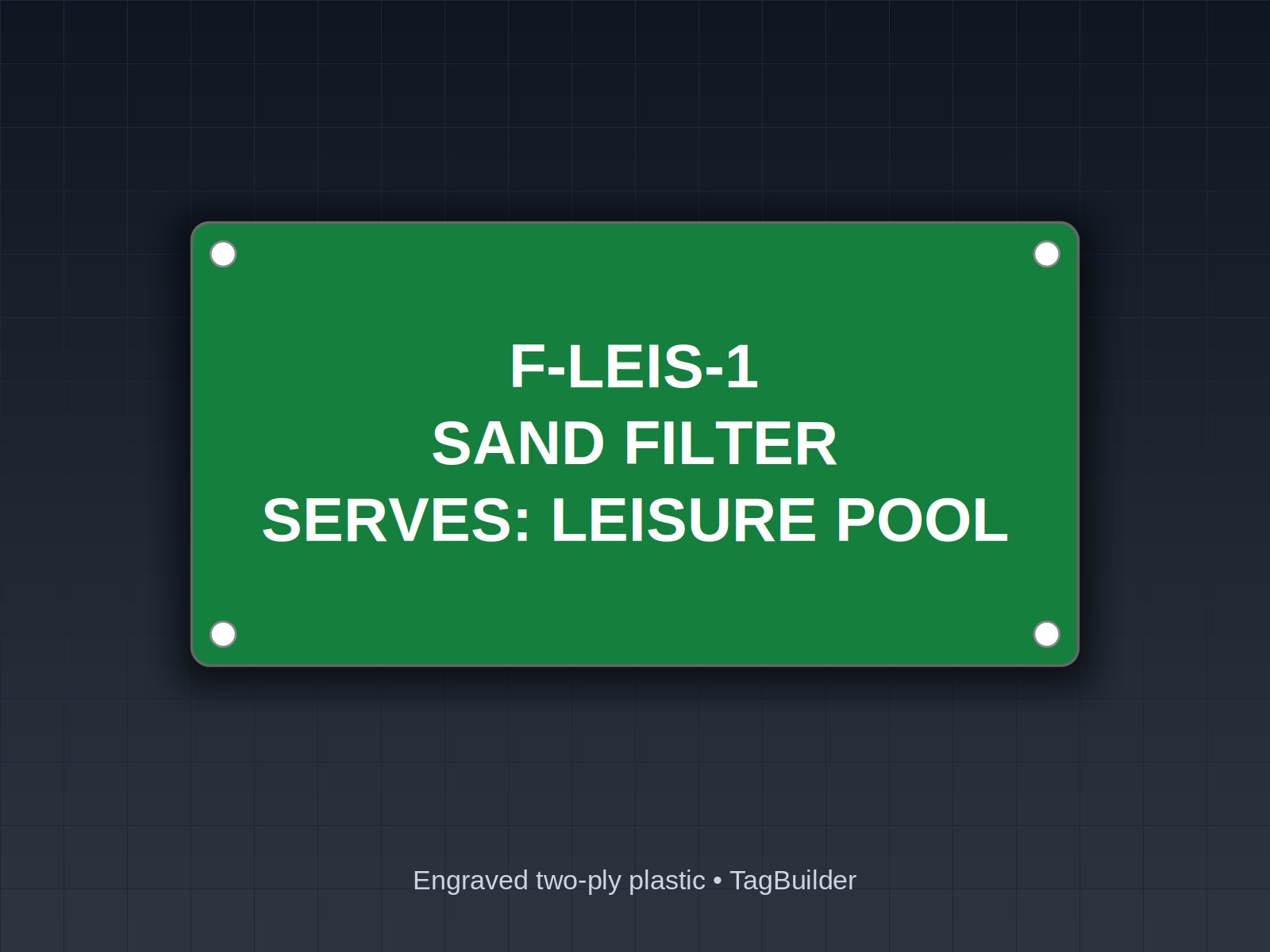
| Filter | F-[POOL]-# | F-LAP-1 / LAP POOL / FILTER |
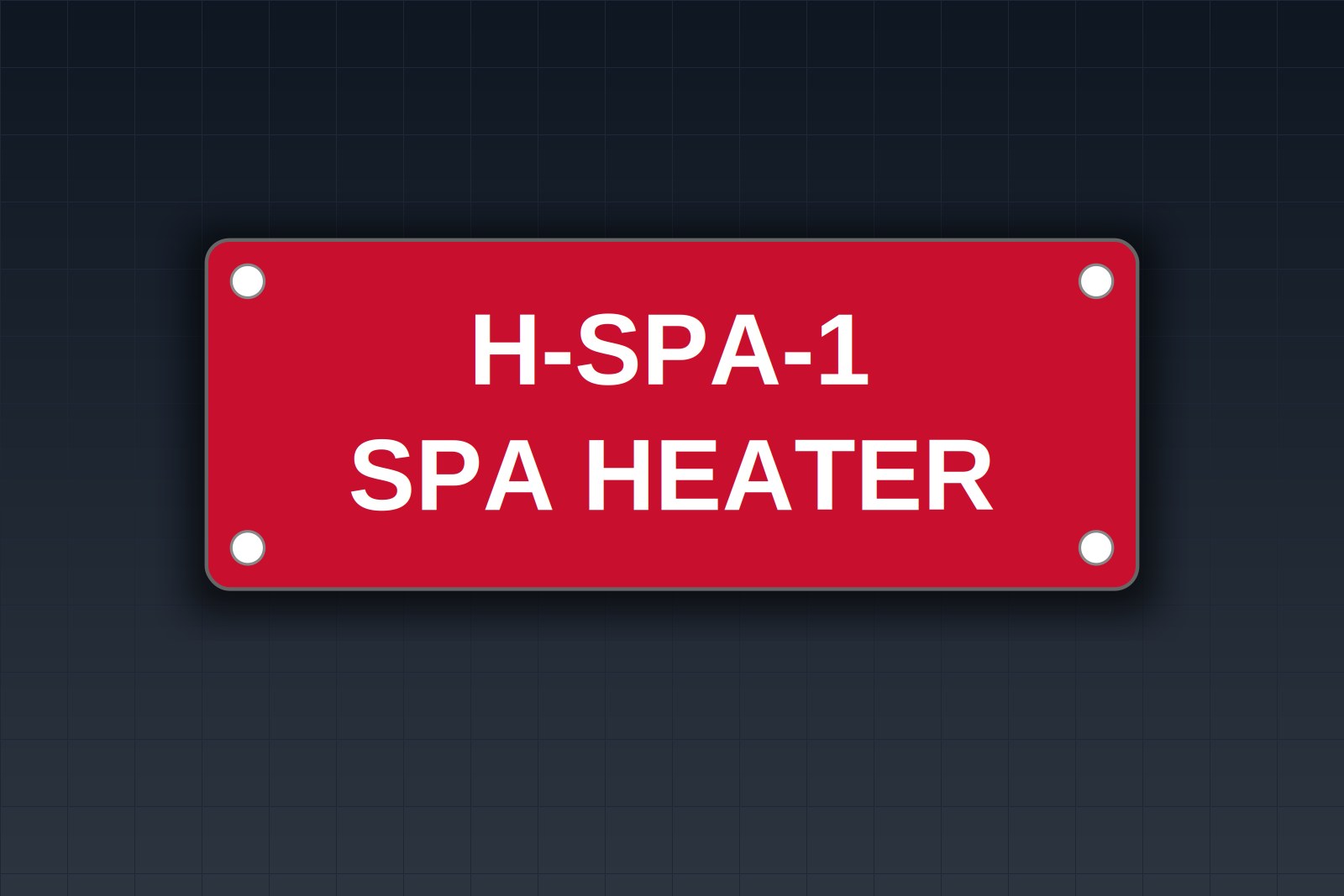
| Heater | H-[POOL]-# | H-THER-1 / THERAPY POOL / HEATER |
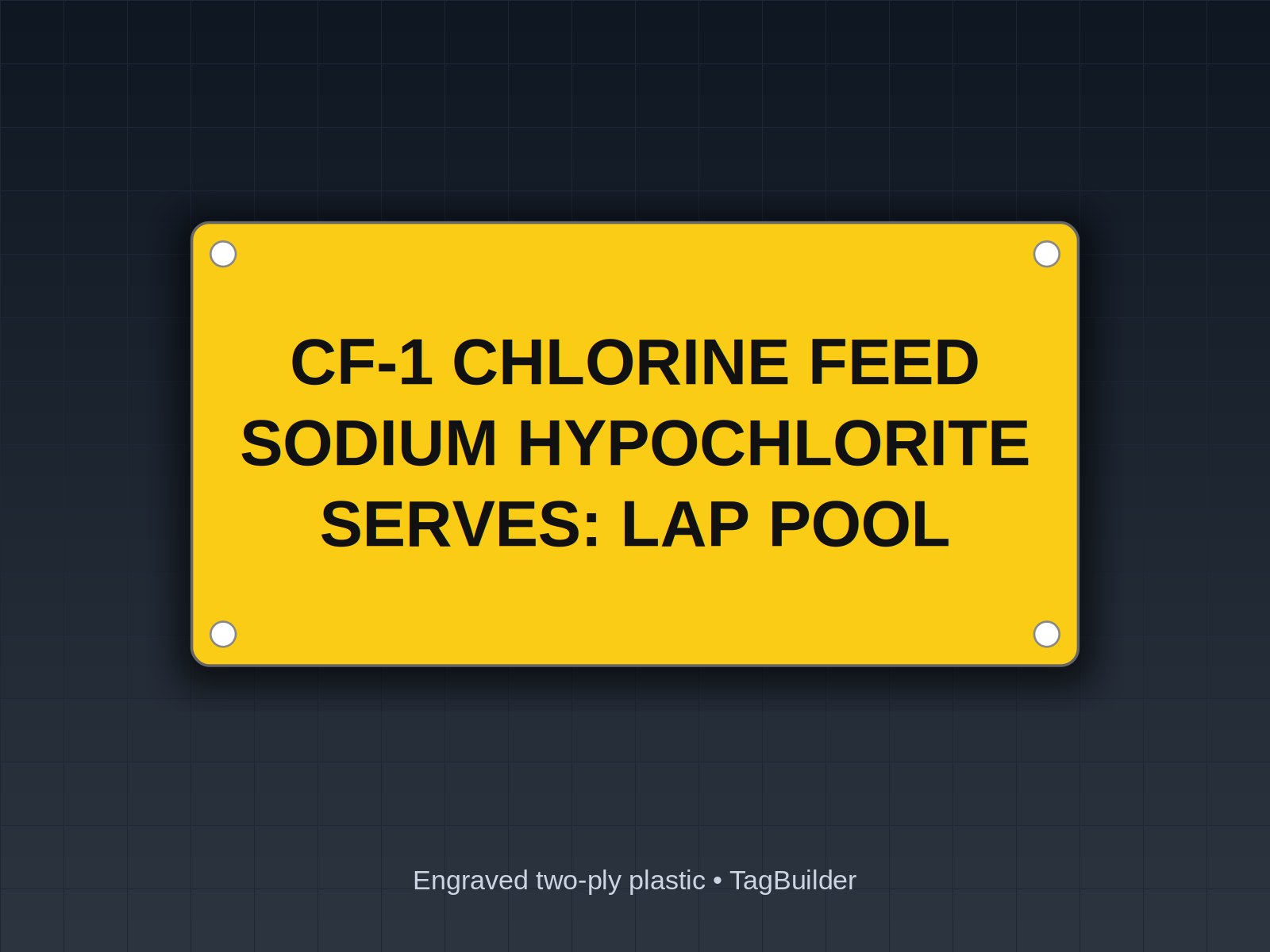
| Chemical feeder | CF-[POOL]-# | CF-LEIS-1 / LEISURE POOL / CHLORINE FEED |
| Controller | CC-[POOL]-# | CC-LEIS-1 / LEISURE POOL / CHEMICAL CONTROLLER |
| Valve | V-[POOL]-## | V-THER-04 / THERAPY POOL / MAIN DRAIN SUCTION |
Two habits keep the scheme readable. First, put the full pool name on the second line, so a person who has not memorized the codes still reads LEISURE POOL. Second, number within each pool, so P-LAP-1 and P-LEIS-1 never collide. If a pool has a lead and a standby pump, say so on the plate; the stock LEAD PUMP label covers that case, and you can add the pool ID beside it.
Give each pool its own color
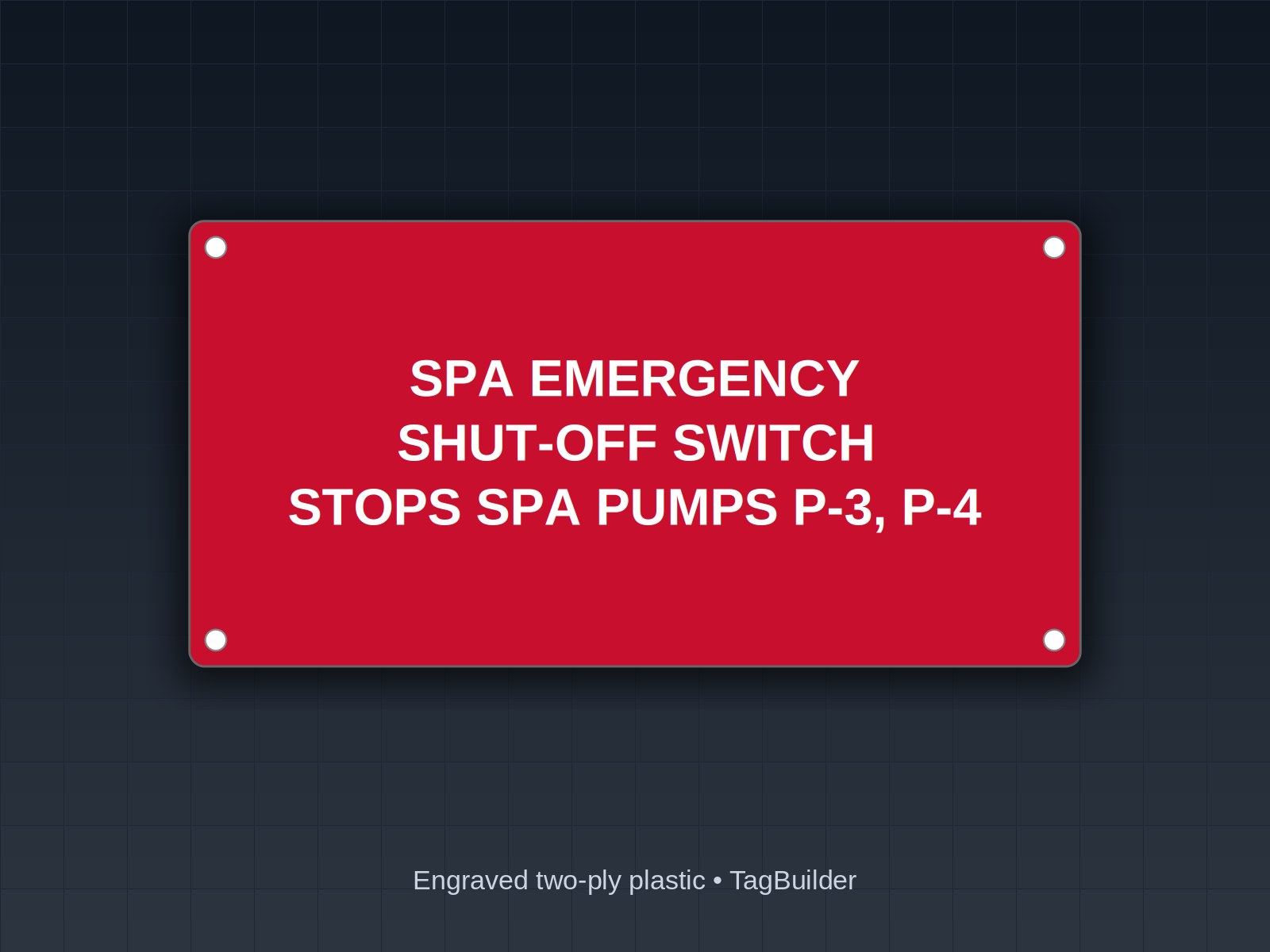
A color per pool lets someone see at a glance which system they are standing at, from across the room, before reading a word. A common choice is blue for the lap pool, green for the leisure pool and red for the spa or therapy pool, with white letters on each.
Be clear with staff that this is a facility choice, not a code color. Nothing requires blue for a lap pool, and red here has nothing to do with fire protection. If your plant or campus already uses color for pipe contents, read the valve tag color code guide first so the pool colors do not collide with an existing scheme. Always keep the printed ID on the plate too, because color alone fails for color-blind staff and in poor light.
Make the name travel with the water
The scheme only works if the same name appears everywhere a person might look. Carry the pool code through five places:
- Equipment plates on every pump, filter and heater.
- Controllers and feeders, on the enclosure itself, not on the wall behind it.
- Valve tags, using the V-[POOL]-## format and, where useful, a source or destination line such as FROM SURGE TANK or TO LAP POOL RETURN.
- The valve chart, which lists the same IDs in the same order as the tags.
- A key plate at the door, listing each pool code, its full name and its color.
For the valve side, the valve numbering best practices article covers how to keep numbers unique and chart-friendly, and the pump room valve tag and flow arrow guide covers direction and function wording. The chart on the wall and the tags on the pipe should match character for character, so a person can read one and find the other.
For the door plate, use a large engraved plate with pool codes in letters about an inch high so they read from the threshold, and the full pool names below in smaller type. Mount it at eye level where a person must pass it on the way in.
Worked example: a three-pool rec center
This center has a lap pool (LAP), a leisure pool (LEIS) and a therapy pool (THER). Each pool has its own pump, filter, heater and chemical control. The lines below are copyable plate text, one plate per entry, in the format of 3 x 1 inch equipment ID plates unless noted.
Door key plate (large format)
- POOL KEY / LAP = LAP POOL (BLUE) / LEIS = LEISURE POOL (GREEN) / THER = THERAPY POOL (RED)
Lap pool, blue
- P-LAP-1 / LAP POOL / LEAD PUMP
- P-LAP-2 / LAP POOL / STANDBY PUMP
- F-LAP-1 / LAP POOL / FILTER
- H-LAP-1 / LAP POOL / HEATER
- CF-LAP-1 / LAP POOL / CHLORINE FEED
- CF-LAP-2 / LAP POOL / ACID FEED
- CC-LAP-1 / LAP POOL / CHEMICAL CONTROLLER
Leisure pool, green
- P-LEIS-1 / LEISURE POOL / LEAD PUMP
- F-LEIS-1 / LEISURE POOL / FILTER
- H-LEIS-1 / LEISURE POOL / HEATER
- CF-LEIS-1 / LEISURE POOL / CHLORINE FEED
- CC-LEIS-1 / LEISURE POOL / CHEMICAL CONTROLLER
Therapy pool, red
- P-THER-1 / THERAPY POOL / LEAD PUMP
- F-THER-1 / THERAPY POOL / FILTER
- H-THER-1 / THERAPY POOL / HEATER
- CF-THER-1 / THERAPY POOL / CHLORINE FEED
- CC-THER-1 / THERAPY POOL / CHEMICAL CONTROLLER
Sample valve tags
- V-LAP-01 / LAP POOL / SUCTION ISOLATION
- V-LEIS-03 / LEISURE POOL / RETURN TO POOL
- V-THER-04 / THERAPY POOL / MAIN DRAIN SUCTION
Use the stock LEAD PUMP label where it fits and the 3 x 1 equipment ID plate for the rest, then use the rectangle plate configurator to enter your own pool names and the valve tag configurator for the V- tags. Browse the pump labels for other stock sizes.
Frequently Asked Questions
How do I label pool equipment that serves more than one pool?
Put the pool name or a short code in the ID of every pump, filter, heater, feeder and controller, and repeat it on the valve tags and the valve chart. A format like P-LAP-1 or CF-LEIS-1 tells the reader the equipment type, the pool and the unit number in one line.
Do I need to label which pool each pump serves?
Many jurisdictions expect it where equipment for more than one pool shares a site. California's Title 24 is one example, and many other states and the Model Aquatic Health Code expect something similar. Check the current edition and ask your local health department what it looks for.
Should every pool have its own color?
It helps, because it lets staff recognize the right system from a distance. The colors are your choice and not a code requirement, so write them on the door key plate, and keep the printed pool name on every plate in case color is hard to read.
What should be on the sign at the equipment room door?
A key that lists each pool code, the full pool name and its color. Keep the codes large enough to read from the doorway, and make sure they match the plates exactly.
Can I reuse the same numbers for each pool?
Yes, as long as the pool code is part of the ID. P-LAP-1 and P-LEIS-1 are different units, so each pool can start at 1. Never reuse a pool code, and never let two plates share the same full ID.
How do I keep the valve chart and the tags consistent?
Generate both from one list. Write the valve IDs and descriptions once, order the chart by pool, and engrave the tags from the same list so a wording change happens in one place.
Send us one pump or filter ID with its pool name and we'll engrave a sample plate and mail it, no charge.
If the room also holds emergency controls, the emergency shutoff and main drain label guide pairs with this scheme. You can also request a plate through our free sample page and see how engraved text holds up in a damp equipment room before you label the rest.
UL, NFPA, NEC, ASME, CEMA, TIA, ANSI and OSHA are names or marks of their respective organizations; TagBuilder is not affiliated with or endorsed by any of them. Requirements above are paraphrased summaries, not the text of any standard. Always work from the current published edition and your AHJ.