Pool Chemical Room Labels: Feed Pumps, Tanks, Injection Points and Valves
Two feeders sit side by side, the tubing looks the same, and the person filling tanks today did not install either one. Whether that fill goes into the right tank depends on what is written on the equipment.
Important Disclaimer
This article is provided for general informational purposes only and does not constitute legal, safety, or professional compliance advice. Regulations, standards, and codes are subject to change and may be interpreted differently by authorities having jurisdiction (AHJ). Always consult with qualified safety professionals, licensed engineers, or legal counsel to determine the specific requirements applicable to your facility. TagBuilder is not responsible for any actions taken based on this information.
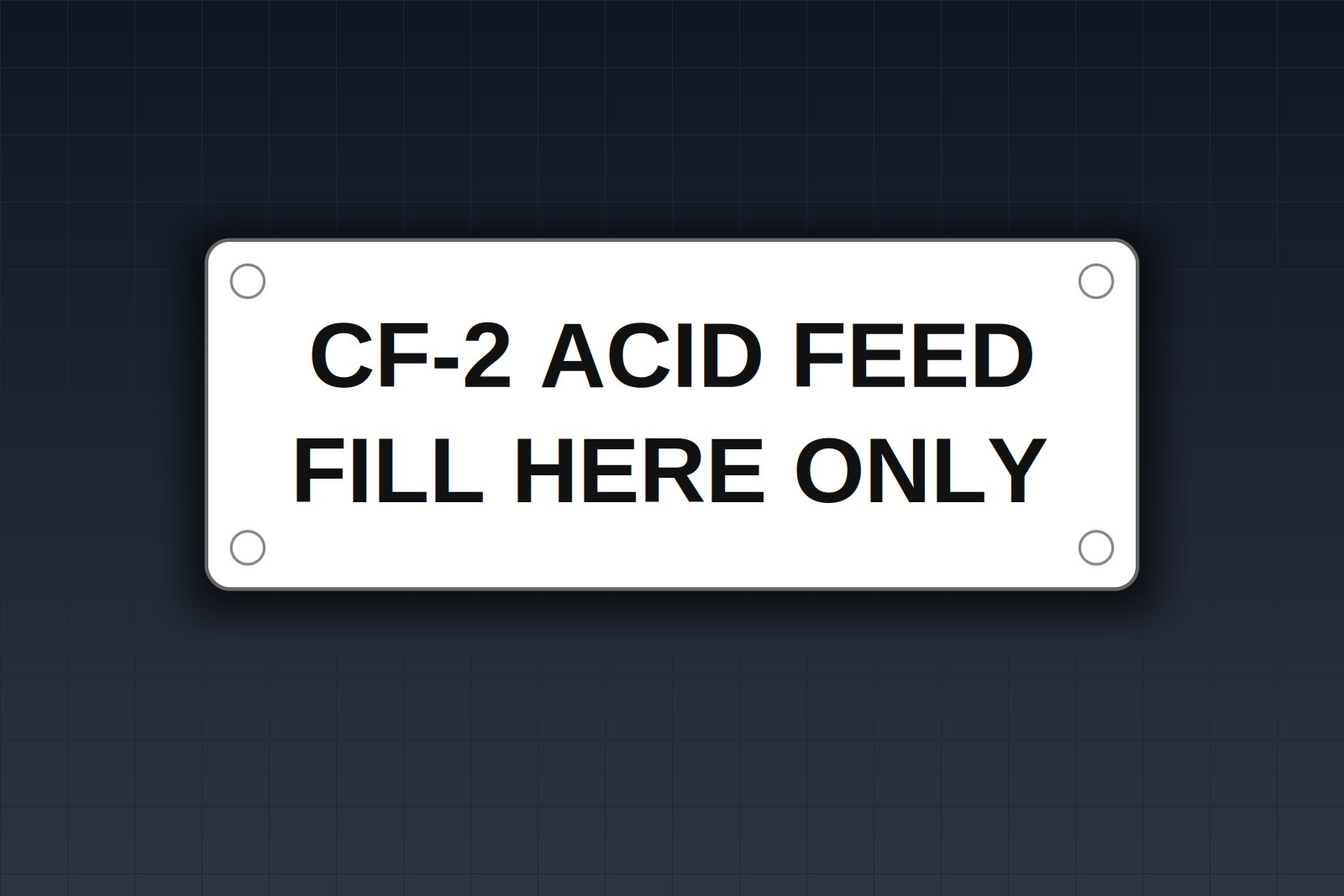
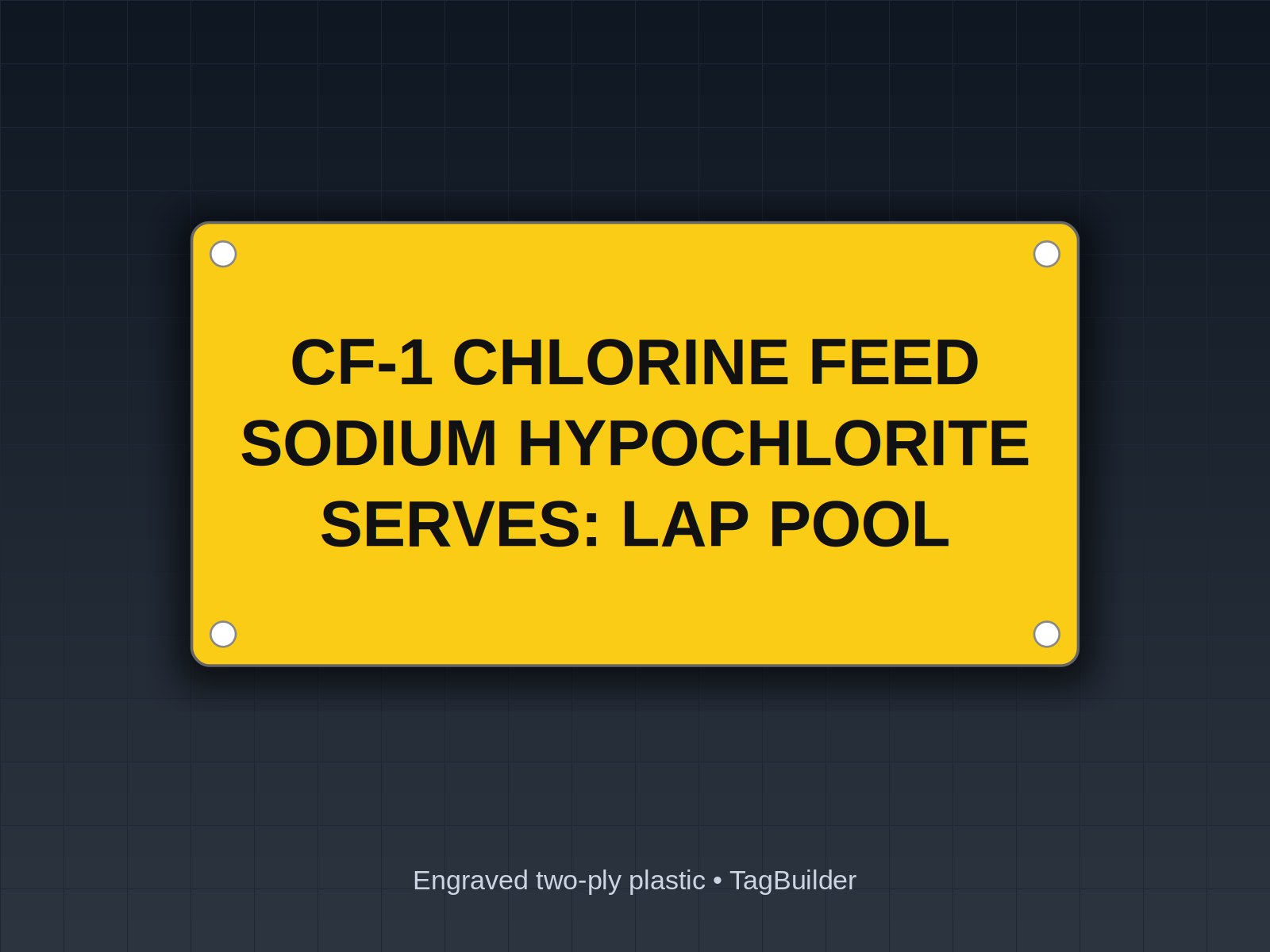
A pool chemical room label should say which chemical, which piece of equipment, and which pool it serves. Give every feeder, tank, fill point, injection point, line and isolation valve the same ID and the same color, so anyone can trace one chemical from the tank to the pool without guessing. The wording is short, for example CF-1 CHLORINE FEED, LAP POOL, and it is engraved so it stays readable in a damp, corrosive room.
What this article covers, and what it does not
This is about permanent identification: which feeder, which tank, which line, which pool, which injection point. That is the part a relief tech or delivery driver reads before they connect a hose or open a valve.
Chemical hazard labels on containers under OSHA HazCom (29 CFR 1910.1200) and GHS, and the NFPA 704 diamond, are separate requirements. They are handled by your chemical supplier and your safety program, and we do not make them. Engraved ID plates sit next to those labels. They do not replace them.
Why identification matters in a chemical room
Sodium hypochlorite and muriatic acid are routinely stored within a few feet of each other. Both are clear to pale liquids, both run through similar tubing, and both feeders may be the same make and model. If acid goes into a hypochlorite tank, or the two lines get cross-connected during a repair, the result can be a toxic gas release, a building evacuation and a closed facility.
Most of these events start with a person who was told "the tank on the left" and found it was on the right. A label that names the chemical and matches the label at the fill point removes the guesswork.
Build one ID scheme and use it everywhere
Pick a short code per feed system and carry it to every component on that system. A simple pattern is a two-letter chemical prefix, a number, then the chemical name and the pool.
- CF-1: chlorine feed, first pool
- AF-1: acid feed, first pool
- CF-2 and AF-2: the same pair for a second pool
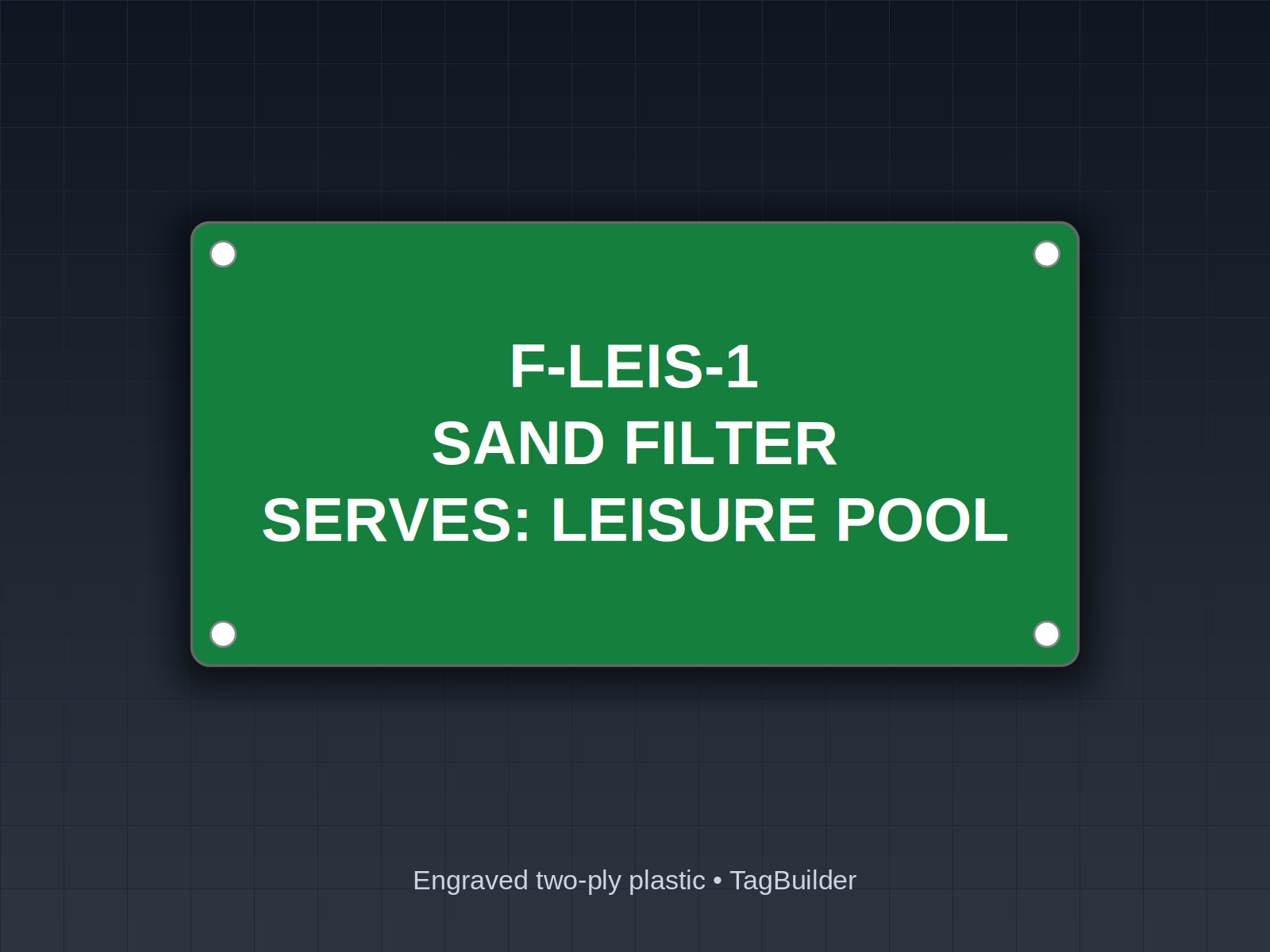
If you are following the numbering in the brief, CF-1 CHLORINE FEED, LAP POOL and CF-2 ACID FEED, LAP POOL also work, as long as the facility uses one convention consistently and the code is unambiguous. The prefix letters should not be reusable for something else in the building. Multi-pool sites should read the guide to labeling which pool each pump serves first, because the pool name is what keeps the codes unique.
The labels, item by item
The table below lists each item in a chemical feed system, the plate wording we would put on it, and how it is usually mounted.
| Item | Plate wording | Mounting |
|---|---|---|
| Chemical room door | POOL CHEMICAL ROOM / AUTHORIZED PERSONNEL ONLY | Screws or adhesive on the door face, eye level |
| Feed pump | CF-1 CHLORINE FEED PUMP / LAP POOL | Screws into the wall or stand beside the pump, not on the pump housing |
| Storage tank | CF-1 CHLORINE TANK / LAP POOL | Plastic ties or adhesive on the tank or its containment, facing the room |
| Tank fill point | CF-1 FILL / CHLORINE ONLY / LAP POOL | Screws or ties at the fill connection, readable from the hose position |
| Tubing and pipe | CHLORINE with an arrow showing flow direction | Plastic ties around the line at both ends, at each wall pass-through and at each change of direction |
| Isolation valve | CF-1 ISOLATION / CHLORINE | Plastic tie through the handle or a tag hung on the valve |
| Injection point | CF-1 INJECTION / CHLORINE / LAP POOL | Tie or screw at the fitting on the recirculation line |
| Controller | LAP POOL CHEMICAL CONTROLLER | Screws or adhesive beside the display |
| Interlock note | FEED STOPS WHEN RECIRCULATION FLOW STOPS | Adjacent to the flow switch or on the controller panel |
Tank fill-point labels
The fill point is where the most expensive mistake happens, so it should carry the most obvious plate. Put the same ID as the feeder, the chemical name in the largest letters on the plate, and the word ONLY. A plate about 3 x 6 inches with 3/4 inch letters on the chemical name is easy to read from a hose position. Mount it at the connection itself, not on the wall three feet away.
Injection-point tags
The injection point is where chemical enters the recirculation line. Tag it with the feeder ID, the chemical and the pool, so a tech who is tracing a bad reading can walk from the controller to the fitting. Install the tag on the fitting side that stays accessible, because the line itself is often insulated or boxed in.
Tubing and pipe labels
Chemical name plus a flow arrow, repeated often enough that no stretch of line is unlabeled between two identified points. ASME A13.1 is the usual reference for pipe marking, including legend and direction of flow, but it is written for pipe, so how closely you follow it for small feed tubing is a facility decision. Check the current edition if your jurisdiction or insurer points to it.
Controller and interlock labels
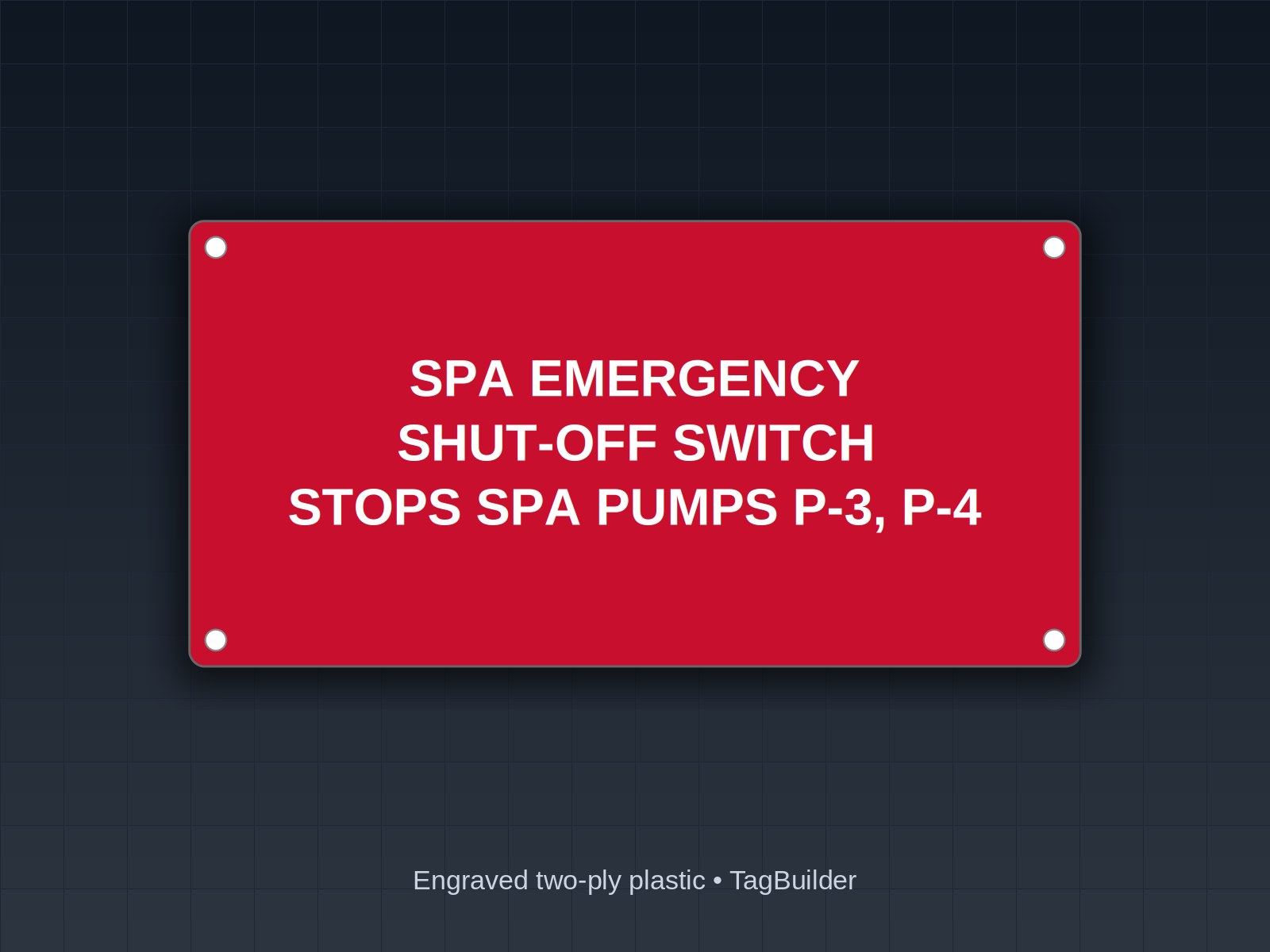
Many feed systems are set up so the pumps stop when recirculation flow stops. If yours is, say so in plain words on the controller or flow switch: FEED STOPS WHEN RECIRCULATION FLOW STOPS. It tells the next person that a feed pump that will not run may be a flow problem, not a pump problem, and that the interlock should not be bypassed to "get chemical in." Only label an interlock that has been verified to work that way.
Color: pick a convention and keep it
Colors are a facility choice, not a code requirement we know of. A common convention is yellow for chlorine and white or another clearly different color for acid. What matters is that the color is the same on the tank, the feeder, the line and the valve, so a quick glance matches up the whole system. Write the convention on a legend plate in the room if more than one person services it.
The stock black-on-yellow V-001 valve tag fits the chlorine side of that convention for isolation valves. For equipment that must not be started or valved in during service, the DO NOT OPERATE tag is available with mounting holes. Chemical-specific wording such as the IDs above is built in the rectangle plate configurator and the circle valve tag configurator.
Materials for a corrosive room
Chlorinated, acidic air attacks many metals, including some stainless grades, and pitting and rust staining show up early near fill points and open containers. Engraved two-ply plastic tags on plastic ties or plastic screws hold up well in these rooms because there is nothing in the tag or the fastener to corrode. The engraved text is cut into the plate, so it does not rub off the way printed ink can when someone wipes a spill. For a comparison of materials, see brass vs. stainless vs. plastic valve tags.
What state and model codes expect
Many state and local pool codes, and the Model Aquatic Health Code (MAHC), commonly expect chemical feed equipment and chemical storage to be identified and kept separated from incompatible chemicals. The details differ by jurisdiction and by edition: some specify wording, some specify separation or containment, and some leave it to the health department inspector. Check the current edition of your code and ask your AHJ what they look for. Engraved identification supports that work, but it does not make a room meet any code on its own.
Worked example: a two-feeder chemical room
This is a complete list for one lap pool with a hypochlorite feeder and an acid feeder. Copy it line for line and change the pool name. Use yellow plates for the CF items and white plates for the AF items, or whichever convention your facility has chosen.
- Door: POOL CHEMICAL ROOM / AUTHORIZED PERSONNEL ONLY, 1 inch letters on the first line
- Legend plate (inside door): YELLOW = CHLORINE / WHITE = ACID
- Tank: CF-1 CHLORINE TANK / LAP POOL
- Fill point: CF-1 FILL / CHLORINE ONLY / LAP POOL
- Feed pump: CF-1 CHLORINE FEED PUMP / LAP POOL
- Line label (repeat): CHLORINE → (flow arrow pointing toward the pool)
- Isolation valve: CF-1 ISOLATION / CHLORINE
- Injection point: CF-1 INJECTION / CHLORINE / LAP POOL
- Tank: AF-1 ACID TANK / LAP POOL
- Fill point: AF-1 FILL / ACID ONLY / LAP POOL
- Feed pump: AF-1 ACID FEED PUMP / LAP POOL
- Line label (repeat): ACID →
- Isolation valve: AF-1 ISOLATION / ACID
- Injection point: AF-1 INJECTION / ACID / LAP POOL
- Controller: LAP POOL CHEMICAL CONTROLLER
- Interlock: FEED STOPS WHEN RECIRCULATION FLOW STOPS
If your acid is something other than muriatic acid, write what is actually in the tank. The label has to match the chemical, not the habit.
Frequently Asked Questions
What should a pool chemical feeder label say?
It should say the feeder ID, the chemical and the pool it serves, for example CF-1 CHLORINE FEED PUMP, LAP POOL. Keep the wording identical to the tank and fill-point labels for the same system so one search for the ID finds every component.
How do I label a chemical injection point on a pool recirculation line?
Put a tag on the fitting with the feeder ID, the chemical name and the pool, such as CF-1 INJECTION, CHLORINE, LAP POOL. Mount it where it can be read without removing insulation or covers, and add a flow arrow on the line just upstream.
Do I still need OSHA and NFPA labels if I have engraved ID plates?
Yes. HazCom and GHS container labels and the NFPA 704 diamond are separate requirements, handled by your chemical supplier and your safety program. Engraved ID plates name the equipment and lines; they do not replace hazard labeling.
What should a pool chemical storage room door sign say?
Name the room and limit access, for example POOL CHEMICAL ROOM, AUTHORIZED PERSONNEL ONLY. Some jurisdictions or insurers expect additional wording, so ask your AHJ what they look for.
What color should chlorine and acid labels be?
That is a facility choice. A common convention is yellow for chlorine and white or another distinct color for acid, kept the same at the tank, feeder, line and valve. Post a legend plate so new staff know the convention.
What material holds up in a pool chemical room?
Engraved two-ply plastic on plastic ties or plastic screws is a good fit, since chlorinated, acidic air attacks many metals, including some stainless grades. Avoid metal fasteners near fill points and open containers.
Send us one feeder or tank ID and we'll engrave a sample tag and mail it, no charge.
The chemical room is one part of the mechanical space. The pump-room valve tag and flow arrow guide covers the rest of the loop, and the multi-pool equipment label guide shows how to keep IDs distinct across several pools. If you want to see the engraving first, you can also request a free sample.
UL, NFPA, NEC, ASME, CEMA, TIA, ANSI and OSHA are names or marks of their respective organizations; TagBuilder is not affiliated with or endorsed by any of them. Requirements above are paraphrased summaries, not the text of any standard. Always work from the current published edition and your AHJ.