Boiler Room Labeling: Boilers, Burners, Pumps, Valves, Expansion Tanks and the Emergency Shutoff Sign
It is 2 a.m., the building has no heat, and the person who walks into the boiler room did not install anything in it. Every device looks alike, and nothing says which pump feeds which loop or where the gas comes off.
Short answer: label a boiler room in the order a technician walks it. Start with the emergency shutoff switch and its sign at the exit, then each boiler and burner, each pump, each valve, the expansion tank and air separator, and finally the gas train and piping. Use the same identifiers that appear on the mechanical schedule and drawings, so the plate on the wall matches the paper in the binder.
Important Disclaimer
This article is provided for general informational purposes only and does not constitute legal, safety, or professional compliance advice. Regulations, standards, and codes are subject to change and may be interpreted differently by authorities having jurisdiction (AHJ). Always consult with qualified safety professionals, licensed engineers, or legal counsel to determine the specific requirements applicable to your facility. TagBuilder is not responsible for any actions taken based on this information.
Why Boiler Room Labels Matter
Bad or missing labels cause the same few problems again and again:
- The operator presses the wrong device. An unmarked switch near the door might be a light switch, a pump disconnect or the burner shutoff. In an emergency nobody should have to guess.
- The tech services the wrong unit. With two identical boilers, working on B-2 while believing it is B-1 means isolating the wrong piece of equipment.
- The reorder arrives in the wrong size. When a tag is painted over or missing, the replacement gets ordered from memory. Keep a written legend list with sizes and colors.
- The inspector asks questions nobody can answer. Insurance and jurisdictional inspectors commonly ask where the emergency switch is and how equipment is identified. A labeled room answers most of that before they ask.
1. The Remote Emergency Shutoff Switch and Its Sign
Automatically fired boilers commonly have a manually operated emergency switch that cuts fuel and power to the burners from outside the hazard area. ASME CSD-1 addresses this for many installations, and many state and local boiler rules add their own requirements. The usual expectation is a switch located at the boiler room exit, often just outside the door, so the operator does not have to walk past the equipment to reach it.
The details vary: exact location, mounting height, whether more than one switch is needed, and wording. They depend on the jurisdiction, the code edition and the insurer. Ask the AHJ or the insurance inspector before you order anything.
The sign itself should be short and unambiguous. Common legends are:
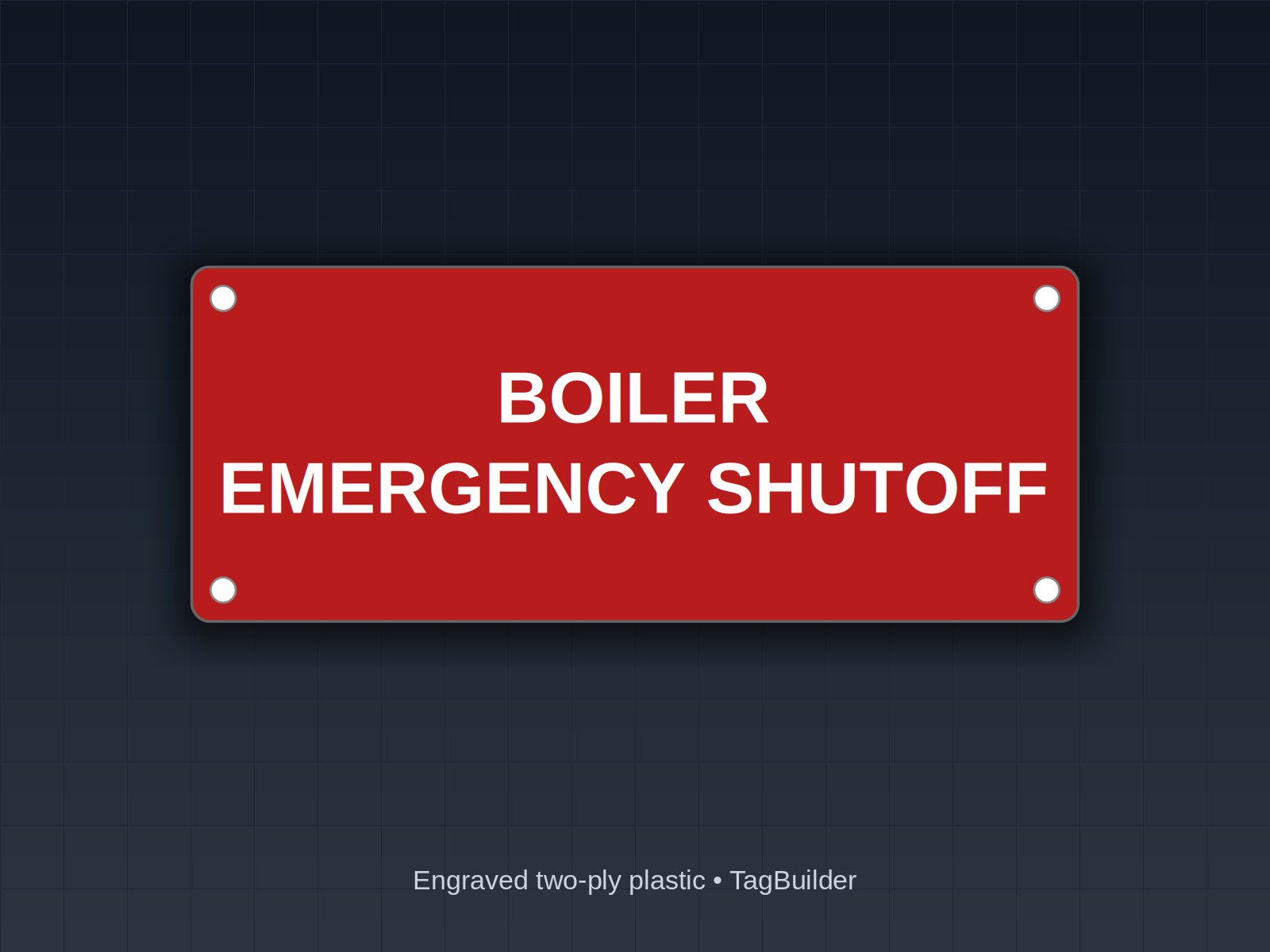
- BOILER EMERGENCY SHUTOFF
- EMERGENCY BURNER SHUTOFF with a second line such as BOILER ROOM if there are other emergency devices nearby
Use high-contrast text, usually white on black or white on red, large enough to read from across the corridor. The 4.0 x 2.0 boiler safety label, 1/4 x 2 inch, white on black with holes is a ready-made size for this kind of sign. Screws through the mounting holes hold better than adhesive near a doorway that sees traffic and cleaning.
2. Boiler and Burner ID Plates
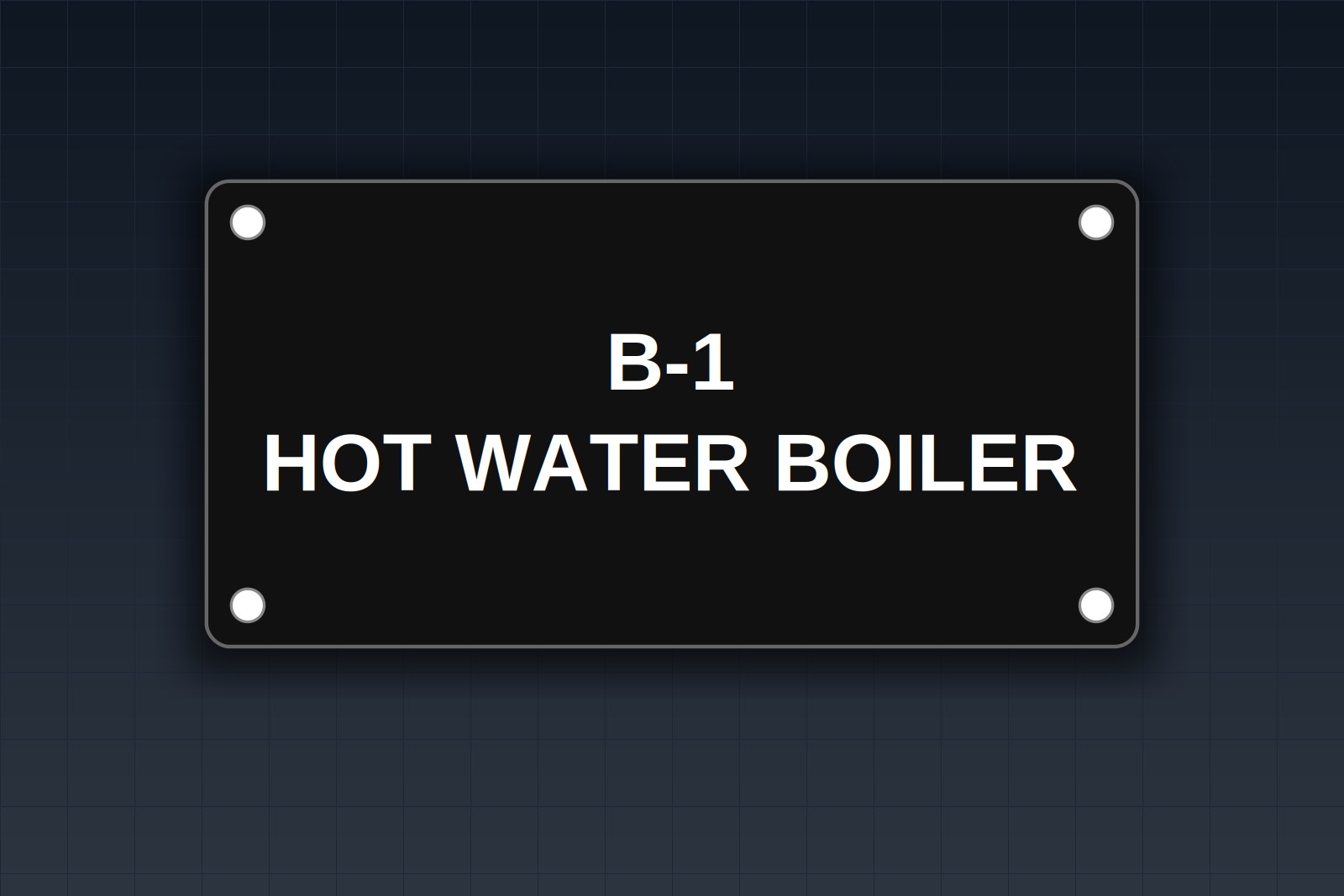
Give each boiler a plate that matches the mechanical schedule exactly. If the drawings call it B-1, do not label it BOILER 1 or NORTH BOILER. Add the service or fuel line so the plate is useful on its own.
Burners deserve their own plates when the burner is a separate assembly or can run on more than one fuel. A dual-fuel burner label should state each fuel, for example BURNER B-1 / NAT GAS / #2 OIL.
Heat and mounting
Mount plates away from the hottest surfaces: the flue, the stack connection, the burner housing near the flame and the front of the firebox. Use engraved stainless for very hot spots and engraved plastic elsewhere. On hot or dusty surfaces use screws or a stainless chain rather than adhesive, because adhesive lets go with heat cycling and dust. Plastic plates should sit on the cooler parts of the boiler jacket or on the wall behind it.
3. Pumps
Pump labels should carry the identifier, what the pump serves and, for pairs, which is lead and which is standby. Typical legends:
- HWP-1A / HOT WATER PUMP / LEAD
- HWP-1B / HOT WATER PUMP / STANDBY
- P-2 / BOILER CIRCULATOR / B-2
Put the label on the pump body or its base, not on the motor cover alone, since covers get swapped. If you need a ready-made plate, the lead pump label, 4 x 2 inch, white on black with holes covers the lead position. Mark the standby pump the same way so there is no doubt about which one the controls start first.
4. Valves
Valves are where most of the guessing happens. A circle valve tag with a short service code and a number lets a tech identify the valve and find it on the chart. Tag the isolation valves on each boiler supply and return, the pump isolation valves, the gas shutoff, the makeup water valve and, on steam systems, the blowdown valves.
For hot water systems, the 2 inch HWS tag and the 2 inch HWR tag cover supply and return. For gas, the 2.5 inch gas shutoff tag is large enough to read at a glance. Color conventions differ between facilities and standards, so pick one scheme and write it down; the valve tag color codes guide explains the common choices.
The table below lists suggested legends and tag types for the main items in the room. Sizes are starting points; adjust for viewing distance.
| Item | Suggested legend | Tag type and size |
|---|---|---|
| Emergency shutoff | BOILER EMERGENCY SHUTOFF | Rectangle plate, about 4 x 2 in, screws |
| Boiler | B-1 / HOT WATER BOILER | Rectangle plate, about 4 x 2 in |
| Burner | BURNER B-1 / NAT GAS | Rectangle plate, engraved stainless near heat |
| Pump | HWP-1A / LEAD | Rectangle plate, about 4 x 2 in |
| Supply valve | HWS V-03 | Circle tag, 2 in |
| Return valve | HWR V-04 | Circle tag, 2 in |
| Gas shutoff | GAS SHUTOFF B-1 | Circle tag, 2.5 in |
| Expansion tank | ET-1 / EXPANSION TANK | Rectangle plate, about 3 x 1.5 in |
5. Expansion Tank, Air Separator and Chemical Feeder
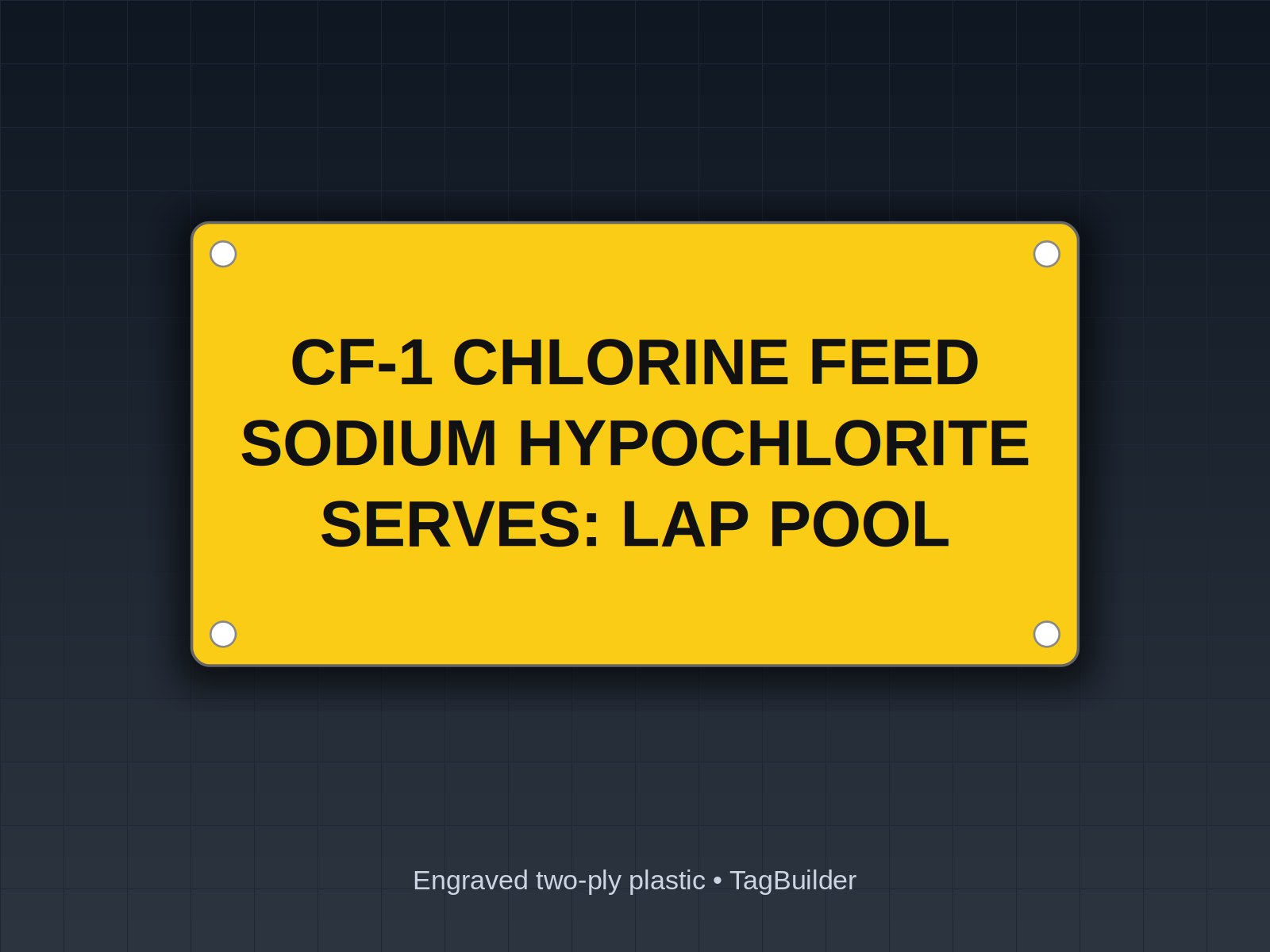
These get skipped because they just sit there, but they are the first things a tech looks for on a pressure complaint. Label the expansion tank ET-1 and, if there is room, add the precharge or fill note your mechanical contractor uses. Label the air separator AS-1 and the chemical feeder CF-1 / GLYCOL FEED or CF-1 / CHEM FEED, whichever it is.
Do not put pressure numbers on a plate unless they will never change. A wrong number on a permanent label is worse than no number.
6. Gas Train and Pipe Markers
The gas shutoff is the one a responder needs fastest. Tag the manual shutoff ahead of each burner train and mark it with the boiler it serves. Pipe markers on the gas line, the hot water mains and the makeup line then tell anyone following a pipe what it carries and which way it flows. Marking schemes are covered in the pipe marking guide; check the current edition and your AHJ for color and size.
Worked Example: Two-Boiler Hot Water Plant
Here is a tag list you can copy and adjust. Replace the numbers with those on your own schedule.
Equipment plates
- BOILER EMERGENCY SHUTOFF (at the room exit)
- B-1 / HOT WATER BOILER
- B-2 / HOT WATER BOILER
- BURNER B-1 / NAT GAS
- BURNER B-2 / NAT GAS
- HWP-1A / LEAD
- HWP-1B / STANDBY
- ET-1 / EXPANSION TANK
- AS-1 / AIR SEPARATOR
Valve tag schedule
Each row is one circle tag. The location column is for the valve chart, not the tag.
| Tag | Service | Location |
|---|---|---|
| V-01 | GAS SHUTOFF B-1 | Gas train, B-1 |
| V-02 | GAS SHUTOFF B-2 | Gas train, B-2 |
| V-03 | HWS B-1 ISOLATION | B-1 supply |
| V-04 | HWR B-1 ISOLATION | B-1 return |
| V-05 | HWS B-2 ISOLATION | B-2 supply |
| V-06 | HWR B-2 ISOLATION | B-2 return |
| V-07 | HWP-1A SUCTION | Pump 1A inlet |
| V-08 | HWP-1A DISCHARGE | Pump 1A outlet |
| V-09 | HWP-1B SUCTION | Pump 1B inlet |
| V-10 | HWP-1B DISCHARGE | Pump 1B outlet |
| V-11 | MAKEUP WATER | Fill line |
| V-12 | ET-1 ISOLATION | Expansion tank |
Print the same list as a valve chart, frame it near the room entrance and keep a copy in the maintenance binder.
Frequently Asked Questions
Where does the boiler emergency switch have to be?
Commonly at or just outside the boiler room exit, so the operator can reach it without walking past the equipment. The exact location and the number of switches depend on the code edition, the state or local boiler rules and your insurer, so confirm with the AHJ before you mount anything.
What should a boiler emergency shutoff sign say?
Keep it short and plain, such as BOILER EMERGENCY SHUTOFF or EMERGENCY BURNER SHUTOFF. Use high-contrast lettering that can be read from the corridor. Some jurisdictions or insurers specify the wording or color, so ask first.
Do boiler valves need tags?
Many inspectors and insurers expect the main valves to be identified, and tags are the practical way to do it. Even where no rule requires them, tagged valves cut the time spent tracing pipe during a no-heat call. Check your AHJ for specifics.
What color are hot water supply valve tags?
There is no single answer. Many facilities use their own scheme, and pipe marking standards define colors for the pipe markers rather than for every valve tag. Choose one scheme, apply it everywhere and document it on the valve chart.
What should go on a boiler room valve chart?
List the tag number, the service, the location, the normal position (open or closed) and what the valve isolates. Add a line for the equipment it protects, such as B-1. Keep the chart in the room and in the maintenance binder.
Send us your boiler room tag list, or one plate, and we'll engrave a free sample so you can check size and color on site.
If you are tagging the rest of the mechanical room, the HVAC equipment abbreviations guide helps keep identifiers consistent, and the valve tag attachment methods guide covers chains, screws and hot-surface mounting. To order circle tags with your own legends, use the circle tag builder.
UL, NFPA, NEC, ASME, CEMA, TIA, ANSI and OSHA are names or marks of their respective organizations; TagBuilder is not affiliated with or endorsed by any of them. Requirements above are paraphrased summaries, not the text of any standard. Always work from the current published edition and your AHJ.