School and University Labeling Standards: Ordering Nameplates and Valve Tags to Campus Spec
The campus design standard says one thing, the master spec says another, and the plates you ordered match neither. The result is a rejected submittal, a punch-list item at final inspection, or a mislabeled breaker that someone opens by mistake.
Important Disclaimer
This article is provided for general informational purposes only and does not constitute legal, safety, or professional compliance advice. Regulations, standards, and codes are subject to change and may be interpreted differently by authorities having jurisdiction (AHJ). Always consult with qualified safety professionals, licensed engineers, or legal counsel to determine the specific requirements applicable to your facility. TagBuilder is not responsible for any actions taken based on this information.
Campus equipment labels are governed by the owner's design standard, usually in the identification sections of the specification: 26 05 53 for electrical, 23 05 53 for HVAC and 22 05 53 for plumbing. Each plate or tag carries the owner's equipment ID, what the equipment serves or what feeds it, and often the building number, in the size, color and attachment the section lists. Where the spec and the NEC differ, the stricter requirement usually governs, but the NEC edition adopted locally and the AHJ decide, so confirm both.
Why campus standards override the generic spec
A consulting engineer's master spec often carries a generic identification section. A university or school district adds its own design standards on top. Those standards reflect years of maintenance lessons: which plates survived, which adhesives let go, which naming schemes the maintenance staff could actually search.
The owner's section usually wins when the two conflict. Bid documents sometimes say so in Division 01 or in the general conditions. If the documents are silent, ask in writing before you order.
Code sets the floor. Examples are the NEC rules on identifying disconnecting means (110.22), circuit directories (408.4) and field-applied equipment markings (110.21(B)). Section numbers and wording change between editions, so check the edition your jurisdiction has adopted. For pipe, many specs point to ASME A13.1 for marker color and legend, again subject to edition and owner preference.
How to read the identification section
Spec sections are written to be skimmed by engineers, not ordered from. Work through them in this order.
- Find every identification section. Check 26 05 53, 23 05 53 and 22 05 53. Also check 21 05 53 for fire suppression, 27 and 28 for low voltage and fire alarm, and any owner appendix.
- List every rule that changes the plate. Color, size, letter height, material, attachment, text format and spare quantity.
- Build a one-page matrix. One row per equipment type, one column per rule. Table 2 below shows the shape.
- Get the owner's naming convention in writing. This is the step most orders skip. The plate text must match what the maintenance group has in its records.
- Submit a sample for sign-off before you order the full run. The reviewer sees the real plate, not a description of it.
Table 1: Spec items to find, what to look for, and common values.
| Spec item | What to look for | Common values (varies by owner) |
|---|---|---|
| Plate material | Laminated plastic, stainless or aluminum for outdoor or washdown | Engraved two-ply plastic, often 1/16 in or 1/8 in thick |
| Color scheme | Background and letter color, by system or by equipment type | Black letters on white, or color-coded by system |
| Letter height | Minimum, sometimes by line (ID line larger than detail lines) | 1/4 in minimum, larger for the ID line |
| Plate size | Minimum size, or a size table by equipment | Stated as a minimum or by equipment type |
| Attachment | Screws, rivets or adhesive, and where each is allowed | Mechanical fasteners on many campuses; adhesive only as a supplement |
| Text format | Building number, equipment ID, serves, fed from | Building prefix plus type plus number |
| Valve tags | Tag content, size, and a valve chart | Building and valve number on the tag; framed chart in the mechanical room |
| Spare stock | Extra plates or tags turned over to the owner | A stated percentage of the total |
| Record data | Must IDs match the asset register or CMMS? | Yes, on most campuses |
Color rules: build the matrix first
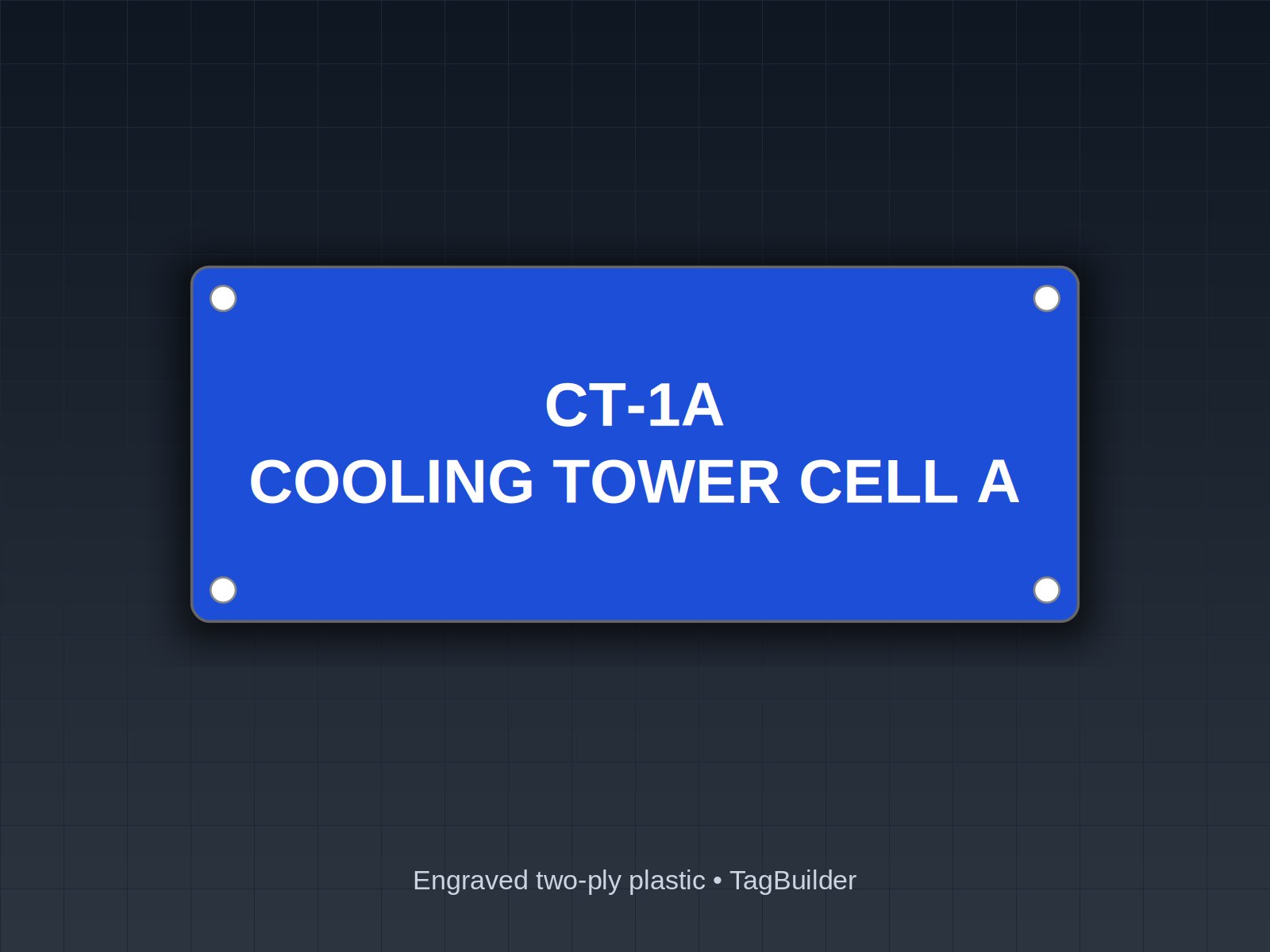
Many campuses color-code by system so a technician can read the plate color before the text. The exact colors belong to the owner. Do not assume the colors from the last campus you worked on.
Table 2: Example equipment-versus-plate-color matrix. Treat every row as a placeholder until the spec confirms it.
| Equipment | Plate color | Letters |
|---|---|---|
| Normal power panels, switchgear | White | Black |
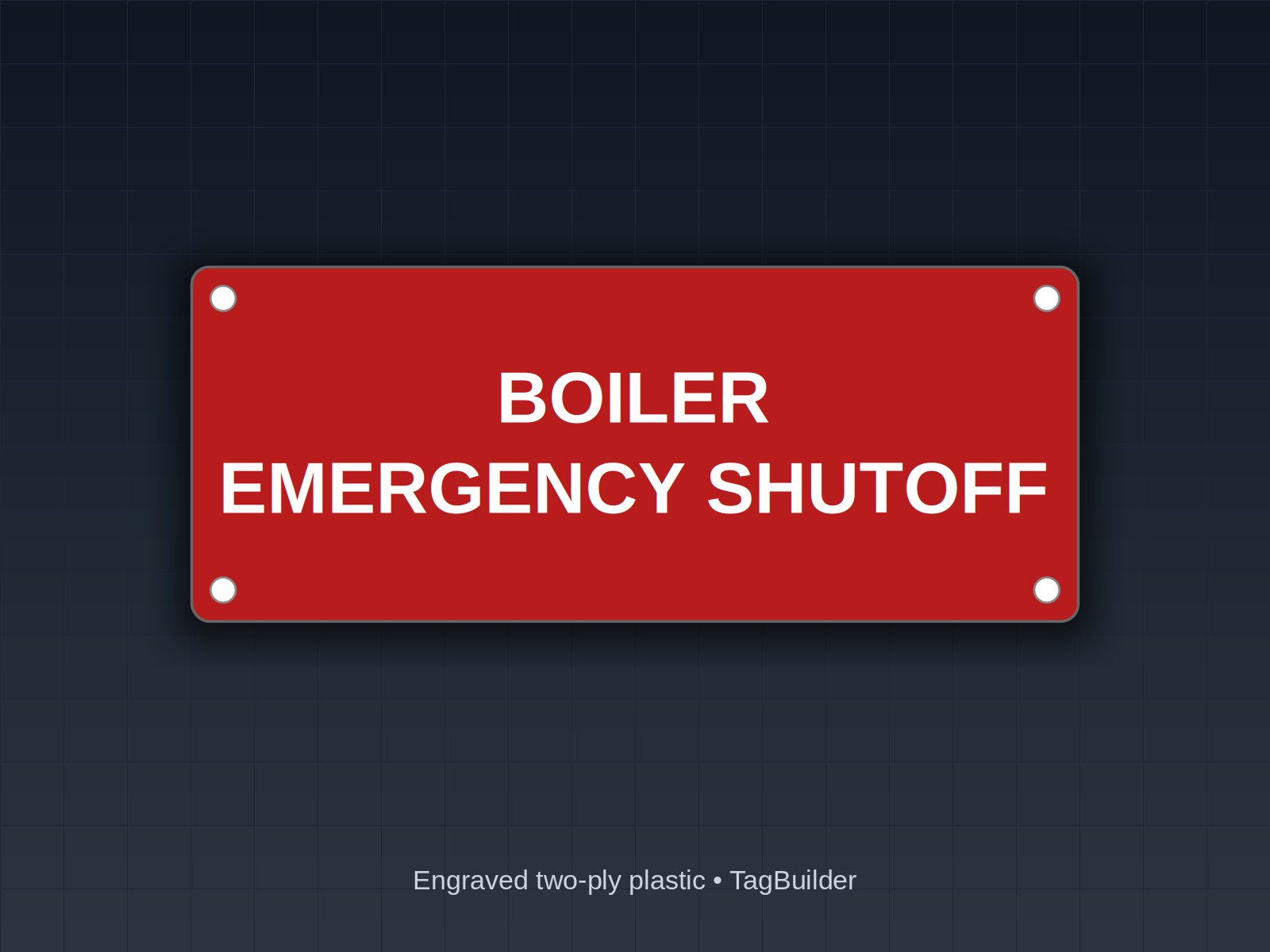
| Emergency or life-safety branch | Red | White |
| UPS-backed loads | Orange, or another owner-chosen color | Black |
| Standby or optional systems | Owner-defined | Per spec |
| Air handlers and mechanical equipment | White, or per mechanical section | Black |
| Valve tags | Often color-coded by system | Per spec |
If two sections give two colors for the same item, stop and ask. A request for information costs a day. Replacing a full run of plates costs more.
Make the plate text match the campus records
A plate that reads B114-AHU-02 helps only if the maintenance system also calls it B114-AHU-02. Many campuses run a CMMS or asset register. Work orders, PM schedules and shutdown procedures refer to the same IDs.
Ask for the asset register export or the naming rule before you finalize the equipment schedule. Then check three things:
- Prefix: building number first, or building abbreviation first.
- Separators: hyphens, slashes or spaces, and whether leading zeros are used (HW-031, not HW-31).
- Source and load lines: whether the plate carries a FED FROM line, a SERVES line, or both.
For the general approach to numbering, see the valve numbering system guide. For what belongs on a nameplate, see the equipment nameplate guide.
Worked example: Building B114
Here is a set of plates for a campus building numbered B114, written the way you could paste them into an order. Sizes and colors are examples. Replace them with your spec values.
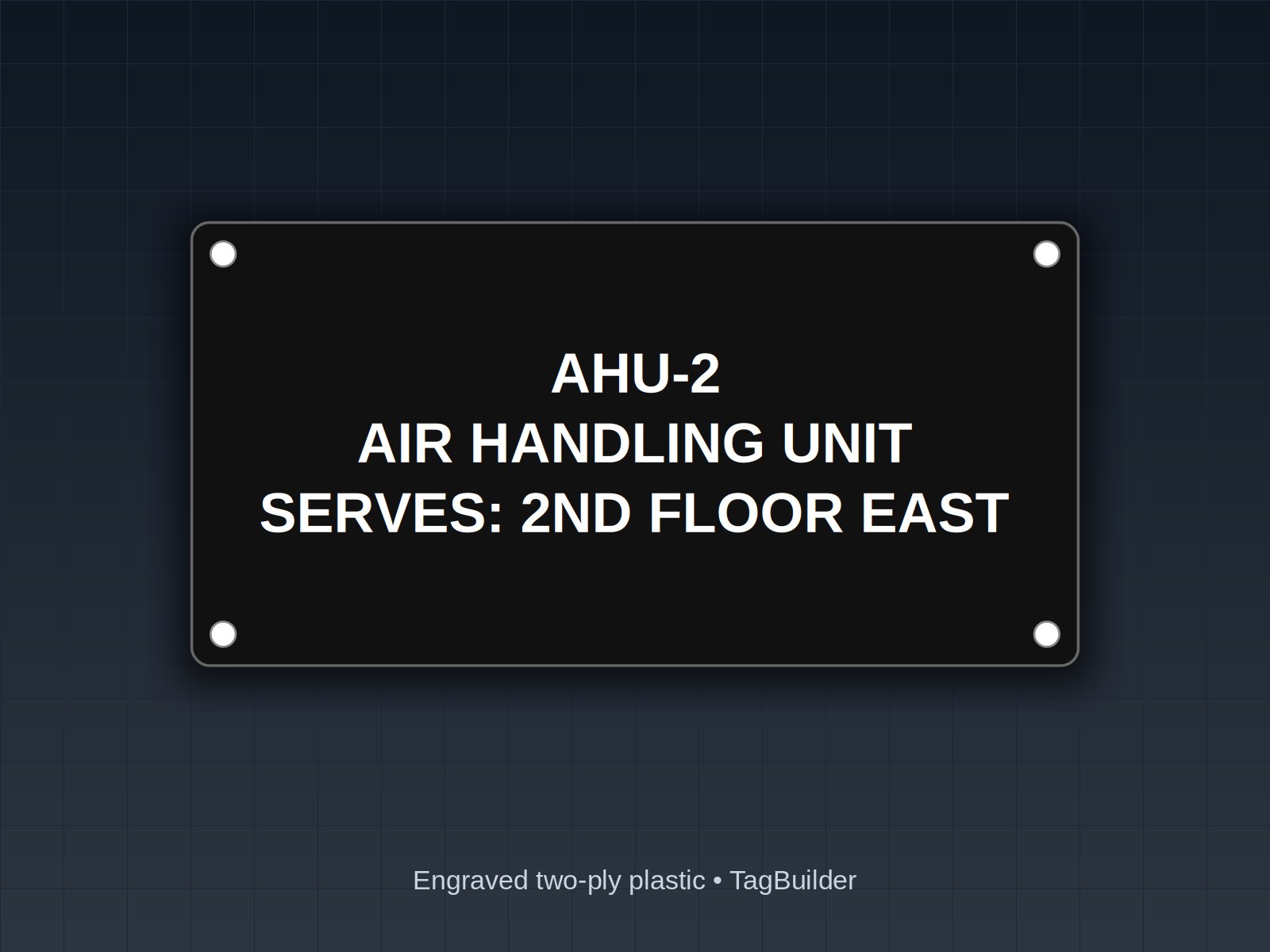
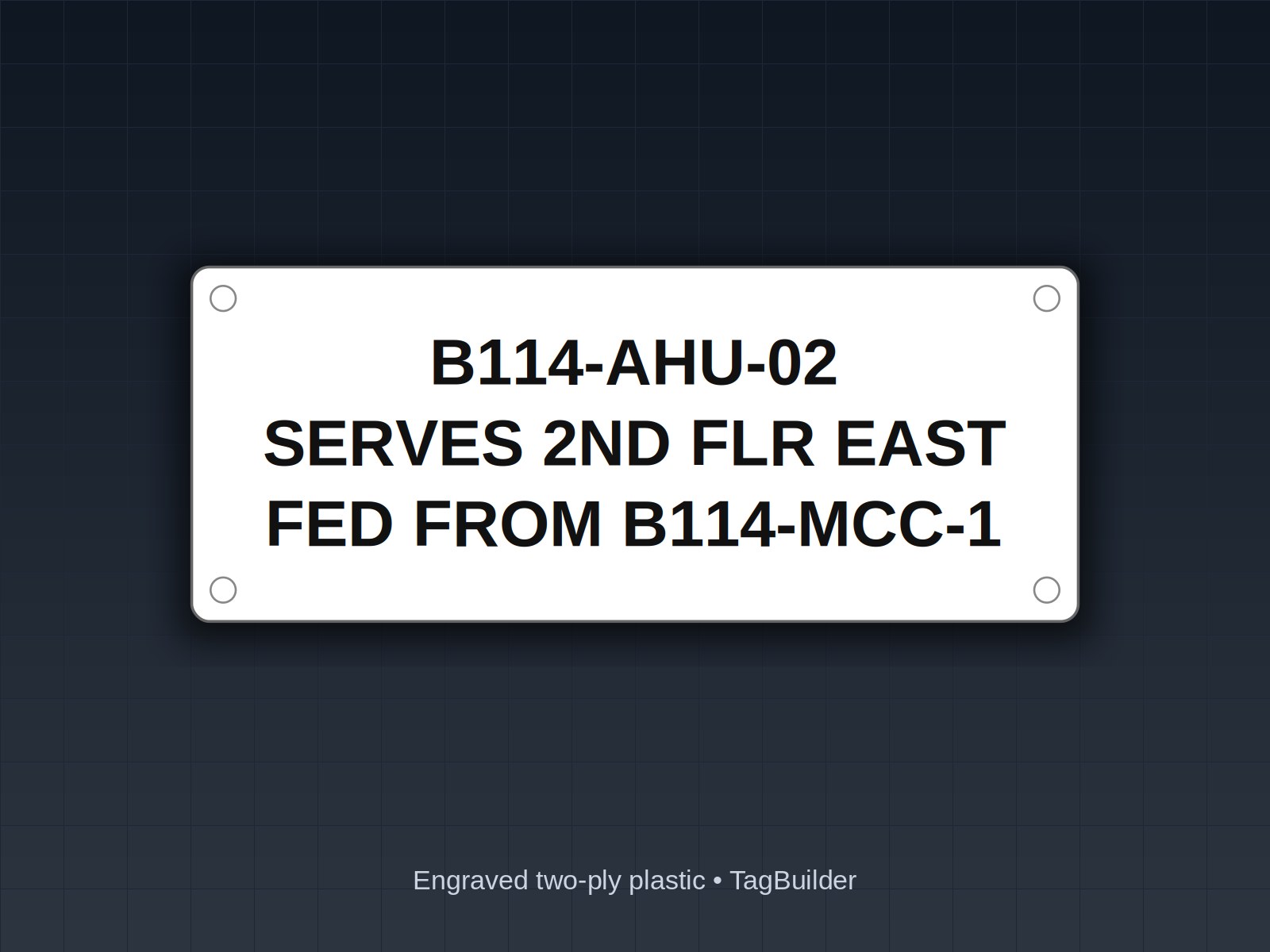
Plate 1: Air handler
- Line 1: B114-AHU-02 (3/8 in letters)
- Line 2: SERVES 2ND FLR EAST (1/4 in letters)
- Line 3: FED FROM B114-MCC-1 (1/4 in letters)
- Size: 5 in x 1-1/2 in, 1/16 in two-ply plastic
- Colors: black letters on white
- Attachment: two screws, or as the spec directs
Air handler plates follow the same pattern across a building, so start from the AHU equipment plate and change the text to your ID scheme.
Plate 2: Panelboard
- Line 1: B114-LP-2A (3/8 in letters)
- Line 2: 208Y/120V 3PH 4W (1/4 in letters)
- Line 3: FED FROM B114-DP-1 (1/4 in letters)
- Size: 5 in x 1-1/2 in, 1/16 in two-ply plastic
- Colors: black on white for normal power; swap to the owner emergency color for a life-safety panel
The voltage line and the source line are the two items an electrician reads first. Check what your edition of the NEC and the owner require for panelboard markings, and put them on the plate. The equipment ID plates are a good base for this layout.
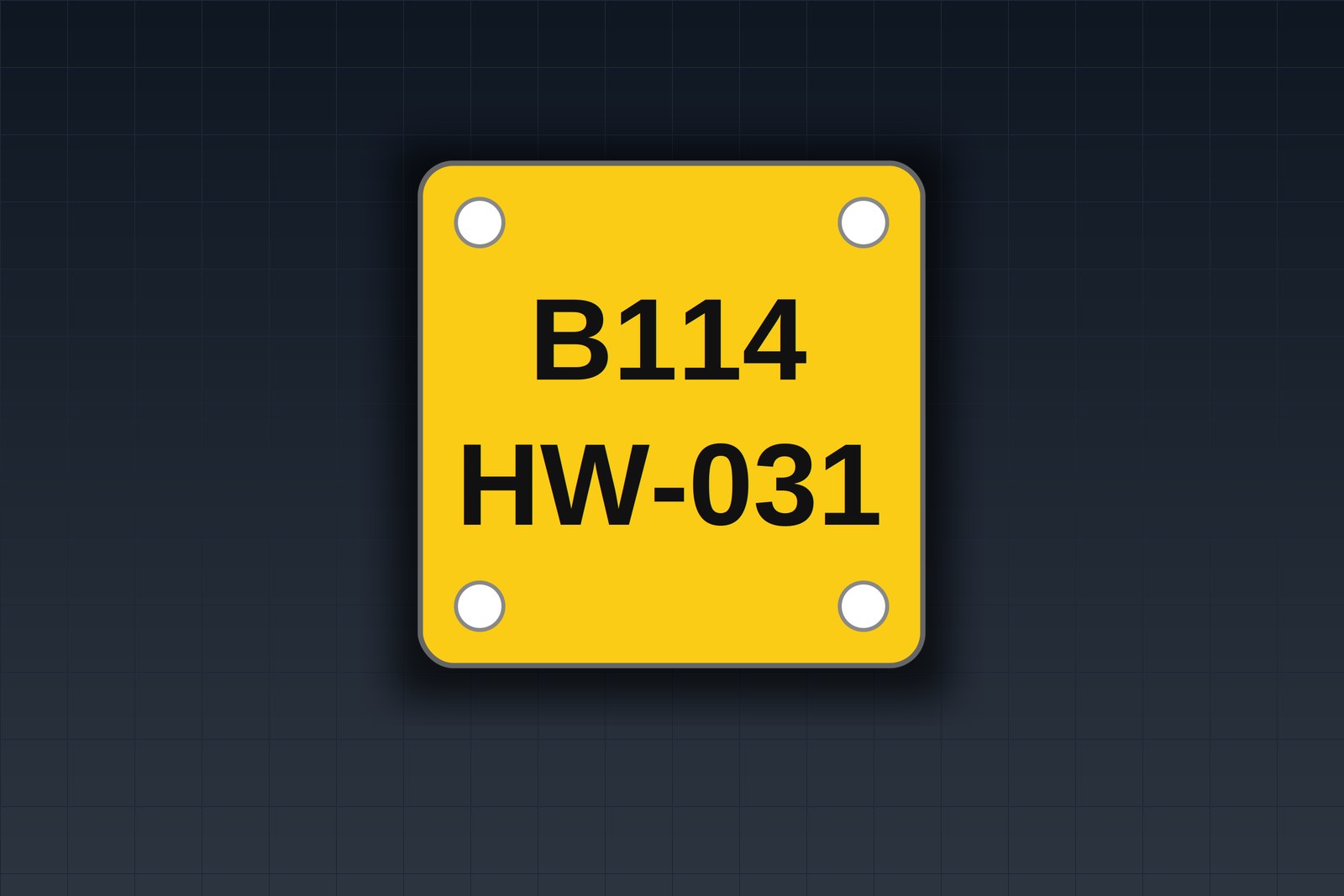
Plate 3: Valve tag
- Top line: B114
- Bottom line: HW-031
- Size: 1-1/2 in round
- Colors: per the owner's system color table
You can order the 1-1/2 in black-on-yellow valve tag as it stands, or open it in the configurator and change the text to your building and valve number. Match each tag to a row on the framed valve chart. The chart and the tags must agree on every number.
Order to spec: send the schedule, get matching plates
The fastest path from spec to installed plates has four steps.
- Send the spec section, the equipment schedule and the naming rule.
- Confirm the matrix: colors, sizes, letter heights, attachment, spares.
- Review a submittal sample plate against the spec.
- Release the full order. Plates and tags come back matching the schedule.
Ask for a spare percentage in the order if the spec calls for one. Counting spares after the job closes wastes time. For help turning a drawing and bill of materials into an order-ready list, see the guide to specifying engraved labels on panel drawings.
Frequently Asked Questions
What does a 26 05 53 electrical identification spec have to say about nameplates?
It typically covers plate material, colors, letter height, attachment method and the text format for panels, switchgear, disconnects and similar equipment. Details vary by owner and by edition of the spec template. Read the owner's section and any appendix, then confirm the NEC edition your AHJ enforces.
Do I need a valve chart if every valve already has a tag?
Many campus standards require both. The tag identifies the valve in the field. The framed chart in the mechanical room lists each valve, what it controls and where it sits. If your spec lists a chart, plan for it in the closeout documents.
Can I use adhesive-backed plates on a campus job?
Only if the spec allows it. Some owners require screws or rivets and allow adhesive as a supplement. Others accept adhesive on smooth, clean surfaces. Check the attachment line in the identification section before you order.
What letter height do campus nameplates need?
Many specs set a minimum of 1/4 in for general text and a larger size for the equipment ID line. Your spec may differ. Use the figure in the owner's section, and size the plate so the longest line fits at that height.
How do I make plate text match the campus CMMS?
Ask the facilities group for the naming rule or an export of the asset register. Copy IDs from that source into your equipment schedule instead of retyping them. Then compare the schedule to the plates before release.
Is a sample plate worth the extra step?
Yes. A sample shows the reviewer the color, letter size and layout in hand. It catches spec misreadings before the full order is cut, and it gives the owner a record of what was reviewed.
Send us your campus labeling spec section. We'll engrave a submittal sample plate to it, no charge.
If you have the schedule ready, the next step is small: pick the stock plates from the valve tag catalog, change the text to the owner's scheme, and request a free sample plate for the submittal package. The valve tag size chart helps you check that the longest ID fits the tag at the letter height your spec requires.
UL, NFPA, NEC, ASME, CEMA, TIA, ANSI and OSHA are names or marks of their respective organizations; TagBuilder is not affiliated with or endorsed by any of them. Requirements above are paraphrased summaries, not the text of any standard. Always work from the current published edition and your AHJ.