Washdown-Ready Equipment and Valve Tags for Food Plants
Your valve labels are curling after a week of caustic and hot water, and the pieces that come off end up on the floor or in a drain. Here is how plants tag valves, lines and equipment so the ID stays put and nothing sheds.
Important Disclaimer
This article is provided for general informational purposes only and does not constitute legal, safety, or professional compliance advice. Regulations, standards, and codes are subject to change and may be interpreted differently by authorities having jurisdiction (AHJ). Always consult with qualified safety professionals, licensed engineers, or legal counsel to determine the specific requirements applicable to your facility. TagBuilder is not responsible for any actions taken based on this information.
The short answer: in a washdown zone, use engraved stainless tags on stainless chain or wire for valves, and engraved plates held with stainless hardware or sealed edges for equipment and control stations. Skip paper and vinyl in the spray zone. Engraved text is cut into the surface, so it does not rub off the way printed ink can, and a solid metal tag has no adhesive edge to lift.
What goes wrong with printed and vinyl labels
A label that works on a dry electrical panel often fails in a plant that washes down every shift. Caustic, acid and sanitizer cycles, hot water and pressure spray work on the label edge first. Once an edge lifts, water and soil get behind it, and the label becomes a place for residue to sit that sanitation cannot reach.
The failures are practical, not dramatic:
- Smeared or faded print. A tech reads the wrong line and opens the wrong valve, or sends a CIP return to the wrong tank.
- Lifted edges. Soil collects under the label, and sanitation has one more spot to work around.
- Loose pieces. A corner that peels off is a foreign-material concern the plant then has to account for.
- Missing labels. Someone guesses at the ID, and the reorder arrives in the wrong size or legend because nobody can read what was there.
Where tags go in a washdown zone
Sanitary design and material decisions belong to your food safety team and the programs your plant works under. What follows is the general thinking fabricators see plants use, not a rule. Check it against your own hygienic design requirements and your customer or auditor expectations.
- Fewer crevices. Pick tags and attachments that are smooth and easy to rinse. A flat plate with sealed or spaced mounting is easier to clean than a label with a seam.
- No peeling edges. Mechanical attachment beats adhesive in the spray zone.
- Away from product contact surfaces. Mount tags on frames, supports and valve bodies outside the product zone, not on surfaces product touches.
- Smooth stainless. Solid stainless gives the plant one material to inspect and one material to wash.
- Plastic where it stays dry. Engraved two-ply plastic suits dry-side panels, offices and mechanical rooms. Whether it belongs in a given wet area is the plant's call.
The table below lists common tag locations in a washdown area, with the tag type and attachment most often used for each.
| Location | Tag type | Attachment | Note |
|---|---|---|---|
| Process and CIP valves | Engraved stainless circle tag | Stainless chain or wire on the handle or stem | Keep the tag clear of the product zone |
| Line and header identification | Engraved stainless tag | Stainless wire around the pipe or support | Tag at valves and branch points |
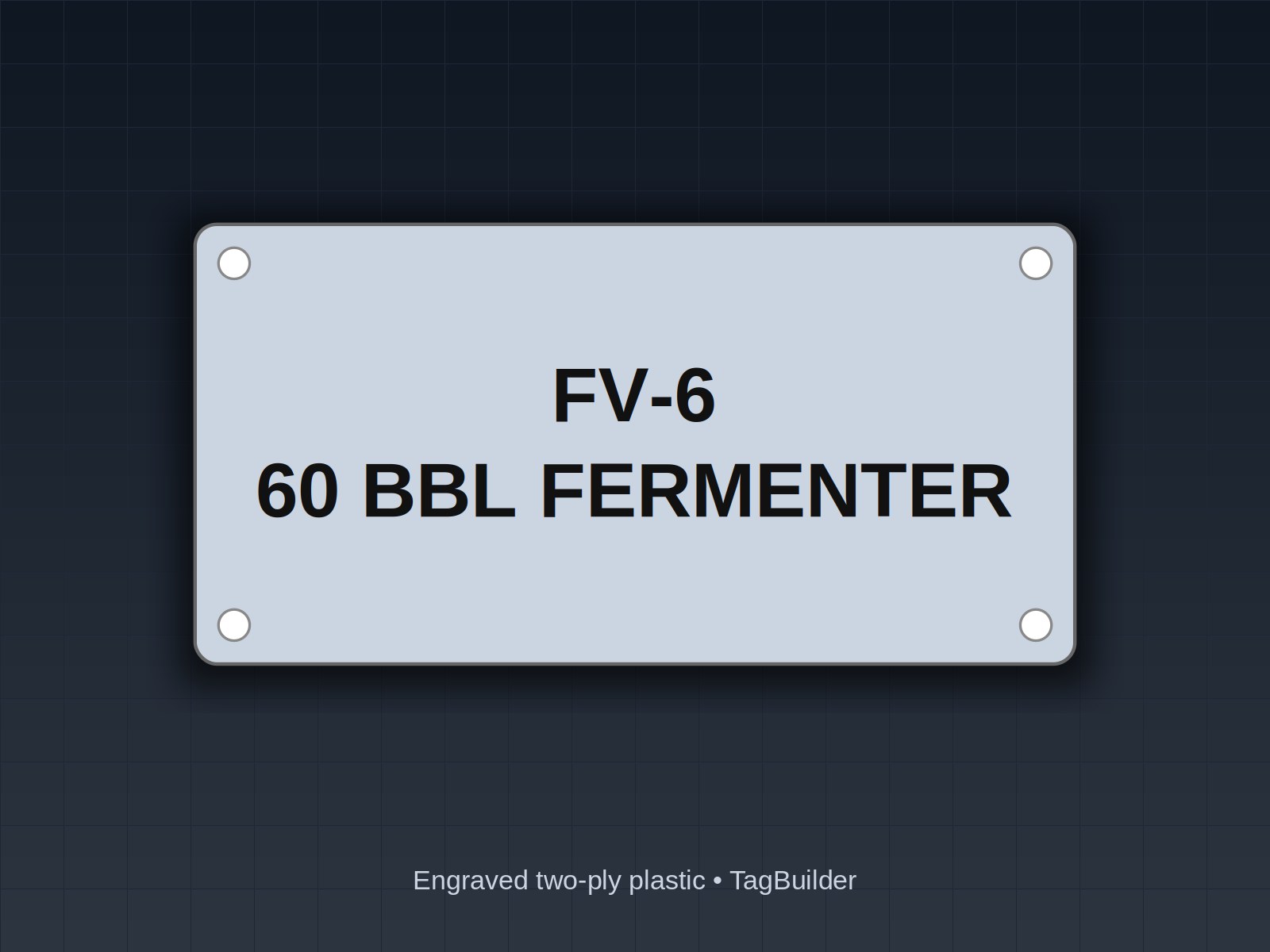
| Equipment (mixers, fillers, pumps) | Engraved stainless plate | Stainless fasteners, or sealed edges | Mount on the frame, not a product surface |
| Control station in spray zone | Engraved legend plate | Under the operator ring, fastened | Replaces stickers on the station |
| Dry-side panel or office | Engraved two-ply plastic | Screws or adhesive, per location | Outside the spray zone only |
Valve and line tags: engraved stainless on stainless chain
Valves are the tags people read most and the ones most often damaged. An engraved stainless tag hung from the handle on stainless chain or wire survives repeated washdowns because the legend is cut into the metal, not laid on top of it. Many plants use a 1.5 inch round tag with a short ID, such as the V-101 stainless valve tag. If you want to supply your own numbers, start from the blank stainless valve tag or build a full set in the circle tag builder.
A few habits help in a food plant:
- Keep the legend short. A valve number and, if there is room, a service abbreviation. Long text gets hard to read at arm's length.
- Use one chain or wire style plant-wide. The sanitation crew then knows how to clean around it, and it is easier to inspect.
- Check the attachment on a schedule. Add tag chains and wires to the same inspection that covers other hardware, so a failing link gets replaced before it comes apart. Some food safety teams prefer wire loops over beaded chain for this reason, so ask yours.
For a comparison of attachment options, see the valve tag attachment guide, and for material trade-offs read brass vs. stainless steel vs. plastic valve tags.
Equipment ID plates and control station legends
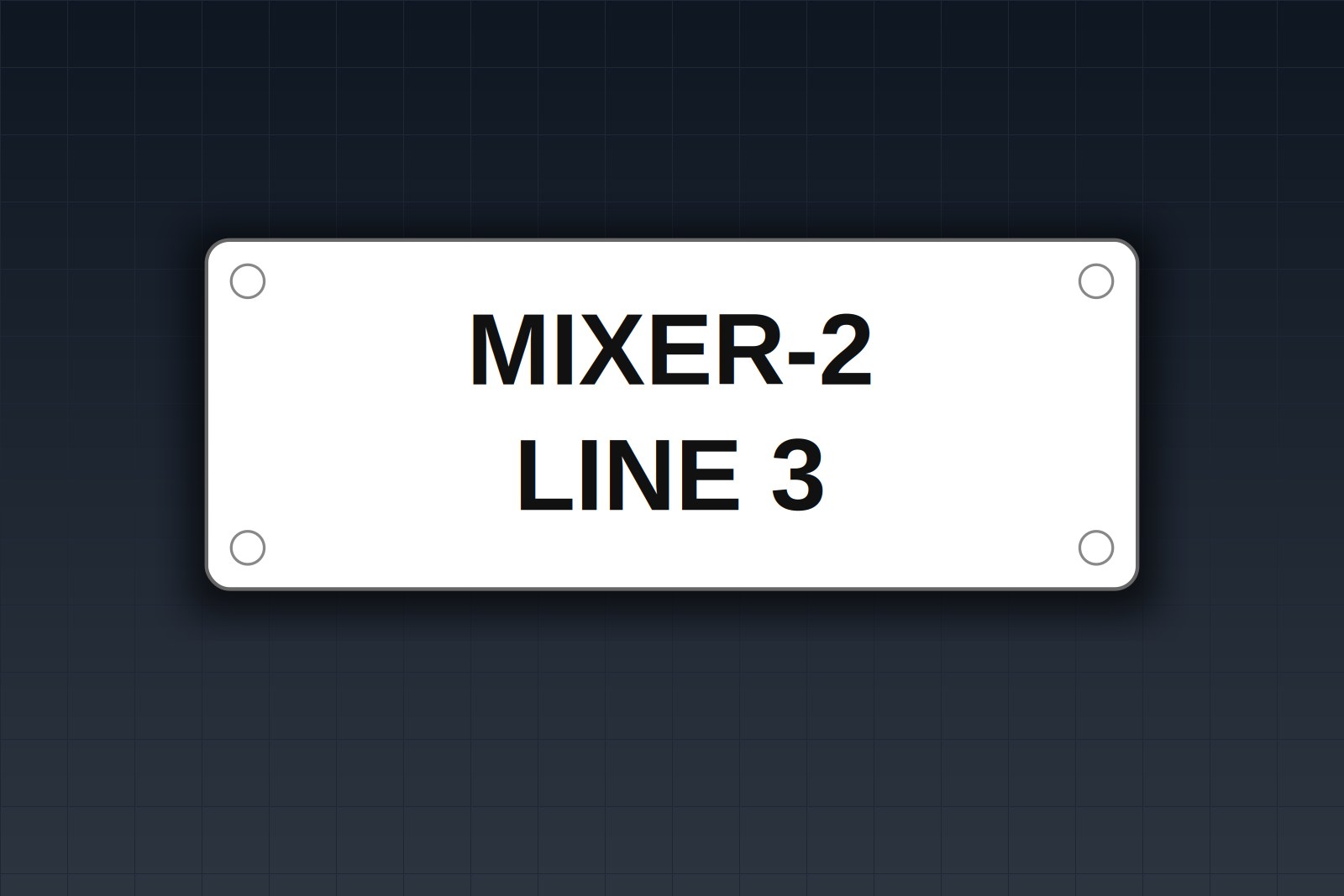
Equipment IDs like MIXER-2 or FILLER-1 are what maintenance and sanitation use to talk to each other. A plate on the frame, held with stainless fasteners, or with sealed edges where the plant specifies it, gives both crews the same name for the same machine. If the ID is only on a work order, someone eventually services the wrong unit.
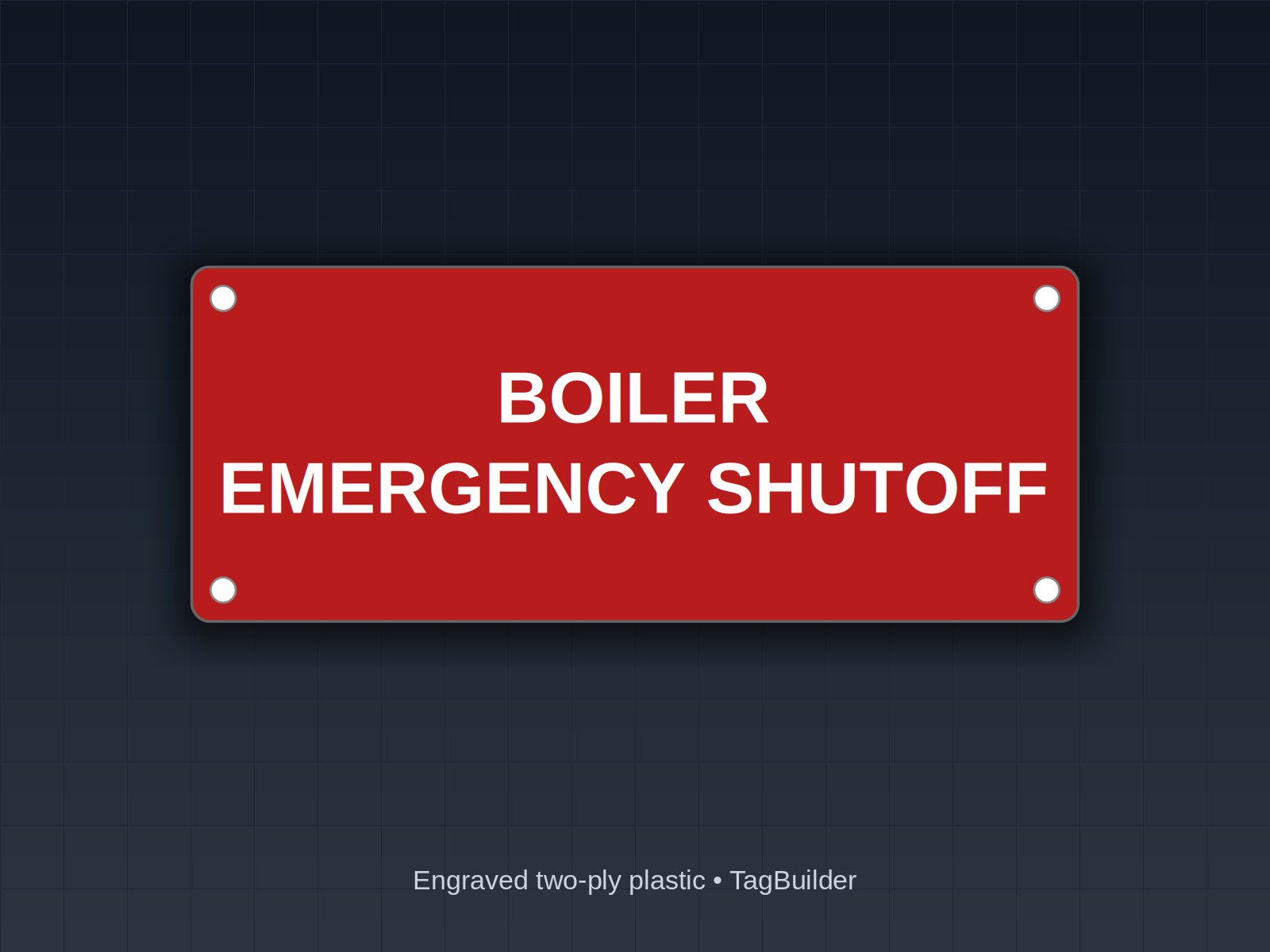
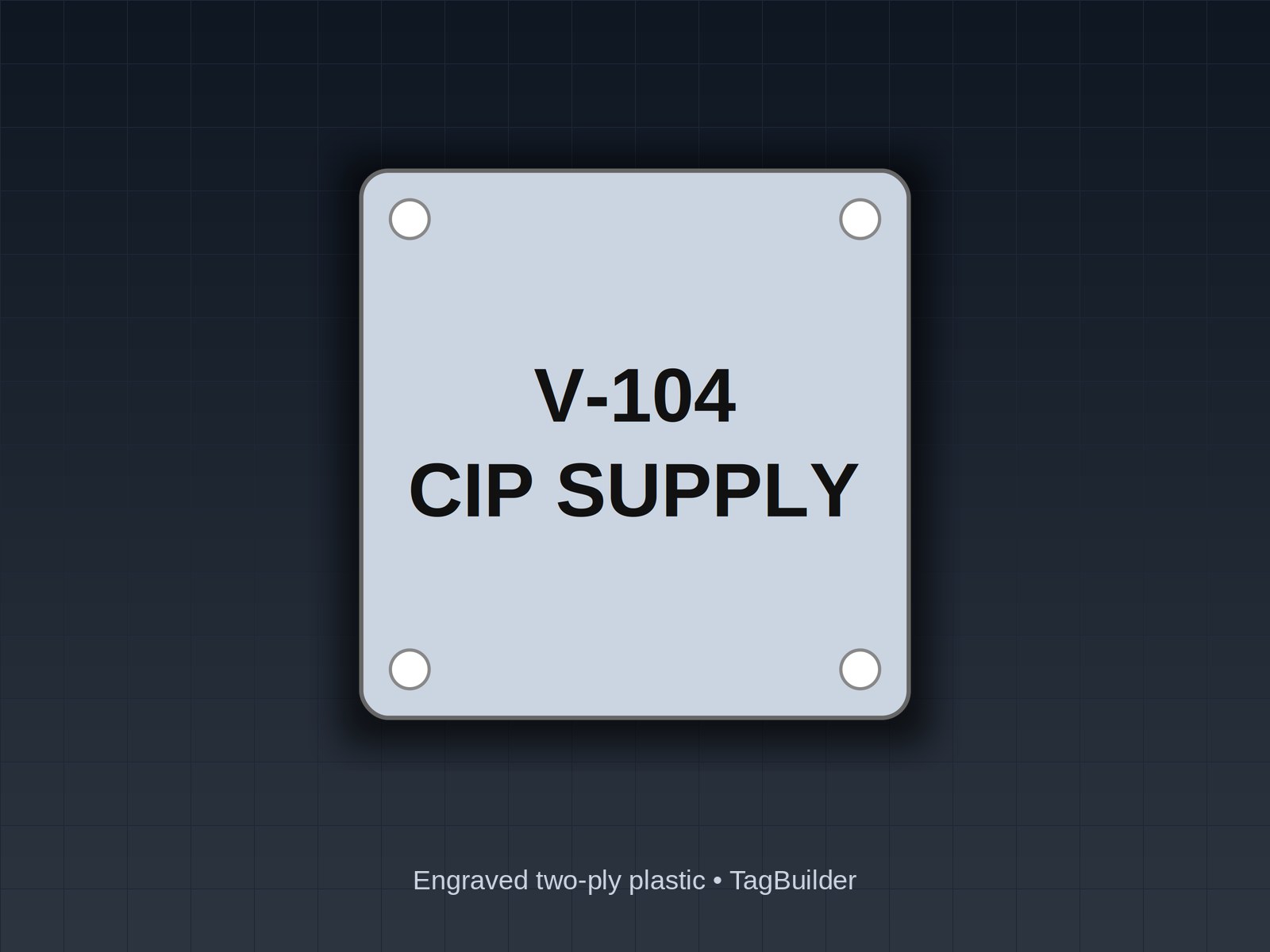
Control stations that see spray are the other weak spot. A sticker over a pushbutton is the first thing to go. Instead, use an engraved legend plate that sits under the operator ring and is held mechanically, so START, STOP, RESET and E-STOP stay readable. If the operator cannot read the legend, they press the wrong device, and that is a safety problem, not just a housekeeping one. For dry-side panels, the PUMP-1 panel label is an example of a 4 x 2 inch engraved plate with mounting holes, and the rectangle plate builder covers custom legends and sizes.
Worked example: a CIP skid and processing line
The list below is one way to tag a small CIP skid and the line it serves. Copy it, change the numbers to match your drawings, and keep the same pattern across the plant. The table lists each tag with its engraved text, material and attachment.
| Tag text | Item | Material | Attachment |
|---|---|---|---|
| CIP-S | CIP supply line | Engraved stainless | Stainless wire on the line support |
| CIP-R | CIP return line | Engraved stainless | Stainless wire on the line support |
| V-101 to V-106 | Product valves, line 1 | Engraved stainless circle tag | Stainless chain on the handle |
| V-107 to V-112 | CIP, water and steam valves | Engraved stainless circle tag | Stainless chain on the handle |
| MIXER-2 | Mixer ID plate | Engraved stainless plate | Stainless fasteners to the frame |
| PUMP P-3 | Transfer pump ID plate | Engraved stainless plate | Stainless fasteners to the base |
To add the service, put a short abbreviation under the number, for example V-107 / CIP-S or V-110 / STEAM. Number valves in the order a person walks the line, so V-101 sits near the start and V-112 near the end. The valve numbering guide explains how to build a scheme that survives later changes.
Choosing legends that people read correctly
Plants ask what a CIP valve tag should say. Keep it to the valve ID and a short service code your crews already use. Match the abbreviations on the P&ID and the sanitation procedures, so the tag, the drawing and the SOP all agree. Where the same word means different things in different departments, spell it out once on the drawing and keep the tag short.
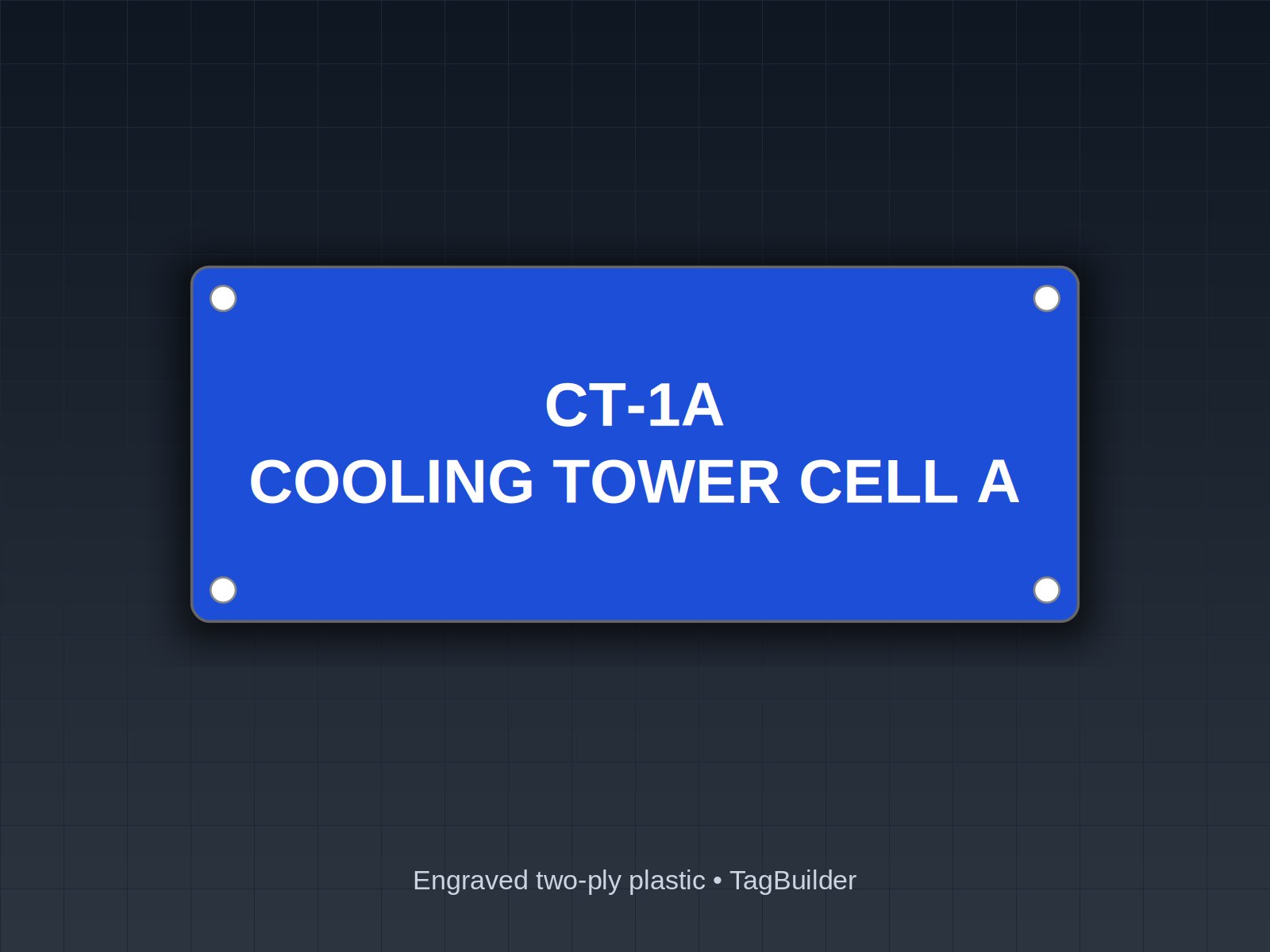
Do not rely on color alone to tell lines apart. Wet, dim areas and some conditions of vision make color hard to read, so put the text on the tag and use color as a second cue if at all.
Send one valve or equipment ID and we'll engrave a free sample tag you can run through a week of your washdowns.
Frequently Asked Questions
What labels hold up to washdown?
Engraved stainless tags held on mechanically, with chain, wire or fasteners, are the usual choice in the spray zone. The text is cut into the metal, so it does not rub off like printed ink, and there is no adhesive edge to lift. Confirm the material and finish with your food safety team.
Are stainless valve tags better than plastic in a food plant?
In wet, caustic and sanitizer areas, many plants prefer stainless because it is smooth, rigid and a single material to clean. Plastic is fine on dry-side panels. Which one belongs in a given area is a decision for your food safety team and the programs you operate under.
How do you attach tags in a washdown area?
Use stainless chain or wire on valve handles and stems, and stainless fasteners or sealed edges for plates on equipment. Mount tags away from product contact surfaces, and include the attachment in your regular inspection so worn links get replaced.
What should a CIP valve tag say?
The valve number and a short service code, such as V-107 and CIP-S. Match the wording to your P&ID and your sanitation procedures so everyone reads the same name for the same valve.
Can I use adhesive labels in a washdown zone?
It is not a good fit for the spray zone. Edges tend to lift under caustic, hot water and pressure, which traps soil and can send loose pieces into the area. Adhesive labels can still work in dry areas outside the washdown zone.
If you are replacing a mixed set of labels, start with the valves: browse the valve tag catalog, pick the numbering pattern in the numbering guide, or request a free sample and run it through your own washdown cycle first.
UL, NFPA, NEC, ASME, CEMA, TIA, ANSI and OSHA are names or marks of their respective organizations; TagBuilder is not affiliated with or endorsed by any of them. Requirements above are paraphrased summaries, not the text of any standard. Always work from the current published edition and your AHJ.