Arc Flash Warning Labels: NEC 110.16 vs NFPA 70E 130.5(H) Wording, Size and Placement
Get this made: TagBuilder (Solid Ideas Engraving, Waterford, PA) engraves Design your own (from $3.82). No minimum order, no setup fees, most orders ship in 2–3 business days, rush available. Custom text and size: open this design in the configurator. Or email the spec to support@tagbuilder.net for a written quote and PDF proof the same business day.
You searched for arc flash labels and found generic warnings and study-specific plates sold under the same name. Before you order, work out which one the job calls for and who supplies the data on it.
Disclaimer: general information, not legal or compliance advice. Codes change and inspectors interpret them differently, so confirm requirements with a qualified professional. Full disclaimer
Two Labels That Get Called the Same Thing
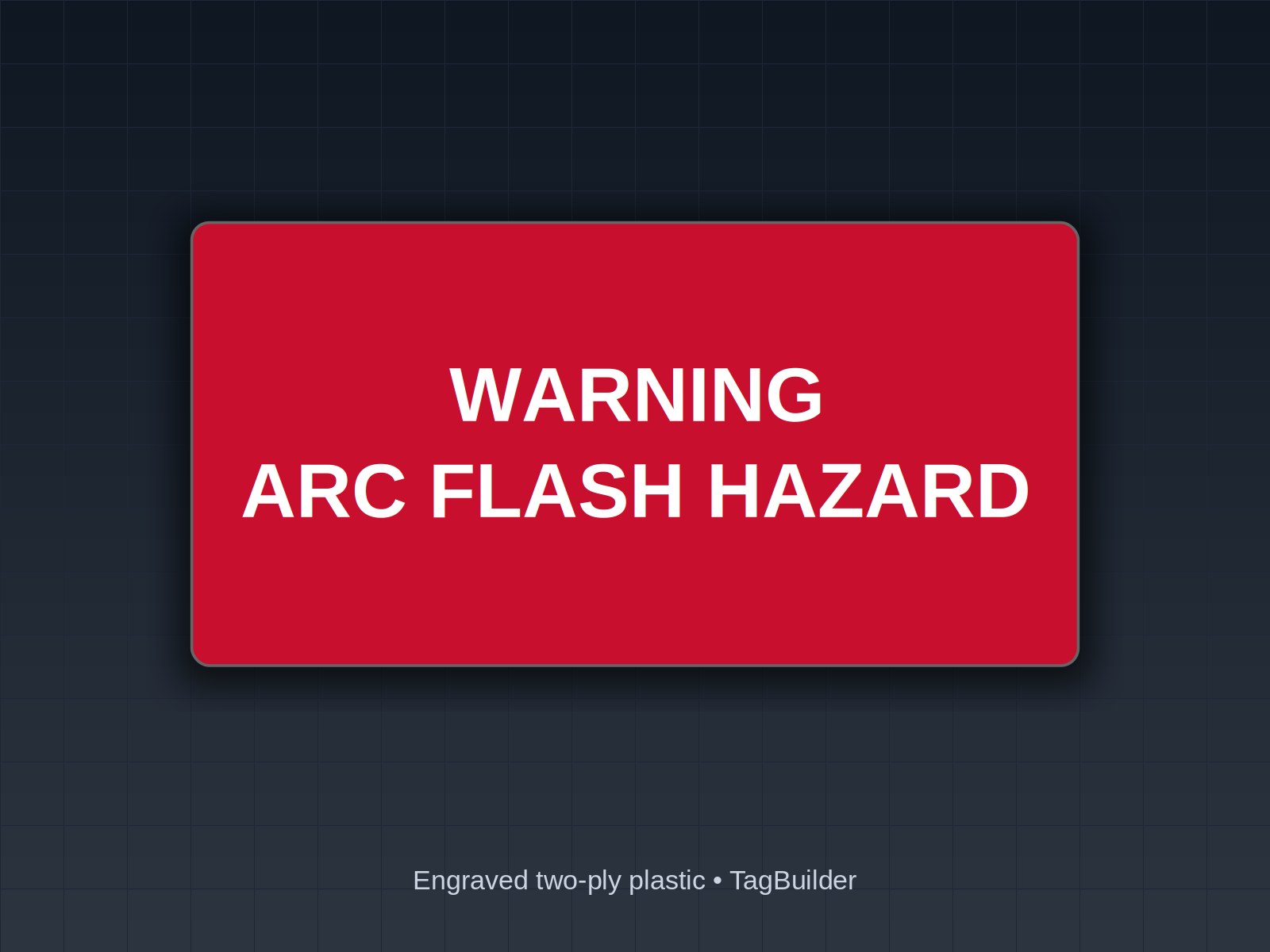
An arc flash warning label in the general sense tells a qualified person that a potential hazard exists. An equipment label with study data helps that person plan the work: voltage, boundary, and energy or PPE information for that specific equipment.
The first idea is associated with NEC 110.16(A) in the 2023 and earlier structure. The second comes from NFPA 70E 130.5(H). NEC 110.16(B) sits between them and is often mistaken for the generic warning. In the 2023 edition, it calls for an arc flash label on certain larger equipment.
The edition matters. Jurisdictions adopt the NEC on different schedules, so confirm which one governs your permit. The guide to arc flash label requirements under NFPA 70E covers the broader background.
What NEC 110.16 Asks For, by Edition
110.16(A): the general warning (2023)
In other than dwelling units, 110.16(A) covers equipment such as switchboards, switchgear, enclosed panelboards, industrial control panels, meter socket enclosures and motor control centers that is likely to need examination, adjustment, servicing or maintenance while energized. The factory or field marking warns qualified persons of a potential arc flash hazard. It does not call for a calculated incident energy value. Manufacturers often supply this marking, but verify that it is present and visible.
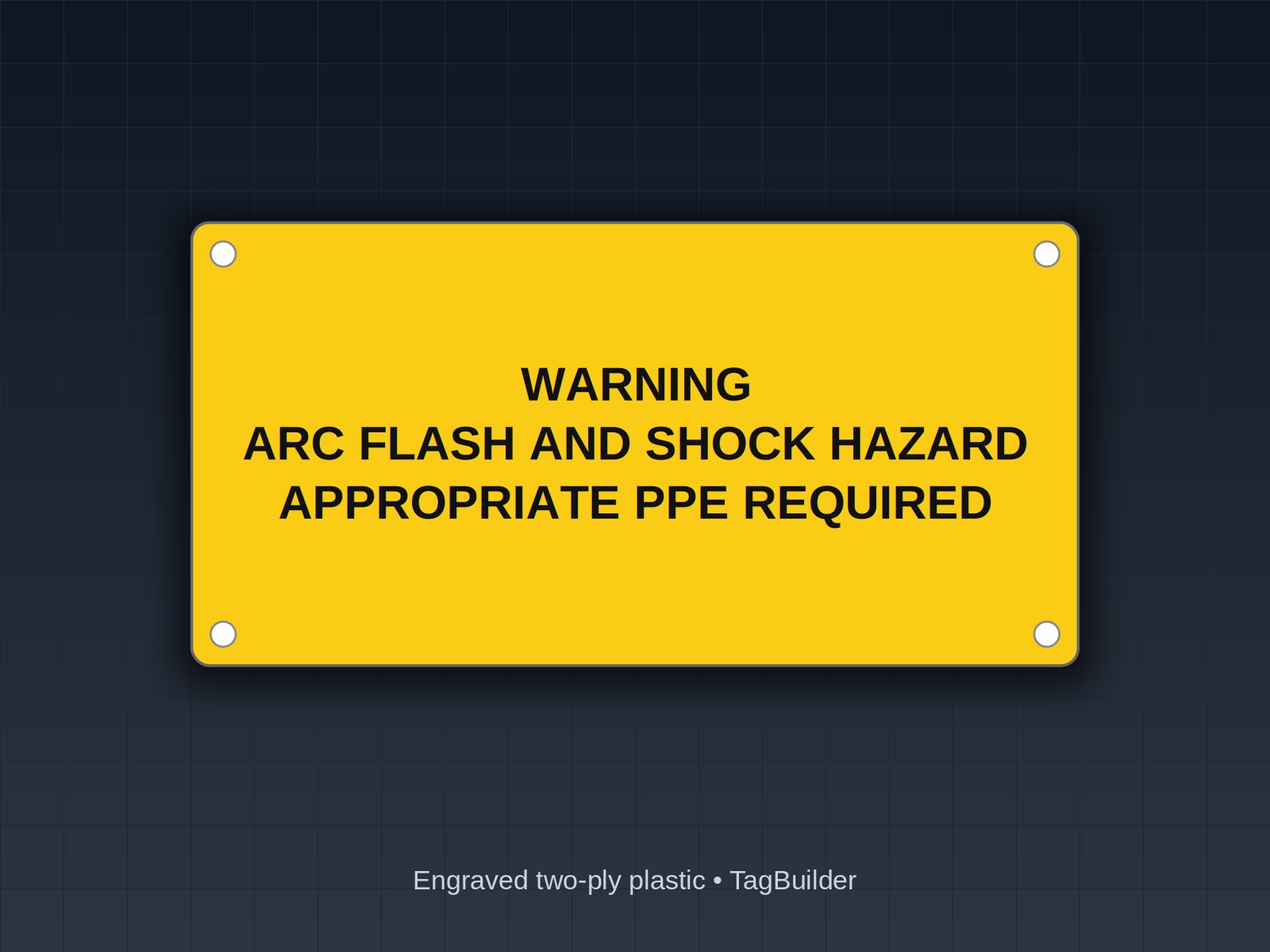
Wording such as WARNING: Arc Flash and Shock Hazard is common. Treat it as typical wording, not as a script required by the NEC.
110.16(B): service and feeder-supplied equipment (2023)
The 2023 edition adds a requirement for service and feeder-supplied equipment rated 1,000 A or more, outside dwelling units. The permanent label follows applicable industry practice and includes the date the label was applied. NFPA 70E is the usual reference for its content.
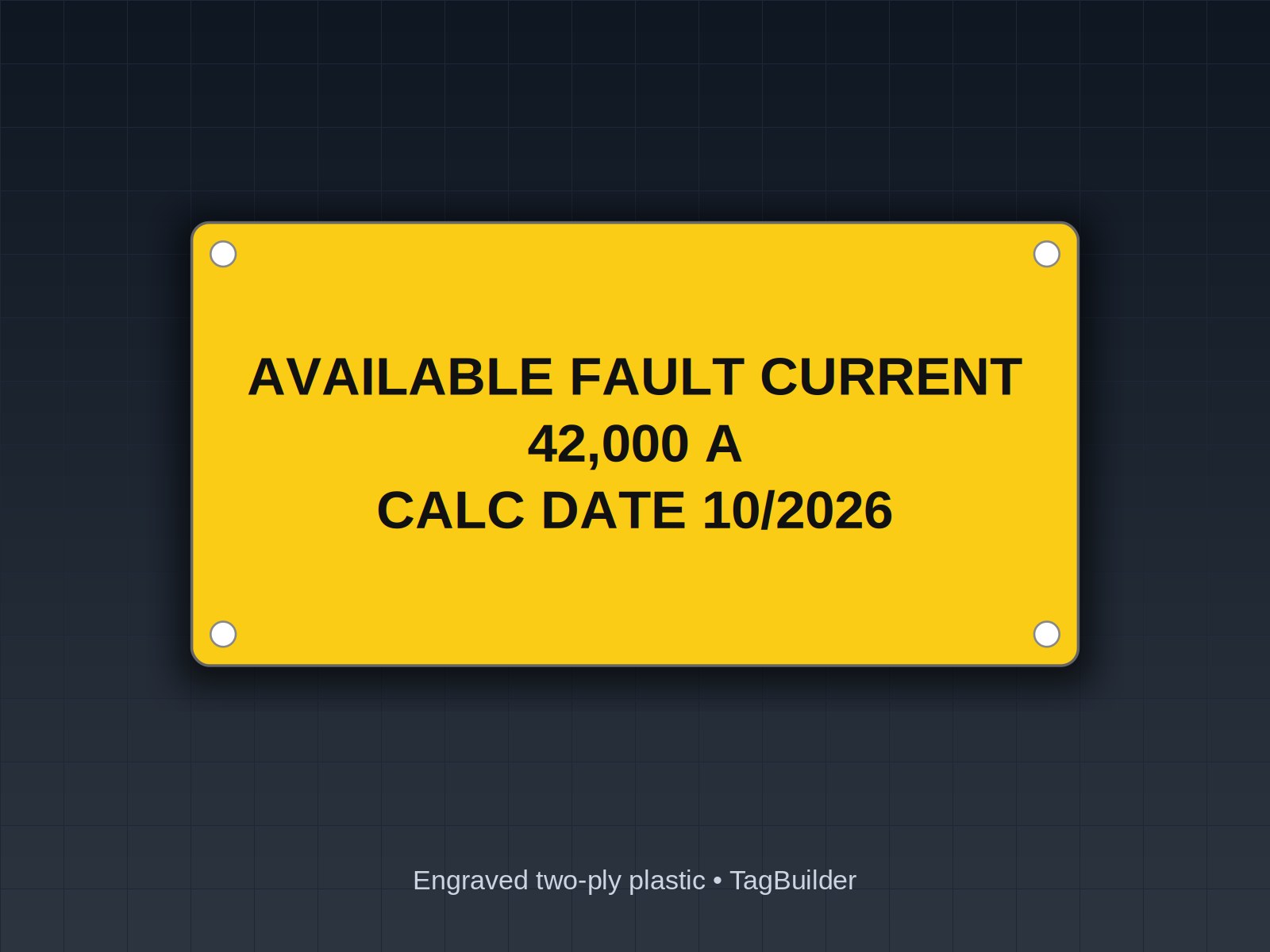
A common point of confusion is available fault current. The 2017 and 2020 versions of 110.16(B) included it among the label items for the equipment they covered. The 2023 text replaced that item list with the reference to industry practice. Available fault current marking for service equipment is addressed separately in 110.24, which has its own scope, date item and exceptions. Do not assume an arc flash plate satisfies it.
The 2026 edition
The 2026 NEC reorganizes 110.16 as an arc flash hazard marking, without the earlier (A) and (B) split, and drops the ampere threshold. For covered service and feeder-supplied equipment, the listed content is nominal system voltage, arc flash boundary, available incident energy or minimum required PPE, and the date the assessment was completed. Check the adopted text for scope and local amendments.
In every edition, check 110.21(B) as it applies to field-applied hazard markings. In general it addresses effective warning words, colors or symbols, permanent attachment, durability for the environment, and limits on handwriting.
What NFPA 70E 130.5(H) Puts on the Label
NFPA 70E is a workplace electrical safety standard. In the 2024 edition, 130.5(H) applies to equipment such as that listed above, in other than dwelling units, when it is likely to need work while energized. It has no 1,000 A threshold. The label carries:
- Nominal system voltage
- Arc flash boundary
- At least one of the following: available incident energy with its working distance, or the arc flash PPE category from the table method (not both of these two); minimum arc rating of clothing; or a site-specific level of PPE
The equipment owner is responsible for documenting, installing and maintaining the label. A contractor may supply and mount it under contract, so state that scope in writing. The standard also addresses earlier labels, so check that text before replacing an entire set. Our comparison of the 2018 and 2024 versions of 130.5(H) explains what changed.
Side-by-Side Comparison
| Item | General warning (2023 NEC 110.16(A)) | Study data label (NFPA 70E 130.5(H)) |
|---|---|---|
| Purpose | Alerts to a potential hazard | Gives data for planning energized work |
| Typical content | Signal word and arc flash warning | Voltage, boundary, energy or PPE information |
| Study or table method needed | Not for the general warning | Needs a documented risk assessment basis |
| Who is responsible | Factory or field marking; commonly the manufacturer or installing contractor | Equipment owner; supply and mounting may be contracted |
| When to replace | Missing, damaged, unreadable or no longer suitable under the governing rules | When review or a system change shows it is inaccurate, or it is no longer legible |
Under 2023 110.16(B), one well-planned label commonly carries the 130.5(H) data plus the application date. Ask your AHJ whether a separate general warning is expected where the equipment does not already have one.
NFPA 70E calls for the data to be reviewed for accuracy at intervals not exceeding 5 years. That is a review interval, not an automatic expiration date. Changes to the utility source, transformers, protective devices, settings or system configuration can call for an update sooner.
Plate Size, Lettering, Color and Placement
The provisions discussed here do not set one plate size. A 5 x 3.5 in plate is a practical choice for a study data label because it holds about ten short lines without crowding. As a shop starting point, consider a signal word about 0.4 in high, key values about 0.2 in, and identification lines no smaller than about 0.125 in. These are layout suggestions, not code values. Your site specification governs.
For signal words, colors and layout, engineers commonly refer to ANSI Z535.4. Orange is associated with WARNING and red with DANGER. Do not choose DANGER from an energy value alone unless your study or site standard defines that rule. For engraved two-ply plastic, confirm the color scheme before ordering, and check that the material and adhesive or fasteners suit sunlight, heat, washdown and chemicals at the location. Engraved text does not rub off like printed ink.
- Place the label where a qualified person can see it before starting work.
- On motor control centers and switchboards, follow the study's equipment breakdown. Many sites label each vertical section or access point.
- Check whether rear or side access needs its own label.
- Be careful with removable covers that can be swapped between equipment.
- Keep clear of vents, handles and manufacturer nameplates. Do not drill an enclosure for fasteners without checking its rating and the manufacturer's instructions.
Worked Example: 480 V Motor Control Center
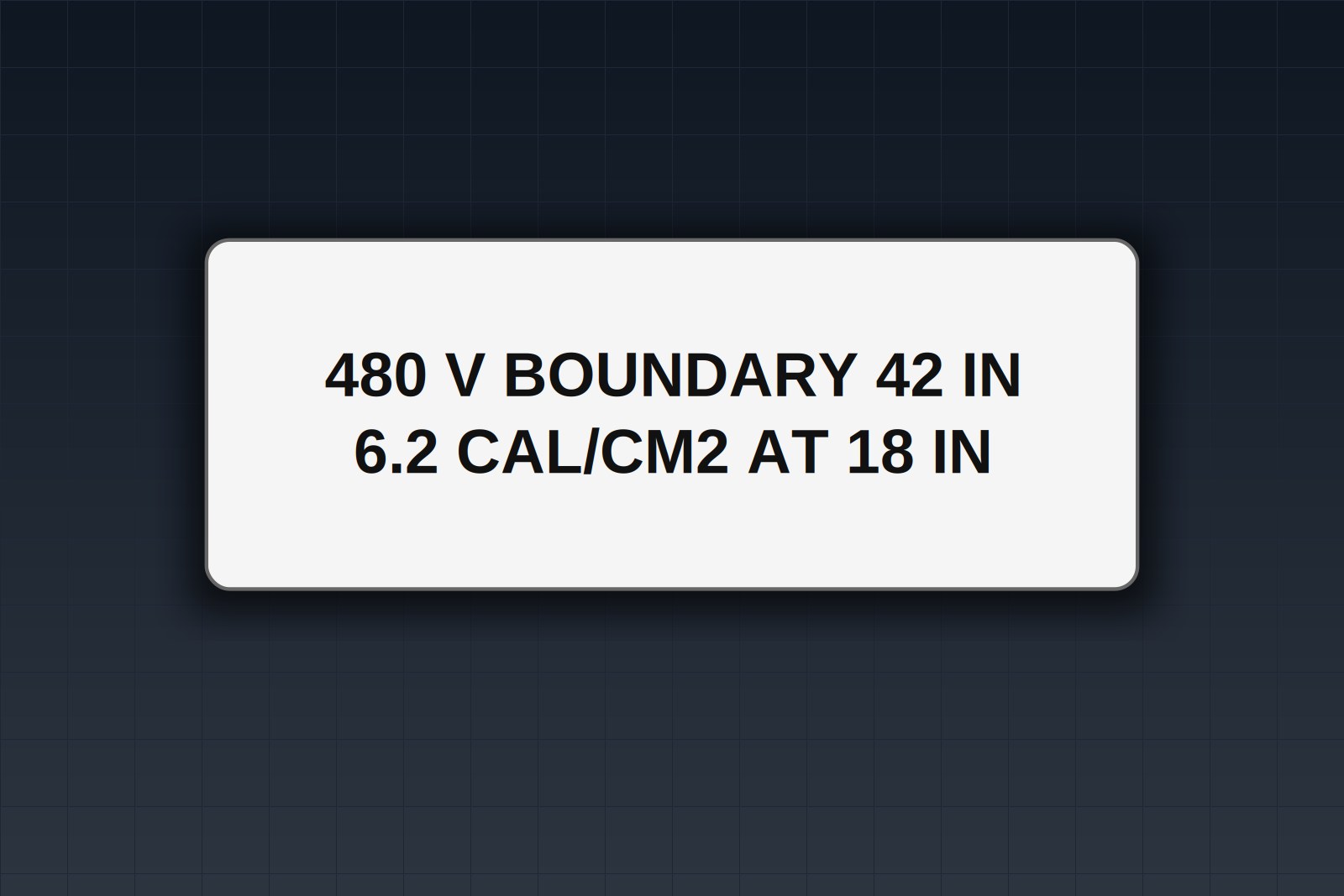
Assume the study for MCC-2 reports 6.2 cal/cm² at 18 in. The boundary, shock distances, dates, study number and firm field below are sample entries. Do not copy any value onto real equipment. For this example, the MCC is feeder-supplied, rated at least 1,000 A, and under the 2023 NEC, so the application date is included.
| Line | Text on the 5 x 3.5 in plate |
|---|---|
| 1 | WARNING |
| 2 | ARC FLASH AND SHOCK HAZARD |
| 3 | EQUIPMENT: MCC-2 |
| 4 | NOMINAL VOLTAGE: 480 VAC |
| 5 | ARC FLASH BOUNDARY: 48 IN |
| 6 | INCIDENT ENERGY: 6.2 CAL/CM² |
| 7 | WORKING DISTANCE: 18 IN |
| 8 | LIMITED APPROACH: 42 IN / RESTRICTED: 12 IN |
| 9 | STUDY: AF-001 BY [FIRM] DATE: 2026-03-15 |
| 10 | LABEL APPLIED: [INSTALL DATE] |
Replace both bracketed fields before ordering. If the plate will be engraved before the installation day is known, settle with the AHJ how the application date will be marked durably.
No table-method PPE category appears because the plate already shows incident energy. Shock approach distances are commonly included, but they are not among the 130.5(H) items listed above. Verify them for the actual equipment and exposed parts. For a 2026 NEC job, identify the assessment completion date clearly as ASSESSMENT COMPLETED, and confirm that the study date shown is that date.
Before You Send an Order
An engraved plate carries study data as fixed text, so the equipment ID and study date should be on every study data plate. They let someone match the plate to the report and spot an outdated one. The study date is a shop recommendation here even where the governing text does not list it.
Do not order engraved results the study has not provided. Do not estimate a boundary, borrow values from a similar MCC, or derive PPE information from amperage. Send:
- The final study label schedule, with its revision and date
- Equipment IDs matched to field nameplates and one-line drawings
- The governing NEC and NFPA 70E editions and any site label standard
- Plate size, colors, mounting method, environment and quantity per access point
Have the study preparer or owner's designee check the proof line by line, especially decimals, units and similar equipment IDs. When data changes, remove the superseded plate as the new one goes on.
Frequently Asked Questions
Is a generic arc flash warning label enough?
It addresses a different purpose from a study data label. It does not supply the 130.5(H) boundary and energy or PPE information, and it may fall short of what 2023 110.16(B) or the 2026 marking provision calls for. Check the equipment, rating, adopted edition and site program.
Does NEC 110.16(B) require available fault current?
The 2023 text of 110.16(B) does not list it, although the 2017 and 2020 versions did. Check 110.24 separately, along with any local amendment, project specification or AHJ expectation.
Can I use an NFPA 70E label maker without a study?
A label maker or online builder only formats the information you enter. It does not perform the risk assessment. The values need a documented basis, either an incident energy analysis or a properly applied PPE category table method, including the table's limits.
Do arc flash labels expire after five years?
The five-year figure is the maximum interval for reviewing the supporting data. If the review or an earlier system change makes a label inaccurate, it needs to be updated. Some sites also require a new date or replacement under their own procedures.
Who buys the labels, the contractor or the owner?
NFPA 70E places responsibility for the 130.5(H) label with the equipment owner. NEC work is checked as part of the installation, and project contracts often assign marking to the contractor. Spell out who provides the study, orders the plates, mounts them and handles later revisions.
Send us your arc flash study results and we will engrave a plate for each piece of equipment.
If you are lining out a single plate, start with the rectangle nameplate builder and check the proof against the study. For other hazard markings on the same job, see our warning labels. If the labeling is part of a wider maintenance program, the NFPA 70B section is a related place to look.
Disclaimer. This article is provided for general informational purposes only and does not constitute legal, safety, or professional compliance advice. Regulations, standards, and codes are subject to change and may be interpreted differently by authorities having jurisdiction (AHJ). Always consult with qualified safety professionals, licensed engineers, or legal counsel to determine the specific requirements applicable to your facility. TagBuilder is not responsible for any actions taken based on this information.
UL, NFPA, NEC, ASME, CEMA, TIA, ANSI and OSHA are names or marks of their respective organizations; TagBuilder is not affiliated with or endorsed by any of them. Requirements above are paraphrased summaries, not the text of any standard. Always work from the current published edition and your AHJ.