Transformer Nameplate Requirements: NEC 450.11 Marking and What the Plate Must Show
Get this made: TagBuilder (Solid Ideas Engraving, Waterford, PA) engraves Design your own (from $3.82). No minimum order, no setup fees, most orders ship in 2–3 business days, rush available. Custom text and size: open this design in the configurator. Or email the spec to support@tagbuilder.net for a written quote and PDF proof the same business day.
The factory plate on a transformer is faded, painted over or missing, and you need to know what a replacement has to say before anyone energizes or inspects the unit.
Disclaimer: general information, not legal or compliance advice. Codes change and inspectors interpret them differently, so confirm requirements with a qualified professional. Full disclaimer
What NEC 450.11 asks the transformer nameplate to carry
Section 450.11 is the marking rule for transformers. Paragraph (A) covers the nameplate the manufacturer provides. Paragraph (B) covers source marking, which can be applied in the field. Paragraph numbering and exact wording shift between editions, so check the edition your jurisdiction has adopted before you quote it on a drawing or a punch list.
In plain terms, 450.11(A) expects the nameplate to give:
- Manufacturer name
- Rated kVA
- Frequency
- Primary and secondary voltage
- Impedance for transformers rated 25 kVA and larger
- Required clearances for transformers with ventilating openings
- Amount and kind of insulating liquid where liquid is used
- For dry-type units, the insulation system temperature class
Most dry-type plates also show the temperature rise, phase count, taps, wiring diagram and weight. Those items usually come from the product standard the transformer was built to rather than from the NEC text itself, so treat them as part of a complete plate even when the code section does not list each one.
Field-by-field reference
This table maps each item to where it comes from and what a typical value looks like on a dry-type distribution transformer. The values are examples only. Your plate is the authority.
| Field | Where it comes from | Typical value |
|---|---|---|
| Manufacturer name | NEC 450.11(A) | Name as it appears on the original |
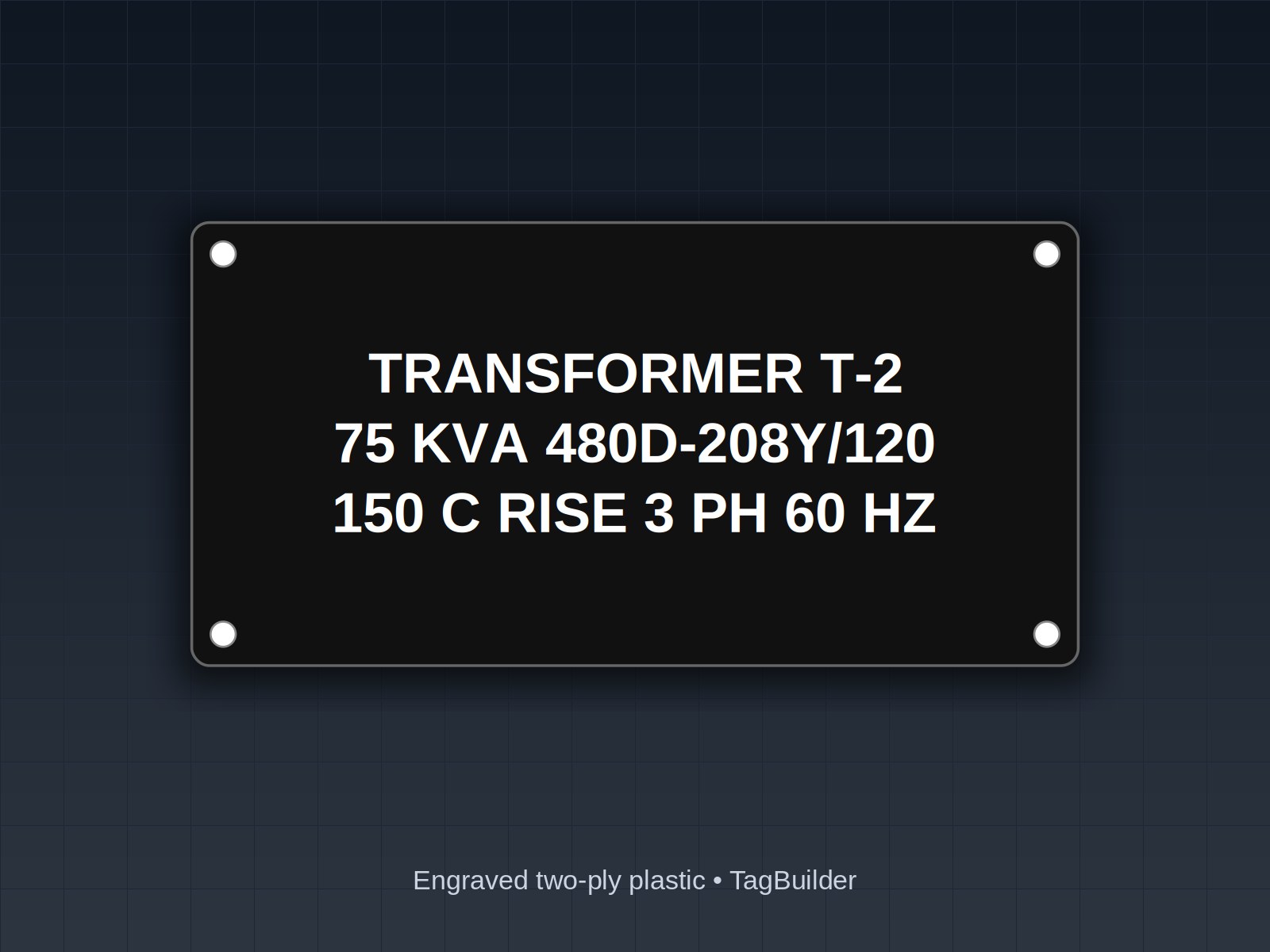
| Rated kVA | NEC 450.11(A) | 75 kVA |
| Frequency | NEC 450.11(A) | 60 Hz |
| Primary voltage | NEC 450.11(A) | 480 V delta |
| Secondary voltage | NEC 450.11(A) | 208Y/120 V |
| Impedance (25 kVA and up) | NEC 450.11(A) | A percentage, often in the 3 to 6 percent range |
| Ventilation clearances | NEC 450.11(A), units with ventilating openings | Minimum distance to walls and obstructions |
| Insulating liquid | NEC 450.11(A), liquid-filled units | Kind and gallons |
| Insulation system class | NEC 450.11(A), dry-type | Commonly 220 C on a 150 C rise unit |
| Temperature rise | Product standard, normally on the plate | 150 C |
| Phases, taps, weight, diagram | Product standard | 3 phase, 2 taps at 2.5 percent below, and so on |
| Source marking | NEC 450.11(B) | Upstream panel or switchboard and circuit |
Worked example: 75 kVA, 480 delta to 208Y/120, 150 C rise
Here is a layout for a replacement plate on a 4 x 3 in blank. The text is stacked in short lines so every field stays readable at a glance. Everything shown is illustrative. Copy your own values from the original plate or the manufacturer's records.
Line by line:
- Line 1: MANUFACTURER NAME, MODEL / CATALOG NO.
- Line 2: SERIAL NO. / DATE CODE
- Line 3: 75 kVA 3 PH 60 Hz
- Line 4: PRI 480 V DELTA 90 A
- Line 5: SEC 208Y/120 V 208 A
- Line 6: IMPEDANCE 4.5 % (copy the real figure)
- Line 7: DRY TYPE INSULATION CLASS 220 C 150 C RISE
- Line 8: VENTILATED MIN CLEARANCE 6 in ALL SIDES (copy the real figure)
The amp figures are rated current, which you can check yourself: 75,000 VA divided by 1.732 times 480 V gives about 90 A, and divided by 1.732 times 208 V gives about 208 A. If your plate lists different amps, trust the plate. Eight lines on a 4 x 3 in plate leaves room for characters around 1/8 in tall, which is plenty for a nameplate read at arm's length.
Replacing a missing or unreadable plate
A replacement plate restores information. It does not restore anything else. Keep these points in front of you:
Copy, never guess
Every rating must come from the original plate, a photo of it, the manufacturer's records matched to the serial number, or the factory test report. If a value cannot be confirmed, leave the field off and ask the manufacturer rather than filling in a likely number. A wrong impedance or insulation class on a plate can send a short-circuit study or a feeder sizing calculation in the wrong direction.
The listing mark stays with the manufacturer
A listing or certification mark on the original plate was applied by or for the manufacturer under their product program. A plate made by an engraver is a data plate, not a substitute for that mark. If the listing mark is gone, talk to the manufacturer or the AHJ about what they will accept for that unit.
Material and mounting
Engraved two-ply plastic suits indoor dry-type units. Engraved stainless is the better choice for outdoor, washdown or hot locations. Mount the plate where it can be read after installation, and use the adhesive or fasteners that suit the enclosure surface. Our dry-type transformer ID label guide covers the equipment ID labels that go beside the factory plate.
Adding a field-applied source and fed-from plate
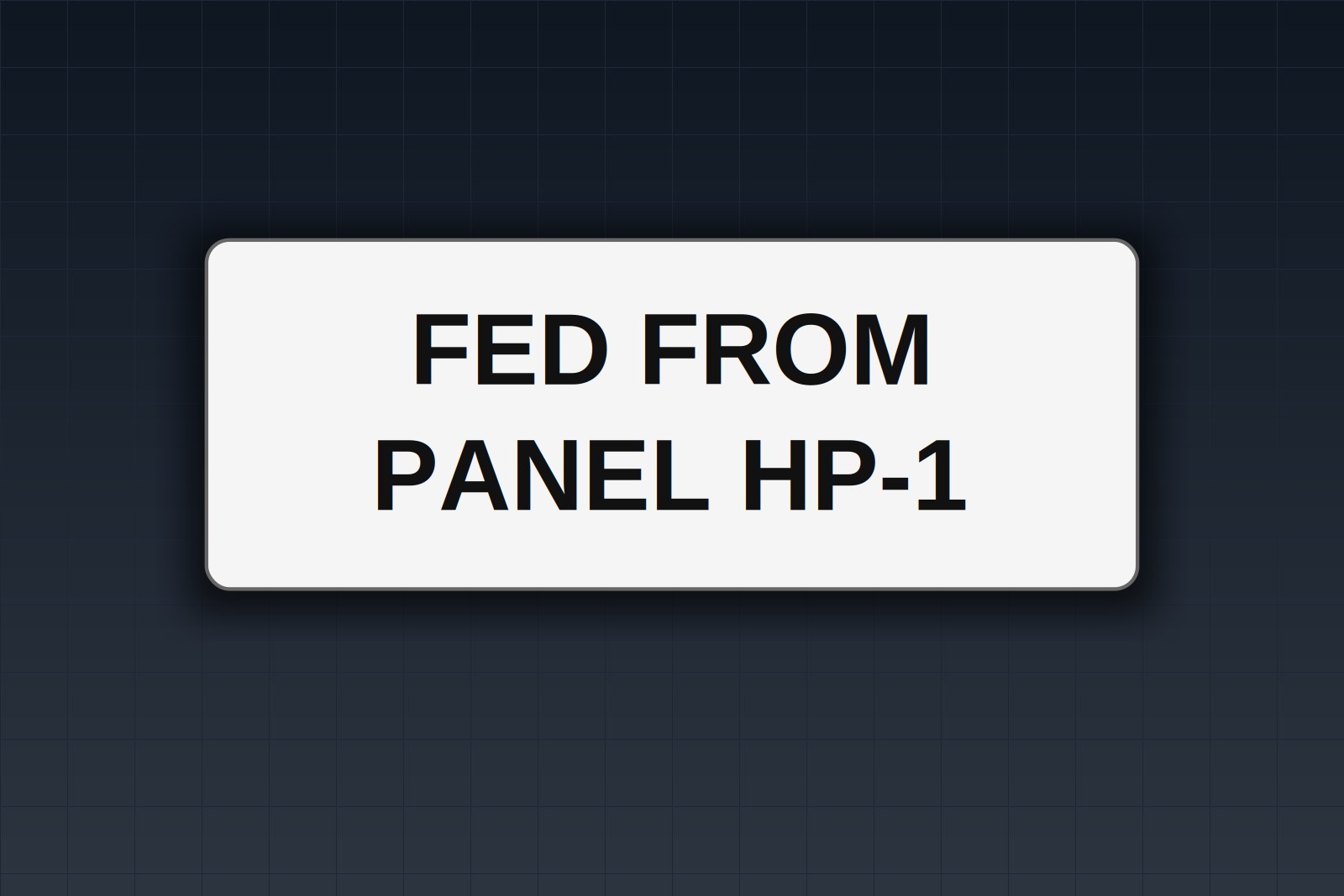
Paragraph 450.11(B) in recent editions deals with marking the source of supply to a transformer. In general terms, many AHJs expect the transformer to be marked with the equipment that feeds it, and the marking can be applied in the field. Edition wording and local practice differ, so confirm what applies to your job.
A practical source plate has three parts:
- The transformer's own ID, such as T-2 or XFMR-LP1
- The word FED FROM followed by the upstream equipment, such as SWBD MDP, CKT 14
- Optionally the downstream panel it feeds, such as FEEDS PANEL LP-1
Keep it separate from the factory plate. A field plate with your naming scheme should never be mounted over the original ratings. The fed-from label article walks through naming conventions you can reuse here.
Reading a plate in the field: a quick checklist
- Confirm the plate matches the unit: serial number, kVA and voltage against the nameplate on the enclosure or the submittal.
- Check primary and secondary connection type, delta or wye, before landing conductors.
- Note the temperature class and rise if you are checking conductor or room temperature assumptions.
- Read the clearance note before placing storage or partitions near a ventilated unit.
- Photograph the plate and file it with the as-builts before it gets painted or damaged.
Frequently Asked Questions
Does NEC 450.11 require impedance on every transformer plate?
The requirement as commonly read applies to transformers rated 25 kVA and larger. Smaller units may still show it, but check the edition you work under.
Can I make my own replacement transformer nameplate?
You can have a data plate engraved with the original ratings. It does not carry the manufacturer's listing mark, and the values must be copied from the original or from manufacturer records.
What if the original plate is unreadable and I have no records?
Contact the manufacturer with the serial number and any visible catalog number. Many keep build records. Where none exist, an engineer or the AHJ may need to decide what documentation is acceptable.
Is a fed-from plate required by the NEC?
Source marking is addressed in 450.11(B) in recent editions, and many AHJs expect it. Older editions differ, so check yours and ask your inspector.
What material should I choose for an outdoor transformer?
Engraved stainless holds up to weather, sun and temperature swings better than plastic. Indoor dry-type units are usually fine with engraved two-ply plastic.
Order an engraved transformer nameplate with the ratings copied from your original plate.
If you need a plate with your own layout, start with our engraved nameplates or set up the exact size and line count in the rectangle lamacoid configurator. For equipment IDs on the rest of the room, the equipment ID labels keep the numbering consistent.
Disclaimer. This article is provided for general informational purposes only and does not constitute legal, safety, or professional compliance advice. Regulations, standards, and codes are subject to change and may be interpreted differently by authorities having jurisdiction (AHJ). Always consult with qualified safety professionals, licensed engineers, or legal counsel to determine the specific requirements applicable to your facility. TagBuilder is not responsible for any actions taken based on this information.
UL, NFPA, NEC, ASME, CEMA, TIA, ANSI and OSHA are names or marks of their respective organizations; TagBuilder is not affiliated with or endorsed by any of them. Requirements above are paraphrased summaries, not the text of any standard. Always work from the current published edition and your AHJ.