Fed From Labels: NEC 408.4(B) Source Identification for Panelboards and Switchboards
You open a panelboard in a dark corridor and nothing on the cover says where its power comes from. The cost is a red-tagged final inspection, a wrong breaker opened during maintenance, or responders hunting for a shutoff.
Important Disclaimer
This article is provided for general informational purposes only and does not constitute legal, safety, or professional compliance advice. Regulations, standards, and codes are subject to change and may be interpreted differently by authorities having jurisdiction (AHJ). Always consult with qualified safety professionals, licensed engineers, or legal counsel to determine the specific requirements applicable to your facility. TagBuilder is not responsible for any actions taken based on this information.
A fed-from label names the equipment that supplies a switchboard, switchgear or panelboard, and it goes on the supplied equipment where a person can read it. NEC 408.4(B) addresses this for feeder-supplied equipment in other than one- and two-family dwellings. Wording and numbering differ between editions, so check the edition your jurisdiction has adopted and ask the AHJ how it reads the location part.
What 408.4(B) asks for
In plain terms, the section expects feeder-supplied switchboards, switchgear and panelboards to be marked to show where their power originates. The marking needs to be permanent and suited to the environment. Many AHJs do not accept hand-written markings for this purpose.
Two points trip people up:
- Name the source equipment, not just a breaker number. "CKT 7" means nothing without the board it sits in.
- Add the physical location of that source, such as the room number or area. The code text speaks of the device or equipment where the power originates, and many engineers and inspectors expect the location on the plate too, because the person reading it may need to walk to the source.
How it differs from nearby rules
Section 408.4(A) covers the circuit directory inside the panel. We cover that in the panel schedule to engraved breaker labels guide, so this article does not repeat it. Section 110.22 covers disconnect identification, which has its own guide: NEC 110.22 disconnect identification labels. The fed-from plate is a separate item that describes the supply side of the board.
What goes on the plate
Keep the plate short enough to read from standing distance. Use this order:
- Equipment designation, in the largest letters. Use the engineer's designation exactly as it appears on the drawings.
- Voltage, phase and wire count, on the same plate.
- Fed-from line: source equipment, circuit or breaker when it applies, and its location.
Plates commonly use letters from 1/2 in to 3/4 in for the name line and smaller letters for the source line. The right size depends on the plate and how far away the reader stands.
Table 1: Minimum information and examples by equipment type
| Equipment type | Minimum info | Good example | Weak example |
|---|---|---|---|
| Main switchboard | Designation, voltage, utility or generator source and where it enters | MSB / 480Y/277V 3PH 4W / FED FROM UTILITY XFMR PAD, NORTH YARD | MAIN BOARD |
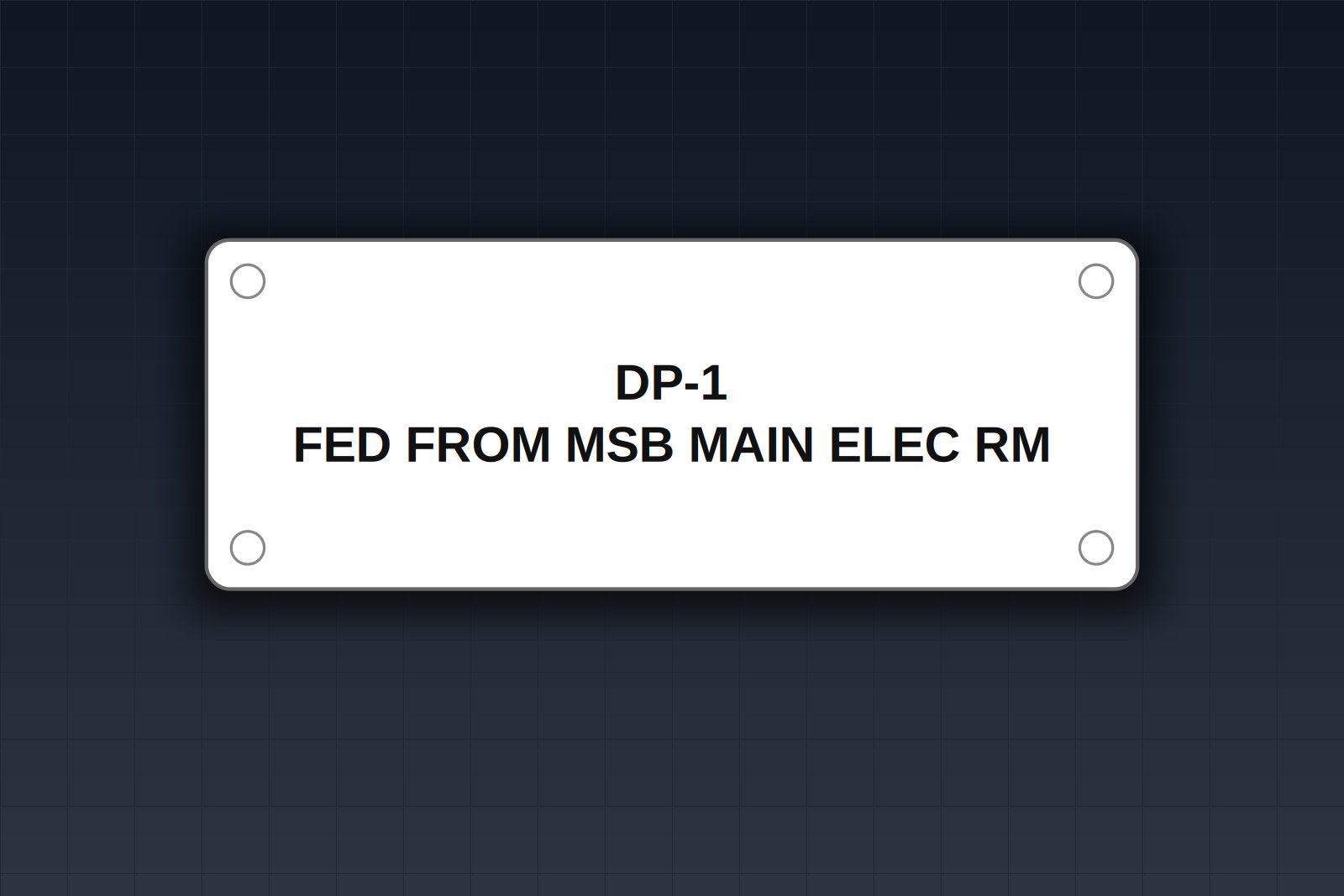
| Distribution panel | Designation, voltage, source equipment, source location | DP-1 / 480Y/277V 3PH 4W / FED FROM MSB, MAIN ELEC RM G01 | FED FROM MSB |
| Dry-type transformer | Designation, source panel and circuit, location of source | T-1 / FED FROM DP-1 CKT 7,9,11 / ELEC RM 210 | XFMR FED FROM DP |
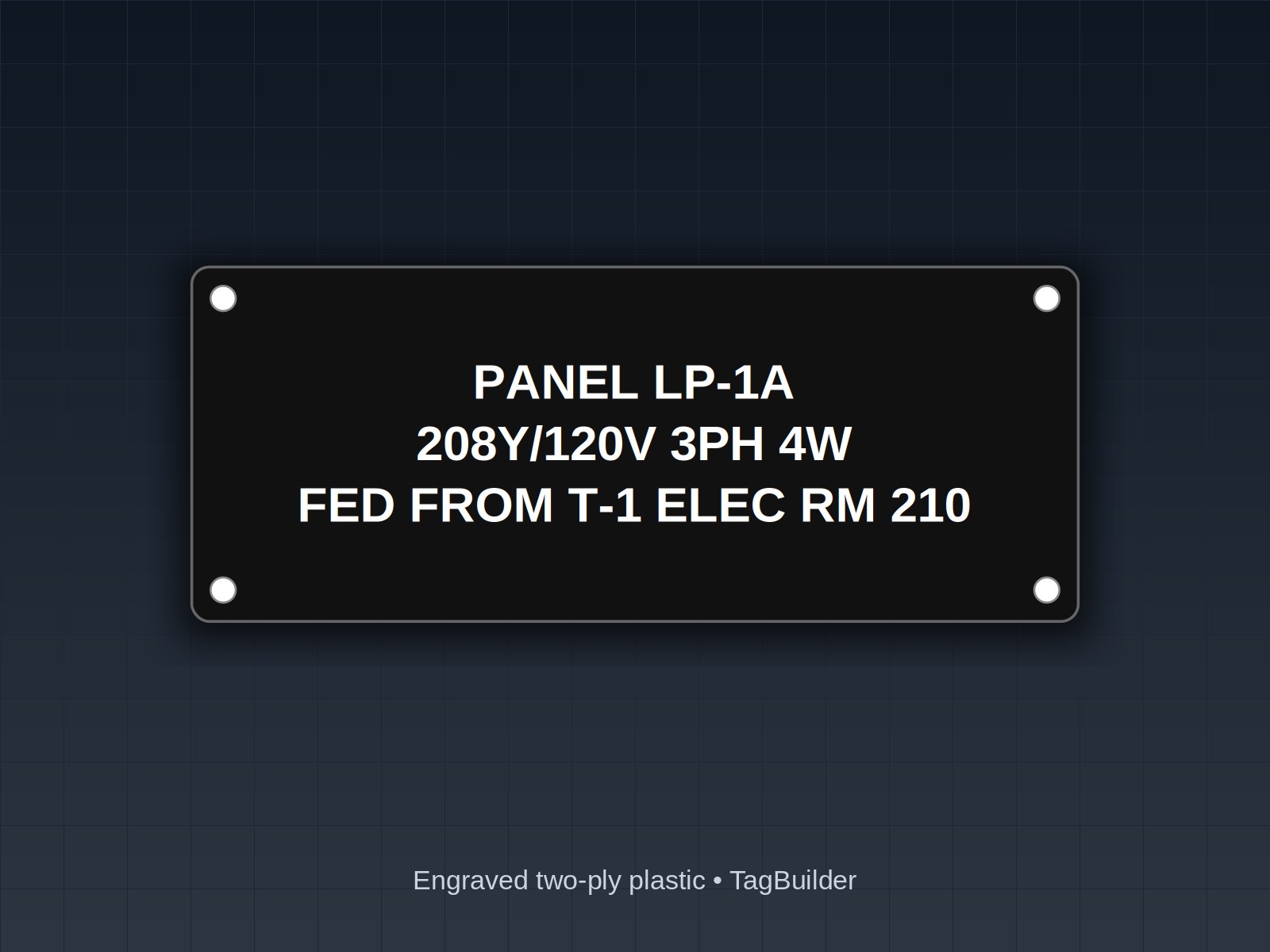
| Branch panelboard | Designation, voltage, source, location of source | PANEL LP-1A / 208Y/120V 3PH 4W / FED FROM T-1, ELEC RM 210 | FED FROM MDP |
| Panel on an ATS | Designation, both sources named, ATS location | EP-1 / NORMAL: DP-1 VIA ATS-1 / EMERG: GEN-1 VIA ATS-1 / ATS-1 IN ELEC RM 110 | EMERGENCY PANEL |
The weak example in the branch panelboard row is the one we see most. "FED FROM MDP" with no room and no voltage tells the reader nothing when the building has two main distribution panels, or when the panel moved during a renovation.
Worked example: a 3-story office
The building has one service. The chain runs MSB to DP-1 to T-1 to LP-1A. Here is the exact text for each plate, line by line.
Plate 1: MSB
- Line 1: MSB
- Line 2: 480Y/277V 3PH 4W
- Line 3: FED FROM UTILITY TRANSFORMER, NORTH YARD PAD
Plate 2: DP-1
- Line 1: DP-1
- Line 2: 480Y/277V 3PH 4W
- Line 3: FED FROM MSB, MAIN ELEC RM G01
Plate 3: T-1
- Line 1: T-1
- Line 2: FED FROM DP-1 CKT 7,9,11
- Line 3: ELEC RM 210
Plate 4: LP-1A
- Line 1: PANEL LP-1A
- Line 2: 208Y/120V 3PH 4W
- Line 3: FED FROM T-1, ELEC RM 210
For each plate, a 4 x 2 in size in white letters on a black two-ply face works well. Put the name line at roughly 1/2 in to 3/4 in and the source line smaller. Mount it on the panel cover or the enclosure near the door, not on a removable interior trim that can swap between panels.
If you want a stock plate for a standard panel ID, see the 2.5 x 1 in panel identification label or the larger 4 x 2 in panel identification label. You can order either as is, or change the text in the configurator to carry the source line above.
Practical tips
Put the voltage on the same plate
The voltage line costs one row and saves a trip to the drawings. It also sits next to the source line, so the reader sees what the board is and where it comes from together.
Use the engineer's designations exactly
If the drawings say DP-1, do not engrave DP1 or MDP-1. A mismatch between the plate and the one-line diagram is the fastest way to start a punch-list argument. If the field changes a designation, get the revised drawing first and engrave to that.
Panels fed from an ATS
A board downstream of an automatic transfer switch has more than one source. Name both the normal and the emergency source, and name the ATS and where it sits. Where the equipment can be fed from a second source in other ways, the multiple power sources label is a separate warning plate and does not replace the fed-from line. Order that label as is, or edit the text in the configurator.
Re-feeds after renovation
When a panel gets a new source, the old plate is wrong and stays wrong until someone replaces it. Add the plate swap to the renovation scope. Remove the old plate rather than covering it, so nobody reads two sources.
A related plate: system voltage identification
Where a building has more than one nominal voltage system, the NEC calls for the system to be identified. Sections 210.5(C) for branch circuits and 215.12(C) for feeders are the places to look, and the exact wording and method vary by edition. In practice this often means a plate or color scheme at the panel stating the voltage system. Putting the voltage on the fed-from plate, as in the example above, covers the reader's practical need, but confirm with the AHJ whether a separate voltage identification is expected on your project.
Frequently Asked Questions
Do I need a fed-from label on every panelboard?
For feeder-supplied switchboards, switchgear and panelboards in other than one- and two-family dwellings, the section applies. Check the edition your jurisdiction has adopted and ask the AHJ about any exception for your project.
What does a fed-from label have to say?
It names the equipment where the power originates. Most inspectors and engineers also want the physical location of that equipment and, for a transformer or a multi-pole feed, the circuit or breaker. Adding voltage on the same plate is common practice.
Can I use a hand-written label or a printed sticker?
Many AHJs do not accept hand-written markings for this purpose, and the section calls for permanent marking suited to the environment. Engraved text does not rub off like printed ink, which is why many contractors choose an engraved plate screwed or bonded to the enclosure. Confirm the attachment method with your AHJ.
Is a breaker number enough?
No. A breaker number tells the reader which pole, not which board. Name the source equipment and its location, then add the circuit when it helps.
What do I put for a panel fed from a generator or ATS?
Name each source and the ATS. For example, list the normal source, the emergency source and the room that holds the transfer switch. Keep the text in the order the engineer's one-line shows.
Who writes the text, the engineer or the contractor?
The designations come from the engineer's drawings. The contractor confirms the field conditions, such as room numbers and circuit numbers, and sends the list to be engraved.
Send us your riser or panel schedule. We'll engrave one panel ID with its fed-from line as a free sample.
The next step is small. Send the list, the schedule or the one-line, and we return plates matched to it. If you want to see the work first, the free sample is the low-risk start. For the inside of the panel, read the electrical panel labeling requirements guide, and for transformers see the dry-type transformer nameplate guide.
UL, NFPA, NEC, ASME, CEMA, TIA, ANSI and OSHA are names or marks of their respective organizations; TagBuilder is not affiliated with or endorsed by any of them. Requirements above are paraphrased summaries, not the text of any standard. Always work from the current published edition and your AHJ.