Apartment and Multifamily Electrical Labels: Meters, Unit Disconnects and Panels
The utility will not set meters, and the inspector holds the final, until every meter position, unit disconnect and unit panel carries the same permanent unit number. A wrong or missing number sends a red tag, or worse, opens the wrong tenant's breaker.
Important Disclaimer
This article is provided for general informational purposes only and does not constitute legal, safety, or professional compliance advice. Regulations, standards, and codes are subject to change and may be interpreted differently by authorities having jurisdiction (AHJ). Always consult with qualified safety professionals, licensed engineers, or legal counsel to determine the specific requirements applicable to your facility. TagBuilder is not responsible for any actions taken based on this information.
Each meter position, its unit disconnect and the unit panel should carry the same permanent unit number, plus the building address on the meter plate. The NEC asks for disconnects marked with what they serve (110.22(A)), service disconnects marked as such (230.70(B)), a directory in each panel (408.4(A)) and the source of supply on unit panels (408.4(B)). Section numbers and wording shift between editions, and many utilities add their own rules on top, so check the current edition, your AHJ and the utility's metering manual.
Why the numbers have to match
A meter stack with 24 positions looks the same from the front. Without a plate on every position, nobody can tell 2B from 3B. The utility will not energize a position it cannot trace to an address. The inspector will not pass a final where the meter, the disconnect and the panel inside the unit disagree.
The same labels matter after turnover. A maintenance tech who needs to kill power to one unit reads the plate and opens that disconnect. A fire crew looks for the house shutoff and the unit disconnects. If the plates are missing or wrong, they guess.
What the NEC asks for, in plain terms
This is a paraphrase. Read the current edition for the exact text.
- 110.22(A): each disconnect is marked to show what it serves. In a meter stack, that means the unit number.
- 230.70(B): each service disconnect is permanently marked as a service disconnect. The marking sits where it is visible and is clearly separate from the other markings around it.
- 230.72: service disconnects are grouped. Where they are not all in one place, a plaque or directory at each location shows where the others are. 230.2(E) covers identification where a building has more than one service. Check which edition your jurisdiction has adopted.
- Occupant access: in a multiple-occupancy building, each occupant has access to their own service disconnect. Where that is not practical, the code has provisions for management-controlled access. That language varies by edition, so confirm it with the AHJ.
- 408.4(A): every circuit in a panelboard is identified in a legible directory.
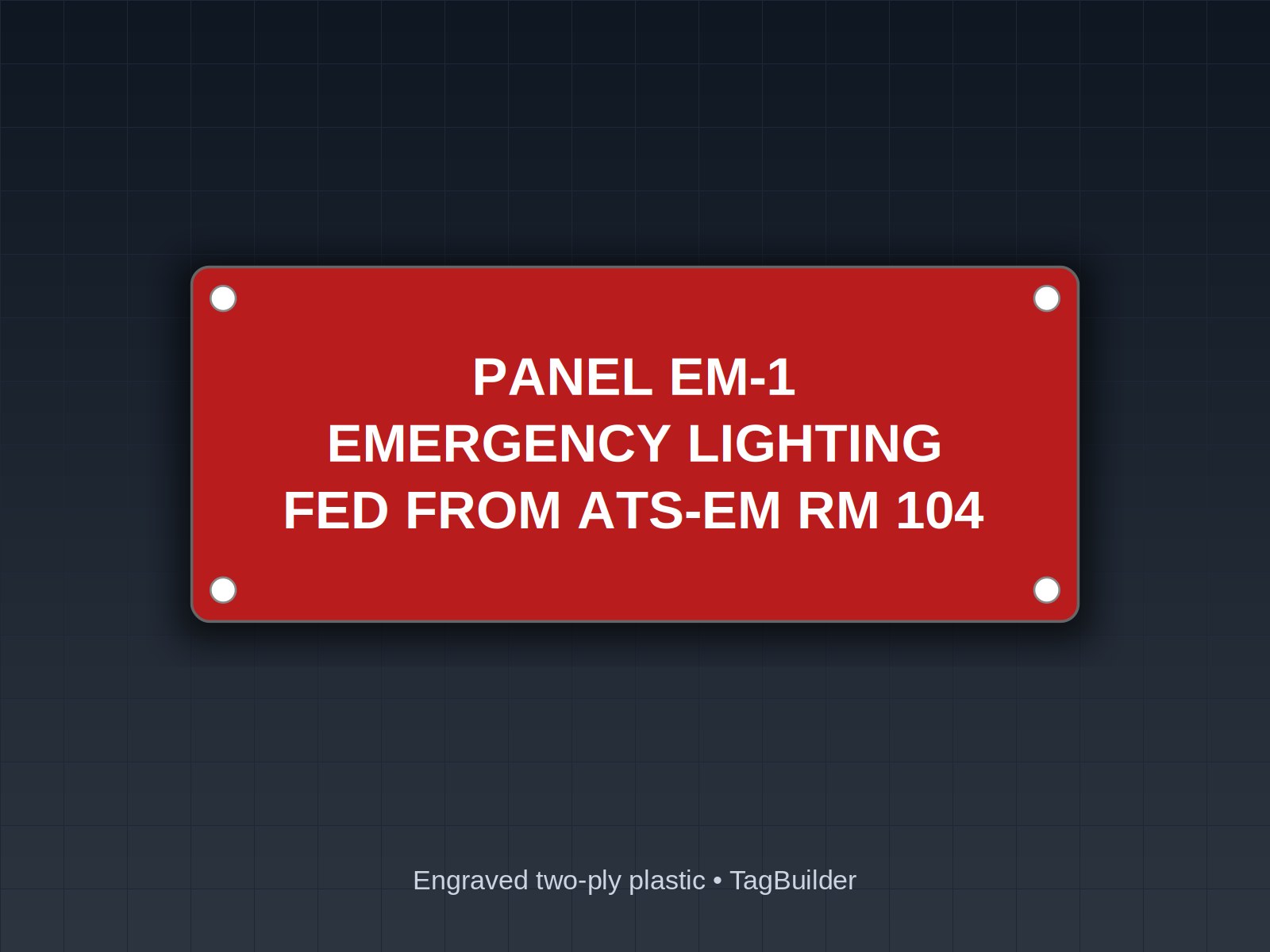
- 408.4(B): panelboards, other than in one- and two-family dwellings, are marked with the source of supply, commonly written as a fed-from label. Apartment unit panels fall on the multifamily side of that line.
Our guides on NEC 110.22 disconnect identification and fed-from labels under 408.4(B) go deeper on those two sections.
What many utilities add
Many utilities publish a metering manual that sits on top of the NEC. Common items:
- A permanent plate at each meter position showing the unit number and the service address, matching the number on the unit door.
- Engraved or riveted plates. Marker, label tape and paper cards are commonly rejected.
- A minimum letter height, often stated in the manual.
- Plates fastened with screws or rivets on outdoor meter centers, not adhesive alone.
Get the manual before you order. If it states a letter height, tell us and we size the plate to it.
Table 1: what goes where in a multifamily building
Table 1 lists each location, what the plate says and why it is there.
| Location | What it says | Why |
|---|---|---|
| Meter position | Unit number and street address | The utility and inspector trace each meter to a unit. Many utilities require it before setting meters. |
| Unit disconnect at the meter center | Unit number and the word DISCONNECT | 110.22(A): marked with what it serves. Also marked as a service disconnect where it is one (230.70(B)). |
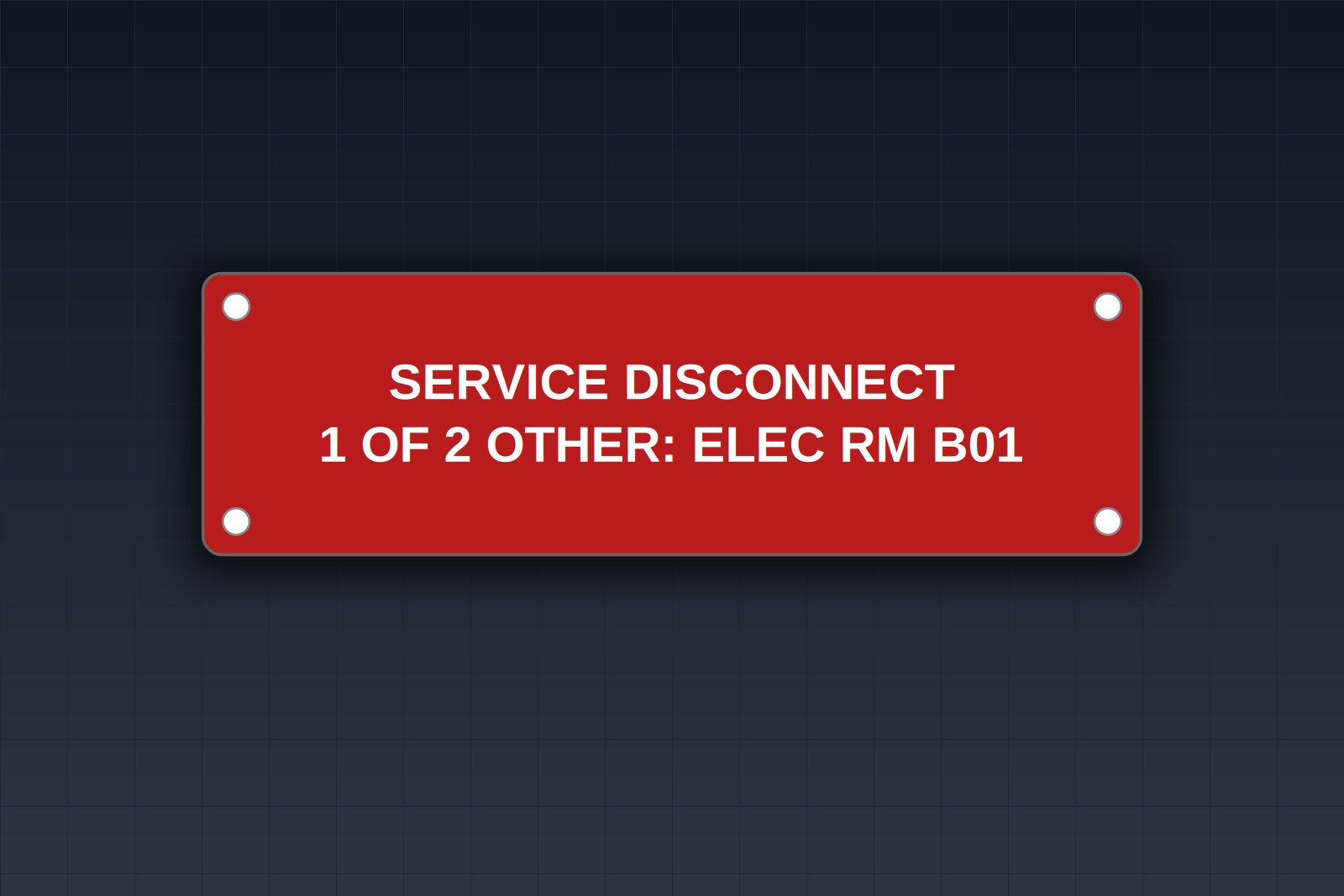
| Main service disconnect | SERVICE DISCONNECT | 230.70(B): permanent marking. |
| Where disconnects are in separate places | Plaque or directory showing where the others are | 230.72 and 230.2(E), edition dependent. |
| House panel | Panel name and source | 408.4(B) source of supply. |
| Unit panel inside the unit | Unit number and fed-from location | 408.4(B). The tenant and the tech both find the right source. |
| Inside each panel | Circuit directory | 408.4(A). |
Worked example: a 24-unit building
The building is 1450 Main St. It has three floors, units 1A to 1H, 2A to 2H and 3A to 3H, one meter center MC-1 in electrical room B01, and a main switchboard feeding a house panel. Use the unit numbers from the architectural door schedule everywhere. Do not renumber for the electrical drawings.
Here is the plate list, line by line.
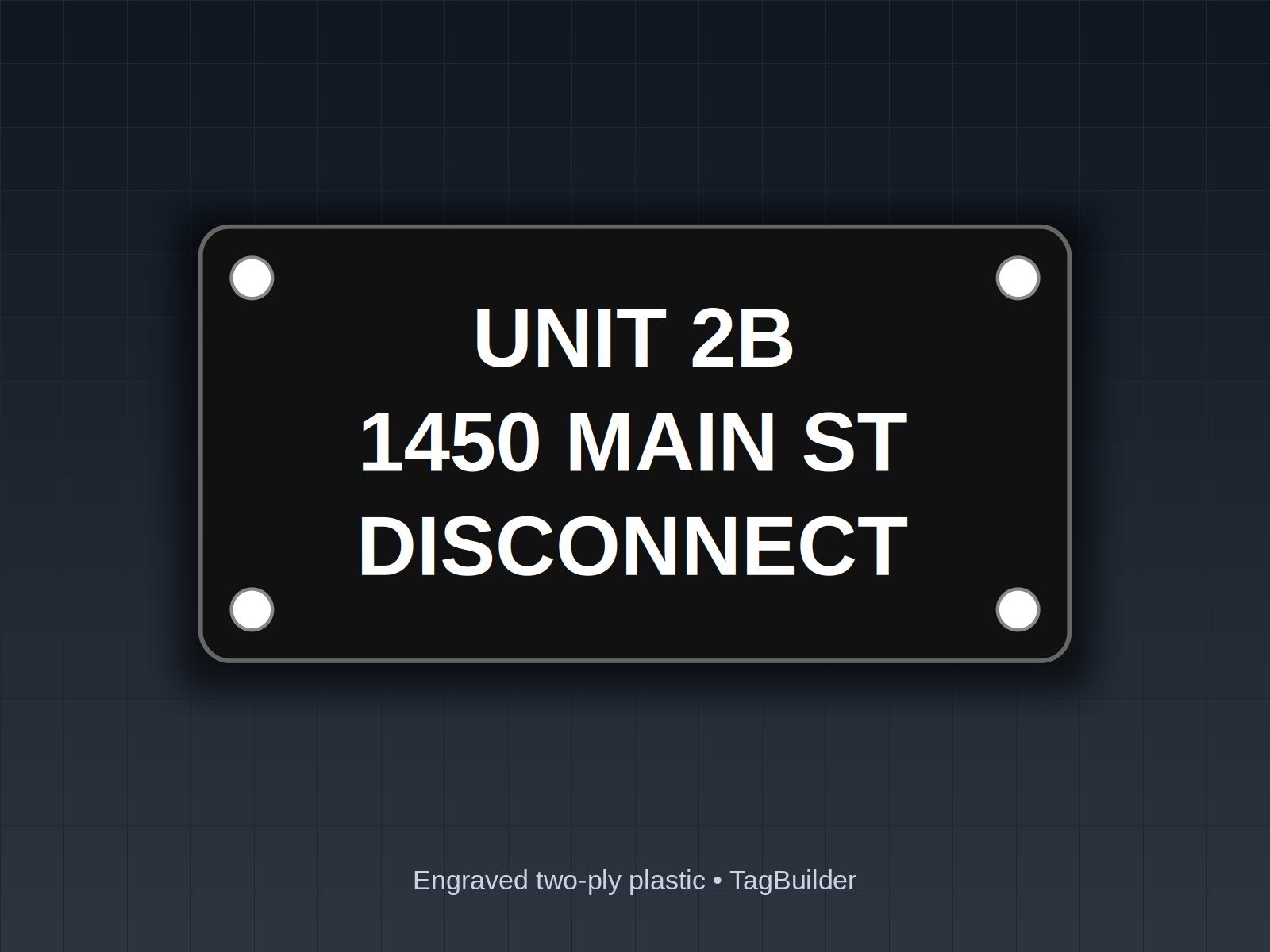
- Meter position plates (24): 3 x 1 in, white on black, two lines.
Line 1: 2B
Line 2: 1450 MAIN ST - Unit disconnect plates (24): 3 x 1 in, white on red, one line.
UNIT 2B DISCONNECT - Main plate (1): 4 x 2 in, white on red.
SERVICE DISCONNECT - House panel plate (1): 2.5 x 1 in, white on black, two lines.
Line 1: HOUSE PANEL HP
Line 2: FED FROM MAIN SWBD - Unit panel plates (24): 4 x 1.5 in, white on black, two lines.
Line 1: UNIT 2B
Line 2: FED FROM METER CENTER MC-1, ELEC RM B01
Check the pairing before anything is engraved. Meter 2B, disconnect 2B and panel 2B all point to the same unit. A tenant in 2B who loses power because someone opened 3B is a labeling failure, not a wiring failure.
Ordering the stock plates
The service disconnect plate is a stock item. See the 4 x 2 in SERVICE DISCONNECT plate, white on red. Order it as-is, or change the text in the configurator.
The unit disconnect plates follow the same pattern. The 3 x 1 in disconnect plate with mounting holes is the right size. Order it as-is for a main, or change the text to UNIT 2B DISCONNECT, then repeat for each unit.
The house panel plate fits the 2.5 x 1 in panel identification plate. Change the text to match your panel name and source. More on the disconnect side is on the disconnect labels page.
Ordering and mounting tips
- Order from one list. Export the unit list from the door schedule and use it for meter, disconnect and panel plates. One source prevents a 4C that becomes 4-C on one plate.
- Keep the format identical. Same letters, same order, same spacing, everywhere.
- Screw or rivet on outdoor meter centers. Weather, cleaning and tenant traffic pull adhesive plates loose over time.
- Send the sequence. If the meters stack in a pattern, tell us. We can sort plates by position so the install goes in order.
- Plan for spares. Order a few extra for the units that change during construction.
Frequently Asked Questions
Do I need to label every meter position in an apartment building?
Yes, in practice. Many utilities will not set meters until each position carries a permanent unit number, and many AHJs expect the same. Check the utility's metering manual and your AHJ for the exact requirement.
What does a unit disconnect label have to say?
It identifies what the disconnect serves, which means the unit number. Where the device is a service disconnect, it also needs the service disconnect marking under 230.70(B). Wording and edition details vary, so confirm with your AHJ.
Can I use a label maker or marker on a meter stack?
Many utilities reject both. They want permanent plates, commonly engraved or riveted, that stay readable for the life of the building. Engraved text does not rub off like printed ink.
Do unit panels in an apartment need a fed-from label?
Commonly yes. 408.4(B) asks for the source of supply to be marked on panelboards other than in one- and two-family dwellings. Apartment units fall on the multifamily side. Check the current edition you are working under.
Should the unit numbers match the door numbers?
Yes. Use the numbering from the architectural door schedule on the meter, the disconnect and the panel. Matching numbers is what the utility and inspector check, and it keeps a tenant from losing power by mistake.
Send us your unit list and meter layout. We'll engrave one unit disconnect plate as a free sample.
The next step is small. Send the unit list, the schedule or a one-line drawing, and we will build plates to match. If you want to see the work first, ask for a free sample. For the rest of the building, the NEC 408 panel labeling guide covers directories and panel identification.
UL, NFPA, NEC, ASME, CEMA, TIA, ANSI and OSHA are names or marks of their respective organizations; TagBuilder is not affiliated with or endorsed by any of them. Requirements above are paraphrased summaries, not the text of any standard. Always work from the current published edition and your AHJ.