Transformer ID Labels: What to Put on a Dry-Type Transformer Plate
The factory nameplate tells you what the transformer is. It does not tell the next electrician which breaker feeds it or which panel it serves. Leave that out and you risk a failed walkthrough, a wrong breaker opened, or responders hunting for the shutoff.
Important Disclaimer
This article is provided for general informational purposes only and does not constitute legal, safety, or professional compliance advice. Regulations, standards, and codes are subject to change and may be interpreted differently by authorities having jurisdiction (AHJ). Always consult with qualified safety professionals, licensed engineers, or legal counsel to determine the specific requirements applicable to your facility. TagBuilder is not responsible for any actions taken based on this information.
A field ID plate for a dry-type transformer commonly shows its designation, kVA, primary and secondary voltage, what feeds it, and what it feeds. Mount it on the front of the enclosure, where anyone opening the cover or standing at the unit can read it. The factory nameplate required by NEC 450.11 stays in place and is not replaced. Section numbers and wording change between editions, so check the edition your jurisdiction has adopted and ask your AHJ what it expects.
Two plates, two jobs
A dry-type transformer carries two different plates. The manufacturer applies the first. You or your contractor apply the second.
Paraphrasing 450.11, the factory nameplate gives the maker's name, rated kVA, frequency, primary and secondary voltage, and impedance on larger units. It also lists required clearances for ventilated units, plus the insulation class and temperature rise. It describes the equipment. It says nothing about where the unit sits in your building.
The field plate describes the installation. It answers the questions a maintenance electrician asks at 2 a.m.: what is this, where does its power come from, and what does it serve?
Table 1: Manufacturer nameplate vs. field ID plate, field by field
| Item | Manufacturer nameplate | Field ID plate |
|---|---|---|
| Who applies it | Transformer manufacturer | Contractor or facility |
| Designation (T-2A) | No | Yes |
| kVA rating | Yes | Yes, repeated for quick reading |
| Primary and secondary voltage | Yes | Yes, with phase and wires |
| Frequency, impedance, insulation class, temperature rise | Yes (impedance on larger units) | No |
| Ventilation clearances | Yes, where ventilated | No |
| Fed from (source and location) | No | Yes |
| Feeds (downstream panel) | No | Yes |
| Secondary disconnect location | No | Optional |
What goes on the field ID plate
Keep the plate to facts a person can verify by looking at the one-line drawing.
- Transformer designation, matching your drawings and panel schedules.
- kVA rating, copied from the factory nameplate.
- Primary voltage, phase and wires, such as 480 V, 3 PH, 3 W.
- Secondary voltage, phase and wires, such as 208Y/120 V, 3 PH, 4 W.
- Fed from: the source panel, the circuit or breaker position, and the room.
- Feeds: the downstream panel or panels.
- Secondary disconnect location, if the secondary protection is not at the transformer.
The fed-from line does the most work. Our guide to fed-from labels and NEC 408.4(B) covers how to write it so it stays accurate when circuits change.
The code sections that touch this plate
No single section says "put this plate on a transformer." Several sections together explain why the plate is useful, and many AHJs expect it. Confirm each against your adopted edition.
450.11 and 450.14
450.11 covers the factory nameplate, as described above. 450.14 deals with the transformer disconnecting means. In general terms, the disconnect sits in sight of the transformer, or its location is marked on the transformer. A remote primary breaker is the common case, and the fed-from line on your plate is one way to mark it. Check the current text and your AHJ's reading.
110.22
110.22 calls for disconnecting means to be legibly marked to show their purpose, unless the purpose is evident. A breaker labeled only by a circuit number does not meet that intent. Label the breaker in the source panel with the transformer designation too.
408.4(B)
The panel on the secondary side needs its own source identification under 408.4(B). The "feeds" line on the transformer plate and the "fed from" line on the panel label should point at each other. Make them match exactly.
210.5(C) and 215.12(C)
A transformer creates a second voltage system. Branch circuit and feeder conductors on the secondary side need identification by phase and system where the building has more than one voltage system. Your plate states the secondary system so the conductor marking has a reference. The exact method and edition language vary, so check both.
110.16 and 110.21(B)
Arc-flash and warning labels usually sit beside the ID plate. 110.16 addresses the arc-flash hazard warning on certain equipment. 110.21(B) addresses field-applied hazard markings. Neither replaces the ID plate. See the arc flash label template guide for that label. A danger high voltage label can go on the enclosure as well, where your safety program calls for one.
Worked example: T-2A, 75 kVA, 480 V delta to 208Y/120 V
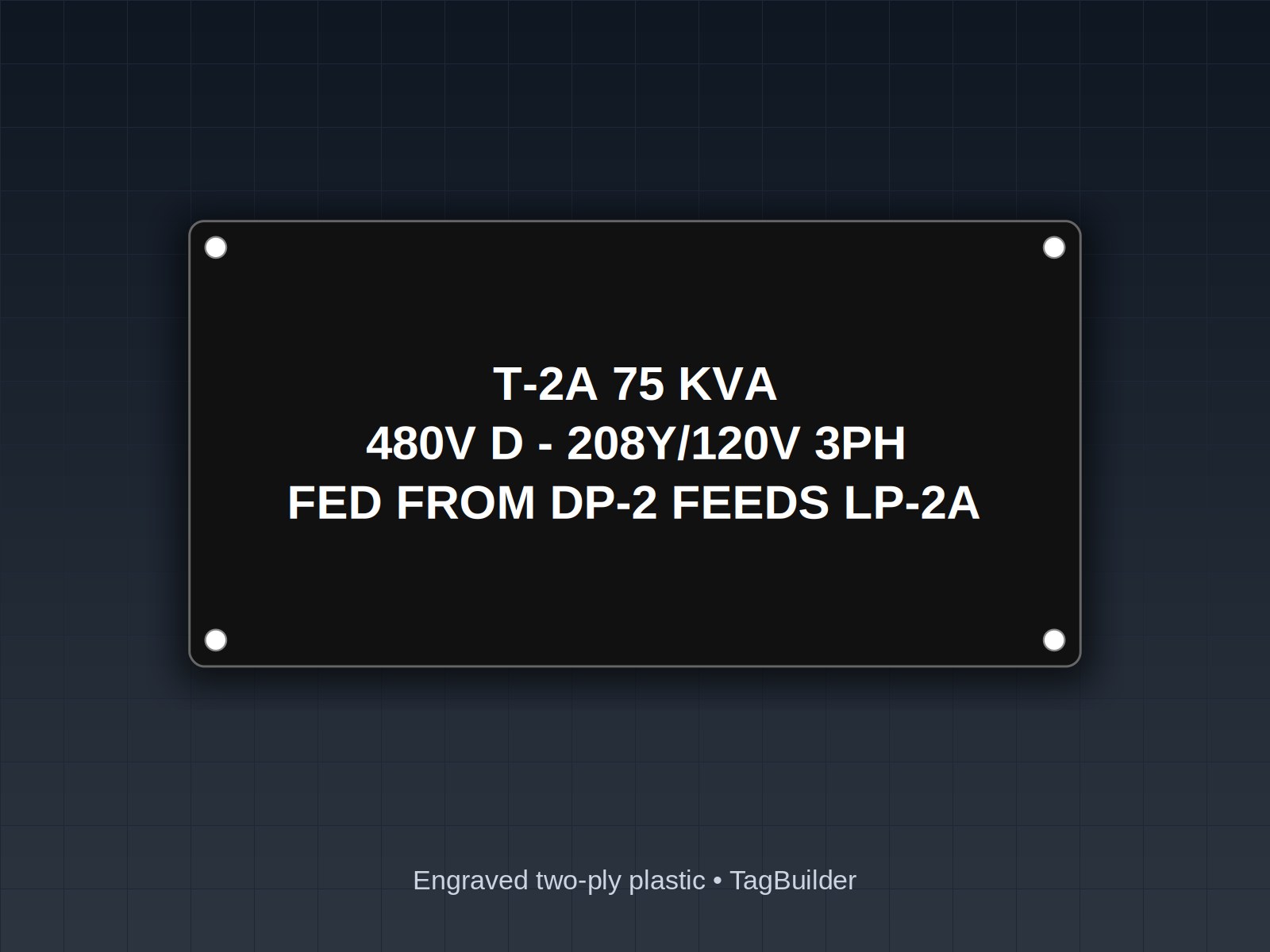
This unit sits in an electrical room, fed from distribution panel DP-2. It serves lighting and receptacle panel LP-2A.
Main ID plate. 6 x 3 inch, white text on black, with mounting holes. The 6x3 transformer label is a stock plate. You can order it as-is or change the text in the configurator. A 5 x 2 inch plate also works for shorter text.
Plate text, line by line:
- T-2A
- 75 kVA
- PRIMARY: 480 V, 3 PH, 3 W
- SECONDARY: 208Y/120 V, 3 PH, 4 W
- FED FROM: DP-2, CKT 14, 16, 18
- LOCATION: ELECTRICAL ROOM 214
- FEEDS: LP-2A
- SEC. DISCONNECT: LP-2A MAIN
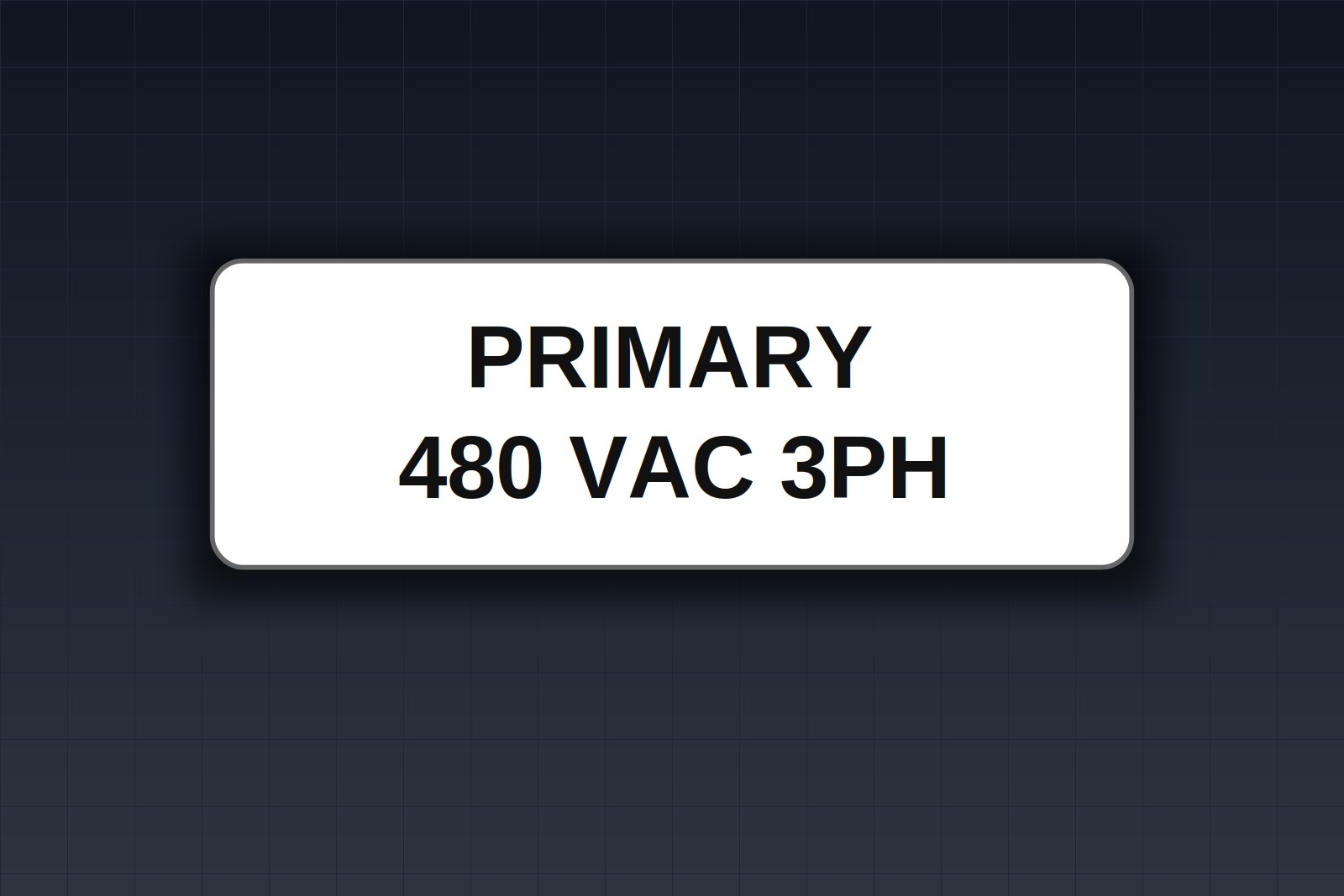
Matching voltage pair. Two 3 x 1 inch plates, white on black, set at the primary and secondary terminal compartments:
- PRIMARY 480 VAC
- SECONDARY 208Y/120 VAC
The 3x1 primary voltage label is a stock item, and you can change its text to read SECONDARY for the second plate. The 4x2 transformer label is a smaller option if the enclosure face is tight.
On the panel side, label the DP-2 breaker "T-2A PRIMARY" and add "FED FROM: T-2A" to the LP-2A panel label. Now every location points to the next.
Where the plate goes on the unit
Mount on the enclosure front or side panel, at a height a person can read without a ladder. Mechanical fasteners through the pre-drilled holes hold up better than adhesive on a painted steel surface that warms and cools every day.
- Keep plates off vent louvers. They block airflow and the plate will not sit flat.
- Keep plates off the enclosure top. Heat collects there, and the top is hard to read.
- Do not cover the factory nameplate. Mount the field plate beside it.
- Keep the plate readable with the cover closed, and keep it clear of the working space in front of the unit.
Engraved text does not rub off like printed ink, which helps in a mechanical room where people wipe down and bump equipment.
Get the plates made without the guesswork
You do not need to fill out a form for each unit. Send the transformer schedule, a panel schedule, or the one-line drawing. We read the designations, sources and loads, and return plates to match. If you want to check the layout first, our free sample is the low-risk first step. Look at the text, the size and the hole spacing on one plate before you order a full set.
Frequently Asked Questions
Do I need a field label if the transformer already has a nameplate?
Commonly, yes. The nameplate comes from the factory and does not say where the power comes from or where it goes. Many AHJs and facility standards expect a field plate for that reason. Check the current edition and ask your inspector.
What does a transformer fed-from label have to say?
It should name the source panel, the breaker or circuit position, and the room where the source is located. Source identification for the panel it feeds falls under 408.4(B). For the transformer itself, the 450.14 disconnect language is the closest reference. Check how your edition and AHJ read both.
Can I use the same label for the primary and secondary sides?
Use a separate plate for each. Primary and secondary are different voltage systems, and a person opening the unit needs to know which side they are touching. A matched pair of 3 x 1 plates works well.
Does the plate go on the transformer or at the disconnect?
Both, with different text. The transformer gets the ID plate. The primary breaker or disconnect gets a label naming the transformer it serves, in line with 110.22. A remote disconnect also needs its location marked at the transformer where 450.14 applies.
Should the arc-flash label be on the same plate?
No. Keep it separate. The arc-flash label comes from a calculation or a labeling method your facility chooses under 110.16 and 110.21(B), and it gets updated on its own schedule. The ID plate rarely changes.
What size plate fits a 75 kVA dry-type?
A 6 x 3 inch plate fits eight short lines of text with room for margins. A 5 x 2 inch plate fits fewer lines. Size to the text you need and to the clear space on the enclosure front.
Send us your transformer list. We'll engrave one ID plate with kVA, voltages and fed-from as a free sample.
If you also need plates for panels and equipment, start with the equipment nameplate requirements guide. For custom text or sizes beyond the stock plates, use the rectangle plate configurator. For the downstream panel label that pairs with this one, read the fed-from labels article.
UL, NFPA, NEC, ASME, CEMA, TIA, ANSI and OSHA are names or marks of their respective organizations; TagBuilder is not affiliated with or endorsed by any of them. Requirements above are paraphrased summaries, not the text of any standard. Always work from the current published edition and your AHJ.