Elevator Machine Room Labels: NEC 620 Disconnect Identification and Equipment Plates
The elevator is built, the state inspector is on the calendar, and the machine room has unmarked breakers and one handwritten label on the controller. An unlabeled or mislabeled disconnect gets a failed final, or worse, someone opens the wrong breaker while a car is loaded.
Important Disclaimer
This article is provided for general informational purposes only and does not constitute legal, safety, or professional compliance advice. Regulations, standards, and codes are subject to change and may be interpreted differently by authorities having jurisdiction (AHJ). Always consult with qualified safety professionals, licensed engineers, or legal counsel to determine the specific requirements applicable to your facility. TagBuilder is not responsible for any actions taken based on this information.
Quick answer: Each elevator main-line disconnect carries a plate with the car number and the location of the supply-side overcurrent device, and it is numbered to match its machine and controller when more than one is in the room. The car light, HVAC and other utilization disconnects carry similar signs. These requirements sit in NEC Article 620 (620.51, 620.53, 620.54, 620.55), but wording, subsection lettering and disconnect location rules change by edition, so check the edition your jurisdiction adopted and ask your elevator inspector.
What NEC 620 asks you to mark
Article 620 covers the electrical side of elevators, dumbwaiters and escalators. The mechanical and safety side belongs to the ASME A17.1 elevator code, which the state elevator inspector enforces. This article stays on the electrical plates the electrical contractor or building engineer usually supplies.
Main-line disconnect: 620.51
Each car gets a single disconnect for its main-line power supply. It must be lockable in the open position. Where it goes depends on the edition and the machine arrangement:
- Machine room or control space: the disconnect is commonly located there, in sight of the controller.
- Machine-room-less cars: the disconnect is commonly required within sight of the controller.
- Dedicated disconnect room: some recent editions allow it. Confirm with your AHJ.
The identification and sign requirements, in 620.51(D) in recent editions, work two ways. The disconnect is marked to show where the supply-side overcurrent device is. If one room holds more than one driving machine, each disconnect is numbered to match the machine and controller it serves. Subsection lettering shifts between editions, so confirm against the one you work under.
Car lighting, HVAC and utilization equipment: 620.53, 620.54, 620.55
Car lighting, receptacle and ventilation power has its own disconnect under 620.53. Car heating and air conditioning has one under 620.54. Each needs a sign showing the location of its supply-side overcurrent device. Section 620.55 treats other utilization equipment in a similar way. These are separate circuits and separate plates, which is why a machine room with two cars can end up with eight or more.
Shunt-trip: 620.51
Where sprinklers are in the machine room or hoistway, the main-line disconnect is commonly a shunt-trip breaker so power drops before water flows. The operating requirements are in 620.51 (the subsection letter varies by edition). Label the shunt-trip breaker and mark the feed from the fire alarm panel so the next electrician knows it is tied to the fire system. Coordinate the wording with the fire alarm contractor. A stock fire alarm power source label works for the fire alarm side. You can order it as-is or change the text in the configurator.
Table 1: Elevator machine room devices, what the plate says, and the NEC 620 section.
| Device | What the plate says | Section |
|---|---|---|
| Main-line disconnect | Car number, service, source panel and circuit, room of the supply-side overcurrent device | 620.51 |
| Multiple machines in one room | Disconnect number matches the machine and controller it serves | 620.51 |
| Shunt-trip breaker | Car number, shunt-trip, fire alarm interface | 620.51 |
| Car lights, receptacle, ventilation | Car number, function, source panel, circuit, room | 620.53 |
| Car HVAC | Car number, function, source panel, circuit, room | 620.54 |
| Other utilization equipment | Equipment name, source, circuit, room | 620.55 |
| Controller | Controller number matching its machine and disconnect | Edition and AHJ dependent |
Why the numbers matter
In a room with two cars, a technician reads the plate, not the drawing. A disconnect marked only "ELEVATOR" tells them nothing about which car drops when they open it. Matching numbers on the disconnect, controller and machine let a person trace a circuit in seconds. The same scheme helps firefighters and responders who need to kill power quickly.
The location of the supply-side device is the other half. A plate that says "FED FROM DP-1 CKT 2,4,6 ELEC RM 101" points to the upstream breaker. That is the same idea as the source labeling in our fed-from labels guide.
The machine room door and general signs
The door to the machine room commonly carries a sign such as ELEVATOR MACHINE ROOM / AUTHORIZED PERSONNEL ONLY. Many jurisdictions expect it, and it also keeps storage and casual visitors out. The elevator code and the local inspector set any further sign requirements. Do not copy standard artwork or layouts from a code book. Use plain text your inspector accepts.
Disconnect identification in general, outside elevators, is covered in our guide to NEC 110.22 disconnect identification labels.
Worked example: a two-car hydraulic elevator
Two hydraulic cars share one machine room. Panel DP-1 feeds the main-line disconnects and panel LP-1 feeds the car lights. Both panels are in Electrical Room 101. Here is a plate set you can copy and change.
Table 2: Plate list for the two-car hydraulic example. Plates are engraved two-ply plastic with adhesive backing unless noted.
| Plate | Text, line by line | Size and colors |
|---|---|---|
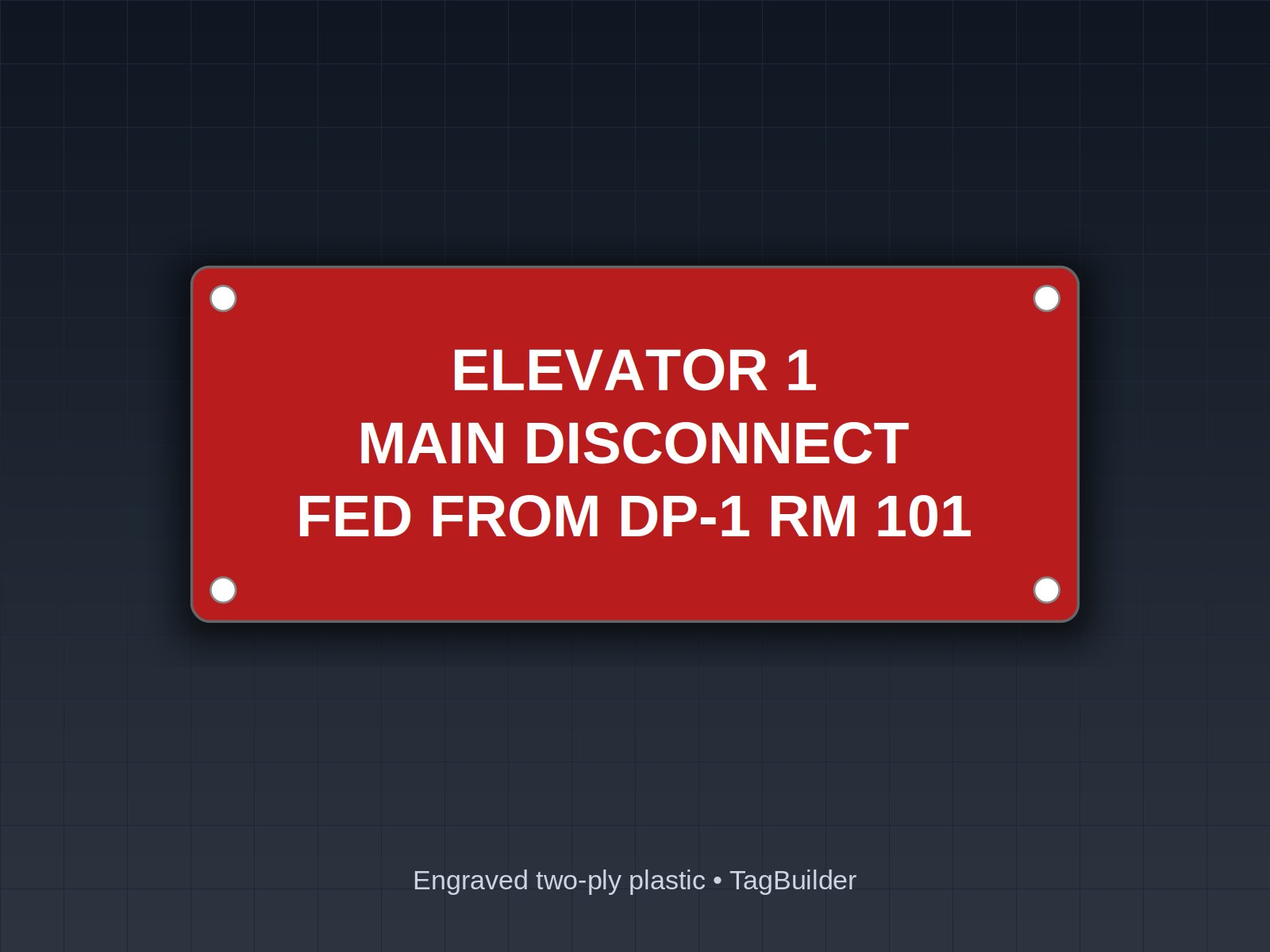
| Car 1 main disconnect | ELEVATOR 1 MAIN DISCONNECT FED FROM DP-1 CKT 2,4,6 ELEC RM 101 | 4 x 2 in, white on red |
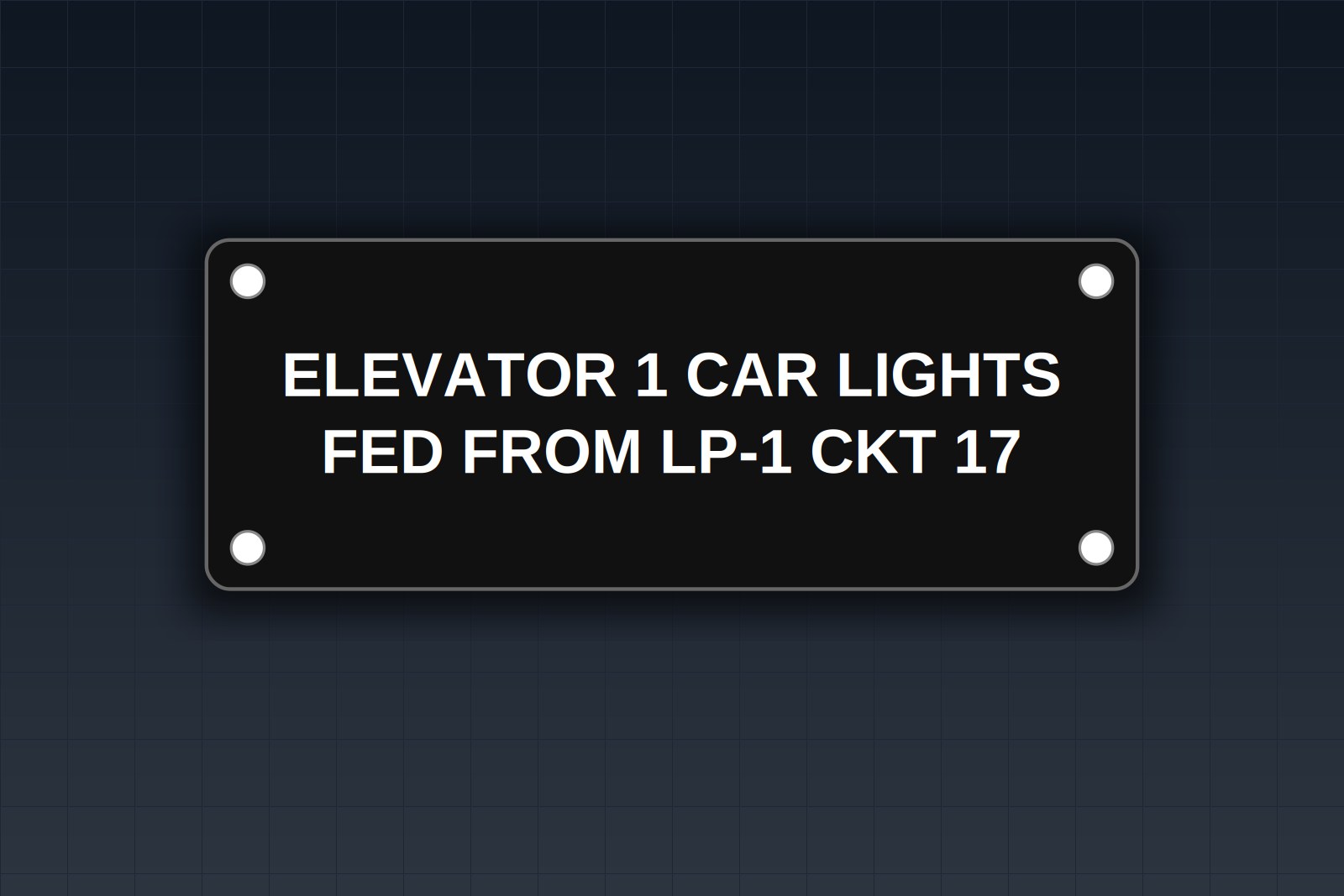
| Car 1 car lights | ELEVATOR 1 CAR LIGHTS FED FROM LP-1 CKT 17 ELEC RM 101 | 4 x 2 in, white on black |
| Car 2 main disconnect | ELEVATOR 2 MAIN DISCONNECT FED FROM DP-1 CKT 8,10,12 ELEC RM 101 | 4 x 2 in, white on red |
| Car 2 car lights | ELEVATOR 2 CAR LIGHTS FED FROM LP-1 CKT 19 ELEC RM 101 | 4 x 2 in, white on black |
| Controller 1 | CONTROLLER 1 | 3 x 1 in, white on black |
| Controller 2 | CONTROLLER 2 | 3 x 1 in, white on black |
| Shunt-trip | ELEVATOR 1 SHUNT TRIP FIRE ALARM INTERFACE CONTACT FIRE ALARM CONTRACTOR BEFORE SERVICE | 4 x 2 in, black on yellow |
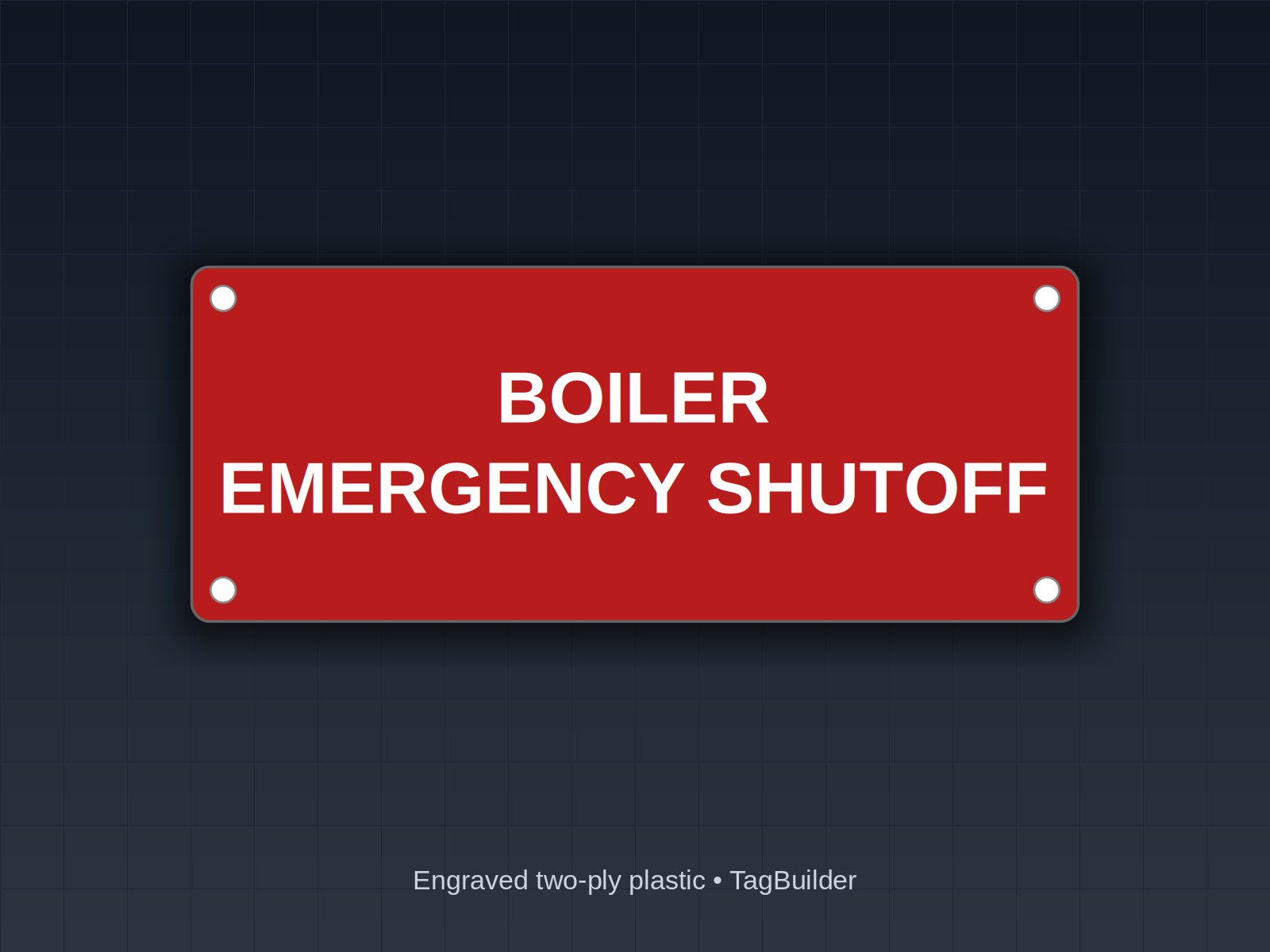
The stock main disconnect label in white on red is a 4 x 2 inch plate. You can order it as-is, or change the text to the car number and source in the configurator. If you need a warning line on a disconnect that stays energized from another source, the hazardous voltage plate in black on yellow is a starting point.
Repeat the pattern for the HVAC disconnects: "ELEVATOR 1 CAR A/C" with its panel, circuit and room. Use the same numbering on every plate in the room. If Car 1 is the north car on the drawings, it stays Car 1 on the disconnect, the controller and the machine.
Before you order
State elevator inspectors and local AHJs differ on wording, colors and mounting. Some want the plate on the disconnect door, others next to it. Some jurisdictions have a state-specific form or a checklist. Ask before ordering. A short call with the inspector or a look at the last inspection report saves a reprint.
- Pull the one-line diagram and the panel schedules for the machine room.
- List every disconnect by car and function: main, car lights, HVAC, other.
- Write the source panel, circuit numbers and room for each.
- Confirm the edition and the AHJ's preferences on wording.
- Number every machine, controller and disconnect with the same car number.
Frequently Asked Questions
Do I need a label on every elevator disconnect?
The main-line disconnect needs identification under 620.51, and the car light and HVAC disconnects need signs under 620.53 and 620.54. Equipment covered by 620.55 follows a similar approach. Confirm the details for the edition your jurisdiction adopted.
What does an elevator disconnect label have to say?
It identifies the car and shows where the supply-side overcurrent device is. In a room with more than one machine, the number matches the machine and controller it serves. Many contractors add the source panel, circuit and room so anyone can find the upstream breaker.
Do I need a shunt-trip label?
If sprinklers are in the machine room or hoistway, the main-line disconnect is commonly a shunt-trip device, and a label at the breaker and at the fire alarm interface helps the next person. Coordinate wording with the fire alarm contractor and the AHJ.
Can I use one sign for the car lights and the HVAC disconnect?
Each disconnect needs its own identification of its own supply-side device. One plate per disconnect keeps the circuit numbers clear. Ask your inspector if a shared plate is acceptable in your jurisdiction.
Where does the machine room door sign go?
On the door, at eye height, on the side people approach from. Many jurisdictions expect an authorized-personnel notice on the machine room door. Confirm the wording with the elevator inspector.
Can I use handwritten or printed paper labels?
Paper and marker fade, smear and peel in a warm machine room. Engraved text does not rub off like printed ink, which makes it a better choice for a plate that stays on the equipment for years. Your AHJ sets what it accepts.
Send us your elevator disconnect list. We'll engrave one numbered disconnect plate as a free sample.
The next step is small. Send the disconnect list, the panel schedule or a one-line drawing, and we engrave plates to match. If you want to see the work first, ask for the free sample. For more on disconnect labels outside the elevator room, see the disconnect label page and our lockout/tagout tag guide.
UL, NFPA, NEC, ASME, CEMA, TIA, ANSI and OSHA are names or marks of their respective organizations; TagBuilder is not affiliated with or endorsed by any of them. Requirements above are paraphrased summaries, not the text of any standard. Always work from the current published edition and your AHJ.