EV Charger Labels: NEC 625 Disconnect Identification and the 2026 Multifamily Plaque
You install twelve chargers, and the inspector asks which breaker feeds station 7. If the plates do not say, you wait for a re-inspection, or someone opens the wrong breaker later.
Important Disclaimer
This article is provided for general informational purposes only and does not constitute legal, safety, or professional compliance advice. Regulations, standards, and codes are subject to change and may be interpreted differently by authorities having jurisdiction (AHJ). Always consult with qualified safety professionals, licensed engineers, or legal counsel to determine the specific requirements applicable to your facility. TagBuilder is not responsible for any actions taken based on this information.
Short answer: Mark each EV charger disconnect with the station it serves (110.22(A)), and list each charger in the panel directory by space or station number (408.4). Mount the disconnect plate on or beside the disconnect. Where the disconnect is remote from the charger, many jurisdictions expect a plaque at the charger saying where it is, and the 2026 NEC adds explicit plaque and emergency disconnect language to 625.43. Check the edition your jurisdiction has adopted and ask the AHJ, because many are still on 2020 or 2023.
What NEC 625 asks for
Article 625 covers electric vehicle power transfer systems. Section 625.43 is the disconnecting means for EVSE. In the 2020 and 2023 editions it applies to equipment over a threshold, commonly 60 A or more than 150 V to ground, and the disconnect must be readily accessible and capable of being locked in the open position. Confirm the exact threshold in the edition you work under.
Two general rules sit behind it:
- 110.22(A): each disconnecting means is legibly marked to show its purpose, unless the arrangement makes the purpose evident.
- 408.4: each circuit in a panelboard directory is identified clearly enough to tell it from every other circuit.
A directory line that reads 'EV' fails the second test the day a second charger goes in. Name each charger by space or station number.
What changed in the 2026 NEC
The 2026 edition restructured 625.43 into subsections. As we read the draft language, three ideas matter to a label shop:
- Where each EVSE in a multifamily setting has its own disconnect, a plaque or directory on the equipment identifies which disconnect serves it.
- Where the disconnect is remote from the EVSE, a plaque at the EVSE tells where it is.
- Sites other than dwellings get an emergency disconnect requirement, with the device placed within a set distance of the equipment.
Read the final published wording before you quote distances or scope. Adoption varies by state and city, and local amendments change it again. Where your jurisdiction is on 2023, the plaque is not required by that text, though an AHJ can still ask for it under 110.22(A).
Which labels an EV charger needs
Table 1: EV charger field labels, where they mount, what they say, and the section behind them.
| Label | Mounts | Says | 2023 NEC | 2026 NEC |
|---|---|---|---|---|
| Station plate | Charger pedestal or wall unit | Station number, source panel and circuit, disconnect location | 110.22(A) when the disconnect is remote; AHJ practice | 625.43 plaque for remote or multifamily disconnects |
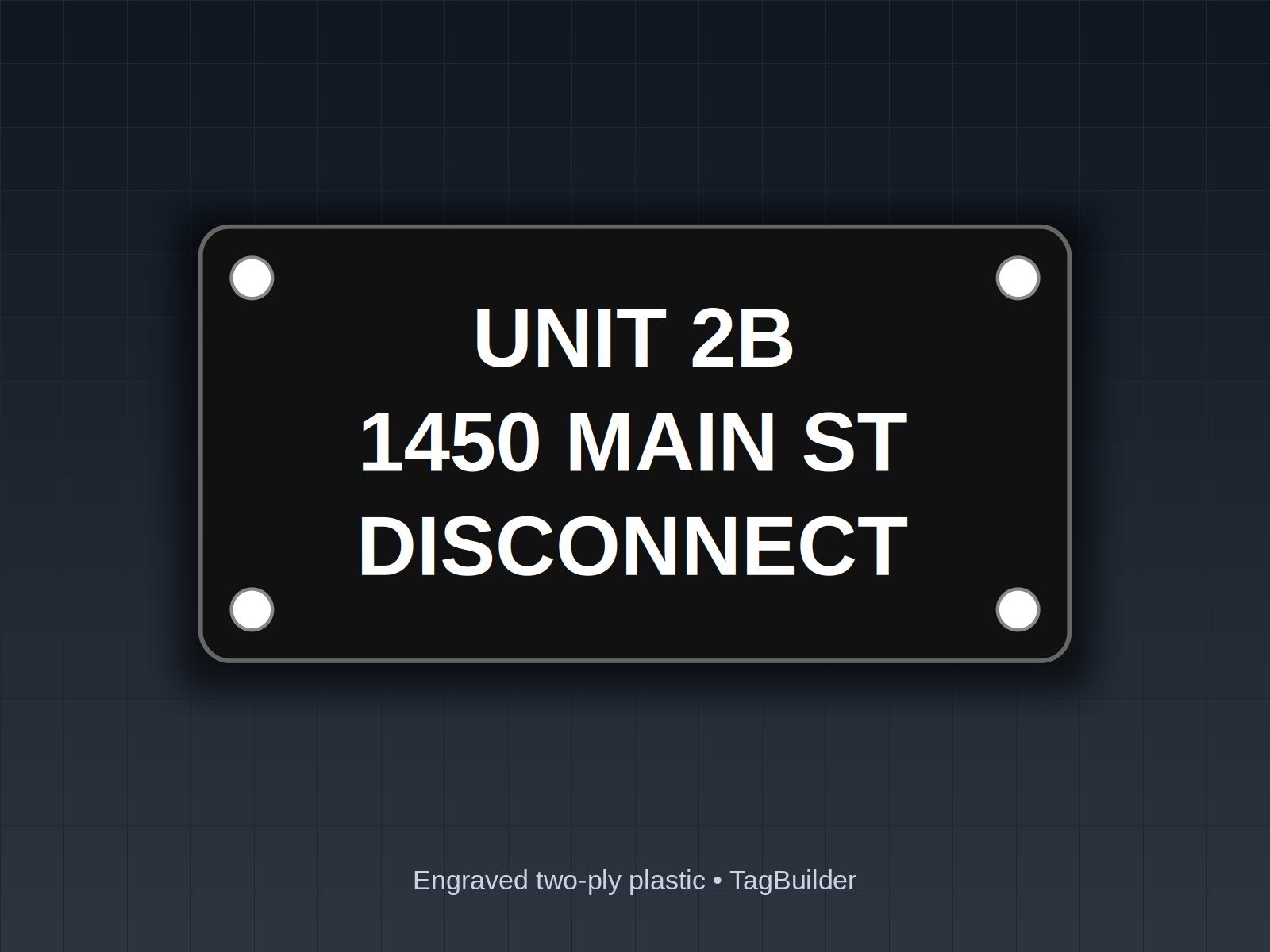
| Disconnect plate | On or beside the disconnect | Station number and 'DISCONNECT' | 110.22(A), 625.43 | 110.22(A), 625.43 |
| Panel directory entry | Panel or schedule | Station number per circuit | 408.4 | 408.4 |
| Emergency disconnect plate | At the emergency disconnect | Site EV charging emergency disconnect | Not in 625.43 as we read it; AHJ may ask | 625.43 for other-than-dwelling sites |
The charger's own nameplate belongs to the manufacturer. Do not cover it. Field labels identify the station number, the source panel and the breaker, which the factory cannot know.
Disconnect plates
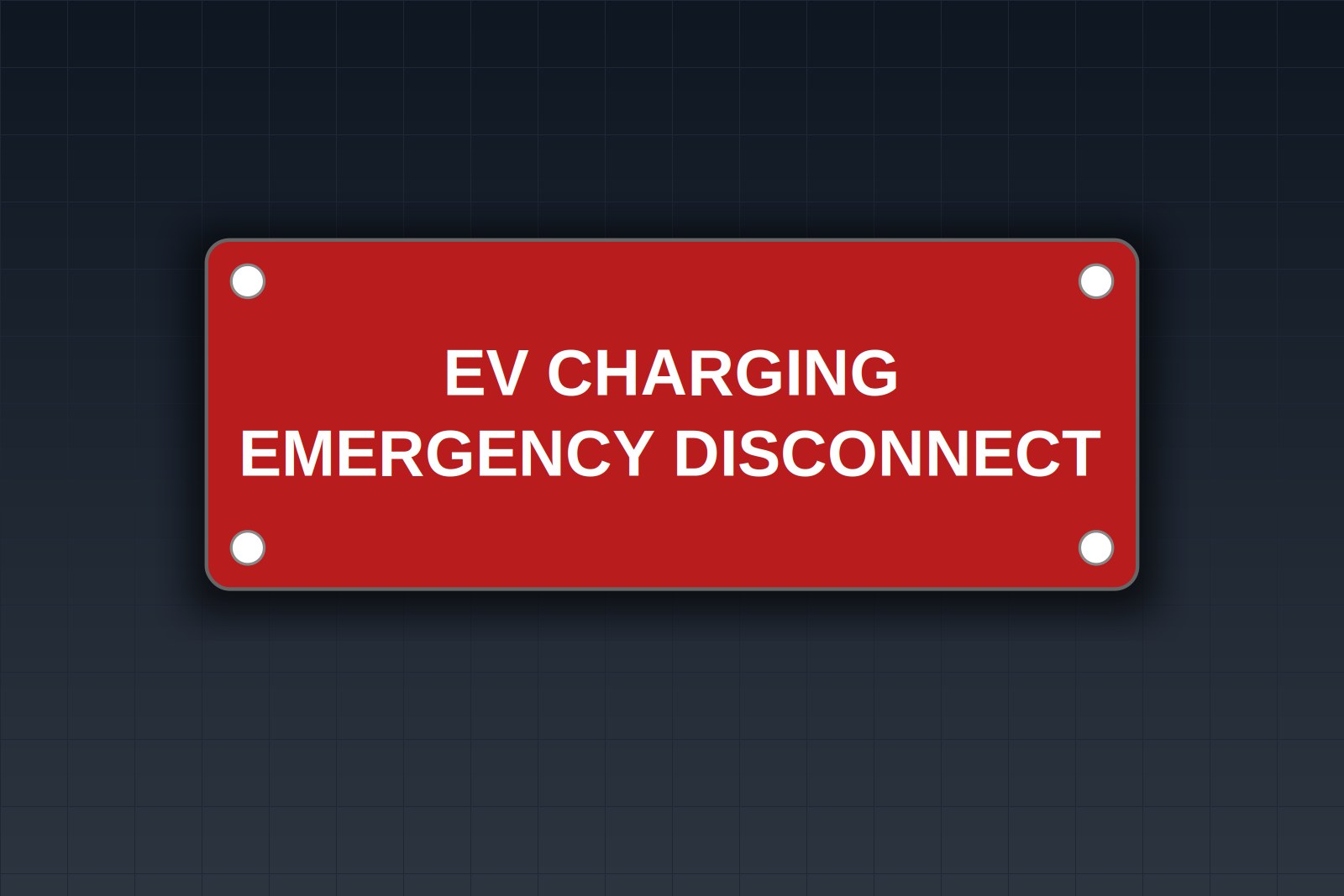
The disconnect plate is the small one that does the most work. It says which station the switch serves, so an electrician at the panel does not guess. For a site emergency disconnect, the stock 3x1 inch emergency disconnect plate, white on red is a common starting point. You can order that plate as-is or change the text in the configurator to name the charging site.
For a feeder or DC fast charger cabinet with a hazard to mark, the 4x2 inch hazardous voltage disconnect plate, black on yellow is available the same way. Pair it with a station plate. Do not use it in place of one.
The general rules for identifying disconnects are in the 110.22 disconnect identification guide.
Worked example: a 12-space apartment garage
Twelve Level 2 chargers, one per space, each on its own two-pole breaker in panel EVP-1. Each disconnect sits in electrical room 102. Spaces are numbered EV-01 through EV-12. This is the set for space 7.
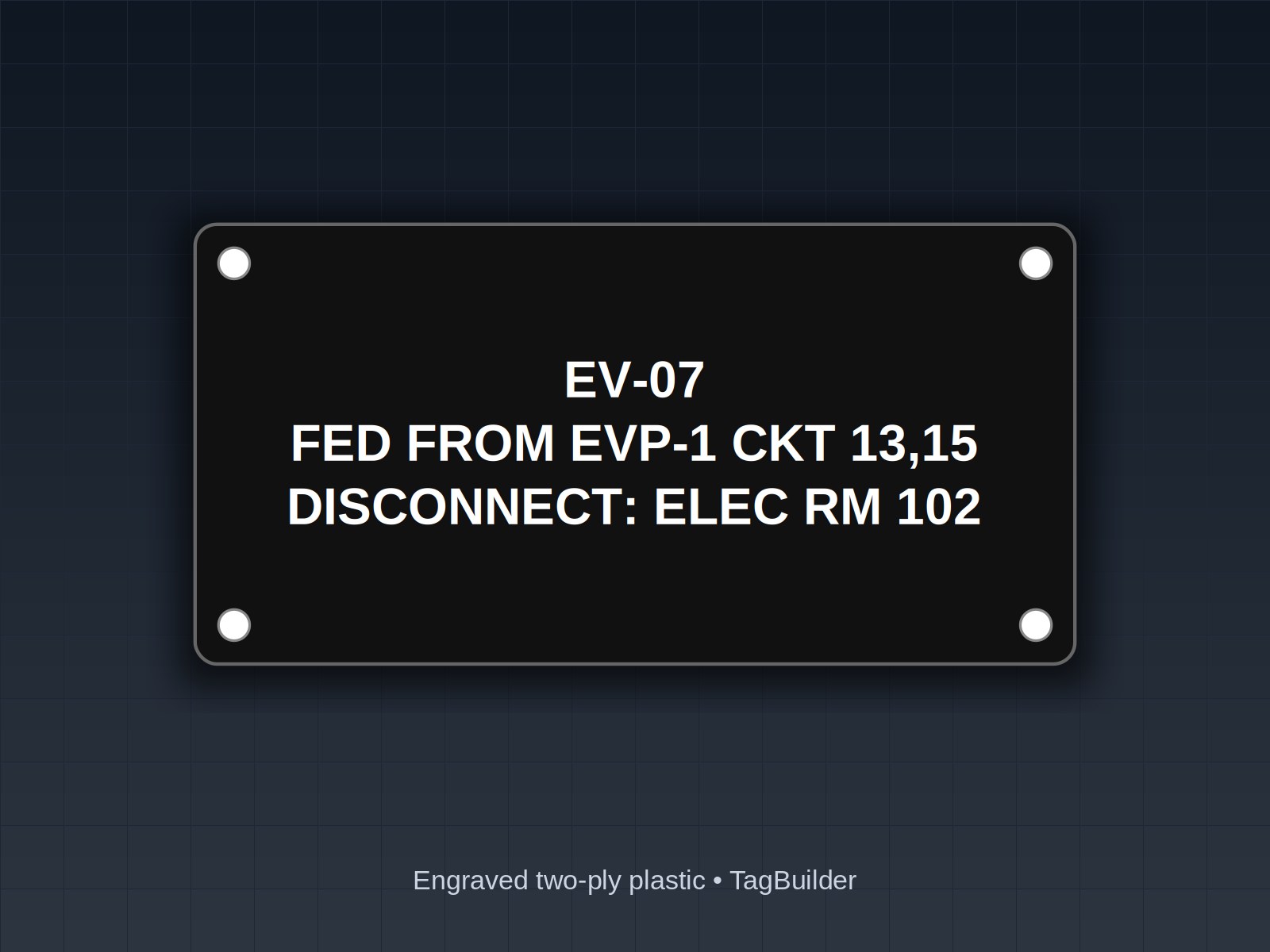
Plate 1: station plate at the charger
Size 4 x 2 in. Black text on a white face. Three centered lines:
- EV-07
- FED FROM PANEL EVP-1 CKT 13,15
- DISCONNECT IN ELEC RM 102
Plate 2: disconnect plate
Size 3 x 1 in. Black on white. One line, mounted on the enclosure beside the handle:
- EV-07 DISCONNECT
Plate 3: site emergency disconnect
Size 3 x 1 in. White on red. Mount it at the emergency disconnect for the garage:
- EV CHARGING EMERGENCY DISCONNECT
Panel directory
Circuits 13 and 15 read 'EV-07'. Circuits 17 and 19 read 'EV-08', and so on. The same station number appears on the pedestal, the disconnect and the directory. That match is what an inspector or a responder checks first. The panel schedule to breaker label guide shows how to build the list.
Fleet depots and DC fast chargers
A DC fast charger arrives with a manufacturer nameplate showing ratings and input data. Your field plates add what the factory cannot: station number, upstream panel, breaker position and the location of the disconnect. At a fleet depot with dozens of stations, number them in a pattern that matches the site drawing, such as row letter plus position (A-03, B-11). Keep the same scheme on the plates, the one-line and the panel schedule.
Multifamily buildings with metered units have a related problem, covered in the multifamily meter and unit disconnect label guide.
Outdoor and garage durability
Parking structures see road salt, wash-down water, vehicle exhaust and sun on open decks. Engraved text is cut into the plate, so it does not rub off like printed ink. For these sites:
- Use engraved two-ply plastic for most stations. Use engraved stainless where pressure washing or chemicals are routine.
- Fasten plates with stainless screws or rivets to the pedestal instead of relying on adhesive alone.
- Mount at a height a person can read from the parking space without kneeling.
- Keep the plate off removable covers, so it stays with the equipment.
Frequently Asked Questions
Do I need a disconnect label on every EV charger?
If the charger has a disconnecting means under 625.43, that disconnect needs marking under 110.22(A). Chargers below the threshold in your adopted edition may not need a disconnect, but the circuit still needs a clear directory entry under 408.4. Ask the AHJ when the case is borderline.
What does an EVSE emergency disconnect sign have to say?
The code text is not a label template. Plain wording that names the function, such as 'EV CHARGING EMERGENCY DISCONNECT', is common. Check the 2026 text and local amendments for placement and wording expectations.
Can I use one label for several chargers?
Not for the disconnect. Each disconnect should name the station it serves. A single sign at a bank of chargers can supplement individual plates by showing where the shared equipment is, but it does not replace them.
What goes on the breaker directory for an EV charger?
The station or space number, not 'EV'. Include both circuit positions for a two-pole breaker, as in 'EV-07, CKT 13,15'.
Is the 2026 multifamily plaque required everywhere?
No. It applies where the 2026 edition is adopted, and adoption dates differ by jurisdiction. Many places remain on 2020 or 2023. Confirm the adopted edition with the AHJ before you order.
Send us your charger layout and panel schedule. We'll engrave one station plate as a free sample and mail it.
The next step is small. Send the station list, the panel schedule or a one-line drawing, and we will return plates that match. Start with a single plate through the free sample, check the text and fit on site, then order the rest. The disconnect label collection has stock plates, and the configurator handles custom station text.
UL, NFPA, NEC, ASME, CEMA, TIA, ANSI and OSHA are names or marks of their respective organizations; TagBuilder is not affiliated with or endorsed by any of them. Requirements above are paraphrased summaries, not the text of any standard. Always work from the current published edition and your AHJ.