Relabeling Panels and Switchboards After a Renovation: Directory and Plate Checklist
The renovation moved circuits, re-fed a panel or added a switchboard section, and the directory on the door still describes the old building. A wrong label sends someone to the wrong breaker and can fail a final walkthrough.
Important Disclaimer
This article is provided for general informational purposes only and does not constitute legal, safety, or professional compliance advice. Regulations, standards, and codes are subject to change and may be interpreted differently by authorities having jurisdiction (AHJ). Always consult with qualified safety professionals, licensed engineers, or legal counsel to determine the specific requirements applicable to your facility. TagBuilder is not responsible for any actions taken based on this information.
After a renovation, every circuit that was added or changed needs a legible label that says what it serves, and the label goes at the panel face or inside the door. NEC 408.4(A) is the section most AHJs point to for circuit directories. Spare positions are identified too, and room names or numbers that will change do not count as lasting identification. Section numbering and wording vary by code edition and local amendment, so check the edition your AHJ enforces.
Why renovations break panel directories
Directories go stale in a predictable way. A contractor moves a lighting circuit to a new breaker, a tenant renumbers the rooms, and the old paper schedule stays in the pocket. Ten years later the maintenance electrician opens a breaker marked "Conf Rm 2" and the wrong area goes dark.
Commonly, 408.4(A) is read this way:
- Every circuit and every circuit modification is identified as to its purpose or use.
- The description is specific enough to tell one circuit from another.
- Spare positions are identified as spare.
- The label does not rely on transient conditions of occupancy. A person's name or a room number that may change is a weak label.
- The identification sits at the panel face or inside the door.
A renovation touches more than the breaker labels. If a panel was re-fed, the source marking under 408.4(B) may be wrong. If a disconnect was added or relocated, 110.22 expects it to be identified. If the system changed, the arc-flash label under 110.16 and the study behind it may be out of date.
What changed vs. which labels to update
Table 1: Renovation changes and the labels they put in question.
| What changed | Labels to check or update |
|---|---|
| Circuit moved to a different breaker | Directory entries for the old and new positions |
| Circuit removed, load abandoned | Old position marked SPARE, or the conductor removed and the position marked SPARE |
| Rooms renumbered or walls moved | Every directory line that names a room |
| Panel re-fed from a different source | Fed-from plate on the panel (408.4(B)), panel schedule header, one-line diagram |
| New switchboard section or new panel | Section plate, panel ID plate, breaker plates, fed-from plate |
| Disconnect added, moved or replaced | Disconnect plate under 110.22, showing what it serves |
| Feeder size, breaker size or fault current changed | Arc-flash label (110.16), study review under the facility's electrical safety program |
The audit: five steps in order
- Trace and verify. Do not trust the old directory. Open each breaker, confirm what it feeds, and record the result. Circuit tracers and a second person at the load make this faster.
- Mark abandoned circuits. If a breaker feeds nothing, label it SPARE. If the conductors were removed, label it SPARE and say so in the schedule notes. Do not leave an old description on a dead breaker.
- Renumber rooms to the new architectural numbers. Use the room numbers from the final drawings, and add a lasting description such as the area or equipment served. "RM 214 LIGHTING" is better than a name, but "2ND FLR CORRIDOR LIGHTING" survives the next renumbering.
- Update the drawing set. Revise the panel schedules and one-line diagram first. The labels should match the drawings, and the drawings should match the building.
- Engrave and install. Order the plates from the verified schedule, not from the markup. Engraved text does not rub off like printed ink, which matters on a door that gets handled for decades.
Worked example: a 42-space panel with six moved circuits
Panel LP-2 serves a second-floor office area. The renovation moved six circuits and renumbered the rooms. Here is the before and after for the affected positions.
Table 2: LP-2 directory, before and after the audit.
| Pos. | Before | After |
|---|---|---|
| 3 | BOB'S OFFICE RCPT | RM 214 RECEPTACLES |
| 5 | ROOM 2 LIGHTS | RM 210-212 LIGHTING |
| 7 | COPIER | RM 216 COPIER RCPT |
| 9 | OLD SERVER ROOM | SPARE |
| 11 | CONF RM 2 AV | RM 220 CONFERENCE AV |
| 13 | (blank) | CORRIDOR EMERGENCY LTG |
Positions 3 and 5 lose the person's name and the generic room label. Position 9 becomes SPARE because the load was removed. Position 13 was an unlabeled circuit the trace found.
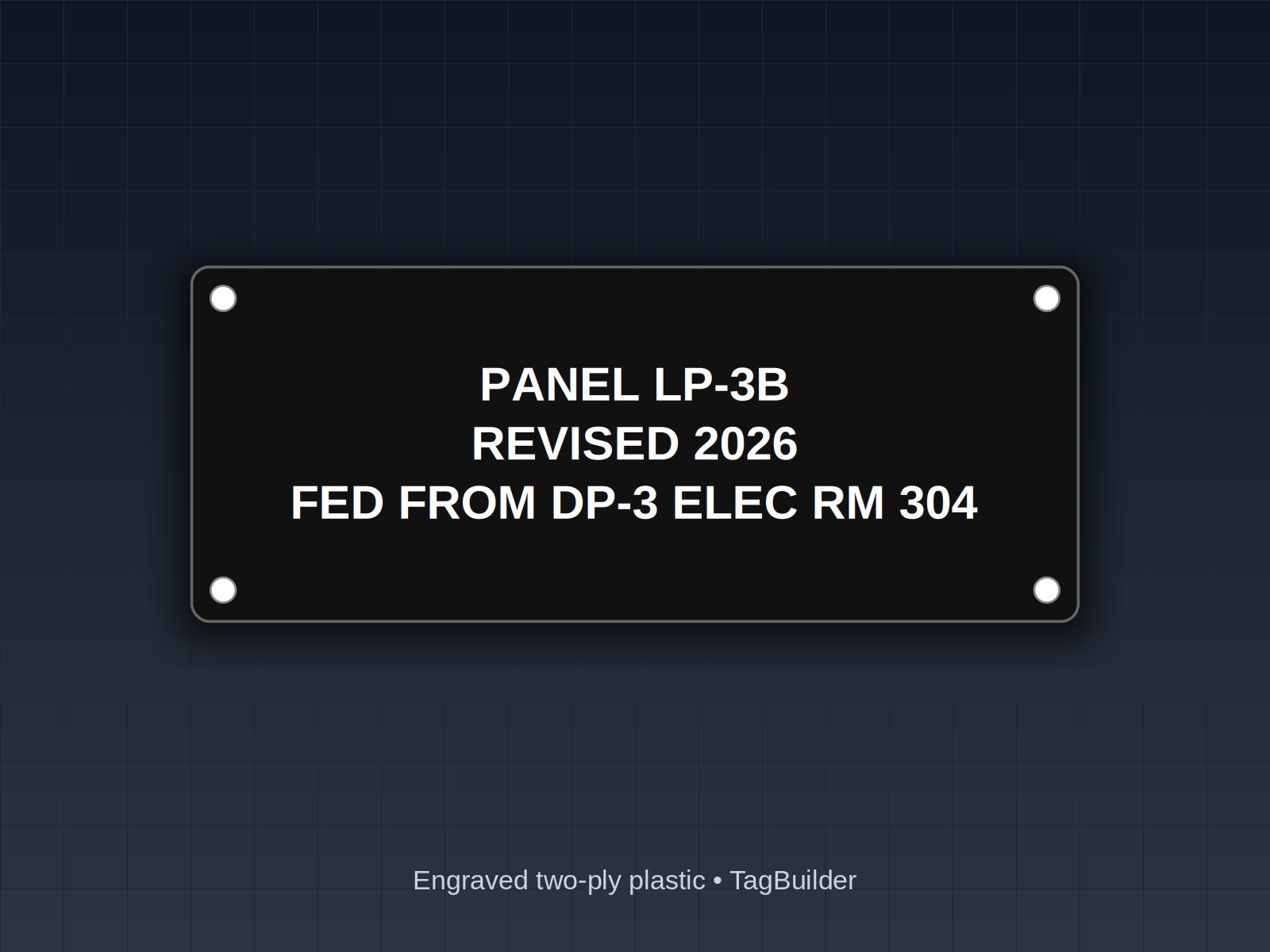
The panel ID plate for LP-2 is a standard item. You can order the 2.5 x 1 inch panel identification plate as-is, or change the text in the configurator to read as follows:
- Line 1: PANEL LP-2
- Line 2: 120/208V 3PH 4W
- Line 3: FED FROM DP-3
- Size: 2.5 x 1 inch. Colors: white text on black.
Breaker plates for the changed positions can be small strips, one line each, white on black, sized to the breaker spacing. Match the font height to what the door or cover allows so the text stays legible.
Switchboard section plates
A switchboard section added during renovation needs its own identification. For a new third section feeding distribution panel DP-3, the section plate reads:
- Line 1: SECTION 3
- Line 2: DP-3
- Line 3: FED FROM MSB
- Size: 4 x 2 inch. Colors: white on black.
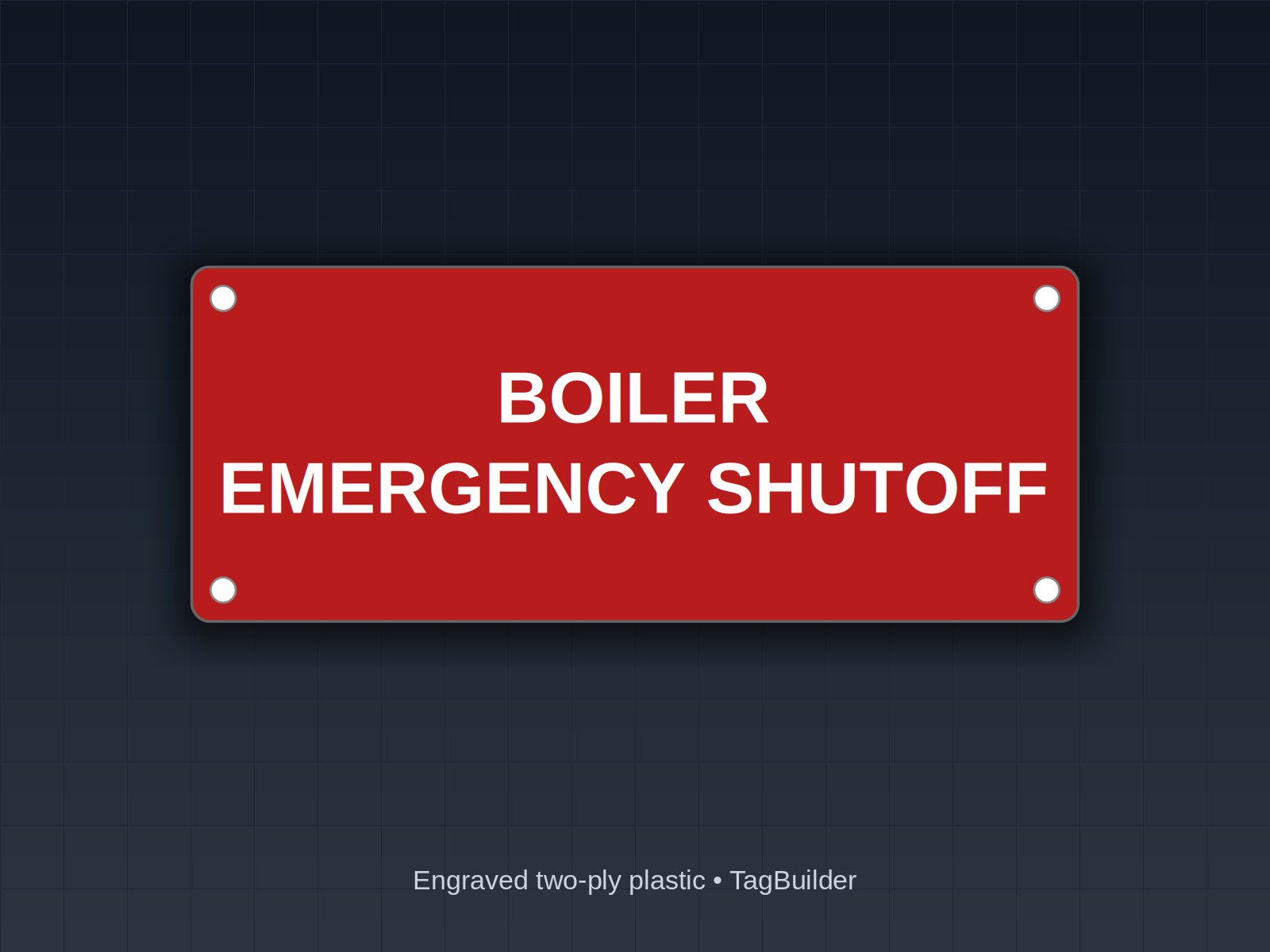
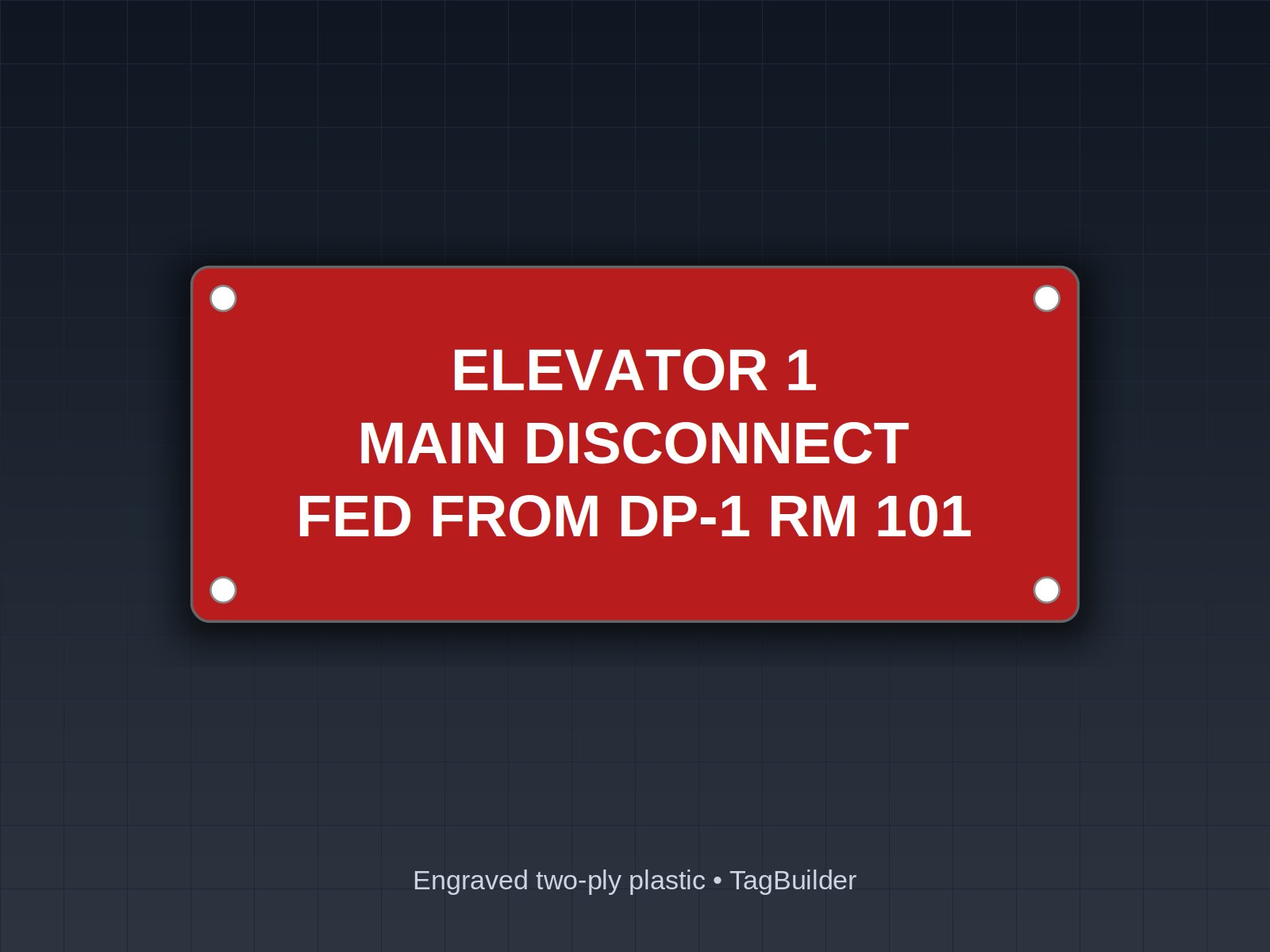
Each breaker in the section gets a plate naming what it serves and, for feeders, the destination panel. If the section includes a disconnect, the 110.22 plate says what the disconnect controls. The 4 x 2 inch disconnect plate, white on red, is stocked. Order it as-is or edit the text to name the actual equipment.
If the renovation changed a feeder, a breaker size or the available fault current, review the arc-flash label too. NFPA 70E expects the incident energy analysis to be reviewed at least every five years and after a major modification, in paraphrase. Check the arc-flash label options and confirm the data with your engineer before any new label goes on.
Who is responsible for relabeling
The contractor of record usually owns it, because the circuit changes are part of the work they performed. Do not assume. Check the project specification, commonly section 26 05 53 (electrical identification), for who provides directories, plates and as-built schedules and when they are due.
Facility managers should add the relabel to the closeout list. Ask for the revised panel schedules, the fed-from plates and the marked-up drawings before final payment. If the spec is silent, the AHJ may still ask for the directory at final inspection.
Frequently Asked Questions
Who updates the panel directory after a renovation?
The electrical contractor of record usually updates it as part of closeout, and the specification (often section 26 05 53) states the requirement. If the facility did the work in-house, the maintenance electrician owns it. Confirm the responsibility in writing before the work ends.
Do I need to relabel every breaker or only the changed ones?
Changed circuits need new labels at minimum. A trace of the whole panel is the safer practice, because renovations often disturb circuits nobody meant to touch. Many AHJs expect the whole directory to be accurate, not only the new lines.
What does a circuit directory have to say?
It has to identify the purpose or use of each circuit in terms specific enough to distinguish it from the others. It also marks spare positions. Describe the load or area, and avoid names and room numbers that may change.
Can I use a handwritten directory?
Section 408.4(A) asks for legible, durable identification. Handwritten cards smudge and fade, and many AHJs prefer a permanent label. Engraved plates avoid the legibility problem. Check your local amendments.
Do I need to update the fed-from label if the panel was re-fed?
Yes, if the source changed, the source marking under 408.4(B) should show the new device or equipment. Check how your edition words the requirement, since the text has been revised across editions.
Does the arc-flash label need to change after a remodel?
It can. If the work changed the available fault current, the protective devices or the feeder configuration, the original study may no longer match. NFPA 70E calls for a review after a major modification, so ask your engineer whether the study needs a refresh.
Send us your updated panel schedule. We'll engrave a matching panel ID plate as a free sample and mail it.
Once the audit is done, the next step is small. Send the schedule or one-line diagram and we return plates to match. If you want to see the work first, the free sample is the low-risk way to start. For turning a clean schedule into a full set of breaker labels, see the guide on panel schedules to engraved breaker labels, and for source marking read fed-from labels under 408.4(B).
UL, NFPA, NEC, ASME, CEMA, TIA, ANSI and OSHA are names or marks of their respective organizations; TagBuilder is not affiliated with or endorsed by any of them. Requirements above are paraphrased summaries, not the text of any standard. Always work from the current published edition and your AHJ.